Aether AI Raises $20 Million to Drive Next-Gen AI Paradigm Shift with Causal World Models | New Unity Ventures Portfolio Company

The large language model paradigm has reached an inflection point. The next stop is causal intelligence.
Artificial intelligence company Aether AI, which focuses on causal world models, announced the completion of its seed round with participation from Unity Ventures.
Founded by Biwei Huang, an assistant professor at the University of California San Diego (UCSD), Aether AI is a cutting-edge AI company specializing in causal world models. The company is dedicated to building a new generation of AI systems that can understand how the real world works, enabling machines to reason, predict, and make decisions in complex environments.
Its goal is not to make AI "bigger," but to make AI "smarter." This shift could change the future trajectory of AI — teaching machines to understand "why," not just "what."
The team possesses the most advanced research expertise and scalable engineering experience in causal AI, consistently treating causal reasoning as its technical core. It is committed to pushing AI from "correlation" to "causality," providing foundational capabilities for robotics, Physical AI, and future general intelligence.

Artificial intelligence company Aether AI, which focuses on causal world models, has officially announced the completion of its seed round, raising approximately $20 million in total. The round was led by Matrix Partners China, with participation from Innoangel Fund, SWC Global, Unity Ventures, and other institutions.
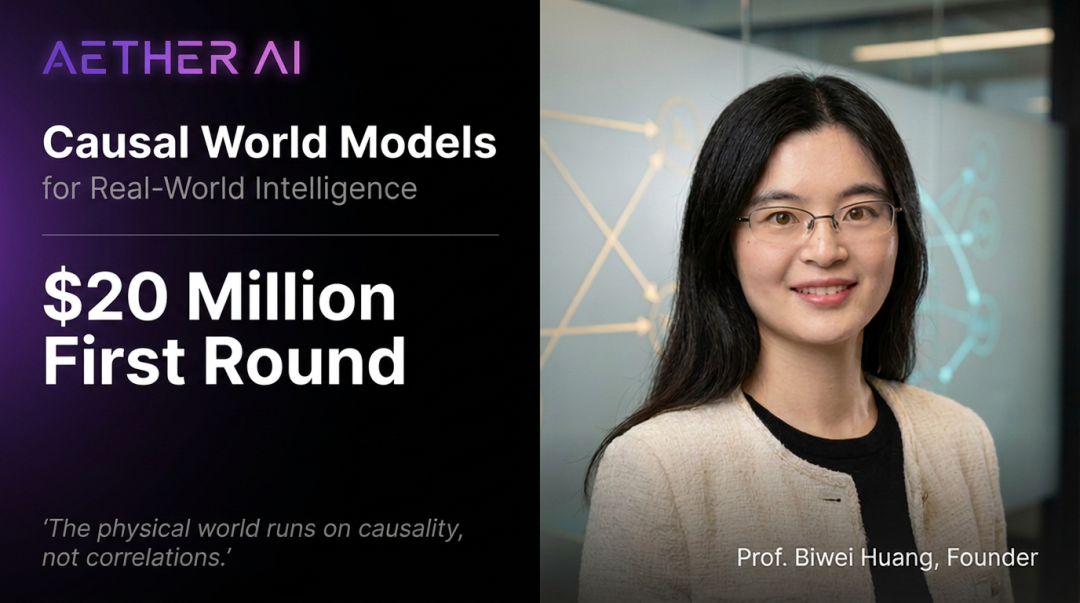
Aether AI was founded by Biwei Huang (Prof. Biwei Huang), an assistant professor at the University of California San Diego (UCSD), and focuses on causal world models. The company stated that the funds will be used for R&D and iteration of causal world models, engineering infrastructure development, core team expansion, and initial commercial deployment in the direction of Physical AI.
Aether AI's mission is clear: achieve stronger generalization with less data, and push AI from "pattern recognition" to "mechanism understanding" — a shift that requires a model built on causal reasoning as its underlying architecture.
Professor Biwei Huang, founder of Aether AI, has over twelve years of research experience in causal discovery and machine learning. In her view, while current mainstream large language models and Vision-Language-Action Models (VLA) perform well in closed test environments, they fundamentally rely on extracting statistical correlations from massive amounts of data. Once deployed in open, dynamic physical worlds, these models hit structural bottlenecks in generalization capability and sample efficiency.
Professor Huang stated: "Over the past decade, deep learning has achieved remarkable success through scaling laws. But when we try to make AI systems make reliable decisions in the real physical world, statistical correlations alone are insufficient — models must understand causal mechanisms. The causal world model that Aether AI is building is an important step toward Physical AI and future general intelligence, and this funding round will give us the ability to accelerate the realization of this vision."

Building AI That Understands the Causal Mechanisms of the World
From a technical standpoint, Aether AI differs from mainstream paradigms in three key ways:

Causal Feature Representation: Directly extracting interpretable causal variables from multimodal inputs such as video, text, and sensor signals, rather than generating uninterpretable black-box embedding vectors;
Causal Structure Discovery: Automatically identifying causal dependencies and hierarchical structures between variables, clarifying "what factors, in what ways, affect what outcomes";
Causal Dynamics Modeling: Projecting how systems evolve under different intervention conditions, giving the model capabilities for counterfactual reasoning and causal imagination.
In early validation, this causal approach has already improved data efficiency by 20–30% in certain manipulation tasks. With only about 50 high-quality causally annotated data points, tasks that previously failed frequently can achieve reliable success rates.
These results demonstrate that causal world models have the potential to partially replace dependence on massive data training through algorithmic structural optimization. For the industry, this represents a technical path with lower training costs, shorter convergence cycles, and stronger cross-domain generalization.
Aether AI's overall technical stack consists of four architectural layers: a Causal Transformer Layer, introducing token-level causal modeling on top of scalable architectures; a Modular Architecture Layer, implementing functionally decoupled neural network modular design; a Causal World Model Layer, completing causal variable identification and dynamics modeling from pixels to physics; and an Agent System Layer, providing causality-driven planning, attribution, and memory mechanisms.
The design philosophy of this architecture is not to start from scratch, but rather to smoothly transition on top of existing scalable architectures, gradually introducing causal mechanisms. Aether AI hopes to build a complete technical stack covering foundation models to agent systems on this basis, ultimately enabling AI to not only recognize patterns but also understand the causal mechanisms behind reality.
At the application level, Aether AI has anchored its first use case in the Physical AI domain, building a unified causal reasoning layer for robots — essentially a "causal brain." In the physical world, every action a robot takes is fundamentally an intervention, and decisions that rely on statistical shortcuts, once wrong, immediately manifest as operational failures. For this reason, Physical AI is seen by the company as the most direct and compelling scenario for testing causal reasoning capabilities.
A World-Class Causal Team
Aether AI's core team comprises scientists, technical experts, and senior engineering talent from top global academic institutions and AI labs.
Founder Dr. Biwei Huang is currently an assistant professor at the Halıcıoğlu Data Science Institute (HDSI) at the University of California San Diego (UCSD). Her academic trajectory spans China, the Max Planck Institute for Intelligent Systems in Germany, Carnegie Mellon University, and UCSD. She has published over 100 papers at top international conferences and journals including NeurIPS, ICML, ICLR, and CVPR, received honors such as the Apple Scholar award, and led the development of Causal-Learn and Causal-Copilot — globally standard open-source tools in causal discovery that are widely used.
The company maintains an academic advisory network covering three generations of core scholars in causal AI, including Turing Award winner Professor Judea Pearl, Max Planck Institute director Professor Bernhard Schölkopf, and causal discovery discipline founders Professor Clark Glymour and Professor Peter Spirtes. Biwei Huang represents the third generation of this academic lineage.
Huang projects that by early 2027, robot manipulation tasks will reach a "GPT-3 moment" — with good generalization across multiple tasks, high success rates, and the ability to execute long-horizon tasks; by the second half of 2027, combining mobility with manipulation, autonomous exploration and lifelong learning in open environments will become possible.
If deep learning taught machines to "see," causal AI aims to teach machines to "understand." This may be the narrow gate leading to general intelligence.
For more information, please visit: https://aetherlabs.ai