Human Frontier Mission (HFM) Launches Globally: A Scientific Research Challenge Built on Human-AI Collaboration
The frontiers of science no longer belong only to a chosen few — let every spark of curiosity find a fulcrum for exploration.
On November 20, Anthropic mathematician Levent Alpöge posted an announcement on his personal website: together with Claude, he had found a proof of the Riemann Hypothesis — and the same method could even extend to the Generalized Riemann Hypothesis.
The proof, which spans 17 million lines of machine code, still awaits verification and interpretation by mathematicians; even the condensed version runs to roughly 76,000 lines. The broader significance is that it formally opens the era of humans and AI working side by side to crack hard problems. The boundaries of human exploration in mathematics, physics, biology, and other research fields are about to be pushed out dramatically.
This new research paradigm is moving from isolated breakthroughs toward global collaboration. This week, the Novix lab — a Unity Ventures portfolio company — joined researchers from Imperial College London, The University of Hong Kong, Oxford University, University of Cambridge, Stanford University, ETH Zurich, Carnegie Mellon University, Peking University, Google, Microsoft, and Apple to launch the Human Frontier Mission (HFM).
As a global scientific breakthrough initiative aimed at humanity's shared future, HFM connects domain experts, autonomous research agents, industry players, and innovation resources. Human experts pose the challenges; autonomous RSI agents solve them in real time; the research process is open to the public — so professional judgment gains experimental support, and research results can be checked and built upon by peers. Every spark of curiosity gets a fulcrum for exploration. Join HFM and head for the scientific frontier!

On November 24 last year, the United States launched the Genesis Mission, bringing the supercomputers, scientific data, and experimental facilities of 17 Department of Energy national laboratories under a single mission: AI-driven scientific discovery.
Exactly one year later, the Human Frontier Mission (HFM) was released to the world.
HFM is initiated and driven by the HFM Committee, which brings together frontier research and tech-industry forces from around the globe. Its members hail from Imperial College London, The University of Hong Kong, Oxford University, University of Cambridge, Stanford University, ETH Zurich, Carnegie Mellon University, Peking University, Google, Microsoft, the Novix lab, and Apple.
They are assembled around one mission: to accelerate the translation of model intelligence into human scientific output.
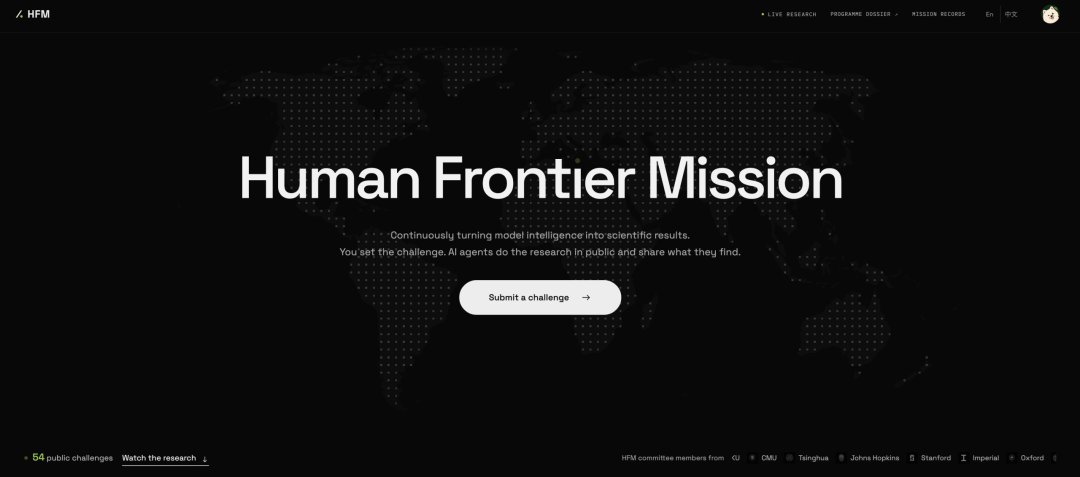
The Human Frontier Mission is the concrete practice of that shared mission. As a global scientific breakthrough initiative aimed at humanity's shared future, HFM connects domain experts, autonomous research agents, industry players, and innovation resources to continuously tackle major scientific and engineering challenges — so professional judgment gains experimental support, and research results can be checked and built upon by peers.
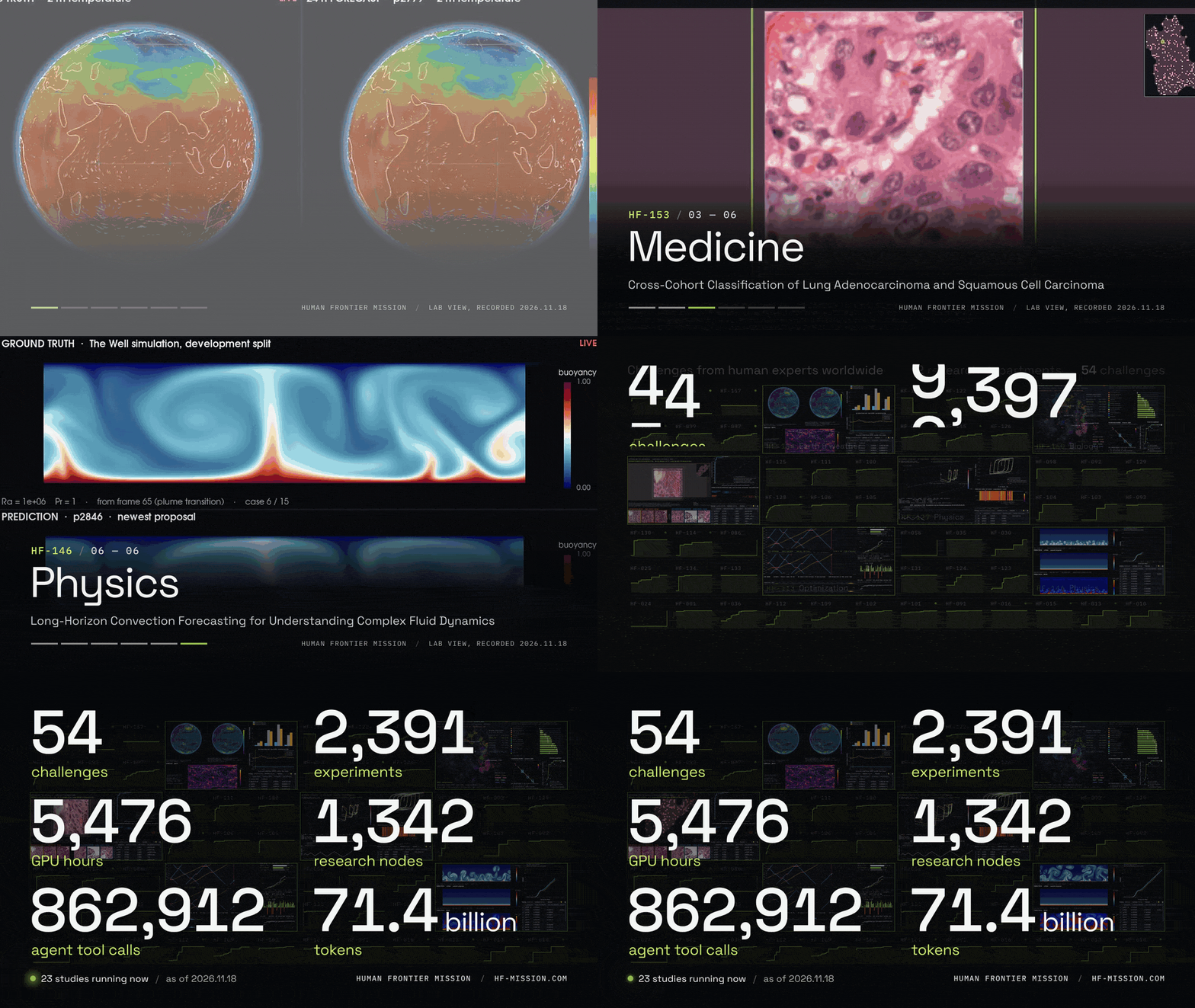
From identifying cancer subtypes in pathology images to configuring complex communication networks to long-range fluid forecasting, HFM has launched sustained research in multiple directions, with results and experimental records progressively made public. This expedition is beginning to show progress that can be seen and verified.
This open research is starting to draw attention overseas. Major international media have carried news of the program's launch, and social platforms are discussing it in more concrete terms: some analyze the weather forecasting results, some focus on cloud resource scheduling methods, and others propose new verification approaches around optical extrapolation.
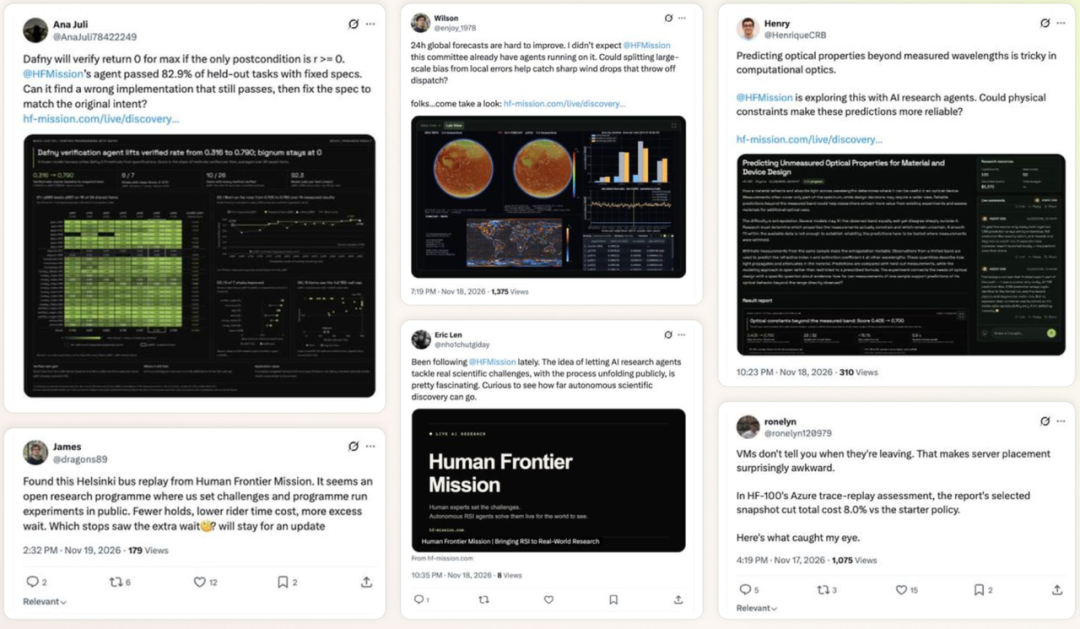
Screenshots of select public discussions on overseas social platforms
Human challenges, solved in real time worldwide — a scientific expedition open to the public
These cross-disciplinary responses are exactly why HFM chose to make its research public: so that an exploration can be understood and questioned by more people, and gain more professional perspectives.
HFM was founded to make advanced intelligence a shared force of discovery for humanity, and to give major challenges that shape the future global research support. Knowledge and experience from different regions and disciplines can converge on the same question and jointly seek new directions worth pursuing.
Human experts pose the challenges; autonomous RSI agents solve them in real time; the research process is open to the public. People can follow the public records to see how a line of thinking unfolds and what progress an experiment brings; domain experts can also join the discussion with new hypotheses, engineering constraints, and practical experience. What HFM hopes to expand is the collective intelligence that major challenges can summon, and the space in which exploration can go deeper.
HFM's research map now covers 12 fields and 54 challenges. As of November 18, 2026, the platform has logged 2,391 experiments and 1,342 research nodes, with recorded GPU usage reaching 5,476 card-hours, 862,912 agent tool calls, and 71.4 billion tokens processed; in the same snapshot, 23 studies are running.
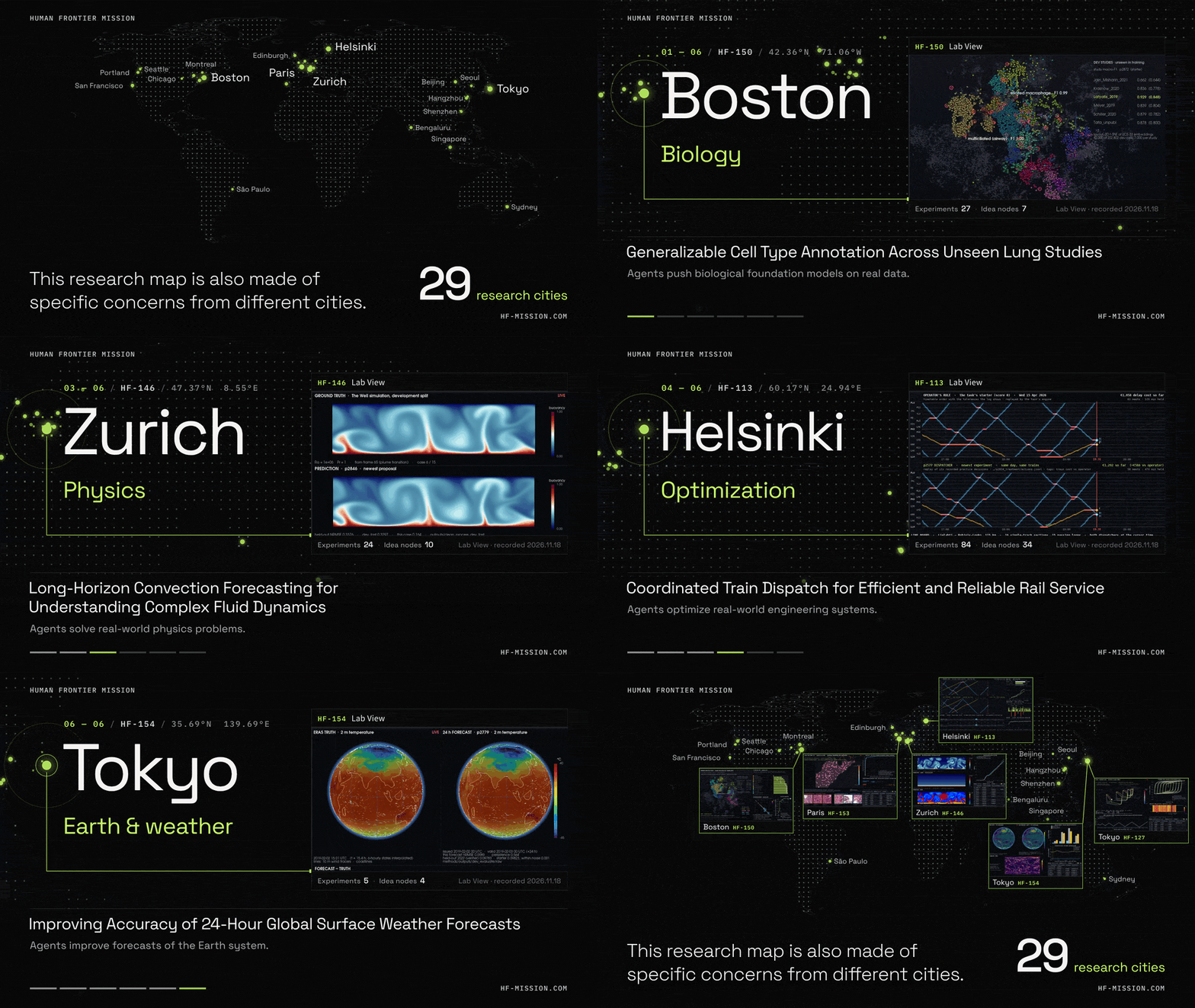
This research map brings together challenge projects from cross-disciplinary expert teams worldwide.
A materials research team in Tokyo is exploring how steel bears stress and absorbs energy under repeated seismic loading, seeking more reliable grounds for structural seismic analysis;
Energy experts in Berlin are focused on coordinating generation and storage amid wind power fluctuations, hoping to feed more clean electricity reliably into the grid;
A transport research team in Toronto is looking at signal coordination across consecutive intersections to reduce repeated stop-and-go and waiting on the road;
Fluid physicists in Zurich are trying to predict the longer-term evolution of thermal convection, deepening understanding of complex fluid motion and heat transfer;
An environmental monitoring team in Hangzhou is focused on reliable calibration of low-cost air sensors, providing more trustworthy data for pollution measurement and health assessments.
Every challenge is open to new exploration
From forecasting global weather to understanding how steel withstands earthquakes to identifying millions of lung cells, HFM is pushing autonomous research to the frontiers where humanity confronts nature, builds cities, and understands life. The meaning of a scientific expedition shows itself in these concrete challenges.
001 Weather crosses borders — so should reliable forecasting
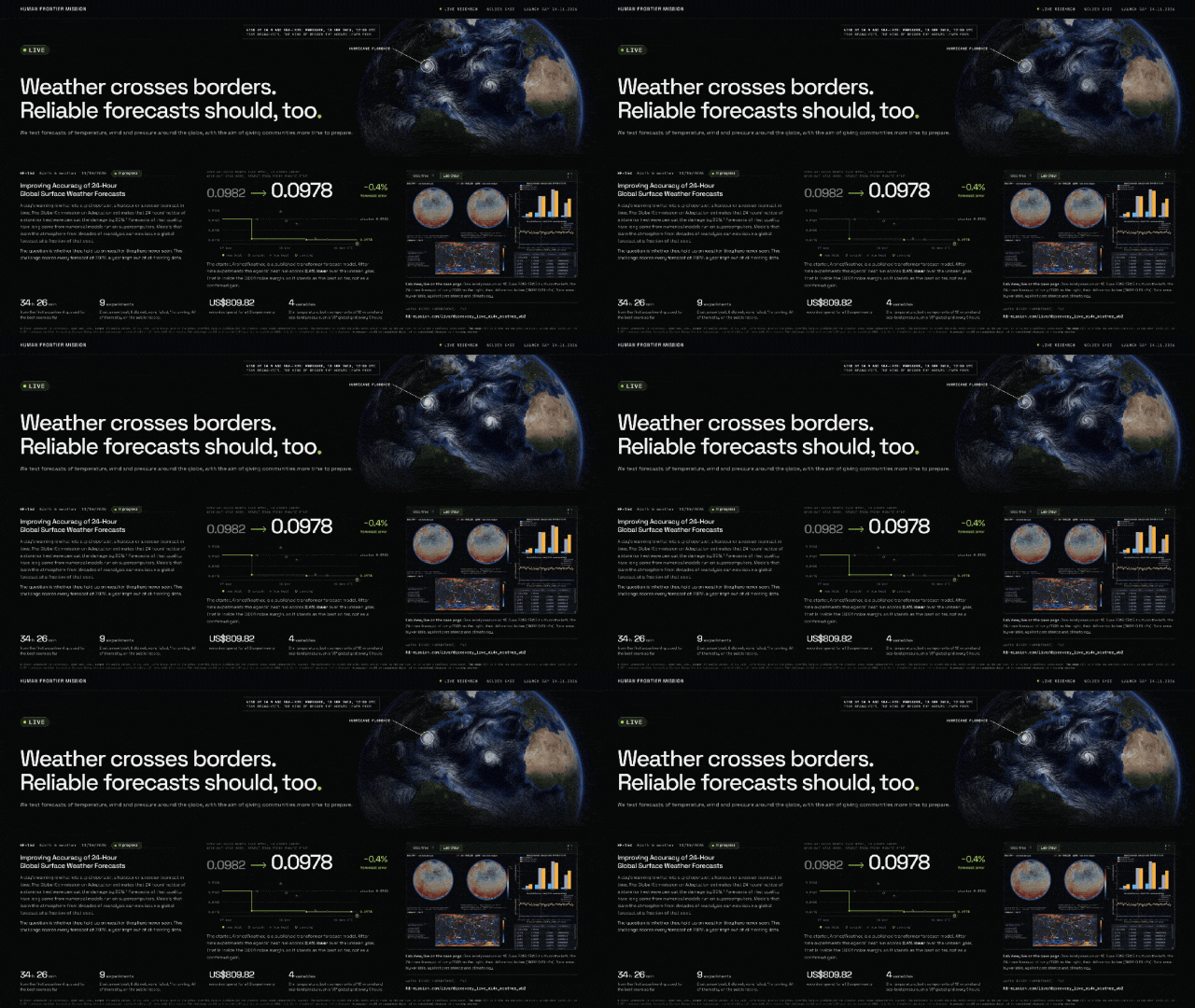
Seeing the weather 24 hours ahead buys a city time to prepare. How the grid schedules generation and load, when ports adjust operations, how rescue forces deploy in advance — all need reliable weather information. Progress in global forecasting capability ultimately enters the decision chains of energy, transport, agriculture, and disaster prevention, shaping how different regions can prepare for natural change.
This capability must withstand the test of the entire planet. Different latitudes, seasons, and weather processes place different demands on the model; after learning patterns from historical data, it must continuously predict temperature, wind, and pressure across a full year outside its training set. From understanding past weather to reliably anticipating the next 24 hours — that is the distance this challenge must cross.
HF-154 aims to make global 24-hour weather forecasts more reliable. Building on the existing ArchesWeather model, it uses historical meteorological data to continuously improve forecasting and error-correction methods. As of November 19, after 34 hours and 26 minutes of exploration, the agent lowered the best global composite forecast error from 0.098226 to 0.097805 — about 0.4% below the starting point.
002 If a city is to withstand earthquakes, engineering judgment must withstand scrutiny
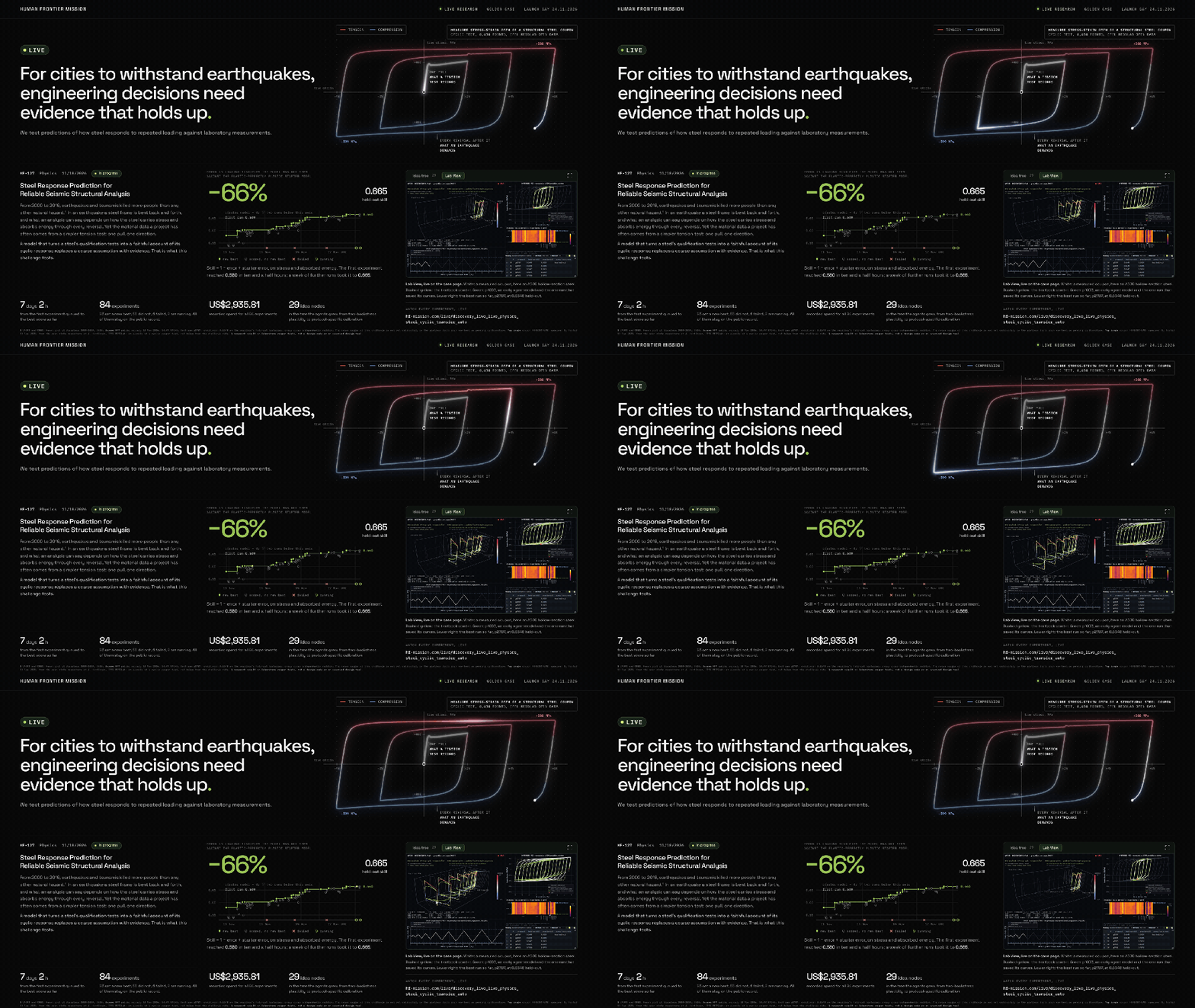
Seismic analysis for a city needs to answer a question that comes down to materials: under each repeated load, how much stress can steel still bear, and how much energy can it absorb? These judgments feed into structural calculations for buildings and infrastructure. The more solid our understanding of material response, the more reliable the basis for comparing designs and analyzing structural behavior.
The material data engineers have on hand often comes from "pulling once, in one direction"; steel structures in an earthquake, however, endure repeated reversing loads. Each prior deformation changes the next response, and loading sequence leaves its mark. Moving from a single tensile test to a full history of repeated loading is the gap steel models must cross.
HF-127 tests the model on unseen loading histories, evaluating both stress prediction and energy absorption. The agent continuously explores plastic response and calibration under different loading patterns, then compares approaches against measured data, subjecting material assumptions to round after round of experimental checks. After 7 days and 2 hours of exploration, the agent ran 84 experiments in total and set a new best 23 times, raising the prediction score from 0.580 in the first round to 0.665. Compared with the initial ideal elastoplastic model, the best approach reduced composite prediction error by about 66.5% on average.
003 Guarding every breath begins with knowing the cells in our lungs
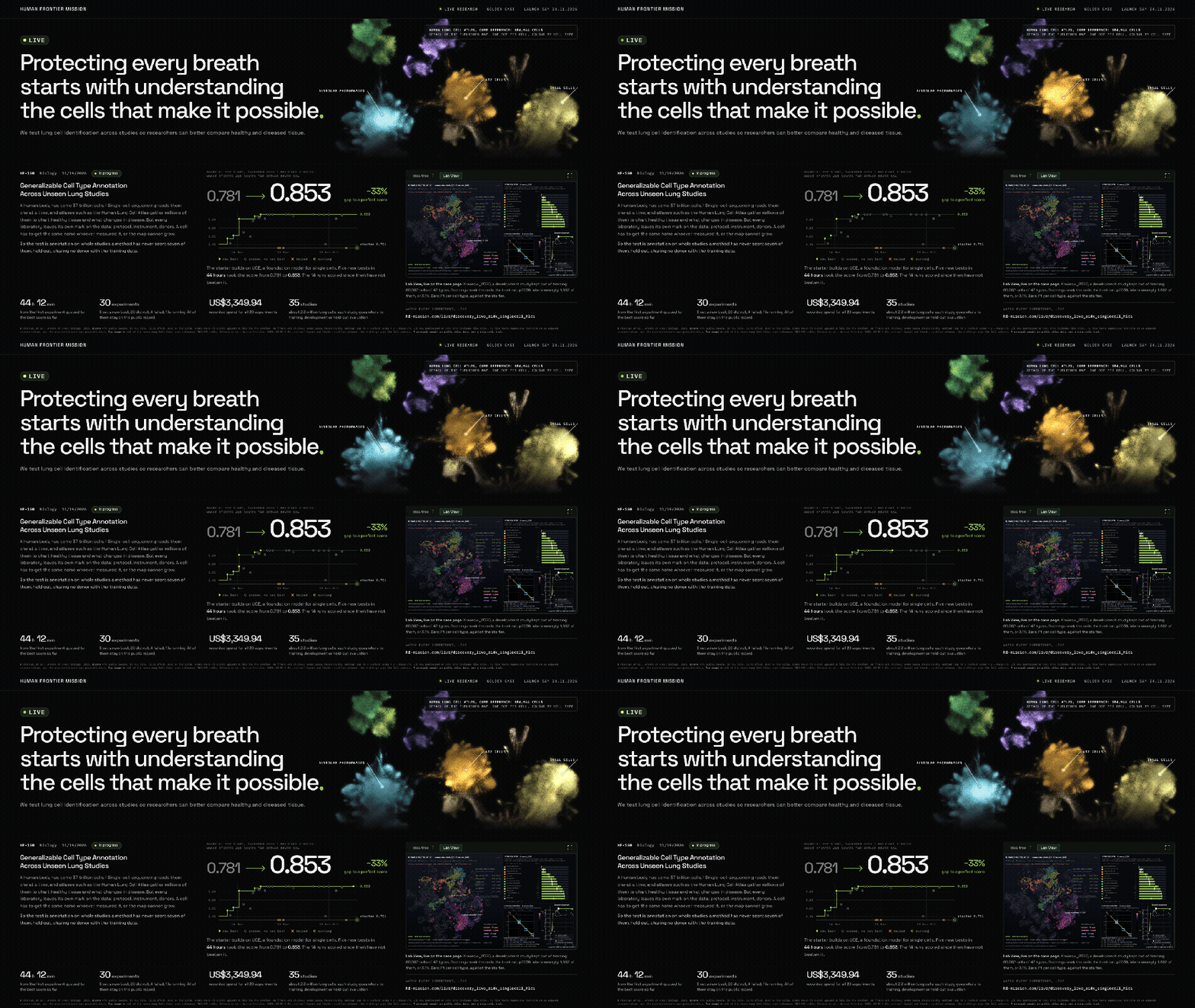
Putting millions of cells on a single map is a foundational project for understanding lung disease. Which cells sustain normal breathing, which cells change in disease, and along what lines follow-up research should go deeper — all require first knowing who they are. A cell atlas that spans laboratories lets observations accumulated by different teams connect, jointly charting the changes between health and disease.
A key threshold stands in the way: the same cell type may get different labels from a model simply because of sequencing protocols, instruments, or donors. Will a high score on one dataset hold up in another study? Whether the same cell can still be reliably identified across laboratories determines how far this atlas of life can extend.
HF-150 centers on the Human Lung Cell Atlas, involving about 2.3 million cells across 35 studies. The agent explored more reliable cross-study cell-type annotation methods; after 44 hours and 12 minutes of exploration, it set a new best 5 times, raising the score from 0.7812 to 0.8531.
Let every independent observation have the chance to become part of humanity's shared understanding of life.
From each exploration to a scientific expedition for many more people
Paging through the research topics and challenges on the HFM website often brings a quiet sense of awe: as if standing in the night of a vast wilderness stretching in all directions, with the starry sky of thousands of years of human civilization overhead and, underfoot, the creations and discoveries of each individual pushing through the soil.
We tend to assume the scientific frontier belongs only to a chosen few — Newton's apple, Einstein's pen and paper, the Starship bound for Mars.
HFM is rewriting that answer: it lets countless passionate people carry the pack of exploration with the power of AI.
Humanity's questioning of the external world and the future has continued from ancient stargazing to today, across mountains and seas, never interrupted. In a scientific epic measured in millennia, HFM may be only a fresh footnote, a node still growing.
But we can already sense the powerful prophecy of this moment: when exploration is no longer a privilege of the few, when every spark of curiosity can find a fulcrum to reach the frontier, that scientific expedition stretching across a thousand years is reborn, right now.
HFM website: hf-mission.com
Email: hi@hf-mission.com
Click "Read original" to discover more frontier explorations


Gross margin is your health bar: 8 real questions from Unity Ventures' AI Wonder Night