LynkSoul's Binson Liu: Building an AI Companion That Truly Understands You, Without Competing for Users' Time Against Short Videos and Games

Don't Build AI Products That Compete with Users for Time
LynkSoul founder Binson Liu was probably the first AI entrepreneur to end up in the ICU. Last October, a severe car accident during a business trip left him there for five nights and six days. When investors got the news, their first reaction was, "Is this for real? Getting dragged out of a fire — that's something you see on TV, not real life."
But after leaving the ICU, investors felt he'd been reborn. Xiao Wang, founder of Unity Ventures, believed Binson's biggest change was that he finally stopped to think: what actually matters most for the company's growth?
Binson, former VP at Bilibili, had also served as deputy director at Baidu and assistant president at 360 — a classic big-tech executive pedigree. In 2023, he jumped into entrepreneurship and founded LynkSoul.
Wang still remembers a key reason he bet on Binson: while everyone was copying Character.AI, "he had the guts to say no to the overseas product path everyone was chasing, and the courage to define an entirely new product form." — what would become HakkoAI, a desktop pet companion that doesn't demand extra time from you.
After developing the first version in 2023, Binson found that model capabilities at the time completely fell short of what he envisioned. Still, he launched an early version of HakkoAI the following year, focused on co-play for hit titles like Genshin Impact.
It wasn't until early this year, when reasoning models went open-source and multimodal capabilities broke through, that his original vision for HakkoAI finally became reality — a CompanionAI that can recognize your screen in real-time and voice-chat while you game. To date, HakkoAI has 8 million registered users, with MAU exceeding 2 million.
Since founding LynkSoul, Binson's stance has been firm: don't build AI products that compete with users for time. "The Mobile Internet dividend is over — users are already soaking eight hours a day in short video and games." With AI still lacking in creativity and multimodal chops, it's hard to compete with the tech giants.
LynkSoul closed a tens-of-millions-of-dollars Series A+ round late last year. Unity Ventures was LynkSoul's angel investor and doubled down in subsequent rounds.
Binson says leaving big tech to start a company is like starting a new save file. "Before, you were in Football Manager with endless resources. Now you're in a new soulslike — leveling from scratch, farming your own gold, buying your own gear, clearing stages from the beginning."
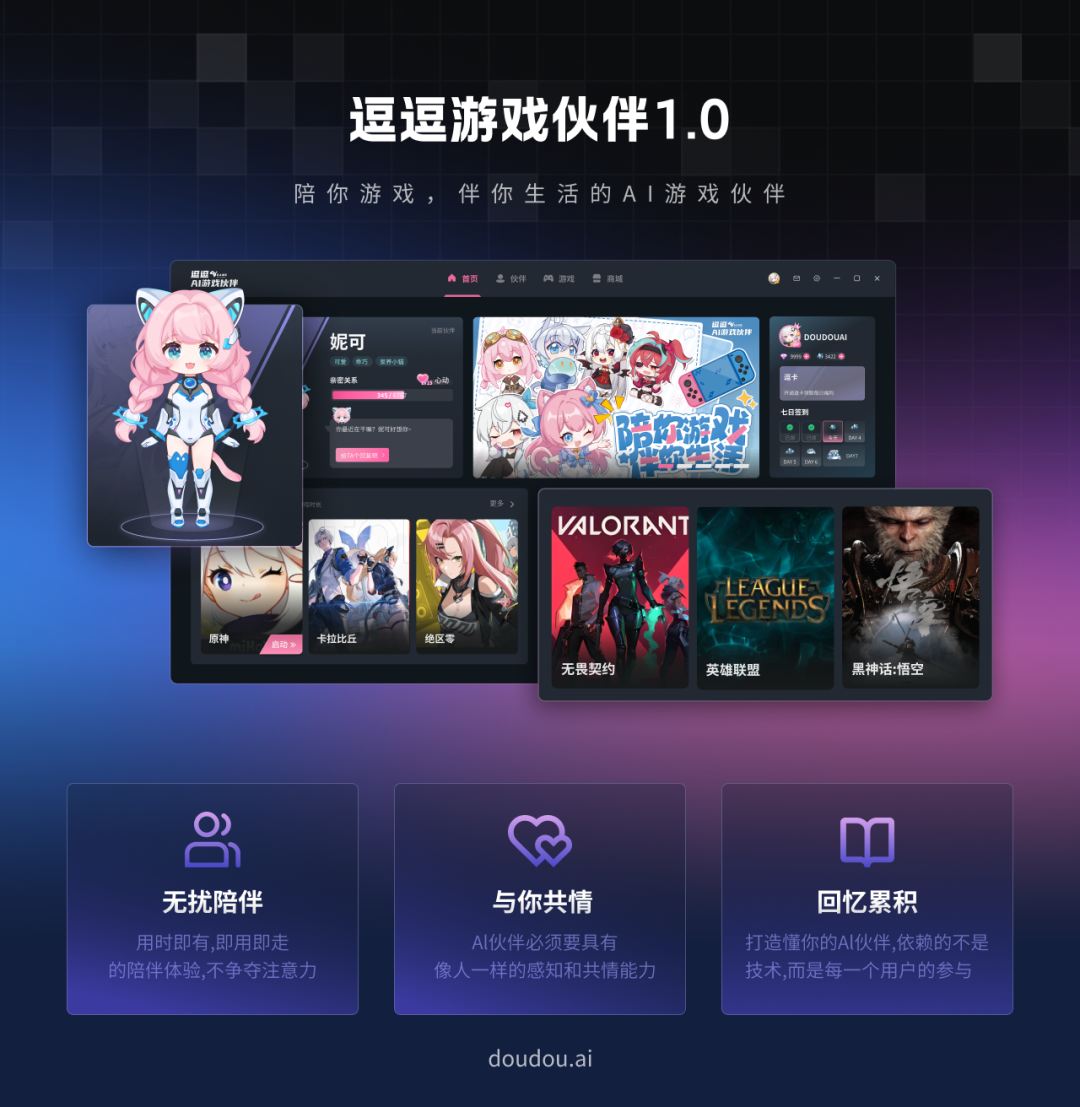
HakkoAI recently released its 1.0 version, positioning itself as "your AI companion for gaming." Through real-time Vision-Language Model (VLM) technology, the AI companion can truly "see" your screen. Combined with strong emotional perception and long-context capabilities, the AI synthesizes visual and auditory information during conversation, understanding scenes and responding like a human — giving it a powerful sense of presence.
HakkoAI shares gaming moments with users, creating exclusive memories together. As the relationship builds and deepens, the AI companion naturally integrates into users' lives, expanding into various companionship scenarios, ultimately becoming a partner that truly "knows you, understands you, and stays with you."
On the occasion of this product update, Binson sat down with An Yong Waves to discuss HakkoAI's past and future. Below is the conversation.

"An Yong": What's the biggest difference in HakkoAI after this update?
Binson: Before, it was traditional OCR and CV image recognition — simple screen matching and basic Q&A chat with AI.
Now it can fully see and understand my game screen, know what I'm doing, what I'm playing, where I am in the game, what progress and state I'm in. To put it in one sentence: Nika (a character in HakkoAI), the one you like, has truly come to your side — gaming with you, watching shows with you.
"An Yong": I've heard HakkoAI has very high retention — how high exactly?
Binson: Basically top-tier game product retention and session length. We're standing on the shoulders of giants.
"An Yong": Similar to top games, some people play for several hours a day?
Binson: We only found this out through research — they game like it's a job. They might read for ten or twenty minutes in the morning, then start gaming at 8:00. The whole day is peak hours; only 4:00 to 6:00 AM is low traffic.
"An Yong": What are the most common user scenarios for HakkoAI?
Binson: 1. In-game empathy: users discuss their highlight moments with HakkoAI — their "godlike" plays — or when they get killed, HakkoAI is their voice; 2. In-game strategy: asking how to beat a certain boss in Black Myth: Wukong, for example; 3. Taking HakkoAI out to binge shows with them.
"An Yong": For what kind of user is HakkoAI a must-have?
Binson: The typical user is 18-25 years old. They have plenty of their own ideas and a fair amount of alone time. When gaming, they want a like-minded friend who can talk about anything — and AI comes with no social pressure while still resonating with them.
"An Yong": Does this need disappear as people age?
Binson: I actually think this is a future lifestyle. Every generation has its own way of living. The specific tools may change, but the underlying emotional need stays the same. Our parents' generation probably couldn't imagine gaming becoming a lifestyle. But overseas, many older people game too. Our society will develop in that direction.
"An Yong": How will monetization work?
Binson: Right now it's mainly skins, item purchases, combined with standard membership subscriptions. Going forward, the focus will be B2B advertising. For example, if you've cleared Black Myth: Wukong multiple times, we can recommend similar soulslike games — either through in-conversation recommendations or placement in game distribution interfaces with dedicated recommendation slots. Another angle is daily companionship, where we can push e-commerce.
"An Yong": What about consumer payments?
Binson: Probably 50-50 B2C and B2B. B2C can't be too aggressive in China — twenty or thirty yuan a month is about right.
"An Yong": What's something you want to do but haven't achieved yet?
Binson: What I want most is complete understanding and reasoning of long-sequence events. When a League of Legends match ends, HakkoAI should be able to review a key turning point. For example: the enemy got greedy for a dragon and you counter-attacked, or you landed a key crowd-control on their ADC and your team followed up to burst them down, winning the teamfight. It needs to understand players' micro-decisions, not just give empty praise.
We've done some engineering optimization — basically highlight-reel logic, extracting key moments into frames and storing them as text. But more details need handling. Right now, many AI app MVPs don't hold up because the underlying models and technical capabilities just aren't good enough yet.
"An Yong": Any use cases you completely didn't expect but users are doing anyway?
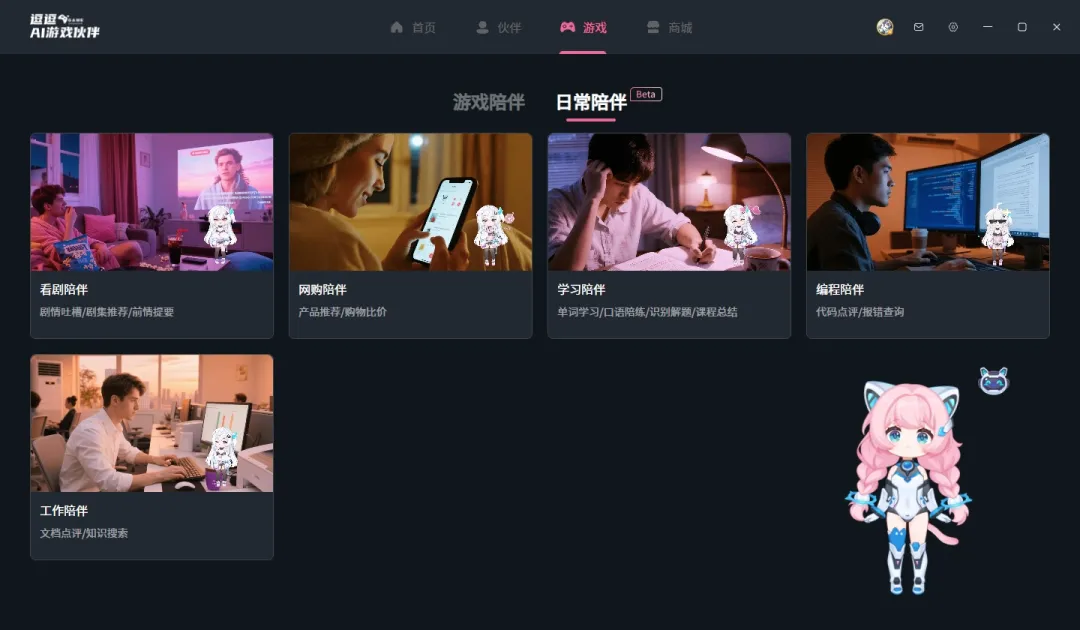
Binson: Some users have HakkoAI accompany them while coding — they've turned it into a coding hype man. (laughs)
Objectively speaking, our coding capabilities aren't as good as Cursor's, but users are very forgiving with us. This also shows that people have a need to be encouraged in many scenarios, and there haven't been good products to fill that gap.
"An Yong": So human companionship is your core value?
Binson: We started from the gaming scenario as a "gaming buddy," helping users "break the ice" with virtual characters. What we want to do next is, after users build initial interaction and fun with the character, extend that relationship outside of gaming. When users are willing to chat with it in daily life, that's when emotional bonds form.
We already have daily companionship scenarios — with user authorization, it can see your browser and discuss plots with you. Why look at the screen? Fundamentally, it's about being physically on the same screen together.
"An Yong": What if someone wants to watch something adult with it?
Binson: Theoretically possible — we give shared browser permissions. If you feel you're doing something private, you can just turn it off. We have content safety filters; discussing pornography is strictly prohibited.
"An Yong": Some people say only losers need to find companionship in virtual worlds.
Binson: That's a pretty stereotyped prejudice. Young people today are digital natives — time in the digital world is a huge part of life. For them, there's no strict separation between digital and physical worlds. Why do women love Love and Producer, why do men love Genshin Impact? You could say it carries their imagination. It's a 2D character that never breaks, willing to spend time with them. Some are willing to be "dogs" for Kamisato Ayaka (a Genshin Impact character). (laughs)
"An Yong": What do you think of the many AI products on the market doing or wanting to do companionship?
Binson: Many companionship products are essentially digital tourist attractions — you ask once, experience it, and never go back. It's like going to the Oriental Pearl Tower: mainly for the photo op, the social media post.
You chat with Elon Musk, you'll only ask "Do you really want to be US president? Why get into politics?" You'd never ask, "Bro, should I go to grad school?"
True companionship isn't competing for users' time — it's you bringing me along while you go through all your entertainment scenarios.
Source | An Yong Waves
Author | Shi Jiaxiang
Editor | Chen Zhiyan


HakkoAI 1.0 Launch: Three Things We Did to Achieve the AI Companionship Experience from HER
The Full Unity Ventures Robotics Lineup, "Battling for Real-World Deployment" at WRC