'Little Rascal' Takes Marathon Runner-Up as Noetix Robotics N2 Becomes Breakout Star | Unity Ventures Portfolio

Keep going, robots
"
Before the Wright brothers invented the airplane, humanity never truly believed it could take to the skies.
On September 3, 1908, the Wright brothers conducted a successful demonstration flight at Fort Myer, finally earning worldwide recognition.
On the morning of April 19, 2025, the world's first humanoid robot half-marathon was held. The 21.0975 kilometers represented not just a competitive distance, but a microcosm of China's robotics development journey. Though considerable progress remains to be made, we believe — and eagerly anticipate — that in the near future, the robots humanity has placed such high hopes upon will walk alongside us as equals.
"
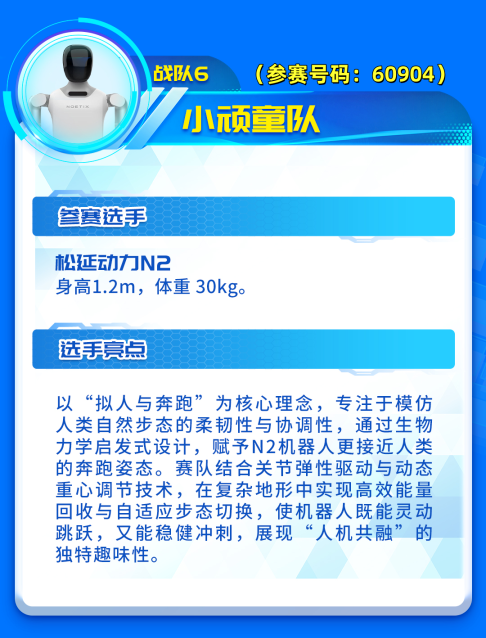
On April 19, the highly anticipated world's first humanoid robot half-marathon kicked off in Beijing. Noetix Robotics, a Unity Ventures portfolio company, entered multiple N2 robots as a team. The "Little Rascals" squad emerged as the competition's biggest dark horse, clinching second place.
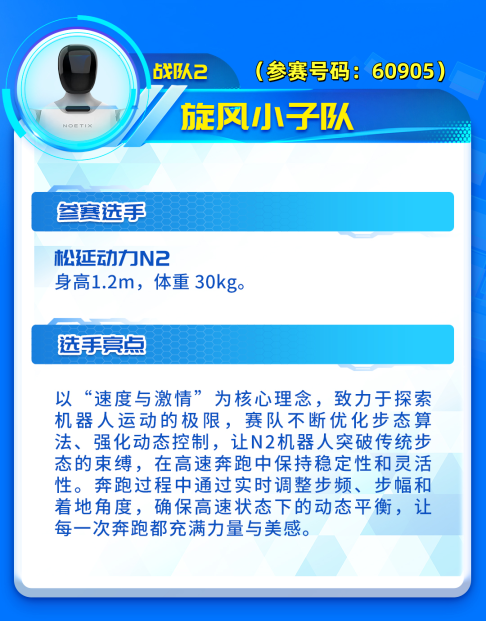
Standing 1.2 meters tall and weighing 30 kilograms, the Noetix Robotics N2 features 18 high-performance joints and an advanced motion control system, enabling it to maintain stability and agility while running at high speeds.
The Little Rascals operated on a core philosophy of "anthropomorphic running" — they were the only competing robots that ran independently without human tethering. Starting from sixth position, "Little Rascal" immediately displayed explosive acceleration, overtaking three competitors in succession to ultimately secure second place. This performance earned massive popularity, with netizens praising it as "kid bro," "running all on its own, so steady," and "this kid's worth watching."
Noetix's other team, "Whirlwind Kids," competed with a "speed and passion" philosophy, pushing hard throughout the entire course to cross the finish line in third place — a commendable showing in its own right.
After the race, the N2 robot treated spectators to a backflip performance, powered by Noetix Robotics' proprietary full-stack motion control algorithms.
Jiang Zheyuan, founder of Noetix Robotics, noted: "A half-marathon tests not just how fast your algorithms can run, but whether the hardware itself can endure 21 kilometers — whether the algorithms remain stable under continuous long-duration operation. So it's a comprehensive test with standardized rules. In the bipedal humanoid direction, we've not only achieved a top running speed of 3.5 meters per second, but also realized consecutive robot backflips and other high-dynamic effects."
Noetix Robotics currently has three main humanoid robot product lines. Beyond the humanoid "N2," there's the home embodied intelligence robot "E1" and the bionic robot "Hobbs." Both the N2 and E1 are now fully open for pre-order, with prices starting at 39,900 yuan — roughly one-fifth of what competitors charge.
Jiang believes every industry goes through a bubble phase, followed by a burst, then a survival-of-the-fittest shakeout that ultimately reveals the truly high-quality enterprises with long-term competitiveness and resilience. Humanoid robots will follow a similar curve; the companies with genuine vitality will be those capable of self-sustaining growth and positive cash flow.
In the near term, Jiang aims to make Noetix Robotics a commercially healthy company — ambitious in vision yet grounded in actual profits. The company currently holds orders for 600–700 humanoid robots plus several hundred bionic humanoid faces. With smooth delivery execution, it could potentially achieve cash flow positivity as early as Q4 this year.
Noetix Robotics will continue refining and upgrading hardware reliability, operational safety, and product functionality, enabling robots to enter service sooner across cultural tourism exhibitions, reception hosting, companion services, and other scenarios — integrating more rapidly into everyday life.
Humans and robots running together is only the beginning. As the old saying goes, distance tests a horse's stamina; technological development still requires time and patience. Among the voiceovers heard throughout this marathon was the public's most earnest hope: "Go for it, robots!"