Yeats.AI Completes Pre-A Round Led by Shenzhen Capital Group, Heli Capital, TCL Ventures and CASSTAR, with Former Apple NPU Executives Betting on Edge General-Purpose Computing Platform | Unity Ventures
Secured nearly RMB 1 billion in funding across three rounds, all led by strategic corporate investors, within its first year.
Recently, edge AI compute infrastructure company Yeats.AI announced the completion of its Pre-A funding round, jointly led by Shenzhen Capital Group, Heli Capital, TCL Venture Capital, and CASSTAR, with follow-on investments from Awinic Electronic (688798.SH), Guokai Technology Venture Investment, Zhaohui Capital, and other institutions. Existing shareholders continued to invest across multiple rounds, consistently oversubscribing.
This marks the company's third funding round within just one year of its founding, bringing cumulative fundraising to nearly RMB 1 billion. Each round has seen several relevant industry capital sources simultaneously backing this early-stage team. The company's investor history already includes Ant Group, Unity Ventures, CASSTAR, Tongge Venture Capital, Fibocom (300638.SZ), Shenzhen Capital Group, and other prominent industry players and top-tier VC firms — with an investment lineup covering key links from supply chain to downstream customer applications. Unity Ventures was the angel+ round investor in Yeats.AI.
The proceeds from this round will continue to fund R&D, tape-out, and delivery of next-generation NPU hardware and software for Agentic & Physical AI, as well as algorithm research in model compression. Meanwhile, the Pre-A+ round is already underway in an orderly fashion.
Yeats.AI's founding team previously worked at Apple's AI acceleration platform — the Apple Neural Engine team. The company focuses on extreme energy-efficiency inference scenarios for next-generation AI Native hardware, building a new unified-ecosystem general-purpose compute platform that provides cross-terminal unified hardware-software solutions for diverse scenarios under Agentic and Physical AI, achieving coordinated development across architecture, hardware, and software.
Currently, Yeats.AI is advancing tape-out of its first high energy-efficiency inference chip for 7B multimodal large model edge deployment, and has initiated R&D on its next-generation high-compute chip for Agentic & Physical AI.
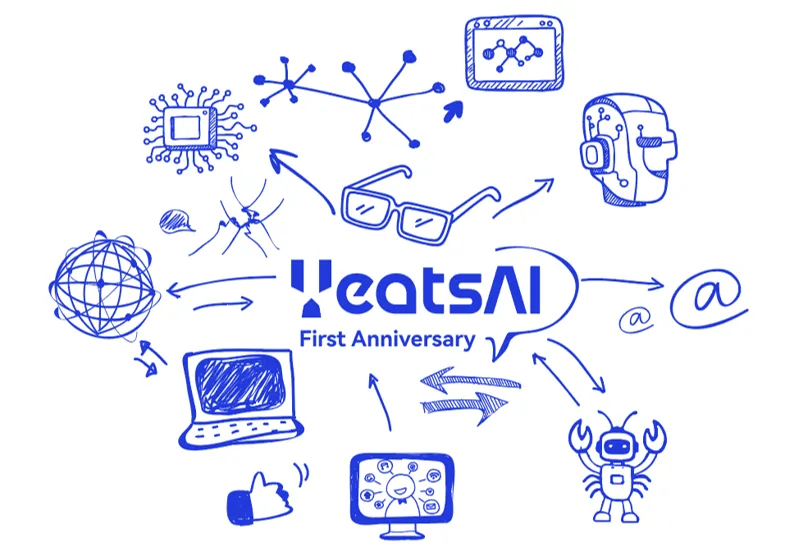
In July 2026, the World Artificial Intelligence Conference (WAIC) sent a clear industry signal: the center of gravity in AI industry competition is shifting further from the cloud toward real-world physical endpoints. AI is accelerating into headphones, glasses, AI Boxes, robots, and other physical carriers, with model capabilities beginning to deeply integrate with specific hardware form factors, interaction modes, and application scenarios.
AI's compute demands are expanding from single-model inference to continuous sensing, multimodal interaction, agent decision-making, and complex real-time control — with all hardware pointing toward a common need: high energy-efficiency edge compute platforms. This means edge compute platforms must confront an increasingly prominent "trilemma": efficiency, generality, and scalability.
This is also where edge AI stands to form a new generation of infrastructure following the GPU — evolving from a single chip toward a unified hardware-software compute ecosystem. Yeats.AI is precisely oriented toward this trend, building a next-generation unified-ecosystem edge general-purpose compute platform.
Yeats.AI's founding team previously worked at the Apple Neural Engine team, leading the underlying NPU architecture, compiler toolchain, and upper-layer model deployment for globally scaled cross-terminal shipments, participating in the full lifecycle iteration and application product definition of NPUs. The team has experience with mass production and shipment of dozens of chips, with advanced process tape-out experience, having been deployed at scale across billions of units in edge-side and terminal-side intelligent hardware scenarios. The company's core team has previously worked at Apple, Microsoft, NVIDIA, Qualcomm, Huawei HiSilicon, DJI, and others, covering key areas including NPU architecture, SoC design, compilers, system software, and model algorithms.
"What edge AI needs isn't more isolated AI accelerators, but a unified compute platform that can continuously evolve across chips, devices, and models," said Yeats.AI's founder. Yeats.AI conducts coordinated design from underlying architecture, instruction set, and compiler through to model deployment, using dataflow architecture and system-level hardware-software co-optimization to enable different models to run efficiently within the same hardware-software NPU framework — achieving extreme efficiency optimization while addressing critical needs in generality and compute scalability for Agentic AI and Physical AI.
Drawing on over a decade of NPU iteration experience from major global technology companies, Yeats.AI is building a general-purpose compute architecture that can deeply cover various edge-side compute demand scenarios — achieving sufficient generality while maintaining deep pipelines for high-efficiency computation, accommodating existing AI neural networks of different sizes as well as future-proof operators. The chips may differ, transistor scale may differ, power budgets may differ, but the underlying AI compute paradigm remains unfragmented.
This deeply aligns with all capabilities currently required by edge AI: on one hand, rapid iteration of models and applications demands sufficient chip generality to cover different models, different operators, and constantly evolving AI workloads; on the other hand, edge devices are constrained by power consumption, cost, thermal management, and storage, and cannot simply follow the cloud GPU path of stacking compute for performance — they must achieve higher energy efficiency and lower per-inference cost within limited resources. Meanwhile, from glasses and headphones as Personal AI to AI Boxes and Embodied Artificial Intelligence as Agentic & Physical AI, the compute demand span across different devices may reach several orders of magnitude, placing higher demands on NPU architecture for the complete spectrum from low-power real-time interaction to large model real-time inference.

Moreover, what truly enables this system to operate at scale is not just the NPU itself, but also Yeats.AI's compiler system behind it. Yeats.AI's vision is to use a relatively centralized compiler infrastructure to transform底层硬件优化 from a "per-application, per-chip manual engineering effort" into scalable, reusable software infrastructure. The founding team previously had deep involvement in major technology companies' compiler systems, capable of targeting both NPU and CPU, covering everything from smart wearables to large terminal intelligent hardware — enabling an AI compute architecture covering hundreds of millions of terminals and tens of thousands of model applications to run continuously, stably, and automatically across different devices and scenarios.
Current AI model paradigms continue to evolve, and as Transformer, Diffusion, Agent, VLA, and world model paradigms keep changing, what underlying compute platforms need is the ability to continuously absorb new model capabilities through compilers, runtime optimization, and complete instruction sets — thereby avoiding rapid chip architecture obsolescence tied to single-model iteration.
Yeats.AI hopes through this hardware-software co-design approach to transform a one-time NPU R&D investment into continuously reusable compute platform capabilities. The company does not treat a single chip product as its endpoint, but rather takes technology evolution as its axis, continuously extending toward different compute tiers and different AI-native hardware scenarios, completing commercialization in tandem with technology maturation.
Going forward, Yeats.AI will continue to collaborate with storage, ODM, and hardware ecosystem partners to build an open industry ecosystem around Personal AI, Agentic & Physical AI, driving scaled deployment of efficient, general-purpose AI compute platforms across more edge and terminal scenarios.


To those who let us see the distance