Cycles and Carriers in Investing

Information Is Not a Signal

2020 was an overwhelming flood of information, so much so that every day felt like a "once-in-a-century" event: the pandemic, circuit breakers, valuations skyrocketing to the heavens. Our nerves grew raw, hypersensitive — the slightest breeze sent markets surging or plunging.
Add or cut? That became the daily agony.
"Noise differs; signal extraction is the same." In this chaotic information world, whether you're adding or cutting is merely a reaction to current information shifts. What we really need to focus on are long-term signals, not short-term fluctuations.
So what's the relationship between information and signal? Isn't information with the noise filtered out already the signal?
To talk about information, we first need to talk about "waves" — in investing, the more common term is "cycles." Because long-term signals aren't static. In the physical world, everything has cycles: people are born, age, sicken, and die; the moon waxes and wanes; this has never been otherwise since ancient times.
So-called constancy is more like a wave function with long period and low frequency — not unchanging, just slower, its cycle stretched longer. Since there's no eternal constancy, there's no eternal moat, no eternal standard of value. Everything is a product of its era, bounded by cycles.
If you fail to recognize cycles, fail to embrace new things as cycles turn, then the very bus that carried you to success will drive you off the cliff.
Who would have thought that Intel, sovereign of chips, would have to confront the cycle of X86 architecture? That Nokia, sovereign of mobile phones, would have to confront the cycle of feature phones?
Actually, discovering long-cycle signals amid information isn't difficult.
Because long-cycle signals have low frequency and long wavelength — strong penetrating power (diffraction). If wavelength approaches infinity, then theoretically it can penetrate all space and time.
Thus space-time is the best test of long-cycle signals. If we look across time-transcending literature, they concern human nature, kindness, integrity, courage, and common sense. These longer-cycle signals reverberate repeatedly in the depths of humanity's collective unconscious, having withstood the test of space and time.
If so, why is life so troubling?
Because the "antenna" requirements for transmitting and receiving long-term signals are truly demanding.
In the physical world, for instance, antenna length needs to be on the same order of magnitude as wavelength — mostly a quarter or even half wavelength. So the longer the signal's period and wavelength, the higher the antenna required to transmit and receive it. That's why TV towers and broadcast stations have tall, straight spires — to increase antenna length for city-wide coverage.
But building tall towers isn't broadly applicable. To solve this, we need to reduce the signal's period to suit shorter antennas. Hence we designed the "carrier wave" — putting long-period signals into short-period carriers. This process is called "modulation." The carrier wave is like an airplane: short period, high frequency, drastically reducing antenna requirements. The signal is like the passenger — boarded onto the plane and transmitted, then the receiver "demodulates" to welcome the passenger (signal) out from the plane (information).
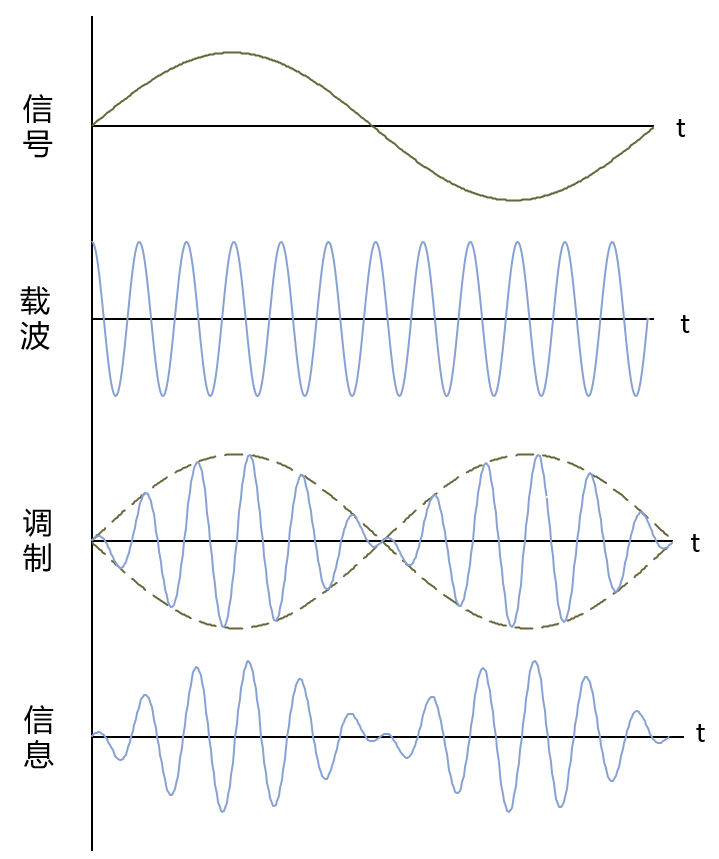
The physical process resembles the figure above: the green signal is long-period variation; the blue carrier is short-period variation. After modulation, the information has short period and high frequency. But if we observe carefully, the envelope (amplitude) of this information is the signal.
With the application of carrier wave technology, massive antennas disappeared. A phone's length suffices to "modulate" and "demodulate" all signals. As high-frequency carrier technology continuously broke through, antenna lengths kept shrinking — especially after 5G, when everything became connectable. In no time, we were drowning in information.
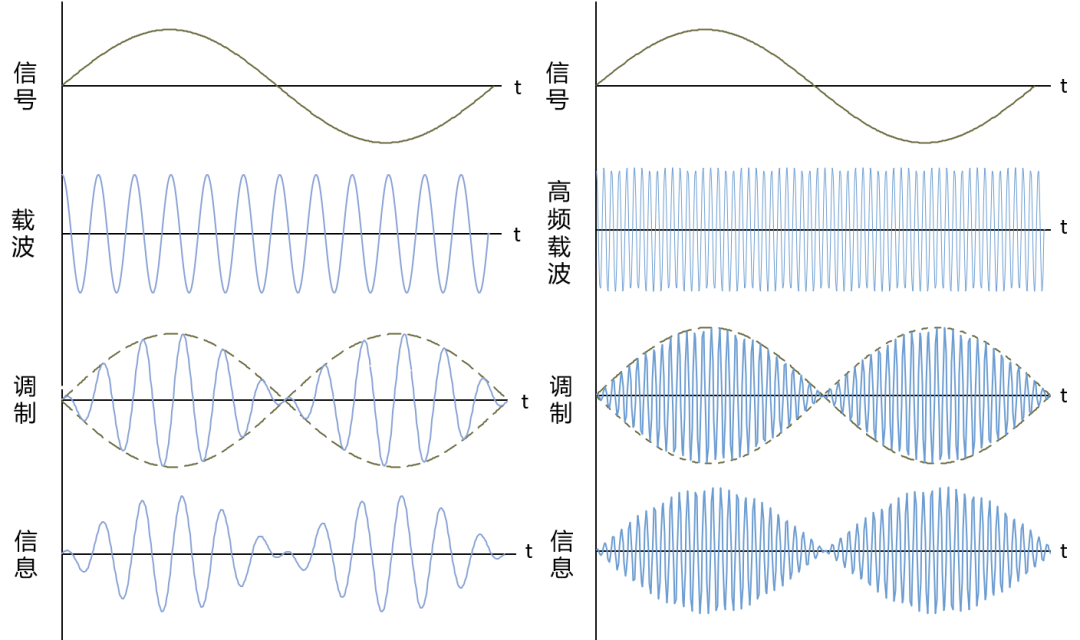
But if we observe further, high-frequency carriers offer higher fidelity in signal restoration — we can more easily discover long-term signals from the envelope of information.
Yet in most investing and life, we mistake information for signal, getting lost in the violent ups and downs of high-frequency carriers, completely ignoring the signal being transmitted behind the information.
In investing, stock prices fluctuate endlessly; management news pours out ceaselessly. And as research deepens, information channels multiply — even the chairman's arguments in morning meetings can be described in vivid detail. Yet this high-frequency information doesn't ease your mind. On the contrary, every day new information leads you to completely different conclusions from the day before:
Today Musk is the greatest entrepreneur; tomorrow Tesla is an outright fraud. Ultimately, you're trapped in an infinite loop of whether to cut or add. At root, we've sunk into the violent details of high-frequency information changes, ignoring the contour formed by connecting all the nodes — that contour is the signal; information is not.
In entrepreneurship, colleague relationships fluctuate endlessly; team gossip pours out ceaselessly — now intimate comrades-in-arms, now completely unworkable adversaries. Daily relationship shifts and new information keep you on edge. Ultimately, trapped in the infinite agony of whether to keep nurturing or fire immediately.
It's all the same. We've merely sunk into high-frequency information changes, ignoring what these isolated events imply about a colleague's character, capability, and values.
We can observe that the richer the information, the higher the frequency, the greater the short-term conflicts between information — even outright contradictions. At this point, don't panic. It means you've entered the high-frequency information stream, where signal clarity is actually higher. What we need to do is step back, extract core nodes, summarize information macroscopically, and discover the contour beyond the information — that is the signal.
Here's a tangential point: long-cycle signals have strong penetration; short-cycle information has strong piercing power.
Penetration is essentially diffraction — think of it as water, flowing around skin. Whatever changes in time and space, long-cycle signals flow through. Short-cycle information has strong piercing power, like X-rays — passing through skin to see bone, not flowing around it.
So we often don't notice long-term signals, while short-term changes consume much of our time. E-commerce platform data and growth trends during Singles' Day; community group-buying data and order structure by city; Tesla's monthly factory capacity and sales... These are all short-term changes. Zoom out: What will the world look like in 5 years? How will community group-buying transform commercial forms and product distribution networks? How will autonomous driving reconstruct our relationship with space and time? These are the long-term signals behind the changes.
Step away from tedious information, and signals emerge naturally.
Like the development and transformation of the internet — Tencent, which tried multiple times to sell but was rejected; Meituan, whose boundaries kept expanding; miHoYo, which just wanted to save otaku. There were countless perturbations and contingencies, but looking back, the wheel of technology rolled forward without interruption.
Industries are the same. History is the same. Life is the same. Don't fixate on single points, don't obsess over bands — abstract and observe long-cycle trends from short-cycle disturbances, and the great way lies before you.
For signal "demodulation" and "restoration," there are many classic algorithms. Returning to investing and life, I'd like to share three points:
(1) Accept high-frequency changes with equanimity
The more attention you pay to something or someone, the more information you acquire, and the more you enter the high-frequency information stream. At this stage, information varies greatly, time intervals are short, conflicts arise. Don't panic, don't agonize — it means you're already in the high-frequency information stream. Variation and conflict between information are inevitable. Simply accept it with equanimity. Whether the customer praises you today or refuses payment tomorrow; whether the company surges ahead today or faces strategic confusion tomorrow — accept it calmly. And the greater the changes, the more they help you discover signals.
(2) Step back from information to discover signals
Learn to record the "extreme points" in event changes. These extreme points can be what you least understand — sudden core metric shifts, or Tesla suddenly charging separately for autonomous driving as an add-on service. Record them, observe them. Signals will connect them, like the pulse of an era, like the great way of life.
(3) Curate long-term information sources
Every person, as an information transmitter, has their own "carrier" characteristics. Some are very high-frequency — one bullish candlestick can be analyzed for a day, one founder's remark can be savored for a year. Some are very low-frequency — what they say sounds useless, focusing on long-term changes rather than fluctuations. We need to understand the characteristics of different information sources around us, curate long-term sources, and regularly calibrate our own thinking patterns.
Finally, we need to recognize that all high-frequency signals are extremely energy-consuming — 5G consumes 3x the energy of 4G. There are always people with extremely high fidelity on small matters, describing things vividly. They add much fun and detail to life, but note that their energy consumption is often high too.
Last of all, think about the essence of things, and return to simple living.
Previously
Signals and Noise in Investing
Signal-to-Noise Ratio in Investment Decisions

Oasis Capital is a new-generation venture capital firm in China, dedicated to discovering the most vital entrepreneurs of the next decade and growing alongside them to create long-term value. "Vitality in Participation" is Oasis's vision and mission. This vitality is both the direction of structural transformation in the era and the resilience and evolutionary power of entrepreneurs. Oasis Capital focuses on early and growth-stage investments, with ticket sizes from $3 million to $30 million USD, concentrating on technology-enabled services in education, healthcare, enterprise services, and other sectors, empowering China's technology-driven new service upgrade.