Dialogue | A New Paradigm for the Globalization of Chinese Tech Brands
Insisting on in-house R&D of core components not only ensures a leading edge in product technology and reliability, but also cultivates a corporate culture of independent innovation. The company remains committed to an internationalization strategy, aiming to achieve 60% of sales from overseas markets before 2030. It continues to pursue intelligentization as a strategic direction.

Right now, Chinese tech brands are writing an entirely new commercial narrative on the global stage. Brand globalization is no longer simply about market expansion — it's about the global reconstruction of technological paradigms and business ecosystems. As China's first new-energy heavy-truck startup to achieve mass production and delivery, DeepWay — a Qiming Venture Partners portfolio company — is actively exploring global markets. At its spring product launch this May, DeepWay announced purchase agreements with multiple domestic and international enterprises, securing cumulative orders for 2,273 units of its new energy heavy-truck models.
At Qiming Venture Partners' 16th RMB Fund Annual Meeting and Investor Summit, Alex Zhou, Managing Partner at Qiming Venture Partners, and Wan Jun, Chairman and CEO of DeepWay, held a dialogue on "The New Paradigm of Chinese Tech Brands Going Global." Wan Jun discussed the impetus behind founding DeepWay, the company's three core strategies, and market response. He also analyzed traditional overseas markets and shared DeepWay's thinking on innovative globalization models.
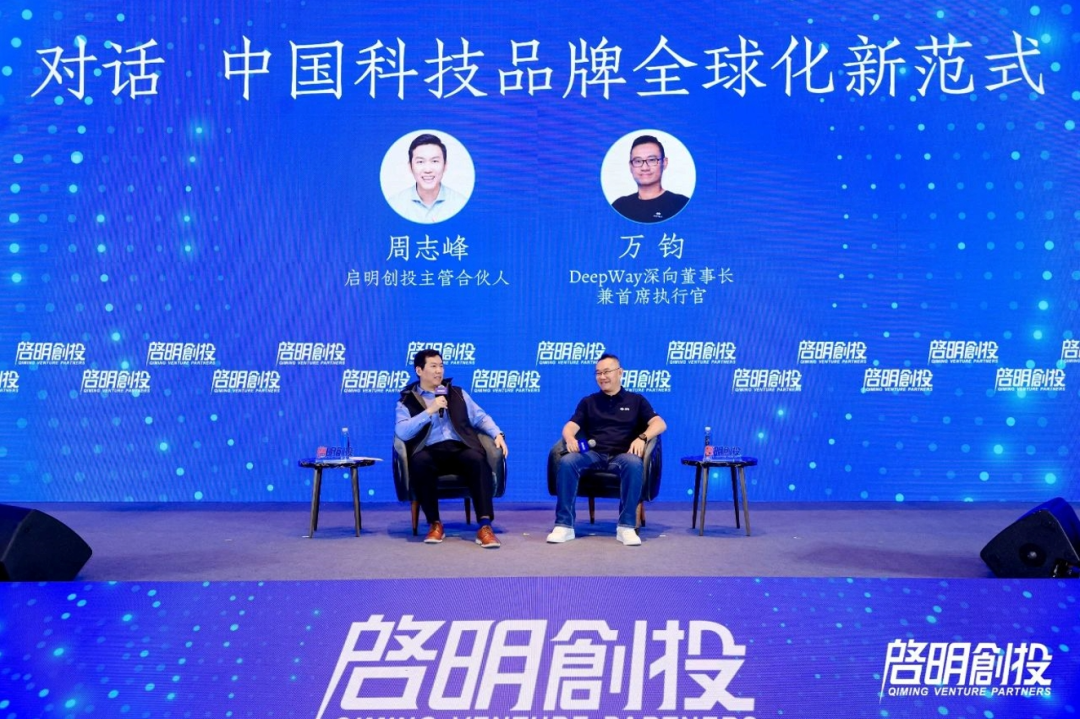
Alex Zhou, Managing Partner at Qiming Venture Partners (left), and Wan Jun, Chairman and CEO of DeepWay (right)
When asked about DeepWay securing thousands of orders in a short timeframe, Wan Jun attributed this to the strong support of the company's three core strategies: insisting on in-house R&D of core components not only ensures leading product technology and reliability, but also fosters a culture of independent innovation; pursuing an internationalization route with a target of achieving 60% overseas sales before 2030; and maintaining a focus on intelligentization.
On the topic of the efficient development of Chinese manufacturing, Zhou cited DeepWay as an example of a Qiming portfolio company that achieved thousands of deliveries in a short period post-investment. He also shared the main globalization models currently employed by Chinese enterprises: direct export, where complete manufacturing happens in China before finished products are sold overseas; OEM partnership models, where overseas factories handle final assembly and products are sold globally under the company's own brand; and localized operation models, where assembly plants are established in target markets, sometimes with independent brands tailored to local needs, achieving full localization from production to marketing.
01/
Addressing Industry Pain Points
With Both Technical Solutions and Societal Support
Alex Zhou: When we were in the United States on business recently, meeting with local investment institutions, we often used DeepWay as an example when discussing "China speed." Tesla is currently the standout among American manufacturing-and-tech convergence companies. They also have a new-energy heavy truck called the Semi, announced in November 2017. More than seven years later, they've delivered just over 200 units.
Wan Jun: We unveiled our concept vehicle on September 17, 2021.
Alex Zhou: When we invested in DeepWay in 2022, it was still "PowerPoint vehicle manufacturing." But mass production and delivery began in Q3 the year before last, thousands were delivered last year, and even more ambitious targets have been set for this year. We told many American investors: this is China speed. Mr. Wan previously founded China's largest logistics services financial platform. What prompted you to establish DeepWay? Please share with us.
Wan Jun: This is actually a classic story of "the pork didn't taste good, so I started raising pigs myself."
I once founded a company called Lionbridge Group. It was China's largest truck finance company and its largest trunk line logistics company. Everyone here may have been my client. Consumers are familiar with the "last mile" delivery by couriers after online shopping. But before that — the trunk line transportation spanning thousands of miles — everyone has likely used our services at some point. One out of every ten express packages in China was transported by my trunk line logistics company. We were also once China's largest owner of trunk line logistics fleets. In the process of operating these vehicles, we discovered numerous problems: they were unsafe, inefficient, unfriendly to drivers, and lacked sufficient intelligentization.
Could new technologies in this intelligent era solve these problems? We're fortunate to live in such times, where new energy technology can address cost issues, AI or intelligent driving technology can address safety issues, and internet technology can address operational management issues. Combined with strong national and societal policy encouragement and support for achieving energy conservation and emissions reduction in the freight industry.
Seeing market pain points, technical solutions, and national and societal support — facing such an opportunity, we resolutely chose to embark on the path of new-energy heavy-truck R&D.
02/
Three Core Strategies
Alex Zhou: You held a launch event earlier, where besides product introductions, you also announced your overseas strategy. Our forum's theme is "The New Paradigm of Chinese Tech Brands Going Global." Let's discuss the company's current situation, including the launch event and your broader globalization strategy.
Wan Jun: Everyone here today is indirectly a shareholder of mine. Qiming Venture Partners led our Series A and continued investing in our Series A+, becoming a very important shareholder. Let me report to all shareholders that on May 8, we held our launch event focused on two core matters:
First, announcing the results of our self-developed three-electric system — the core components in our vehicles: battery, electric motor, and electronic control system.
Second, launching new vehicle models equipped with this self-developed three-electric system.
Before the launch, we conducted a two-week market trial sale. The numbers were very encouraging — we received 1,403 domestic orders in those two weeks. For passenger vehicles this might be a small number, but last year's best-selling commercial electric heavy truck was XCMG's, with annual sales of just over 9,800 units. In comparison, you'll see this is quite a substantial figure. What made me even happier was that many customers wanted us to extend the promotional period, so we announced at the launch that certain favorable conditions would be extended by one week.
We also received over 800 overseas orders. We've only truly been going overseas for less than six months. To get so many orders in such a short time — we're very pleased. But what makes me happier than these results is the core driving force behind them: our three core strategies played a crucial role.
First, in-house R&D of the core three-electric system. In the past, Chinese OEMs didn't conduct in-house R&D, believing that suppliers' role was to provide components, while the OEM's job was final assembly, coordination, calibration, branding, and marketing. Core component R&D was outsourced. We believe that in this new era, we must firmly grasp core component R&D ourselves, accounting for 50% of the work. Trucks are production tools, and the most important metric is energy consumption level, which largely depends on three-electric system coordination. Without autonomous control of the three-electric system, it's difficult to define a quality vehicle.
Based on these considerations, we made the decision to develop the three-electric system in-house. Throughout this process, Qiming Venture Partners provided us with tremendous support. I believe this decision will lay a crucial foundation for the coming years and even decades. It's not just about leading product technology and reliability — more importantly, it establishes corporate culture: that we can and should do our own R&D and innovation.
Second, we adhere to an internationalization route. Let me report an important goal we announced at this launch — we hope that before 2030, DeepWay can achieve 60% of sales coming from overseas markets.
Third, we insist on intelligentization. Our heavy trucks come standard with L2-level combined assisted driving systems. While L2++ is commonplace in passenger vehicles, imagine controlling a vehicle with a total weight of 49 tons, traveling at 100 km/h while towing a 17-meter trailer — achieving assisted driving is no easy feat.
This intelligent assisted driving system can largely free the driver's hands, feet, and eyes during highway driving. To date, DeepWay has accumulated over 1.6 million kilometers of zero-risk, zero-takeover L2-level testing, demonstrating that this vehicle achieves a very high level of assisted driving capability.
So the implementation of these three strategies — core component in-house R&D, going global, and intelligentization — I believe is the fundamental support for our strong sales numbers today.
This support matters more than the numbers themselves.
Alex Zhou: Last year's mass production and delivery numbers, by full-market statistics, we wouldn't yet be considered market leaders. What does full-market statistics mean?
Wan Jun: DeepWay has a label called "forward design." This means we break past technical boundaries and constraints, designing from first principles with electric drive as the foundation, rather than converting existing diesel vehicles to electric — this is based on completely different thinking.
Second, following the principle of beginning with the end in mind: this vehicle will eventually be unmanned, so the chassis we're building today must be digitally controlled, with hardware and software redundancy, achieving high functional safety levels. The truck product displayed outside the venue today was produced and delivered following this approach. For forward-designed, mass-produced electric heavy trucks, besides Tesla's Semi, we're the only one. In terms of delivery scale, we're significantly larger than Tesla Semi. In China, established OEMs are mostly doing diesel-to-electric conversions — essentially still diesel vehicles, only transitional products, not forward-designed electric trucks. Moreover, their product portfolios include not just tractor units but also cement tankers, mixer trucks, and more. We only do one type: tractor units.
Because in the heavy-truck sector, tractor units are the "pearl in the crown." If you can master tractor units, developing other vehicle types becomes "dimensional reduction." Our engineers dare to say: "Give me three months, whatever other truck type you want, I can design it for you." The aforementioned full-market statistics cover all types and all channels of mass production and delivery data. Many enterprises produce and sell multiple vehicle types; we only have tractor units. If looking only at the tractor unit segment, our industry ranking would be higher.
03/
Thinking About Innovative Globalization Models
From a Higher Perspective
Alex Zhou: Let's discuss going global. China itself is a massive market with vast territory, and our logistics and e-commerce industries rank first globally. Why is DeepWay actively pursuing globalization? How are you positioning yourselves? Which countries and regions will you prioritize?
Wan Jun: Going global is one of the most important topics for new energy vehicle companies. Without considering globalization, there may not be a particularly bright future. But new energy vehicle globalization faces enormous challenges. Our traditional markets include Southeast Asia, the Middle East, Australia and New Zealand, and the United States.
Australia and New Zealand have zero tariffs on complete Chinese vehicles, including electric heavy trucks. Southeast Asia requires case-by-case discussion: Vietnam, Malaysia, and the Philippines have tariffs around 5%, still quite friendly; Indonesia is also 5%, but it basically doesn't allow non-local production — for electric heavy trucks, Indonesia basically doesn't allow imports; Thailand has 20% tariffs, so different markets require different plans.
The Middle East generally has tariffs around 5%. South America currently has very high tariffs on China, averaging around 40%. For new energy vehicles including trucks, European tariffs are 30%-50%; the United States has multiple layers, totaling 140% for complete vehicles, 70% for components, and batteries as a separate component approaching 100%.
We must think about not just how to enter — that's superficial thinking. We need to think from a higher level: why are these countries imposing high tariffs, why are they so defensive.
In the past, constrained by their economic development stage, Chinese companies often positioned themselves with habitual thinking — in the early stages of relatively limited resources, they typically viewed "exporting products to earn foreign exchange" as the core goal. But China has changed dramatically. We've grown from a "child" needing assistance to a true "adult," yet we still want to wear children's clothes and interact with the world in a "child's" posture. I believe this is wrong.
Thinking from this higher perspective, you can particularly understand other countries' attitudes toward Chinese enterprises. Recall how China viewed foreign investment in the 1970s and 1980s? We wanted development, employment, and economic advancement — these countries are the same now. When we can understand these countries' aspirations for economic development and improving people's livelihoods, many things become readily solvable. More importantly, now that we possess such capabilities, we should demonstrate major-country responsibility.
With such responsibility and mindset, you'll find the whole world becomes your friend. Recently, I met with a European investor where we discussed this issue. We presented our thinking: achieving output not just of products but of technology, model management, brands, and even business models. And unlike most companies today, we're not fixated on absolute majority control or majority shares in overseas-established companies, nor are we fixated on our own brand. We maintain an open attitude — as long as you're willing to open your market to us, we can develop together and share the brand. There are cases like SAIC-GM and SAIC-GM-Wuling to reference — why must we hold the majority share? If they hold the majority and we hold the minority, with us responsible for operations management, leveraging China's supply chain capabilities and R&D capabilities to provide more competitive products, these problems are all solved. Going further, overseas joint ventures could also choose to list independently on the partner country's capital markets. This investor was very excited after hearing this.
When we become more open, more responsible, and more confident, I believe resources will tilt toward you, and you'll find your relationship with the world becomes more beautiful. Our globalization model is broadly more open, flexible, and adapted to local conditions.
For countries like Australia and New Zealand, which currently may not have great demand for developing new energy vehicles, we adopt direct export models. For Southeast Asia, considering potential issues with direct exports, we choose countries with strong regional influence and good relations with neighboring countries within the region. If a particular country has concerns about Chinese products, we choose to cooperate with such countries and become a regional brand, allowing us to gain much support and achieve a model where "those with virtue have many helpers." These are our preliminary thoughts. While we don't have implemented cases yet, we're confident in this model — at least it's logically sound.
Alex Zhou: Many guests mentioned going global today. Insta360 (Editor's note: a Qiming Venture Partners portfolio company) chooses to complete finished product manufacturing at domestic OEM factories, with 70-80% of sales coming from overseas. But as we discussed, going global may involve establishing local manufacturing plants in some countries after entry, or even using different brands.
Wan Jun: Insta360's action cameras are consumer products. Our electric trucks are production tools, and production tools deeply embedded in local production cycles, so comparatively, our ecosystem complexity is greater, with more stakeholders in the ecosystem.
If an electric truck is going global, we also need to consider other supplements to the local ecosystem. We need to provide financial services, fleet management, intelligent driving, etc., to build the ecosystem. So you'll see it's different from consumer products. I particularly envy Insta360 — when new products launch, overseas users spontaneously rush to buy them. But for us, we must cooperate with local enterprises in overseas markets, enter local ecosystems, and truly become a local enterprise to survive. So I believe it will be "heavier."
Heavy isn't always good, but it also brings a benefit: if you're determined to build such an ecosystem and consistently do so over the long term, once it takes shape, the barriers formed will be very high, and other enterprises won't easily be able to shake your market position.
04/ Serving Grassroots Workers, Sharing the Progress of the Era
Alex Zhou: DeepWay has a new initiative this year — directly bundling the L2 combined assisted driving function, so customers have this feature upon purchase, unlike other vehicles where it requires additional payment as an optional extra. What was the thinking behind this?
Wan Jun: First, we have confidence in our product. **Customers don't need to pay upfront for the kit — we install it first, while allowing customers a 6-month trial period. We're very confident customers will continue subscribing after the trial.
Second, we previously sold the kit separately for a period, and under this business model we had very good penetration — roughly 20%, meaning 20% of customers chose to purchase our kit. This shows the product itself has strong enough appeal and can bring customers sufficient value.
Third, there's also a supply chain management consideration. For the component procurement volume previously needed with only 20% customer purchase rate, if we make the kit standard across all models, the procurement volume becomes much larger. In manufacturing, especially the automotive industry, volume gives you voice, and costs can drop significantly. So we can obtain better supply chain support and pricing through large-scale procurement — this calculation definitely works out.
Alex Zhou: Last year, thousands of DeepWay electric heavy trucks were already running on China's transportation networks. Finally, please share the real evaluations from frontline truck drivers actually driving on Chinese roads, or the most touching comments you've received.
Wan Jun: Search for DeepWay online, and you'll see a public comment from a Gansu user. He runs the dedicated route from Lanzhou to Linxia in Gansu — his father ran this route before him, and now he's virtually become the "monopolist" of this route, basically running it every two days. He feels DeepWay's driving experience is particularly good — sitting in the cab is as comfortable as sitting on a big sofa. He uses the L2 assisted driving system, and in two years of driving DeepWay trucks, he hasn't had a single accident, while his income has also increased compared to before.
He also purchased a Xiaomi SU7. When filming short videos, he displayed both vehicles, saying DeepWay represented his work and the Xiaomi SU7 represented his life. On the Xiaomi SU7, he asked Xiaomi's AI assistant "Xiao Ai" to play Love My China. While this song played, he talked about the benefits DeepWay trucks brought him, singing along himself. The driver's simplicity and passion deeply moved me. As a startup, DeepWay can serve grassroots workers, help them live relatively satisfying lives, and share in the progress of the era — this is precisely the most genuine source of satisfaction for me as an entrepreneur.
Alex Zhou: Thank you for sharing.
Previous Articles
Qiming Stars | DeepWay: The Future New-Energy Heavy Truck Is Essentially an Industrial Robot
Qiming Perspectives | Alex Zhou: 2025 Will Be the Year of Comprehensive AI Application Deployment
Dialogue | Glimpsing the Future of the Humanoid Robotics Industry

Founded in 2006, Qiming Venture Partners currently manages 11 USD funds and 7 RMB funds, with total assets under management reaching $9.5 billion. Since its establishment, the firm has focused on investing in outstanding early and growth-stage companies in Technology and Healthcare sectors.
To date, Qiming Venture Partners has invested in over 580 high-growth innovative enterprises, of which more than 210 have listed on the New York Stock Exchange, NASDAQ, Hong Kong Exchanges and Clearing Limited, Shanghai Stock Exchange, and Shenzhen Stock Exchange, or exited through mergers and acquisitions. Over 80 portfolio companies have become recognized unicorns or super-unicorns.
Many Qiming Venture Partners portfolio companies have grown into the most influential companies in their respective fields, including Xiaomi (01810.HK), Meituan (03690.HK), Bilibili (NASDAQ:BILI, 09626.HK), Zhihu (NYSE:ZH, 02390.HK), Roborock (688169.SH), UBTECH (09880.HK), WeRide (NASDAQ:WRD), Insta360 (688775.SH), Gan & Lee Pharmaceuticals (603087.SH), Tigermed (300347.SZ, 03347.HK), Zai Lab (NASDAQ:ZLAB, 09688.HK), CanSino Biologics (688185.SH, 06185.HK), Schrödinger (NASDAQ:SDGR), MicroPort EP MedTech (688617.SH), Sanyou Medical (688085.SH), Amoy Diagnostics (300685.SZ), Berry Genomics (000710.SZ), GenScript ProBio (688520.SH), Yuanxin Technology, Insilico Medicine, MediLink Therapeutics, LaNova Medicines, Zhipu AI, StepFun, Biren Technology, and others.