Qiming Star | Yuaiweiwu CEO Huaiting Zhang: To Build an AI Application Startup, First Close the Business Loop, Then Let the Model Take Over

The entrepreneurial opportunity in AI applications lies in using generative AI to transform services into manufacturing.

The "Qiming Venture Partners · Entrepreneurship and Investment Forum — Venture Capital Unleashing the Resonance Cycle of AI Technology and Applications," hosted by Qiming Venture Partners as part of the 2025 World Artificial Intelligence Conference (WAIC), was successfully held on July 28 at the Blue Hall of Shanghai World Expo Center.
At this forum, Huaiting Zhang, founder and CEO of Yuaiweiwu, delivered a speech titled Reflections and Practices on AI Application Entrepreneurship.
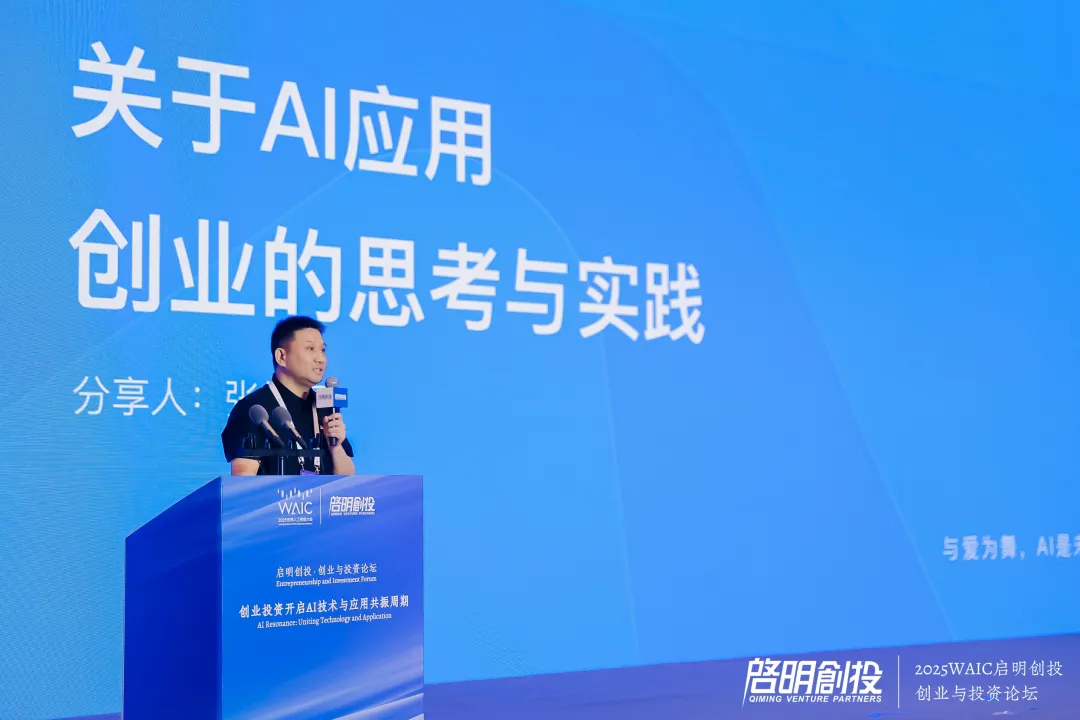
Huaiting Zhang, founder and CEO of Yuaiweiwu
In his speech, Zhang stated that the entrepreneurial opportunity in AI applications lies in using generative AI technology to transform service industries into manufacturing industries, breaking the "impossible triangle" of large-scale (personalization), high quality, and low cost. The core reason we have not yet seen explosive commercialization of AI applications, he argued, is the hallucination of large models, the inaccuracy of reasoning, and the uncertainty of outputs. This demands that teams working on AI applications understand both the business and AI technology itself, balancing model uncertainty with business fault tolerance. The path forward is to first establish a closed business loop, using the business to drive the gradual implementation of AI capabilities, while simultaneously identifying the data flywheel suited to one's specific business scenario. In the intelligent era, cross-disciplinary talent density and a corporate culture of pragmatic innovation are keys to organizational building, while human-machine collaboration is the foundation of enterprise operations.
Below is the full text of Zhang's speech.
Thank you to Qiming Venture Partners for giving a startup like ours — founded just over two years ago — the opportunity to share what we've learned from our entrepreneurial practice in AI applications over the past two years.
More than a decade ago, while working at a major internet company, my team and I developed what was likely China's first large-scale advertising recommendation system using deep machine learning algorithms. The system performed well and gave us our initial understanding of AI. Later, I partnered with like-minded friends to launch my first venture in education, which eventually listed on the New York Stock Exchange, giving us meaningful insight into the education sector. When generative AI emerged, we saw it could expand the possibilities of "technology for good" and equitable education access. So in 2023, my partners and I embarked on our second entrepreneurial journey.
We believe the most important element in education is having good teachers, and achieving true education for all — regardless of gender, urban or rural location, wealth, age, or whether one is child or adult. Everyone should have access to an excellent lifelong AI companion teacher, capable of personalized instruction, guidance, and mentorship based on individual interests, developmental stage, efficiency, potential, state, and personality. Of course, educational resources remain scarce today, and costs are high. When generative AI technology appeared, based on our understanding of both technology and education, we concluded that the marginal cost of individualized educational services would inevitably decrease — theoretically approaching real-time inference costs, with a probable 90% reduction from current cost levels. As technology advances, this cost reduction will only accelerate. At the same time, we believe such an AI teacher should be available anytime, anywhere — accessible whenever needed, regardless of location. Its knowledge base will grow as intelligent systems advance, potentially offering the most suitable personalized guidance to every individual across all domains.
Today I don't want to dwell too much on products or algorithms — there have been plenty of relevant demonstrations here these past few days that you've likely already seen. Instead, I'd like to shift perspective. As a serial entrepreneurial team, we hope to share some modest observations from the vantage point of entrepreneurship.
We believe a major entrepreneurial opportunity in AI applications is transforming service industries into manufacturing industries. Many existing service industries are labor-intensive, and they frequently encounter an "impossible triangle": the desire to provide high-quality service at low cost while achieving large-scale coverage — essentially a paradox. Take doctors as an example. We often experience this in daily life: waiting two hours at the hospital for a ten-minute consultation; or receiving a referral for tests, then waiting in line again, sometimes successfully, sometimes not, perhaps needing to schedule another visit. This fully illustrates that for most people, accessing high-quality service is difficult and costly. Generative AI presents an opportunity to provide personalized services at scale, achieving both quality and quantity. In the virtual digital world, we often hear the term "thousand people, thousand faces" — "thousand people" representing scale, "thousand faces" representing personalization. Similar to recommendation systems, applications like content distribution have already solved the coexistence of scale and personalization, but this hasn't been achieved in service industries, primarily due to the capability boundaries of recommendation systems themselves.
Using generative AI to transform labor-intensive industries: first, replacing labor costs with computing costs is more appropriate. The trend is clear — computing costs will continue to fall while labor costs rise. Second, talent selection, utilization, and cultivation in labor-intensive enterprises is extraordinarily complex, compounded by the loss of excellent personnel. Management costs are extremely high, and full standardization is nearly impossible. But with generative AI technology, standardized service becomes achievable. Once service industries are transformed into manufacturing industries through generative AI, each of us may eventually have dedicated AI teachers, AI lawyers, and AI family doctors at our side.
For AI applications, why haven't we seen large-scale implementation and explosive growth yet? For comparison, let's revisit the prerequisites for the mobile application explosion more than a decade ago. First, 4G networks were basically formed and smartphones had become ubiquitous — the underlying hardware infrastructure was mature. Phones had positioning, camera, and payment capabilities, providing foundational support for mobile applications. Amap, DiDi, and Meituan all relied on phone positioning; Kuaishou and Xiaohongshu used camera functions to record life through video or images; online education companies like Gaotu relied on audio-video live streaming for anytime, anywhere learning. Meanwhile, the普及 of payment functions made application commercialization possible — without it, enormous business opportunities would have been missed. It was precisely this infrastructure that allowed mobile internet application companies to focus solely on the application itself, without needing to construct deeper underlying systems.
Today, we find that models still hallucinate frequently, reasoning capabilities remain insufficiently accurate, and output results are unstable even with identical context. Meanwhile, multimodal capabilities — such as real-time digital human interaction, facial stability under heavy occlusion, real-time generated expressions and demeanor, voice tone, and interaction latency — remain relatively weak. Additionally, many enterprises have yet to encounter scenarios with hundreds, thousands, or even tens of thousands of concurrent inference requests, which requires optimizing substantial underlying architectural capabilities — a high bar for today's entrepreneurial teams. On one hand, one must judge AI development trends and iteration speed — in fact, progress from last year to this year has already surpassed Moore's Law in its heyday; on the other hand, one must clearly understand current model capability boundaries. For text-to-image, the output might be directly usable, but text-to-video for short drama production still falls short. In application, balancing model uncertainty with business fault tolerance is critical. For instance, with recommendation systems doing content distribution, users can simply swipe away videos they don't like; if an advertising recommendation system pushes an uninteresting ad, users can skip it. But if an AI doctor were to perform surgery, could we allow it to make mistakes? Thus the uncertainty of model output directly relates to business fault tolerance. How to balance when to use model capabilities versus when to rely on system capabilities — this is a "real question."
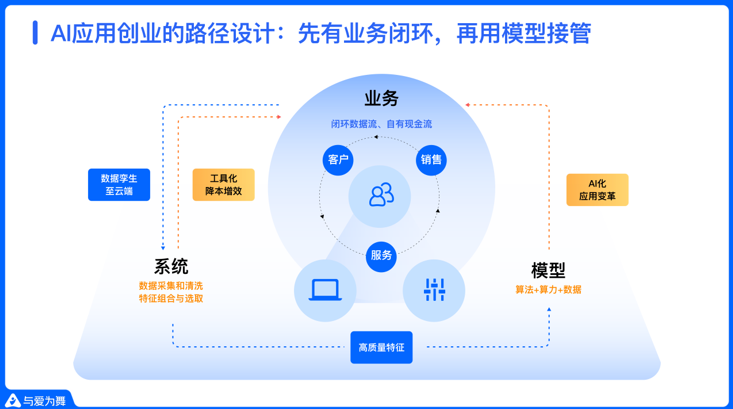
For the path of AI application entrepreneurship, our understanding is: first establish a closed business loop to validate the effectiveness of application scenarios; then gradually use models to assist or replace certain links in that loop, ultimately achieving AI-driven transformation of the business. This is likely a pragmatic, incremental path. In this process, the core question is whether all closed-loop data can reach the cloud? Is there a system that can collect all interaction data and static features to form a high-quality feature set? Then use this effective data to train models, completing the ultimate transformation of AI applications. This thinking benefits from lessons drawn from internet entrepreneurship history — many disruptive technologies emerged from the pressure of mature businesses. Alibaba Cloud and Amazon Web Services, for example, both launched cloud services due to concentrated, explosive usage pressure from their own e-commerce products, initially supporting internal needs before their capabilities overflowed to serve external organizations.
For AI applications, there's also a fundamental question: use AI to empower, or use AI to replace? We believe both are possible, manifesting in different businesses or processes. **AI empowerment is like turning people into Iron Man — the path is intelligent assistance with human decision-making. Since current AI has not yet reached top human levels, human ceiling is higher. Through AI assistance achieving partial standardization, we can likely reduce the variance in human performance. Because humans ultimately make the decisions, we can imagine: if a person makes one decision per second, the daily upper limit is 86,400 decisions. Limited by this, business growth can only be linear. Of course with AI assistance, costs will certainly decrease to some degree. Ultimately, the team's organizational capability is built on management and systems. When we assume a task can be fully replaced by AI — that is, unmanned — we adopt intelligent system-driven approaches. Given current AI is not 100% accurate, human backup is still needed. In the long term, computing power expansion unconstrained by human limitations may achieve exponential growth. At present AI levels, the ceiling may not match humans, but the average will certainly rise, and variance theoretically should approach zero, with costs dropping by orders of magnitude. Under this system, organizational capability need only be built on fully intelligent systems — higher efficiency, lower costs, faster iteration.
People often ask: does AI application have a data flywheel? Recently, both Google and OpenAI announced their models now perform very well on difficult problems from mathematical olympiads. For tasks with deterministic answers like this, today's model capabilities far exceed most humans, so information gained from human interaction is no longer sufficient to enhance their own intelligence. For example, asking "Can I still buy NVIDIA stock?" — if information is sufficiently complete, a standard answer theoretically exists; no need to obtain better solutions through interaction, hence no data flywheel. Or consider a task with complete constraints: "Purchase a second-class high-speed rail ticket from Beijing to Shanghai departing at 7 AM" — the agent simply executes, no iterative optimization data flywheel exists.
What is a data flywheel? Say you request "Order a tasty takeout lunch" — the agent needs to understand user identity, meal time, delivery speed, dietary preferences, location, price range, whether to avoid recent重复 orders, and so on. These require continuous personalized interaction through ongoing use to沉淀 user habits, forming a data flywheel. More complex: "Improve English ability" — which of listening, speaking, reading, writing? How to improve? Current level? Personal learning habits? Learning efficiency? These are static features and dynamic behaviors continuously沉淀 through user interaction, combined with short-term and long-term context, to achieve personalized interaction and gradually form a data flywheel.
What should AI application organizations look like today? We believe talent is paramount, and talent density must exceed business complexity. We now need both domain experts and AI talent — but actually integrating domain talent and AI talent is extraordinarily difficult. We've experienced this in our company: AI talent felt certain work "wasn't AI enough," not fully utilizing models; while domain talent pointed out current model limitations, requiring continued use of original methods. How to integrate them into a unified force — this is critical. Second, we need a corporate culture of pragmatism and innovation coexisting. As mentioned earlier, first build the business loop, then upgrade or transform through AI. We need foundational business capabilities to pragmatically create commercial value, while continuously tracking global technology development and understanding how to apply AI capabilities to business. Third, silicon-based life has become a necessary organizational component. For example, in code development, assistance from tools like Cursor may be needed; in sales, AI can assume specific tasks. Thus, human-machine collaboration will become the foundational operational paradigm for enterprises in the intelligent era. For senior employees who struggle to adapt to this transformation, we must on one hand provide opportunities and timeframes to drive change; on the other hand, we urge our people: look from the future to the present — change your mindset or change your person.
That concludes my sharing. To summarize our AI application exploration in 16 characters: "Business-driven, intelligence-powered, human-machine collaboration, pragmatic innovation." Our company advocates delayed gratification, guiding people to neither overestimate short-term gains nor underestimate long-term accumulation.
Source | IPO Zaozhidao
Previous Articles
Qiming Perspectives | Alex Zhou, Qiming Venture Partners: 2025 Will Be the Year AI Applications Fully Land Qiming Stars | Multiple Qiming Venture Partners Portfolio Companies Appear at 2025 World Artificial Intelligence Conference Qiming Headlines | 2025 WAIC "Qiming Venture Partners · Entrepreneurship and Investment Forum — Venture Capital Unleashing the Resonance Cycle of AI Technology and Applications" Successfully Held

Founded in 2006, Qiming Venture Partners currently manages 11 USD funds and 7 RMB funds, with total assets under management reaching $9.5 billion. Since its inception, the firm has focused on investing in outstanding early and growth-stage companies in Technology and Healthcare innovation.
To date, Qiming Venture Partners has invested in over 580 high-growth innovative companies, of which more than 210 have listed on the New York Stock Exchange, NASDAQ, Hong Kong Exchanges and Clearing Limited, Shanghai Stock Exchange, and Shenzhen Stock Exchange, or exited through M&A and other means. Over 80 portfolio companies have become recognized unicorns or super-unicorns.
Many Qiming Venture Partners portfolio companies have grown into the most influential companies in their respective fields, including Xiaomi (01810.HK), Meituan (03690.HK), Bilibili (NASDAQ: BILI, 09626.HK), Zhihu (NYSE: ZH, 02390.HK), Roborock (688169.SH), UBTECH (09880.HK), WeRide (NASDAQ: WRD), Insta360 (688775.SH), Gan & Lee Pharmaceuticals (603087.SH), Tigermed (300347.SZ, 03347.HK), Zai Lab (NASDAQ: ZLAB, 09688.HK), CanSino Biologics (688185.SH, 06185.HK), Schrödinger (NASDAQ: SDGR), MicroPort EP MedTech (688617.SH), Sanyou Medical (688085.SH), Amoy Diagnostics (300685.SZ), Berry Genomics (000710.SZ), Genor Biopharma (688520.SH), Yuanxin Technology, Insilico Medicine, MediLink Therapeutics, LaNova Medicines, Zhipu AI, StepFun, Biren Technology, and others.