Peng Yongdong: What Is Strategy? | Code Meet 2019

"Knowing Capital, Acting Deep" — At Source Code Capital's 2019 Ma Hui annual meeting, KE Holdings CEO Stanley Peng was invited to share his thinking and practice on the essence of strategy.
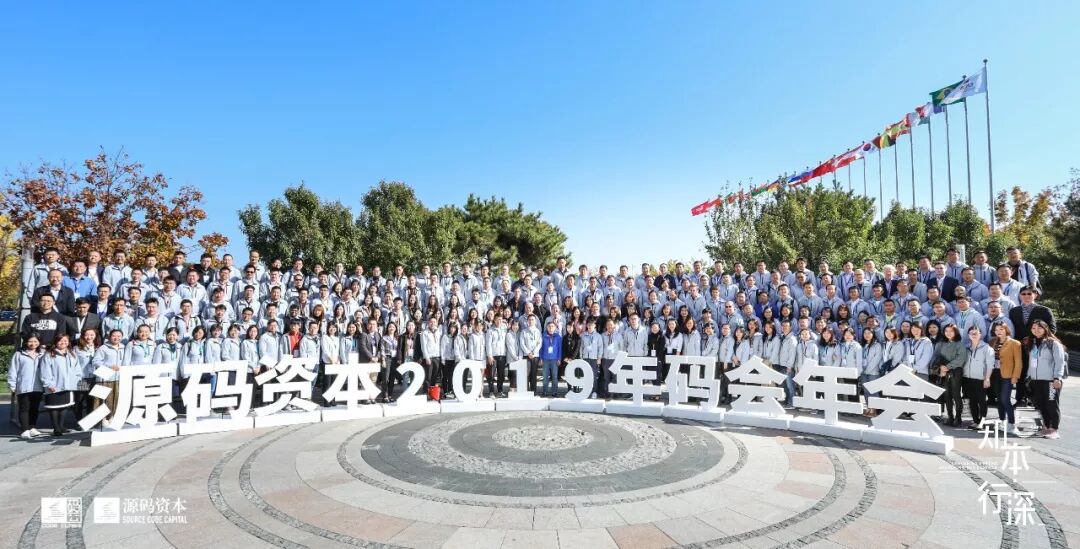
At Source Code Capital's 2019 Code Meeting annual conference, KE Holdings CEO Yongdong Peng drew on the company's strategic thinking and practice to argue that strategy must answer a fundamental question: "What does our existence mean for this industry, for consumers?" He emphasized the need to clearly define your current position (Point A) and your destination (Point B), then implement long-term initiatives around enduring values and belief systems. Strategy, he said, is about consistently doing what is hard but right. By focusing on unchanging values, KE Holdings and Lianjia built a business of quality industrial supply and service excellence through scientific management and values-driven culture.
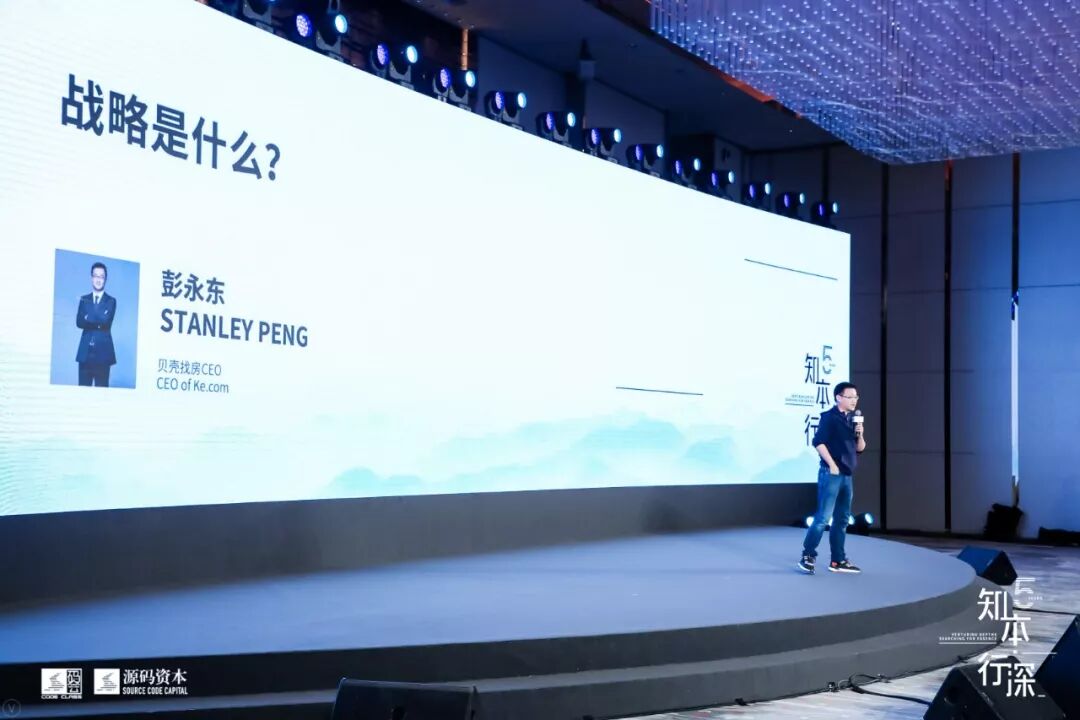
Yongdong Peng, CEO of KE Holdings, speaking at the Code Meeting annual conference

Below is the full transcript of his speech:
What Is Strategy?
Before answering "what is strategy," there's a 0.1-level question: What value does our existence create for society, for our industry, for consumers?
All strategy ultimately returns to this fundamental question — why do you exist at all? Existence is a core issue, and it's the first prerequisite when we talk about strategy.
Strategy Must Answer Two Key Questions
First, we call our current position Point A and our destination Point B. The core question is: where is our current Point A, and where is the Point B we want to reach?
Second, how do we get from A to B? The journey to B involves countless challenges and requires countless capabilities to be built.
Deconstructing Points A and B from Multiple Perspectives
The solution to the second question lies in structural decomposition. The core method is examining the industry from different perspectives. Taking real estate transaction services as an example:
First perspective: online versus offline;
Second decomposition: by product line, residential versus non-residential;
Third: by geography/city, since all industries have offline, location-based attributes;
Fourth: by industry chain — for residential services, this includes brokerage transactions, post-transaction services, and more;
Fifth: B2C versus B2B, whether serving consumers or the industry itself;
Sixth: by customer lifecycle.
The key with different decompositions is understanding present and future directions.
Residential services is an extremely low-frequency domain with very long transaction cycles — a single second-hand home transaction takes over ten weeks to complete, with constant online-offline handoffs throughout.
From an offline perspective, looking at KE Holdings' Points A and B:
The core of this industry is agents and service providers. Strategy at its heart is making a judgment — predicting what changes the industry will undergo. Our own judgment is that service provider efficiency in this industry will double. That's the gap between A and B. To close this gap, all resources must be deployed and built around this central axis.
From an online perspective:
China currently has roughly 250 million housing units, yet monthly active users for online real estate transactions stand at about 50 million. How will this change? In the United States, comparable figures are 200 million units. And as the industry grows, significant online dividends will emerge. This industry's internet transformation lags consumer internet by roughly 3–5 years. This year we're seeing online dividends appear — consumers are increasingly using online information for decision-making. This is a crucial variable for our industry.
We believe this industry will inevitably have online platforms where users can access all housing-related information and services. From an MAU perspective, there will be apps with over 100 million users, capable of carrying all residential needs.
Answering the A and B question means identifying what Point B actually is. I believe Point B's objectives should be mutually reinforcing with Point A's current reality.
Finding the Path to B from Industry Fundamentals
How do you reach Point B? The core is identifying the industry's fundamental nature — very much in line with Source Code Capital's theme today.
I see several fundamentals in industrial internet:
First, it's a business of quality supply. Everyone talks about B-side and C-side, but in service industries the core is demand and supply. In industrial internet, it's a business of quality supply. If you have good, quality supply on your platform, the end result won't be bad.
Second, it's a business of quality. All well-executed services require quality. The core of quality is standards, and behind standards lies infrastructure.
Third, scientific management. In the vast majority of enterprises today, the importance of scientific management in organizational growth is severely underestimated.
Fourth, it's a business of values. Value choices in this industry are crucial.
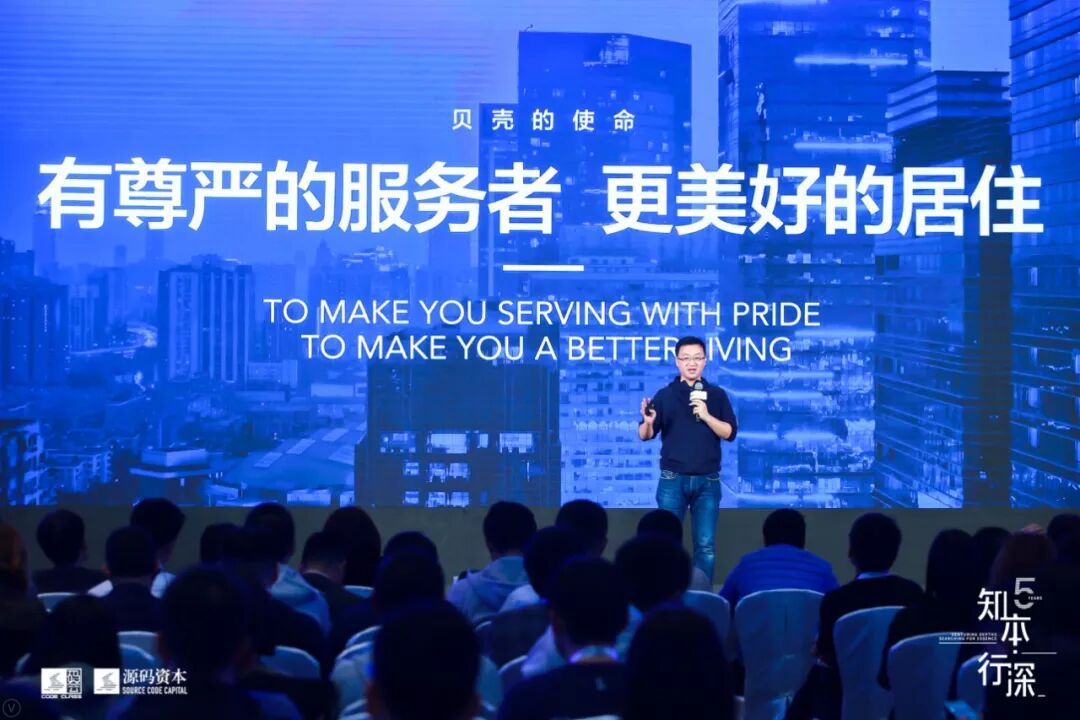
Yongdong Peng, CEO of KE Holdings, speaking at the Code Meeting annual conference
Industrial Internet Is a Business of Quality Supply
Supply-demand relationships in industry have only two basic models: one where supply and demand are independent and separate; another where they are integrated.
Our core approach fuses these two basic models into three relationship types:
First, buyer-seller supply-demand — this is the separated supply-demand business model;
Second, consumer-service provider and service provider-agent supply-demand — this is service supply-demand, where value is exchanged through service, again a separated model;
Third, unique to our industry: agents operate in an integrated supply-demand model. Every agent is both supplier and demander to every other agent, creating very strong network effects among agents. This model is the industry's true fundamental nature.
For example, when one agent places their property listing on a shared platform, others can consume that information and even generate cooperation based on it. This is the cooperation network, and the cooperation network is the industry's essence.
The Industry's Future Is Professionalization of Service Providers
We believe the true core of this industry is supply of quality service providers. If all agents in this industry could double their efficiency, consumers could enjoy genuinely better prices. Without this, the industry cannot be transformed. All our resources go into this: how to attract quality service providers to connect on our platform, how to help them grow? For instance, our agents take examinations twice yearly — we call it the Boxue Exam, with over 100,000 taking it simultaneously each time. Results serve as a crucial metric for professionalism. Then there's the Beike Score — I believe trust is the hard currency of all future commerce — so we built the Beike Score mechanism. Polishing, elevating, and optimizing quality supply is a vitally important proposition worth massive resource investment.
Industrial Internet Is a Business of Quality
Our logic works like this: if the platform does something that's good for consumers but hard for service providers, service providers must passively improve their capabilities to survive. As service provider capabilities rise and consumers are satisfied, they receive positive reinforcement from consumers, becoming more willing to do these hard things — forming a positive incentive loop.
Service industries need to form quality flywheels. Service providers are motivated by consumers, and motivated service providers whose capabilities and performance improve enter their own positive loops.
One complex aspect of industrial internet is the sheer number of roles, the extended timelines, the cumbersome processes — the same service process lacks SOPs. But these are precisely things that can be built when vertically deploying across industries: our property dictionary, quality commitments, industry-wide SOP development and system building, modular services. Many vertical industries can form service APIs, or be redefined through datafication.
Take the property dictionary. China has 250 million homes, each requiring 400 fields to describe. Does it have bay windows? How high from the floor? How many bathrooms? How many windows in each bathroom? These 400 fields contain substantial data. Is this hard? We've encoded all 250 million homes in China into a property dictionary — not hard in itself. But the team behind it needs ten years to feel a sense of achievement, while many organizations are KPI-driven and may not see value across time horizons. That's the hard part.

Yongdong Peng, CEO of KE Holdings, speaking at the Code Meeting annual conference
Quality commitments follow the same pattern. When we launched genuine listings, we faced internal conflict between online and offline value choices. At the time, Lianjia was doing well in Beijing, and the industry's core logic was that more listings meant competitive advantage. But internet's core is information sharing. Some colleagues insisted we must never put information online — listing information was this industry's most precious asset. If competitors knew it, our store coverage advantage would be meaningless.
But consumers desperately wanted this. How to resolve this conflict? I believe when organizations face such conflicts, what you believe matters most. We genuinely believe in consumer first. The critical criterion is: what do consumers want? So starting in 2012, we put all information online, including transaction prices.
Returning to the first question: what does our existence mean for society, for this industry, for consumers? This era truly offers vertical industries tremendous opportunity. At this moment in time, we can genuinely build industry infrastructure. Things like property dictionaries, quality commitments, foundational systems, tools, and services — this generation needs to build them. This is my second point: industrial internet is a business of quality.
What Are the Long-Term Initiatives Around Core Values?
When you see what an industry's fundamentals are, the question isn't how much to invest — it's over-invest. Truly important things require over-investment; truly unimportant things deserve not a penny.
The belief system of CEOs and founders directly determines where you are and what direction you take. Around these core, unchanging values and management systems, we must ask: what are the long-term initiatives? What do we do for the next three to five years? Even the next ten years? The core of strategy is traversing time, being a traveler through time, projecting into the future to see what matters most today.
Industrial Internet Is a Business of Scientific Management
The path to reaching objectives — scientific management gives everyone systematic, organizational capabilities to reach objectives with certainty. The core of scientific management is decomposing objectives, continuously breaking down from one target to the next. The deeper you understand your industry, the finer your decomposition granularity.
Here I reference a model: strategy is positive feedback; management is negative feedback. Before objectives are achieved, we must know both the objective and current reality, creating a gap between them. With this gap, we know what to do to close it — that's negative feedback. Management's power helps you reach objectives.
Industrial Internet Is a Business of Values
In a sense, values are a strategy — a strategy chosen to reach an objective. This strategy must be believed by all: when conflicts arise, this is how we act. This is the power of values-based choice.
First, how do we view consumers? I believe being good to customers means recognizing we're not actually that great. We must focus on customers, because their choices directly determine whether we have a future.
Second, how do we view service providers? Truly caring for the supply side means giving them long-term future development possibilities.
Third, how do we view teams? Every organization needs others. Within organizations, we particularly emphasize teams — no idea can be executed alone today.
Fourth, superior-subordinate relationships. A person's promotion and career development should have no direct relationship with their superiors. That's the best relationship. We believe all power should increasingly flow to consumers, letting consumers decide the entire organization.
Fifth, what is your organization's mission and values? When you start, the mission isn't that grand. As you progress, you discover you have value, then you become narcissistic. Kill the narcissism, recognize your smallness — only then can true mission emerge.
KE Holdings' mission is: dignified service providers, better living. Our existence can transform China's residential values, help consumers get great experiences, help this industry's service providers gain dignity. Everything we do revolves around this mission.
Do What Is Hard but Right
To the first question — what is strategy? My answer: Strategy is doing what is hard but right. Everything right in this world is quite hard, but it faces no time-based survival constraints. Easy things aren't too hard, but easy things don't last — they may have no future at all. And there are only two criteria to test whether something is right: one, is it good for consumers? Two, does it help service providers be good to consumers?
Strategy is doing what is hard but right. Hard things require longer vision, and more down-to-earth execution.


More from Code Meeting 2019
- Where Are the Boundaries of Industrial Internet?
- Technology Empowering New Consumption: Everything Has Just Begun
- How Should Companies Going Global Make Strategic Choices and Decisions?