Code Mark | AI Breakthrough in Chemical Retrosynthesis, Chemical.AI's Performance Nears Decade-Experienced Chemist Level

AI-Powered Smarter, More Efficient Retrosynthetic Route Design
#CodeMoment Key Updates from Source Code Capital and MaHui Members
MaHui member Chemical.AI recently completed an internal evaluation of its ChemAIRS retrosynthesis system. Based on assessments of route design speed, feasibility, and diversity, ChemAIRS's route design capabilities now closely approach those of a chemist with ten years of synthesis experience. The algorithm can also generate two to six distinct synthetic strategies for reference, offering design ideas for identifying better, more economical routes and solving synthesis problems for challenging target molecules.
AI already has extensive applications across multiple subfields of drug discovery, including target screening, molecular design, and activity prediction. As early as fifty years ago, Nobel laureate E.J. Corey began attempting to use computer technology to assist in retrosynthetic route design. However, limited by the hardware and software conditions of the time, this approach did not achieve widespread adoption.
In recent years, multiple AI-assisted retrosynthesis products have been developed and gradually applied in the pharmaceutical field. But to date, no publicly reported test has compared AI's route design capabilities with those of experienced human chemists.
Recently, Chemical.AI's ChemAIRS retrosynthesis system conducted a human-machine comparative evaluation with chemists from Shanghai Yilai Biotech. The results were comprehensively assessed from perspectives including synthesis difficulty, design approach, number of synthetic steps, and route rationality, with thorough analysis of cases comparing ChemAIRS-generated synthetic routes with manually designed ones.
Human-Machine Evaluation Results
The evaluation selected 22 organic molecules (non-chiral) with synthesis difficulty approximating the molecular complexity encountered by medicinal chemists in actual work, with total synthetic route steps ranging from 8 to 14. Sixteen chemists with an average of ten years of synthesis experience completed manual route design, with access to other query tools and reference materials during the design process.
Meanwhile, ChemAIRS performed batch route design on these same 22 molecules, selecting two routes from the results for each molecule for evaluation and scoring. Scoring criteria referenced indicators including rationality of synthetic approach, number of steps, and reaction feasibility. Chemist-designed and machine-generated routes were anonymized during scoring to ensure fairness.
Synthetic Route Design Speed Comparison
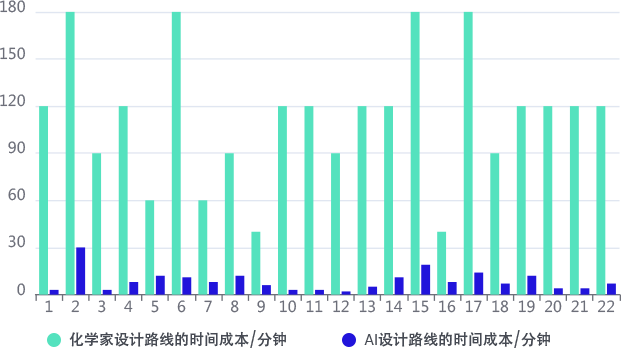
Based on speed assessment results, chemists spent no more than two hours designing synthetic routes, averaging about 1.5 hours. AI route calculation averaged 8.7 minutes total, with the first route found in an average of two minutes. The AI generates multiple routes and can sort them by difficulty and total step count. In terms of route design speed, the AI algorithm is approximately ten times faster than chemists.
Synthetic Route Feasibility Score Comparison
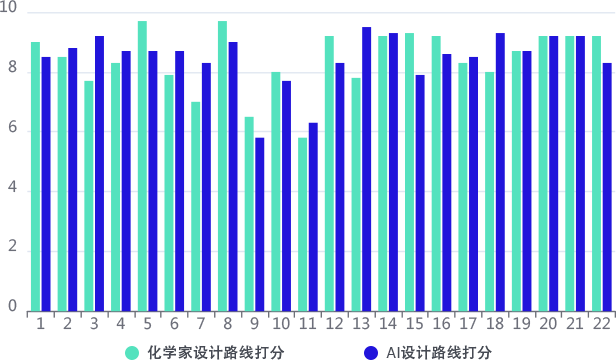
Six senior chemist judges scored the chemist/AI synthetic routes for 22 molecules. Feasible routes should score 6 or above, with 10 as the maximum. Comparison of chemist and AI scores shows that in ten examples, AI route scores were close to chemist scores (within 0.5 points). In seven examples, chemist average scores were higher; in five examples, AI-designed routes had higher average scores. Overall, in 68% of examples, AI achieved parity with or outperformed chemists.
Synthetic Route Diversity Comparison
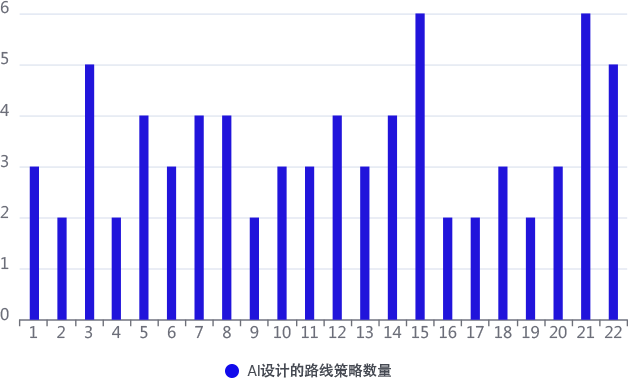
The evaluation team also tallied the number of distinct synthetic strategies in AI routes. Designing routes with different strategies is relatively difficult for chemists. But in actual work, situations frequently arise where a key step fails and a synthetic strategy must be changed. In this evaluation, the AI generated between 5 and 20 routes within minutes. As shown in the figure below, among these routes, each molecule averaged two to six different synthetic strategies, containing different key steps and key intermediates, helping chemists quickly identify higher-success-rate methods and the most economical, readily available starting materials.
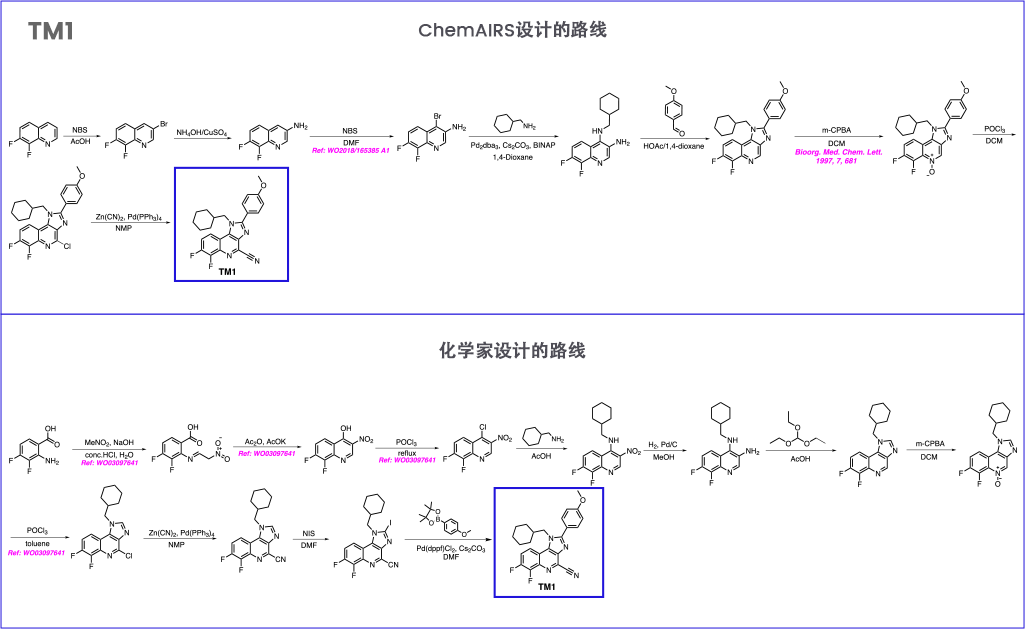
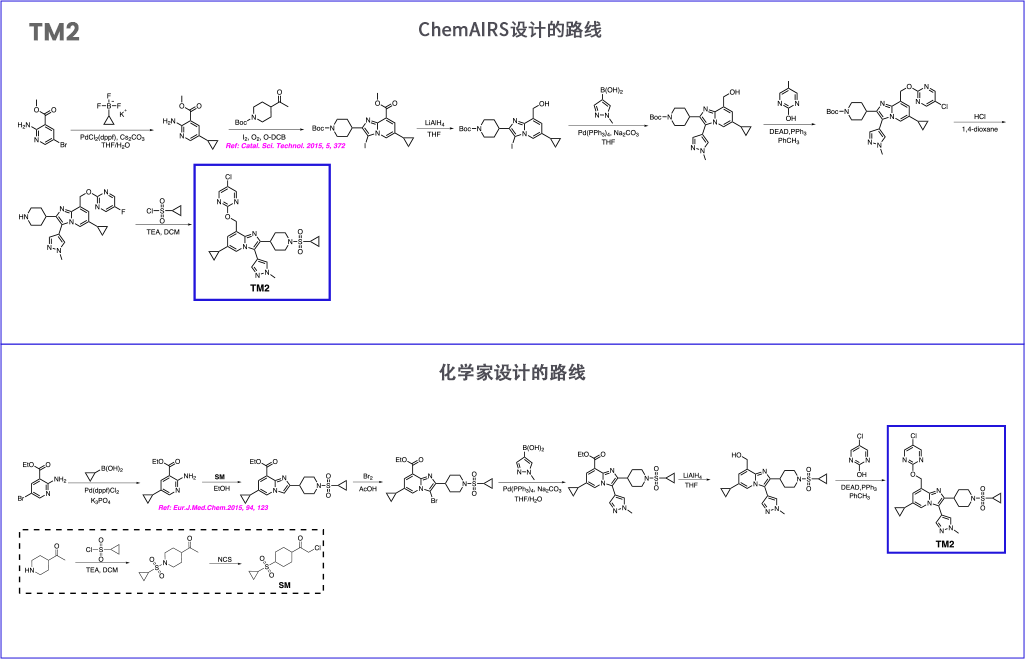
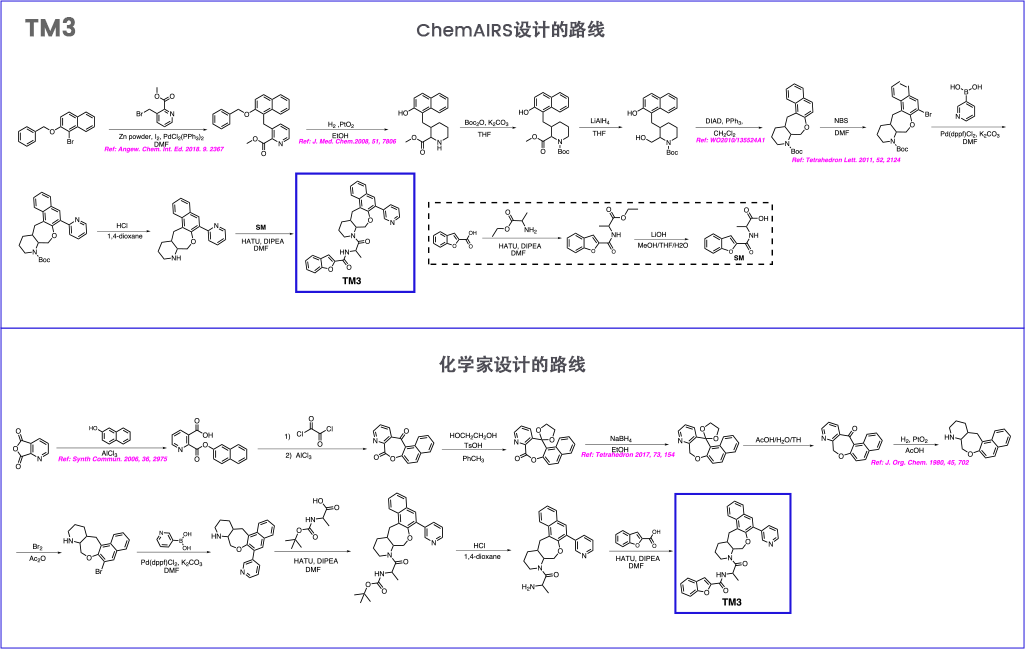
The evaluation team selected three molecules from the 22 tested as demonstrations, verifying that AI algorithm synthetic route feasibility is comparable to or even superior to that of chemists. Taking TM1 as an example, in the reaction constructing the imidazole ring, the chemist used triethyl orthoformate to first construct the imidazole ring in step six, then performed iodination and coupling reactions on the imidazole ring. In the AI synthetic route, an aromatic aldehyde and diamine substrate were used in step five to directly achieve one-step construction of an aryl-substituted imidazole ring, making the AI route more concise and efficient.
In the synthesis of TM2, both routes contained key steps for imidazole ring construction. In the chemist's route, steps two and three successively achieved imidazole ring construction and subsequent bromination. By comparison, the AI synthetic route adopted a more concise and efficient method in step two to achieve one-step construction of an iodine-substituted imidazole ring. Beyond this, the two routes were largely consistent in feasibility and strategy, differing mainly in the sequence of key intermediate synthesis.
In TM3, a seven-membered oxygen ring needed to be constructed. The chemist first used a Friedel-Crafts reaction with subsequent functional group transformation to obtain the seven-membered oxygen ring, but the Friedel-Crafts reaction in step two might have regioselectivity issues, which would inevitably impact subsequent separation and identification. In the AI synthetic route, a diol compound was synthesized in step four, and the seven-membered oxygen ring was constructed via a Mitsunobu reaction in step five, with no selectivity issues and no feasibility problems in other synthetic steps. The AI route scored better than the manual synthetic route.
Human-Machine Evaluation Conclusion
Based on assessment results for route design speed, feasibility, and diversity, ChemAIRS's current route design capabilities closely approach those of a chemist with ten years of synthesis experience, while exceeding experienced chemists in design speed and strategic diversity, improving route design speed by approximately tenfold, enabling faster design of comparable or better routes in 68% of cases, and improving route quality in 23% of cases. The algorithm can also provide chemists with two to six different synthetic strategies for reference, offering design ideas for identifying better, more economical routes and solving synthesis problems for challenging target molecules.
Retrosynthesis systems represented by ChemAIRS cannot replace chemists, particularly for certain relatively novel structures where AI cannot yet substitute for chemists' innovative thinking. But as an important tool for chemists' route design, it can achieve augmented human intelligence — just as cars enable people to move faster. It is believed that with the help of such tools, chemists will be able to design better, more economical, and more environmentally friendly synthetic routes more efficiently and with greater ease.
Note: Due to the limited number of molecules in this internal evaluation, the results are not statistically significant. We look forward to more in-depth and comprehensive testing research in this field in the future.

- MaView | Source Code Capital's Yungang Huang: The Most Important Quality for Entrepreneurs Is the "Spirit of Exploration" — Resilient and Bold
- CodeMoment | Biren Technology Powers On China's Largest General-Purpose GPU Chip
- CodeMoment | GalaxySpace Launches Seven Satellites in One Rocket
- Source Code Capital's Hongjiang Zhang Elected Foreign Member of US National Academy of Engineering
- MaView | The Cross-Disciplinary Intersection of "Technology + Biomedicine": A New Consensus on Convergent Innovation Investment
- CodeMoment | Source Code Capital Completes Fund V RMB Fundraising: Driving Technological Innovation, Empowering SMEs
- 2021: Original Aspiration Is the Future
Click "Read More" to view more MaHui enterprises