Smart Tax Planning: Keeping Employee Incentives at Full Value | ESOP Research

Tax rules, tax planning, and accrual of financial expenses
Preface: ESOP is not merely a commercial, legal, or tax issue. What a CEO truly needs is a comprehensive solution. To this end, Source Code Capital invited four expert teams, each having handled multiple TMT industry equity incentive cases in their respective fields, to appear together on one platform for the first time. They will analyze ESOP from four dimensions — management, legal, tax, and dispute resolution — covering the full process from multiple angles, helping everyone make the most of this tool.
This is the third topic in the ESOP series. We will focus on: why ESOP can generate a tax burden of up to 45%; what tax planning tools are available to prevent equity incentives from losing their effectiveness; and for companies listing domestically, how to reduce the impact of share-based payment expenses on net profit.
Incentivize without falling into traps.

Deloitte Tax Team
Since the first batch of Chinese tech companies listed overseas in the early 2000s,
this team has been a leader in tax advisory services for related equity incentives.
Since 2017 alone, the team has completed more than ten
large-scale equity incentive tax advisory projects.
[The following is the original speech]
Today's sharing is mainly based on an optimistic assumption: that after equity incentives are ultimately cashed out in the market, what will happen, and how to make what happens a bit happier. The discussion is divided into three parts.
In the first part, we will share the basic tax rules for equity incentives, briefly analyzing why a maximum tax rate of 45% is generated, and when it is generated.
The second part covers some tax planning considerations for offshore structures (VIE) equity incentives, sharing from tax and cross-border capital flow perspectives some ideas we are currently exploring.
The third part addresses equity incentive planning structures for domestically listed companies, also discussing how equity incentives are accounted for as financial expenses.
1 Basic Tax Rules for Equity Incentives
Regarding the tax rules for equity incentives, simply put, taxation is divided into two stages. Before obtaining shares without any restrictions, all income is taxed as wage and salary income at the maximum rate of 45%. The other stage is after obtaining shares and acquiring such property rights, when they are sold, taxation is at 20% as capital gains.
Taking stock options as an example, with the exercise date as the dividing line, income from shares before exercise is taxed as wage and salary income, while after exercise everything is taxed as capital gains. If in some special capital transactions, stock options are traded while still in option form — for instance, cash acquisition of stock options — then all income may be subject to individual income tax at the maximum rate of 45%.
As for restricted stock, there is no optional exercise link; instead, there is a vesting link. Once vested, wage and salary tax is triggered, up to 45%.
The following two tables summarize the tax rules for both scenarios.
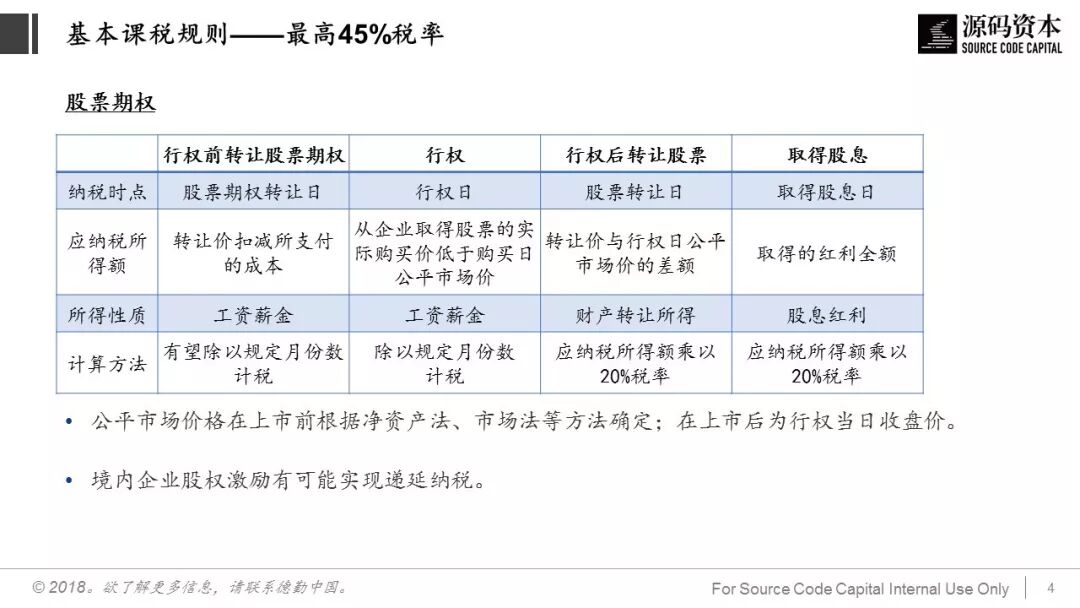
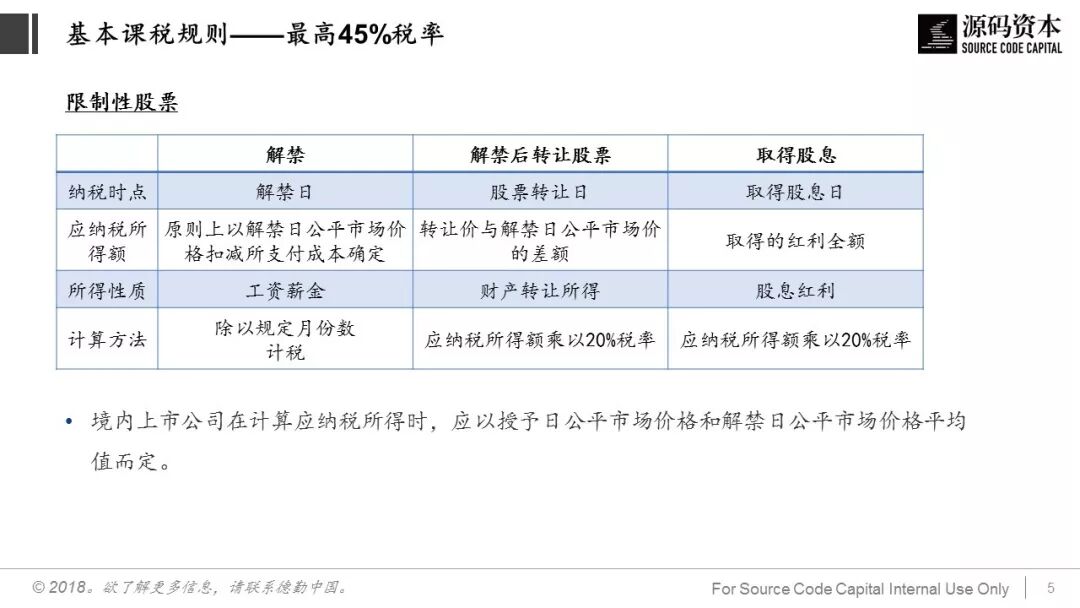
One point to raise here: both tables mention "when obtaining shares, how to calculate wage and salary income." Typically, this is based on the market price of the shares or stock at the time of acquisition, minus the actual cost paid.
For stock options, there is often a higher or lower exercise price; for restricted stock or restricted stock units, it is often a nominal price. After subtracting this price, the difference is wage and salary income, potentially subject to the maximum 45% tax rate.
Here, if it is a non-listed company, how is fair value measured? This is a particularly important point for tax purposes. According to current tax regulations, for non-listed companies, at the time of exercise or vesting, the so-called fair value should first be measured using the company's net asset price. The assumption is that non-listed companies do not have an active market, so the company's own financial data must be used to determine fair value.
I will share further with you later regarding tax planning ideas for non-listed companies.
2 Tax Planning Considerations for Offshore Structure (VIE) Equity Incentives
Before that, let us understand what changes are happening in domestic and international tax regulation at this point in time, also reminding everyone to pay attention to some tax compliance issues in the process of implementing equity incentives.
The first issue: many friends here are from red-chip structure companies, and a considerable portion of future income will be obtained from overseas. Capital gains or labor income obtained from overseas will be reported to Chinese tax authorities based on current international tax information exchange rules, and the scope of this reporting will become increasingly broad. Recently we have received more and more inquiries asking, "Assuming future regulation of overseas income taxation becomes stronger, how can one better plan income obtained from overseas?" Here we judge that income obtained by red-chip companies from overseas, as well as capital gains obtained by red-chip company employees from overseas, being subject to taxation in the future is an important trend.
Next, let us look at how to make declarations. This brings us to the domestic tax reform currently underway in China. This reform first consolidates all labor income together, taxing it at a comprehensive rate. Second, it requires individuals to make annual declarations, meaning I need to aggregate domestic and overseas income each year for a comprehensive declaration in order to enjoy certain cost deduction benefits. These are some recent changes in tax reform.
Under these two changes — strengthened information exchange abroad and individual income tax declaration reform domestically — compliant declaration and tax planning go hand in hand, making future tax compliance and reasonable tax planning important considerations.
Earlier we discussed the basic path for tax planning of overseas listed companies' equity incentives: when obtaining shares, the maximum 45% individual income tax rate applies; when selling shares in the future, the 20% capital gains tax rate applies. If one can obtain shares when the overall company value is lower, then individual income tax will be reduced. Of course, this process may face various issues, because equity incentives involve comprehensive planning, not just taxation. Obtaining shares earlier, on one hand, creates many legal registration issues; on the other hand, it also involves human resources impacts. Regarding these impacts, please refer to the previous two speakers' presentations.
- How to Achieve "Fairness, Value, and Participation" in Effective Equity Incentives? | ESOP Research
- Detailed Explanation of Domestic and Overseas Enterprise (VIE) Equity Incentive Legal Structure Models and Issues | ESOP Research
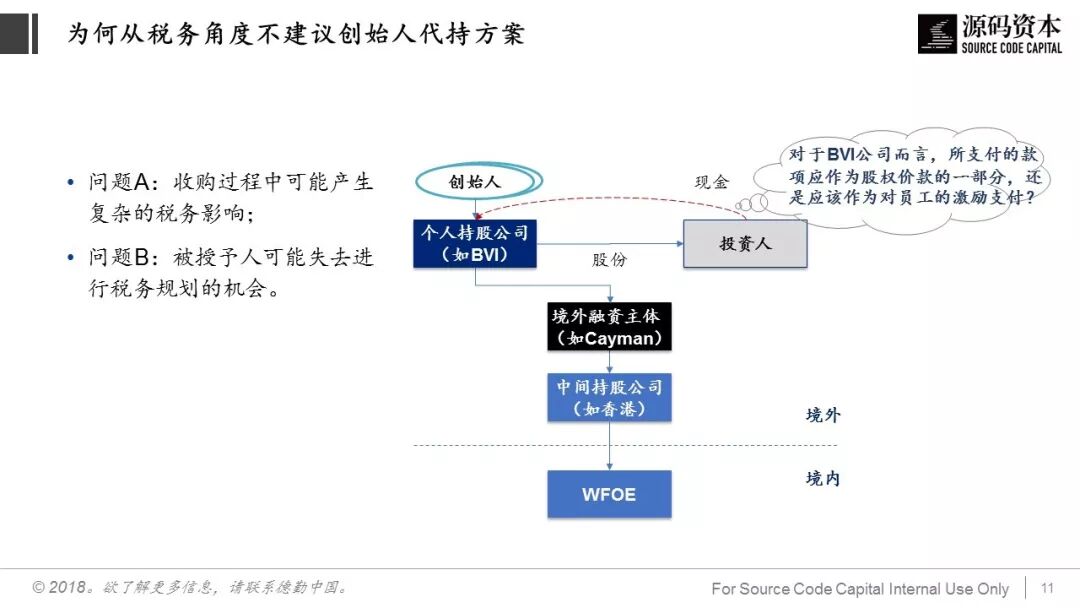
It needs to be emphasized that there are indeed some typical arrangements in the market where founders use a BVI company to hold shares in a Cayman company, but actually hold equity incentives on behalf of employees.
Such arrangements have many benefits from a legal perspective. However, we recently encountered a case where a company adopted such a scheme to hold shares in a Cayman company, and is now being acquired by a large tech company. During the acquisition process, the large tech company offered 20 million for this portion of shares, but the actual payment amount depends on the performance of these employees whose shares are held in trust, whether they are willing to exchange their incentives for the acquirer's incentives, and their years of service at the invested company, among other conditions.
Here a contradiction arises: is the payment of 20 million, or 15 million, meant for the employees or for the equity incentive holding platform? The BVI company's transfer of the Cayman company entity is subject to 10% Chinese withholding income tax, because the tax bureau will view it as the BVI company actually transferring a mainland Chinese company. Meanwhile, when this person obtains the income, they have no equity to sell, so they can only pay tax at the maximum 45% wage and salary rate. Thus an unfortunate outcome emerges: effectively 10% corporate income tax plus 45% individual income tax. To avoid such possible predicaments, we usually remind clients to use a relatively simple structure for equity incentives at the Cayman company level.
3 How Are Equity Incentive Expenses Accounted for in Financial Costs for Domestically Listed Companies?
Regarding domestic equity incentive arrangements versus offshore approaches, they are actually quite different. For overseas listed companies, capital markets do not pay much attention to share-based payment expenses, and there is no 200-person regulatory limit, so our equity incentive arrangements and holding forms can be more flexible. But domestically, it is different.
The most troublesome issue domestically is that the exercise price cannot be set too low. If there is a massive share-based payment expense, it could very well wipe out profits.
Second, apart from innovative enterprises not defined in Announcement No. 17, cross-listing equity incentive plans are currently not allowed. Equity incentive plans formulated before listing must be fully vested before listing, and cannot be delayed until after listing. Also, the number cannot exceed 200 people, and holding platforms are also viewed on a look-through basis. This is a major challenge for tech companies. Additionally, from a tax perspective, current rules are very unclear, and people still generally use holding platforms to plan equity incentives for domestically listed companies.
Regarding where we recommend establishing holding platforms, you may see various different voices in the market, with various places offering preferential policies for establishing holding platforms.
On this matter, we recommend that holding platforms be established in a place relatively close to the company headquarters and with a relatively developed economy, because you will need to handle many procedural issues such as partner registration, changes, and cancellations. If the local government has relatively high efficiency, these issues can be resolved more conveniently.
Second, the tax impact of holding platforms. The first question is: if I establish a holding platform, does the maximum 45% individual income tax disappear?
Theoretically speaking, no. Regardless of what platform is used to purchase cheap stock in a listed company (and this cheap stock is cheap because of the employee's position and work performed, possibly with additional performance conditions), such an arrangement would, I believe, be considered an equity incentive arrangement in accounting and legal terms, and must follow suit for tax purposes. That is to say, although the employee indeed obtains some income from it, even if it is indirect income from the holding platform, there should be a maximum 45% individual income tax obligation.
Second, since I have paid 45% individual income tax and generated wage and salary income. Assuming I paid one dollar and purchased this cheap stock in the listed-to-be company at a fair value of two dollars, when the partnership transfers equity in the listed-to-be company in the future, or transfers equity after listing, can the tax basis become two dollars? This issue requires specific communication with the local tax bureau.
Third, since 45% individual income tax has been paid and corresponding share-based payment income has been generated, can the company that incurred the corresponding expense deduct this for corporate income tax purposes, treating it as a cost expense to reduce the company's tax burden? This is also a matter we need to communicate with the tax bureau in charge of the invested enterprise.
From a financial perspective, for overseas listed companies, the share-based payment expense issue is not so severe. But for domestically listed companies, share-based payment expenses actually concern whether profitability standards can be met, making this issue critical.
How is this expense accrued? As a tax advisor overstepping my bounds, let me briefly share.
Generally speaking, our share-based payments, now that equity incentive arrangements are all calculated in equity, mean that accounting uses shares to exchange for someone's labor. I work for a company, the company gives me shares, I become a shareholder of the enterprise. When do we start accruing this expense? When the enterprise signs such a contract with me, we start accruing the share-based payment expense. When do we stop accruing this expense? When I actually obtain the shares, or when I am no longer subject to any employment conditions. That is to say, for options, accrual starts from the grant date until after the vesting period ends. As for when exercise turns one into a shareholder, that is原则上 no longer accounted for.
There is another issue here. Although the measurement method should use the fair value of enterprise shares minus the cost I should pay, the enterprise's fair value changes every year. If our company's value grows very rapidly, then every year we must recalculate the share-based payment expense.
So we need to consider how to reduce share-based payment expenses, particularly in cases where startup companies sign agreements with employees very early, but formally establish the equity incentive project relatively late, even only a few months before IPO. In such cases, from an accounting perspective, retroactively recording share-based payment expenses becomes relatively difficult, because there is no corresponding complete set of agreements. But if the equity incentive arrangement is determined earlier, allowing employees to enter the vesting and exercise periods sooner, this benefits our normal early recording of share-based payment expenses.
Simply put, fair value minus payment cost is the accounting expense for equity incentives. Fair value changes every year, so the annual expense amount also changes; the higher the fair value, the higher the expense. To reduce the scale of this expense, we may want to implement the equity incentive plan earlier, formally issue the plan to everyone, and enter the vesting state sooner — this is financially beneficial for the company.
That concludes today's sharing. I look forward to further communication with everyone. Thank you!

More ESOP Research

- How to Avoid the Pitfalls in "Equity Incentives"? | ESOP Research
- How to Achieve "Fairness, Value, and Participation" in Effective Equity Incentives? | ESOP Research
- Detailed Explanation of Domestic and Overseas Enterprise (VIE) Equity Incentive Legal Structure Models and Issues | ESOP Research

Source Code Capital
Creating Lasting Real Value

WeChat ID:
sourcecodecapital
More Professional Content
Follow our official WeChat