After Reading 100,000 Words of Sora Discussions, Here Are 6 Takeaways I Want to Share
"I used to not believe it was real. Now I don't believe it's fake."
💡
"Inspiration Weekly" is a column I'll update every week.
Here, I'll record five people or things that inspired me this week — to help me reflect, grow, expand my intellectual boundaries, and become freer and happier.
This week I spent the New Year in Sanya, while tech giants kept dropping bombshells. From Google releasing Gemini 1.5, to NVIDIA launching Chat With RTX, to OpenAI unveiling Sora — it was a total information explosion.
I celebrated the holiday with family, birdwatched at Jianfengling National Forest Park (27 new species added to my life list — absolutely ecstatic), and kept up with all the news. It was the most fulfilling Lunar New Year I've ever had.
This Week's Five in "Inspiration Weekly":
❶ On Sora — six points I want to share
❷ All of this adds up to your life
❸ When I asked AI to calculate my MBTI from my birth chart
❹ What's so great about birds?
❺ Happy New Year — may What You Want Will Come True
❶
On Sora — six points I want to share
"I used to not believe it was real. Now I don't believe it's fake."

Sora — the Japanese word for sky, meaning boundlessness.
At six in the morning on February 16th, I woke up groggy, grabbed my phone from the pillow, and saw a friend sharing news of OpenAI's Sora release. I clicked the official link, scrolled down, kept scrolling, kept scrolling. A few minutes later, I went from sleepy-eyed to sweating — deeply shaken by this soaring ambition and dazzling achievement.
While we were all obsessing over Jia Ling losing 100 pounds, something leaped across the Pacific.
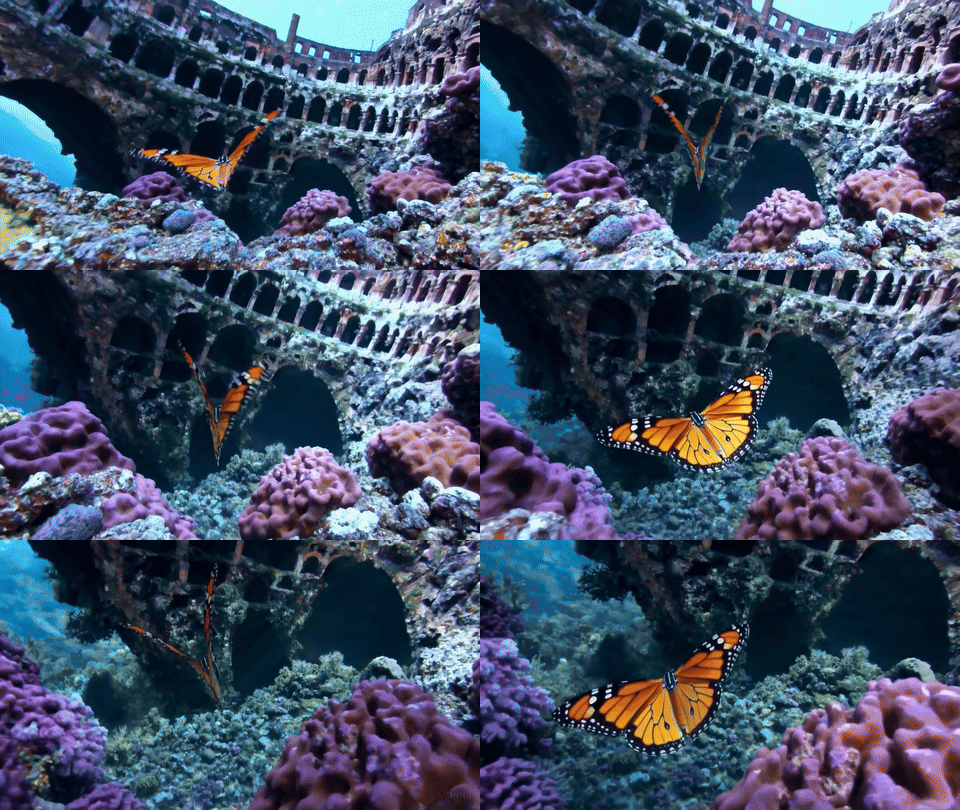
Sora is mind-expanding on video length, clarity, multi-shot consistency, and physical realism. For instance, Sora can reproduce an off-road vehicle on a mountain road, tilting, bumping, kicking up clouds of yellow sand:
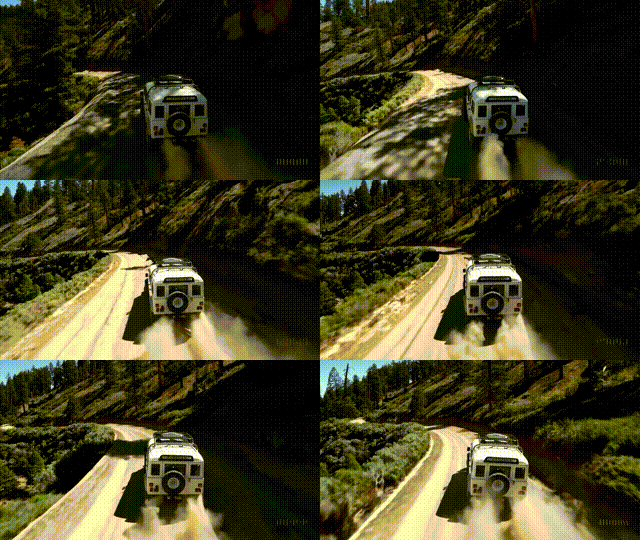
All GIFs in this article are from OpenAI's official website
Partial clips of videos generated by Sora
It can also generate a Dalmatian playing freely on a windowsill, leaping agilely, with sunlight casting accurate shadows:

"I used to not believe it was real. Now I don't believe it's fake."
The internet is already flooded with Sora content. If you want to learn about it, I recommend going straight to the official website (https://openai.com/sora), and secondarily recommend Run Li's article.
Over this period, I roughly estimate I've read 30 reports on Sora, hundreds of Jike/Twitter/Weibo posts, and countless group chat messages — at least 100,000 words in total. There's already ample discussion of Sora's business impact, technical details, and other aspects.
I want to add a few angles:
①
With Sora's release, making videos and writing articles may see their creative barriers converge to roughly the same height.
Video creation ability will become something everyone can possess.
What does this mean for the film and television industry?
On Weibo, Zuoyeben wrote:
Congratulations! The pathological era of film is finally beginning to die — what wonderful news for creators.
Dozens, hundreds, thousands of people forming a crew to shoot mostly meaningless things, then crying to get past censorship, crying to theaters for screening slots, crying to audiences to buy tickets... What a sickness.
If you have a film dream, you no longer need to pitch at festivals, show your script around, beg grandpas for financing, beg grandmas to act. With massive AI support, film can finally return to its origins. As master Kurosawa said: if you really want to make films, go write a screenplay — you only need paper and pen.
Today we can add: if you really want to make films, go write a screenplay — you only need paper and pen, leave the rest to AI.
The same goes for gaming and animation. The era where everyone is a product manager, everyone can be a director, has truly begun — what matters is creativity and script.
That day's arrival, in fact, began yesterday.
In an interview with director Chen Kun, Kuaidao Qingyi mentioned:
What traditional film role benefits most from AI video? Directors and post-production.
Because these two roles always hold the final complete work in their minds, not just the lighting or set dressing in one scene. With a clear vision, you can perfectly harness AI's power, knowing which shots need human actors and which can be AI-generated. This way, what used to take a year and tens of millions to make a film can now, with AI, be reduced to one-tenth the time and money.

②
Before AI with infinite stamina and superior intelligence, humanity's core competitive advantage in content creation may become: insight into human nature, construction of story, and judgment of beauty and taste.
Yet on all three points, AI will likely surpass us too. Following this logic, the remaining human advantage may be face-to-face public speaking and expression. I joked on Jike: Public Speaking and Eloquence may become a required course.
③
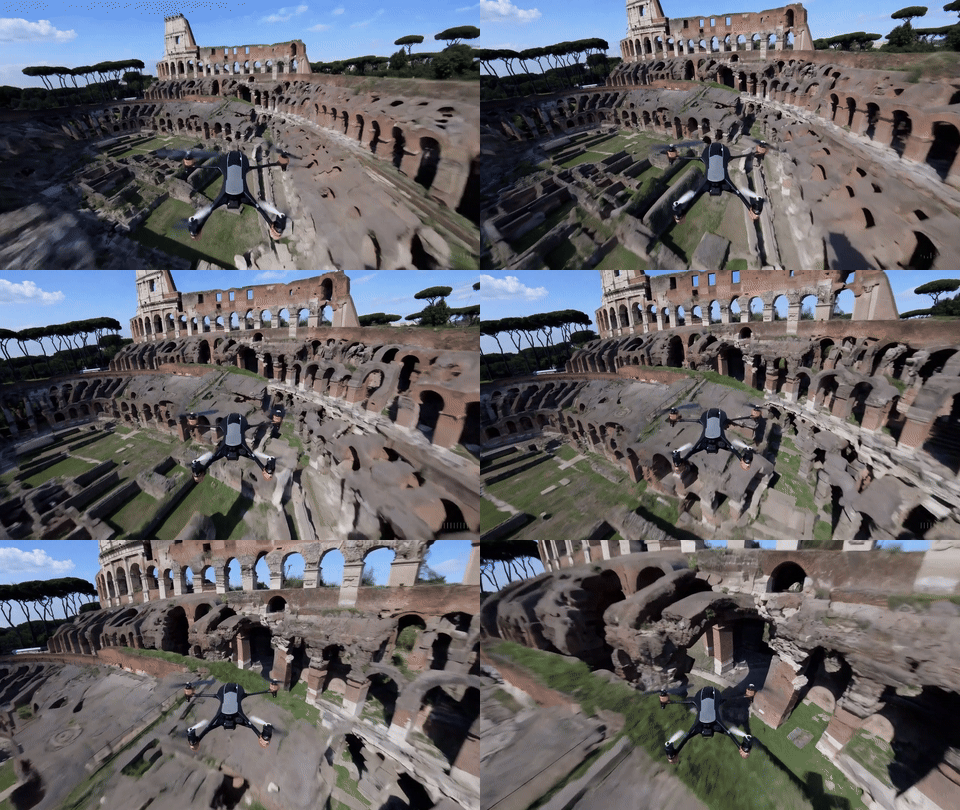
*Quoted from The Forge: Sora Development Timeline, Launch Prep, Technical Challenges: Further Details from X
OpenAI's grand mission to achieve AGI, with its exciting intermittent progress, has become the core motivation for many brilliant minds to join and actively participate in team work.
OpenAI seems to maintain a relatively pure pursuit — for example, letting Peebles, fresh from completing his doctorate, lead the Sora project.
Meanwhile, other追赶者 [chasers] in pursuing model intelligence more or less harbor other motivations: profitability, stock price, market share, internal politics, promotions and raises. Some team leaders may believe they can differentiate through product, commercialization, and other aspects, not just model intelligence. With more and more cases like Sora emerging, it may be time to reconsider large model strategy at the organizational or even national level.
Incidentally, another person capable of rallying brilliant minds to a grand mission is Elon Musk — he relies on a sufficient track record of admirable achievements.
④
Sora's arrival means on the supply side of video content, AI can begin infinite production — but the consumption side remains relatively fixed. People can't watch 100 more videos daily just because of AI; their eyes would give out.
This is already an oversupplied market. In the pre-AI classical content production era, people already made massive amounts of films and short videos, much of it ignored. Yuaaan said on Jike: "AI differs from naive content production in having 10x efficiency gains, but not 10x quality gains."
So how much economic value can Sora's productivity revolution actually create? The amount of video content people consume is constrained by limited time and attention — of the vast waters, we can only drink one ladle.
Of course, there's also substantial possibility that the economic potential Sora unlocks lies entirely outside the content consumption industry.
We should maintain our belief in not lightly mocking or dismissing new things, and hold optimistic expectations for it.
⑤
Therefore, facing Sora, my friend Mu Yikun's reminder is apt — we must keep Amara's Law and Bayes' Theorem in mind:
Amara's Law, proposed by futurist Roy Amara, states that people tend to overestimate the impact of technological change in the short term while underestimating it in the long term. This reminds us that when predicting future impacts of technology or trends, we should guard against shortsightedness and excessive optimism, while also recognizing possible profound long-term changes.
Bayes' Theorem is a principle in probability theory providing a method to update probability estimates of events based on new evidence. This means when we obtain new information, we should adjust our judgments about the likelihood of an event. Bayes' Theorem emphasizes the importance of continuously updating and revising predictions based on evidence.
⑥
Just as OpenAI CEO Sam Altman was already swaggering on Twitter that raising $7 trillion (7 Trillion, roughly 10% of global GDP) would be conservative, why not try $8 trillion — Yann LeCun was still reminding everyone that generative AI doesn't deserve such fanatical faith:
Let me clear a huge misunderstanding here. The generation of mostly realistic-looking videos from prompts does not indicate that a system understands the physical world. Generation is very different from causal prediction from a world model.
On the opposite side from Yann LeCun, Sam Altman is clearly a marketing master, stirringly telling the crowd-pleasing story: technology will soar, progress will be unlimited, gold rush opportunities are at hand, wealth will pile into mountains.
The atmosphere having been built to this point today, even those slightly skeptical of OpenAI's technical approach and generative AI as represented by it may choose to hide in the shadows, hoping for a global economic bubble, firmly believing they'll be the smart lucky ones who cash out before it bursts.
Thus, Yann LeCun's voice at this moment is lonely, powerless. People's attitude toward him gradually slides toward: "Maybe you're right, but what if you're wrong?"
Listen to both sides. Remember to remind yourself: when the whole world is making steel in backyard furnaces, don't let yourself become cannon fodder in the furnace.
❷
All of this adds up to your life
Casey Neistat and his 25 marathons
YouTube top creator Casey Neistat's latest work is "Sisyphus and the Impossible Dream," a story about life's meaning.
In 1997, while riding his motorcycle, Casey was hit by a car running a red light. His thigh was shattered, titanium implanted. Doctors warned him: never run again in his life.
This legend ignored medical advice. Not only did he decide to keep running, he set an "impossible dream" goal: finish a marathon in under 3 hours.
Over the following twenty-plus years, he ran 23 full marathons, at one point reaching 3:09 — tantalizingly close. As he passed 40, Sisyphus's dream seemed increasingly distant. I probably would've rounded up and called it good. But he didn't.
More "infuriatingly," at age 42, he ran 3:01 — truly one minute away, just a few breaths short. My god!
The result? He chose to continue. He registered again for the 2023 Tucson Marathon in Arizona. On his 25th marathon, he finally achieved 2:57.
This Sisyphus finally pushed the boulder over the mountaintop.

After hearing this story, do you find it hard to understand? Why persist? How to explain the meaning of this for life from a philosophical perspective? — I posed this question to ChatGPT, and it said:
From a philosophical perspective, the meaning of life is an ancient and profound question. On this question, there are many different viewpoints and theories. For Casey Neistat's story, we can think from an existentialist angle.
Existentialism emphasizes individual freedom and responsibility, as well as courage and determination when facing difficulties and challenges. In this framework, people are considered creators and deciders of their own lives — their actions and choices shape their own existence. Therefore, pursuing a seemingly impossible goal embodies the core ideas of existentialism.
For Casey Neistat, persisting in his marathon goal wasn't merely about the result itself, nor was it meaningless. Rather, it represented his attitude toward his own life and firm belief in free will, demonstrating his sense of responsibility for his own actions and choices, and his active shaping of his own life — embodying the deep meaning of life that existentialism advocates.
When I asked AI to calculate my MBTI from my birth chart
It got 3 out of 4 right
Before the new year, my podcast "Crossing" released a new episode.
Ronghui and I got a bit carried away chatting, and I'm slowly discovering the fun of recording podcasts:

Welcome to listen and subscribe to "Crossing," a podcast exploring technology and humanities. The name comes from Steve Jobs's words describing Apple as standing at the intersection of technology and liberal arts. Today, we focus on what changes the new generation of AI will bring, especially in consumer products, marketing, and content. Welcome to stand with us at the crossing of technology and humanities, and see what will happen here.
What's so great about birds?
The soul-crushing question
Every birder has been awkwardly confronted with: "What's so great about birds?" Birding is absolutely fun — otherwise why would we birders be so addicted? I've been trying to introspect what makes birding enjoyable, wanting to summarize the feelings and experiences clearly in writing.
Recently, Kemeng recommended a book to me: Better Living Through Birding, by Christian Cooper, a birder living in New York. He started birding as a teenager; he's 60 this year. He's also a Marvel writer, Black, gay, and a classic nerd.
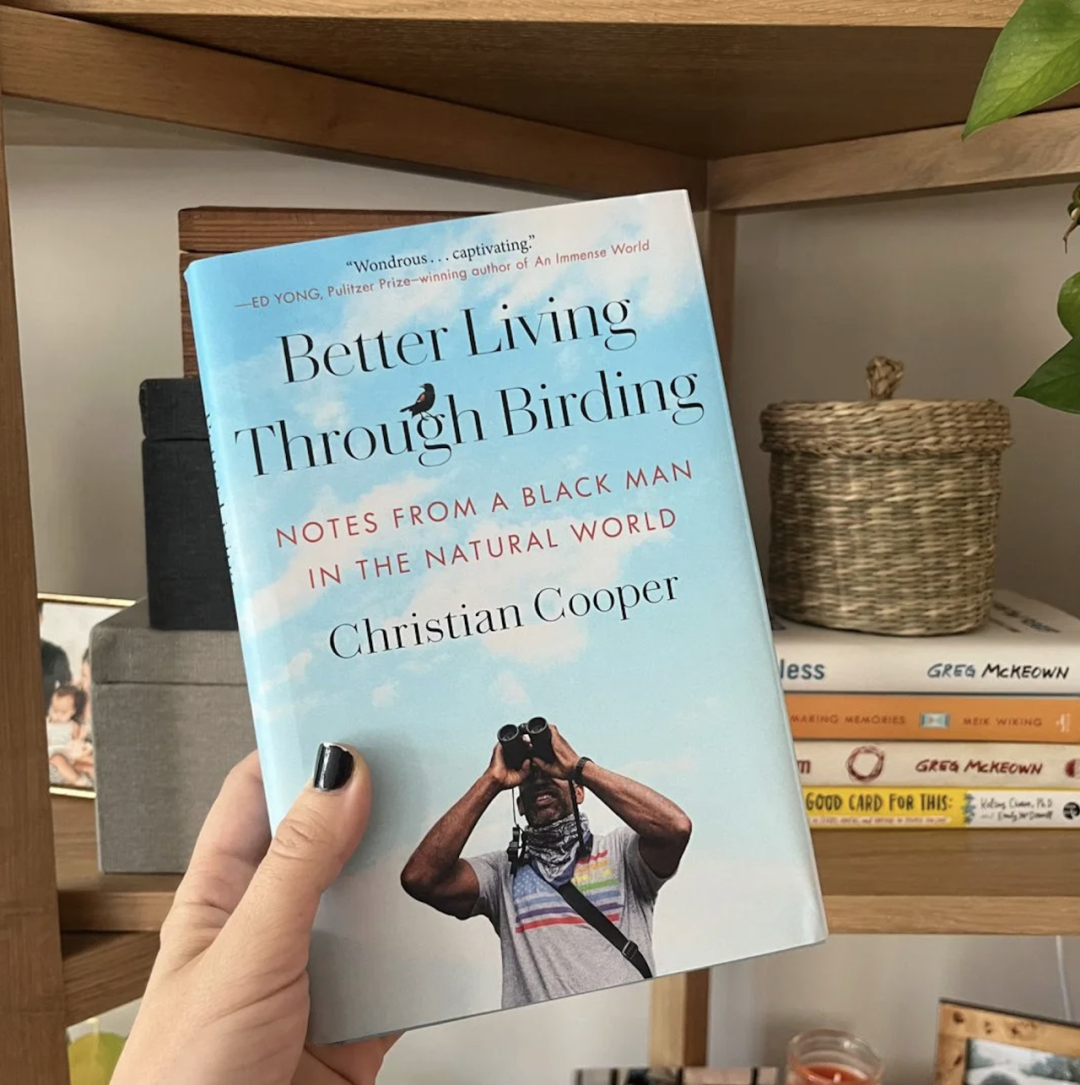
This book is first of all a great story — the author writes his birding anecdotes with wonderful prose. More importantly, he summarizes the joys of birding into seven points, which left me in awe. Each one resonated strongly with me:
- The Beauty of the Birds — birds are inherently beautiful
- The Joy of Being in a Natural Setting — immersion in nature's pleasure
- The Joy of Scientific Discovery — the pleasure of scientific exploration and curiosity
- The Joy of Collecting — the pleasure of collecting
- The Joy of Hunting, Without the Bloodshed — the pleasure of the hunt without the blood
- The Joy of Puzzle Solving — the pleasure of solving puzzles
- The Unicorn Effect — like seeing a legendary unicorn emerge from the forest toward you...
This book is currently only available in English, but after downloading the ebook, simply open it with the WeRead app — the automatic translation is excellent, with paragraph-by-paragraph Chinese-English comparison. An absolute joy to read. (Ah! Another day of praising the WeRead app.)
Reply "birding" in the official account backend to get the ebook.

Red-headed Trogon, photographed by me last week at Hainan's Jianfengling National Forest Park. The park's Mingfeng Valley boardwalk had fallen into disrepair, off-limits to tourists. But birders don't care about such restrictions — they push through barbed wire fences to get in. We walked the boardwalk for over two hours. Simply traversing the tropical rainforest lifted my spirits. When I was gasping for breath, energy completely spent, three Red-headed Trogons descended from the sky, landing on branches ahead, calling, looking around, hopping about as if no one else existed — made my day!
Happy New Year — may What You Want Will Come True
Sincerity makes it so
We like to reflect on the past year's experiences during the New Year, and set goals and wishes for the future. Making wishes can give us hope and motivation, believing the new year will bring good fortune, happiness, and success.
On the last day of 2022, I went to the Shanghai New Year's Eve concert by the Rainbow Chamber Singers, and heard this song What You Want Will Come True — absolutely overjoyed.
Of course, "what you want will come true" is obviously impossible. But it doesn't matter. Just listening to this song, we can get good auspices and good mood — that's enough.
💡
Recent "Inspiration Weekly" updates:
"The Catalyst" is Koji's personal newsletter. A catalyst is a fascinating thing — though tiny, it holds enormous energy, accelerating chemical reactions. I hope through sharing and writing to provide catalysts that inspire myself and others; I also hope catalysts can help me build more meaningful relationships and grow together.
Welcome to add me on WeChat: YuanchengYang
Or see you in Jike town: @koooji