Code Brain | Founders Need to Learn to Let Go

5 Common Mental Traps
#Code Brain
Ecosystem Connection, Cognitive Resonance
Entrepreneurship is an endless journey of self-discovery. Only through continuous personal growth can one drive organizational growth.
Founders and core executives of startups constantly face challenges on multiple fronts: product and service innovation, business model iteration, efficient team collaboration, organizational capability building... These demands require managers to possess extraordinary mental fortitude, intellectual capacity, and physical stamina. Beyond continuously attracting better talent, "turning inward and seeking within oneself" is an essential discipline.
This issue of Code Brain's "Practical Leadership" workshop series, session 3, specially invited Xu Yifeng, partner at Chief Organization Officer, who brings over 20 years of HR experience. Using the "Manager Mindset Model," he helps founders better perceive their role within their companies. This article focuses on five common mental traps for entrepreneurs, excerpted from Xu Yifeng's classroom session.
Article Preview
- Most entrepreneurs operate at the "self-authored" level
- Blind pursuit of consensus can bury good ideas
- Entrepreneurs shouldn't try to control everything; learn to embrace appropriate chaos
- 8 recommended books
Most Entrepreneurs Operate at the "Self-Authored" Level
The question of whether adults can change has long been debated. Tolstoy had a saying: "Everyone thinks of changing the world, but no one thinks of changing himself." So prepare yourselves mentally — first change your thinking and mental models, then translate that into behavioral change, which forms new habits and ultimately changes your life trajectory. This cycle takes a long time.
"Mental models" essentially constitute a person's worldview, outlook on life, and values — foundational thinking rooted deep within us. Changing them is extraordinarily difficult. But only when mental models transform can we achieve the goal of observing, thinking, feeling, and acting in fundamentally different ways.
The importance of this for personal development goes without saying. The reality is that people's mental levels vary tremendously, and different types of entrepreneurs occupy vastly different mental stages.
I'd like to recommend a book — Changing on the Job by renowned executive coach and organizational consultant Jennifer Garvey Berger. It's not an easy read. If you finish it once and still don't fully understand, that's actually good — it means you're expanding your cognitive boundaries.
This book is well-known in the field of adult development. It discusses how a person's self-complexity determines their room for growth, a rather abstract concept. What is self-complexity? It refers to the adaptive capacity to face highly complex environments, engage in multi-perspective thinking, and exercise highly abstract reasoning.
She proposes five levels of mental models (magical mind, self-sovereign, socialized, self-authored, self-transforming) and their characteristics.
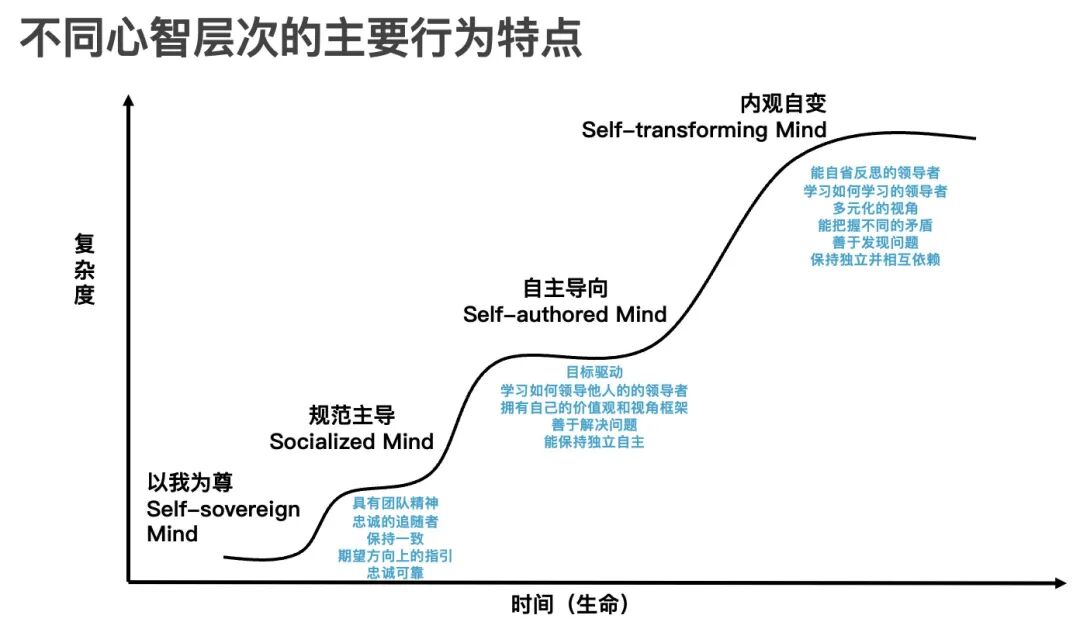
Image source: Speaker's presentation
This diagram intuitively shows how people at different mental stages exhibit different characteristics. These mental levels apply very aptly to entrepreneurs.
Some bosses appear to employees like the "emperors" of old — unpredictable, never knowing what mood they'll be in today, leaving subordinates trembling with anxiety. Whether their people are competent matters less than their loyalty. Such bosses generally hover between "magical mind" and "self-sovereign" levels.
Younger entrepreneurs typically belong at least to the next level up — socialized mind. They possess team spirit, loyal followers, alignment with company direction, and expect directional guidance... Though this mindset can also manifest as rigid rule-following, never crossing boundaries, and lack of innovation.
What does self-authored mean? A crucial characteristic is not believing something just because an authority said so — having one's own judgment and perspective, not parroting others; being goal-driven, learning to lead others, possessing one's own values and framing, skilled at problem-solving, maintaining independence and autonomy.
Entrepreneurs who reach the self-transforming level are relatively rare. Here's a simple test: someone who can articulate "the direction is roughly correct, the organization is full of vitality" and "grey management" is approaching this level.
Who said these two phrases? Zhengfei Ren. In business management, there should be grey between black and white — grey management matters greatly. Such people possess multiple perspectives, reflect and self-examine, maintain independence, and balance different contradictions. This is an extraordinarily high bar for anyone.
The MaHui entrepreneurs here today are positive thinkers, inclusive and open. I sense that the founders present operate at least at the fourth mental level — self-authored, with some possibly at the fifth — self-transforming.
This mental level map aims to help entrepreneurs understand where they currently stand and what stage they should cultivate toward.
Blind Pursuit of Consensus Can Bury Good Ideas
Many entrepreneurs want to change their mental models but often miss the mark. As I've emphasized, mental models comprise one's outlook on life, values, and worldview. Changing foundational thinking is extraordinarily difficult, and it's easy to go astray.
Jennifer Garvey Berger wrote another book called Unlocking Leadership Mindtraps. It's a slim volume, easier to read than Changing on the Job. I'll share her five mental traps with all entrepreneurs, along with some suggestions:
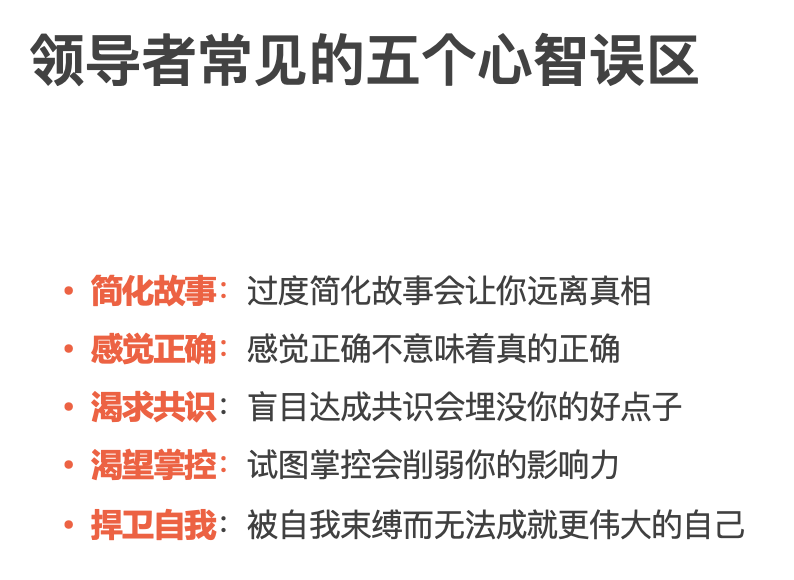
Image source: Speaker's presentation
First mental trap: People easily make judgments based on limited observation — is this person good or not? Consciously or unconsciously, we fill in gaps with imagination to construct a story, and the conclusion usually isn't favorable.
Psychological inertia leads us to reflexively think the worst and oversimplify matters. If you simplify the story, you risk writing someone off prematurely; in reality, they may not be who you think they are. The author offers a highly practical method: construct three different versions of the story, think more, communicate and understand the person better — avoid the simple story trap.
Second mental trap: Trapped by feeling right. We assume what we see is reality as it is, but actually, we see what we are. Everyone has cognitive limitations, everyone has unique mental models, and everyone believes that what they see is truth, is the world. It's not — you only see your world.
How to avoid misperception? The suggestion here is: question yourself, listen. Don't be overly certain of your views. Simply spending time hearing others' perspectives frees you from the feeling-right trap, because you'll discover that what feels right often isn't. It feels right because your mental model frames it that way, but reality differs. This is the second common problem entrepreneurs face.
Third mental trap: You want consensus, want everyone to think like you — actually difficult, and unnecessary. Blindly seeking consensus actually prevents generating more diverse good solutions. That said, we do emphasize that executive team consensus-building is necessary. But if the team has already engaged in sufficient deep dialogue on an issue, then after a decision is made (even without full consensus), execution should proceed — that's fine.
The key message of this mental trap: entrepreneurs face such rapidly changing internal and external environments that leaders shouldn't be too certain of so-called correct answers. Maintain a bit of openness, find possible third options.
For example, when we designed internal course products, I believed in Approach A, while other product managers preferred Approach B. Through discussion, we actually arrived at a better Solution C that integrated multiple perspectives. I shouldn't insist my idea was necessarily better than yours. So third options can break the team's tendency to pursue consensus for consensus's sake, while missing the possibility of producing a better solution.
Entrepreneurs Shouldn't Try to Control Everything; Learn to Embrace Appropriate Chaos
Fourth mental trap, closely related to the CEO role — the craving for control. Strong control isn't inherently wrong for entrepreneurs, but during the startup phase, when the company is building entirely new businesses and models and methods are still being explored, complete control is nearly impossible.
At this stage, entrepreneurs or leaders should consider whether some appropriate chaos might be acceptable. For example, with second-curve innovation businesses, new product experiments — can you maintain some openness and controlled chaos, using low-cost trials to gradually discover new directions and product ideas? Rather than drawing firm conclusions too early, could an open-ended, observe-as-you-go approach yield better results?
Of course, for mature business lines, monitoring metrics and strong control are appropriate. My suggestion: maintain flexibility for new things, try more different approaches, see more possibilities. Don't apply mature business management thinking to these new product and business experiments.
Fifth mental trap, and the last: defending the self. Don't keep thinking "this is just who I am, I can't change." Will you continuously evolve? How you think now doesn't mean you'll think the same way in three or five years.
Look at any accomplished entrepreneur globally — they're remarkably open people, constantly evolving themselves, never setting limits. Why do people love Elon Musk so much? Because they see infinite possibility in him; he never gives himself a fixed persona.
Consider: when you're constantly thinking about who you want to become next, looking inward more, your outlook on life, worldview, and values all shift with age and accumulated experience.
You're all still in early-stage entrepreneurship. If things go well, you'll grow bigger and better, products will reach the market, and looking back in five years, you'll be amazed at your subtle transformation. So don't say too early: "this is just who I am" — don't freeze yourself in place.
Stephen Covey in The 3rd Alternative mentions a concept: many people think about what they'll do after retirement. He says this thinking is wrong, because by retirement it's too late to think about this; and increasingly there won't be a retirement concept at all — at 60 you're still quite healthy, do you really think you should just rest? Or should you find your life's meaning earlier, lay the groundwork, so your work and life remain vibrant, with different vibrancy at different stages?
For the CEO, age isn't a real barrier to growth. Many great entrepreneurs work and learn until old age; their consciousness and thinking far surpass us younger entrepreneurs.
Think "begin with the end in mind" about problems and life meaning. Review and renew every three to five years. Don't imprison yourself too early, and don't dismiss this as abstract — it's intimately connected to your entrepreneurial and life quality.
Recommended Reading
- The Glory and the Dream: A History of the Chinese Communist Party — Jin Yinan
- The 7 Habits of Highly Effective People — Stephen Covey
- The Leadership Challenge — James Kouzes
- Humble Leadership — Edgar Schein
- Man's Search for Meaning — Viktor Frankl
- Working Backwards — Colin Bryar / Bill Carr
- Changing on the Job — Jennifer Garvey Berger
- Unlocking Leadership Mindtraps — Jennifer Garvey Berger

More Code Brain Content
Issue 18: Entrepreneurs' Time Management — "Two Must-Learns, Three Principles, Four Quadrants"
Issue 17: Your Core Startup Team Needs a "Deep Dialogue"
Issue 16: Three Keywords for Corporate Crisis Management from the 3·15 Perspective
Issue 15: The New Evolution of Insurtech
Issue 13: Financial Opportunities in Industrial Internet
Issue 12: Strategic Thinking on Douyin Marketing for Consumer Brands
Issue 11: Inclusive Finance Under the New Economic Landscape
Issue 10: Brand: Meaning, Symbol, Value