Financial Opportunities in Industrial Internet | Code Brain Issue 13

The industrial internet is entering its "golden age," bringing new opportunities for financial empowerment and entrepreneurship.
Code Brain
Issue 13

Code Brain is a key component of Source Code Capital's systematic, productized post-investment service system, and a flagship post-investment service product designed to help Ma Hui entrepreneurs upgrade their understanding. At every stage, we deeply empathize with and continuously explore entrepreneurs' needs, iterating on Code Brain in real time so that entrepreneurs at different stages receive sustained intellectual nourishment. Our goal is to make post-investment services that "actually help," creating unique value for founders.
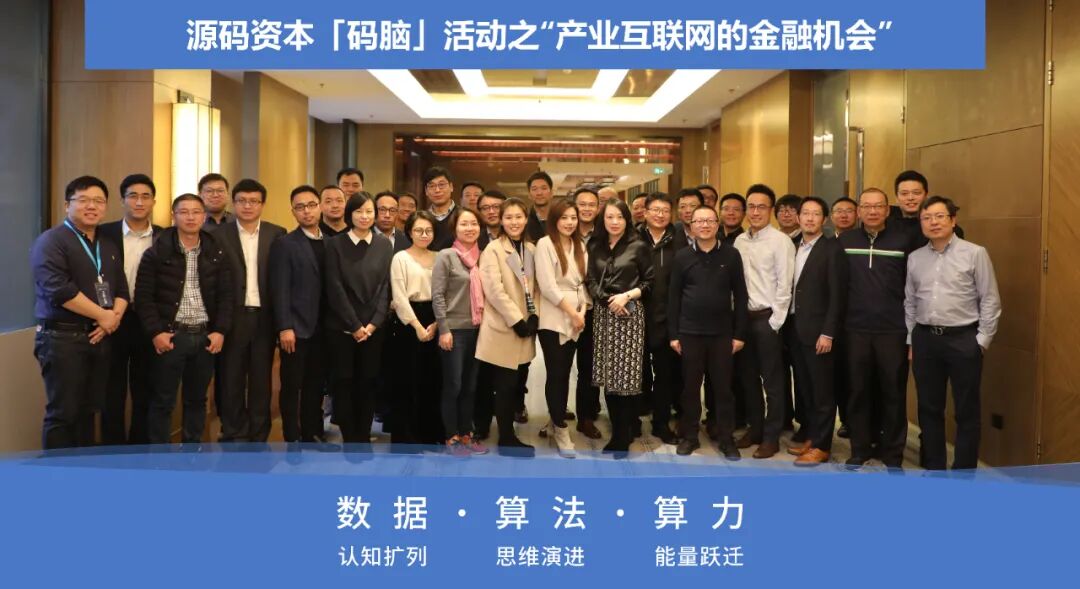
Group photo from Issue 13 of Code Brain
Industrial upgrading has ushered in a "golden age" for industrial internet. At the same time, slowing economic growth and "black swan" events like COVID-19 and trade wars have put considerable pressure on industry players. How to leverage "Internet Plus" advantages and solve industry development problems through financial empowerment, driving deep integration between traditional finance and industrial internet, is a direction that all relevant stakeholders are exploring and working toward.
Source Code Capital's post-investment service team invited leaders from industry associations, industrial internet companies, and financial institutions to engage in in-depth discussions around financial opportunities in industrial internet. We've excerpted and organized the key viewpoints below, hoping they provide some inspiration. (Content is organized by theme and speaking order; no ranking is implied.)
Industrial Internet Development Creates Opportunities for Financial Empowerment and Innovation
Xingshi Wang, Managing Director, Source Code Capital
B2B platforms have already demonstrated enormous impact across various industry chains. As platform transaction volumes continue to rise, their roles in logistics empowerment and informatization enhancement have gradually become more prominent. With the extension of upstream and downstream industry chains and growth in cash flow, B2B platforms' advantages in technology empowerment, operational capability, and inventory turnover rates have naturally opened up opportunities for financial innovation. The development of trading platforms like Alibaba and JD.com has all driven the growth of platform-based financial services, which in turn has further propelled platform transactions. I believe we'll see similar innovation in the industrial internet space.
Furthermore, the application of IoT and other data technologies has continuously improved leasing companies' downstream risk control capabilities in industrial internet, opening a new window for combining industrial internet advantages with financial innovation.
Industrial internet platforms that have already broken through the 10-billion-yuan transaction scale are still maintaining high growth rates, with significant incremental room ahead. The innovative combination of industrial internet and finance will also bring numerous investment opportunities.
Yan Qiang, Founder & CEO, Cijinrong
I've been working in B2B industrial financial services for many years. In the past, large B2B platforms mostly handled financial services themselves. But after years of development and market feedback, the industry has gradually come to understand that this area really needs to be left to the financial sector. I think the timing is right now. Although this business is relatively non-standardized and complex, micro and small enterprises are quite dispersed, and risks are relatively spread out. So I urge capital providers to join the industry as soon as possible.
Guan Zhenggang, Strategy Director, Baixin Bank
In 2017, the "B2B plus blockchain" theme was heavily hyped. Some institutions rushed in without even having basic industry chain data, giving the financial sector a lesson: without foundational online data, there's no way to talk about finance. So I believe industrial internet finance has a very strong sequence — industry must first develop itself, become internet-enabled and online, and only then can finance emerge. I think starting from this year, the second generation of B2B's spring has arrived.
Typical Cases of Financial Needs in Industrial Internet and Upstream/Downstream Industry Chains
Lin Rongzhen, Co-founder, Ruigu
Ruigu is a fairly typical B2B company. Our upstream factories have financing needs for investment and operating loans — these needs are relatively concentrated, with larger amounts, and they can provide relatively comprehensive information and documentation. Our downstream customers are more dispersed, numerous in quantity, and risks are relatively spread out; they need flexible and convenient financial services.
Li Chao, Deputy General Manager of Financial Business Division, Yijiupi
Yijiupi entered through the alcohol market, seizing the window when mobile internet penetrated alcohol distribution. We built the broadest-reaching, most efficient, and best-service fast-moving consumer goods supply chain warehousing and distribution network. Currently in the financial sector, we mainly provide financing services tailored to industry characteristics for FMCG distributors. We hope quality capital providers can join us in providing low-cost financial support to FMCG distributors, thereby reducing their financing costs. We also hope upstream capital providers can accelerate their online processes, moving away from in-person signatures as much as possible and simplifying related procedures.
Zhang Yan, VP of Supply Chain Finance, CassTime
CassTime is an auto parts trading platform company. In our industry chain, downstream vehicle repair shops need financing products covering interest-free periods, credit limits, and bill installment plans, while upstream suppliers need financial services to manage payment periods and accelerate turnover. So overall, we have needs on both the upstream and downstream ends. At the same time, CassTime's transaction data, cash flow data, and basic operational data on downstream repair shops' equipment and personnel can all serve as data sources for risk control.
Chen Zhonghao, Partner, Zhijing Technology (Baibu)
Baibu is an industrial internet platform for textiles. The upstream and downstream of the industry mostly consists of micro, small, and medium enterprises that are relatively dispersed, with few financing channels and difficult access to financing. Now Baibu is using IoT and other IoT technologies to digitally transform factories and enhance asset disposal capabilities across the industry chain, making orders, production, and operations information-based, digital, and online. This enables effective dynamic regulatory对接 with financial institutions, and we hope to cooperate with various financial institutions to promote the upgrading and development of the textile industry.
The Integrated Development of Industrial Internet and Finance Requires Both Industry Openness and Standardization, and Financial Innovation and Reform
Wu Jian, Partner, Source Code Capital
Many companies are now building data middle platforms and advancing data governance. The related data entry and learning costs are substantial. AI can help complete information entry, organization, and retrieval, assist operations, and support decision-making management. In the long run, such AI-assisted systems can free experts from tedious tasks while simultaneously completing the accumulation of data and knowledge. Enterprises providing such services will also gain commercial value while enhancing their data processing capabilities.
Shu Guang, President, Yunnan Trust
Judging the repayment willingness and repayment capacity of micro and small enterprises is a global challenge. Traditional banking financial institutions including trusts cannot judge the implied repayment capacity of enterprises from vertical industry chain data. Only by solving the repayment capacity judgment problem through data-driven approaches can financial institutions and investors participate in industrial internet finance through feasible methods (ABS or loans).
Yan Qiang, Founder & CEO, Cijinrong
Objectively, B2B platforms have needs for fast and convenient financing. But based on regulatory requirements, currently no capital providers are willing to cooperate in doing so. Financial institutions' control over business is based on credit subjects and terminal customer confirmation. So even though micro customers on the industry chain have dispersed needs and small amounts, if the platform acts as a guarantor, banks will attribute all risk assessment to the platform. This puts pressure on the platform on one hand, and on the other hand, banks may not necessarily accept this arrangement. At the same time, for micro customers with loan needs above 300,000 yuan, financial institutions still find it difficult to achieve fully online operations.
Peng Bin, Branch Manager of Technology Branch, Bank of Hangzhou
Industrial internet is one of our five major directions. Currently, we approach industrial internet with an investment-loan linkage logic. For Series A and B stage companies, we've engaged with many projects quite early, but service models for companies as they grow larger are still being explored. Currently, the information flow provided by B2B platforms and their degree of transaction control cannot solve banks' credit risk control problems. Many financing demand parties on industry chains also cannot meet banks' central customer requirement standards. How to properly connect information with bank settlement, forming account system support through real transaction settlement and cash flow operating in a semi-closed manner within the bank system to meet banks' risk management requirements, will be the integration point for industrial internet finance.
At the same time, banks objectively also have issues such as insufficient motivation due to currently good profit situations and internal interest allocation problems, which require relevant entities to seek breakthroughs through internal and external combinations.
Guan Zhenggang, Strategy Director, Baixin Bank
Using external data risk control to monitor enterprise operations has not been very effective. We currently下沉 the risk control strategies of industrial internet enterprises, also using some core management's personal data layered with enterprise data for judgment. This risk control model performs noticeably better than pure enterprise data models. At the same time, we must value the role of industry experts and enhance understanding of vertical industries.
In the future, in every vertical B2B industry, two to three leading industrial internet platforms will emerge. Industry standards will gradually improve, and industrial internet finance will be relatively easier to enter at that point.
Lin Rongzhen, Co-founder, Ruigu
Entering the second half of industrial internet, leading industrial internet platform enterprises have basically established complete warehousing and distribution systems, with complete platform data. Enterprises will determine the depth of their involvement in upstream and downstream transaction links based on cost-effectiveness ratios.
Huan Gongdi, VP, Bairong Yunchuang
B2B e-commerce platforms doing financial business need a cultivation process. No institution starts operations on day one with perfectly complete and beautiful data. So financial institutions need to cultivate and incubate industries, growing together with industrial platforms. Financial institutions not understanding industries, and industrial platforms not understanding financial institutions' demands, is a frequently encountered situation. The frequent communication of business standards and parameters between industry and finance involved in the cooperation process — as an intermediate technology partner, Bairong can coordinate both sides to establish solutions through data and risk control services.
Zhang Zhiyuan, Product Deputy Director, ZNLH
ZNLH is a B2B enterprise focused on construction machinery leasing. Based on big data and AIoT intelligent management, we use data to drive operations, building digital operational capabilities. Through client-side transaction onlineization and IoT platform-guided enterprise operations management, based on business operation scenarios and acquired industry, market, customer, project, transaction, and equipment big data, we further guide enterprise management of people, finances, and materials through intelligent algorithms.
Currently ZNLH uses customer payment effectiveness and timeliness data, layered with socially sourced customer data and enterprise-ZNLH cooperation data, to establish internal collaboration and risk control models, then provides different tiered business policies. As business rapidly expands, we're now接触 more and more industries. The improvement in data samples helps us better enhance enterprise health while improving customer satisfaction. The channels and scope for acquiring data will continue to expand going forward.
Solving the Separation of Asset Credit and Entity Credit Will Create New Industrial Internet Finance Opportunities
Xu Mengzhe, Managing Director, Qing'an Investment
China's ABS market currently finds it difficult to separate asset credit from entity credit. Many investors evaluate ABS within the same framework as credit bonds. The main reason for this phenomenon is the lack of relatively mature legal systems and asset service systems support, causing investors to not only focus on asset credit but also entity credit during investment, avoiding credit risk. Startup industrial internet enterprises should avoid diversifying into operations that make it difficult for investors to judge risks. Instead, they should specialize in a certain main business and achieve certain scale. When their business risks and returns are relatively clear, they will more easily gain investor recognition and more easily obtain financing through securitization.
He Liang, Financing Director, Edianzu
Edianzu is China's largest enterprise IT leasing service and management platform. Over the past two to three years, the debt capital source that has most supported our business has been financial leasing, followed by bank capital. As a startup-stage private technology company, there may be a ceiling on the growth of entity credit limits, making it difficult to match subsequent enterprise growth after reaching a certain development stage. Currently Edianzu has some new financial leasing explorations, such as solving the credit subject problem through separating leasing entities and asset management entities. At the same time, Edianzu is also attempting to issue ABS. Leasing asset repayments are stable and dispersed, meeting requirements for underlying assets, but still cannot escape the problem of entity credit ratings.
Shu Guang, President, Yunnan Trust
Traditional financial institutions have difficulties in solving credit subject separation and also lack deep understanding of industries. Trust companies are natural SPVs, capable of simultaneously handling asset management subjects and service decisions, thereby solving the problem of capital providers recognizing assets but not subjects. We are also improving our informatization levels and professional capabilities in this area.
Xu Ziyue, VP, Beike Financial Services
We're currently cooperating with trusts to build an SPV, essentially solving capital sources and tax issues through leasing revenue rights financing, while achieving isolation of revenue rights, assets, and capital. This is currently being explored.
Future Outlook for Industrial Internet Finance
Sun Ye, Director of Inclusive Finance Department, Bairong Yunchuang
Both finance and industry have a磨合 process. There's a concept of industry first, then finance. Industrial finance needs cultivation — understanding customer needs and transaction habits, customers' specific situations and repayment plans — before designing risk-controllable financial products. Collaborating with industrial internet platforms to build out the products, then doing internet finance business, is how to reach asset scenarios of several tens of billions or over 100 billion.
Li Hong, Chief Product Officer, Fumin Bank
Financial needs are not just credit business. For industrial internet, there also needs to be payment and settlement, account services, capital management, and complaints and other basic informatization services. It's comprehensive financial services, a set of online internet banking-based product solutions, comprehensively serving industrial internet and various financial service needs.
Huan Gongdi, VP, Bairong Yunchuang
We currently have roughly three logics. First, using personal data of industrial internet enterprises' legal persons, shareholders, and executives as risk control prerequisites. Second, building industry graphs, clarifying an enterprise's upstream and downstream data. Third, doing risk control based on stronger data like invoices, cash flows, and logistics, achieving capital-asset对接. This is our thinking for future industrial internet finance.
MIA, Head of Micro and Small Credit, Meituan Financial Services
We should view industrial internet finance opportunities from four levels: first, traffic and entry points; second, processes and experience; third, data and risk control; fourth, capital. Industrial internet finance should include levels and dimensions such as inclusive finance, micro and small finance, and industrial finance. The further forward in these four levels, the higher the standardization capability requirements; the further back, the stronger the vertical industry attributes become. 2C惯性 thinking is difficult to apply in 2B scenarios.

More Code Brain Content
Issue 12: Strategic Thinking on Douyin Marketing for Consumer Brands
Issue 11: Inclusive Finance Under the New Economic Landscape
Issue 10: Brand: Meaning, Symbol, Value
Issue 9: Stoking the Fundraising Fire
Issue 8: Mining India, Practical Experience Sharing
Issue 7: How to Design Mini Program Virality, Acquiring Users at Low Cost
Issue 6: How to Use Douyin for Customer Acquisition?