"Code Brain" "Standing Together Against COVID-19" Series Session Six: Cash Flow "Lifeline" Management Strategies in Crisis Moments

Speaker: Weibo Huang, CFO of Ziroom
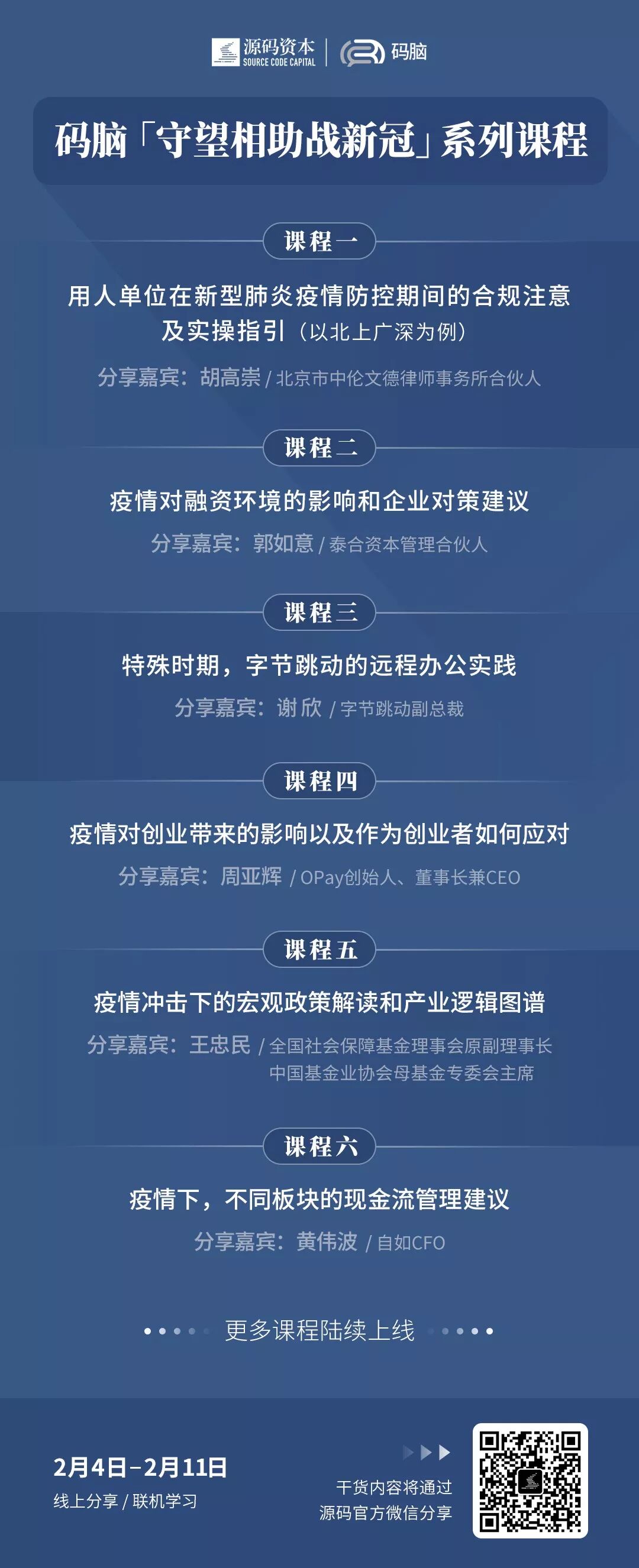
As the pandemic deepened, every sector of the national economy faced immense pressure. On one hand, healthcare systems and logistics supply chains urgently needed expanded capacity; on the other, online education and remote work became essential needs. Market demands and business models were quietly shifting — new opportunities were emerging from the crisis. To address this new landscape, Source Code Capital's post-investment services team designed the Code Brain "Standing Together Against COVID-19" webinar series. From February 3 to 11, we invited experts and industry leaders to share insights online on topics including employee leave and return-to-work policies, startup fundraising, remote collaboration, financial and cash flow management, and policy analysis — hoping to provide intellectual support to Ma Hui members from every angle, ease anxieties, and help everyone face these challenges together.
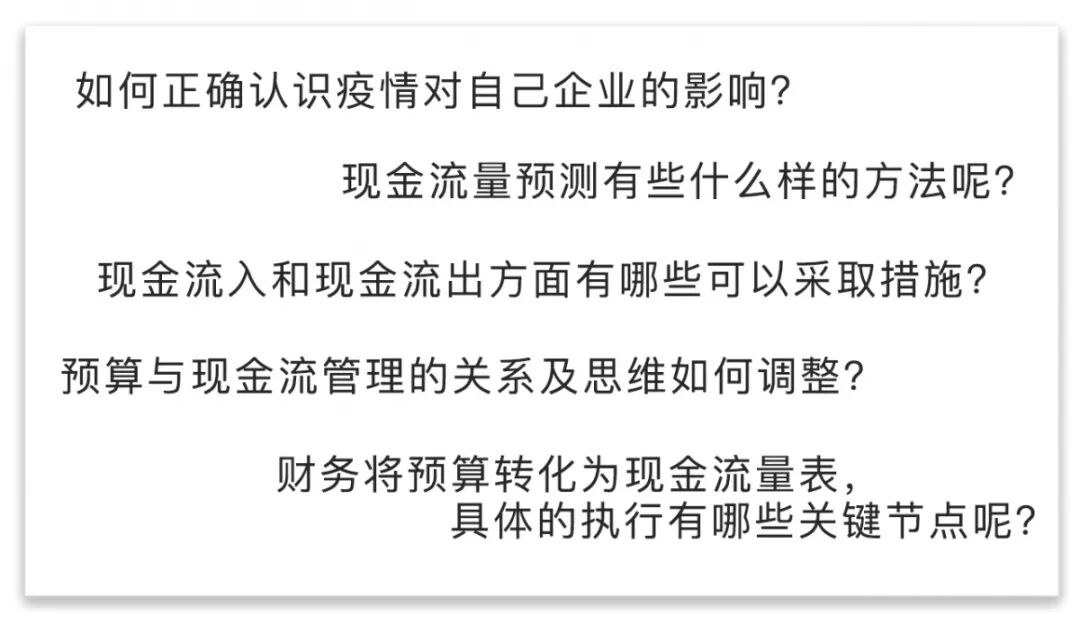
On the topic of financial cash flow management, Huang Weibo drew on his years of financial management experience to share his own framework for "cash flow lifeline management in emergency moments." Companies should take concrete measures across macro, meso, and micro levels to ensure cash flow security. In execution, he emphasized the importance of "meticulous planning, strong execution, and team alignment."


Huang joined Ziroom in 2017 as Chief Financial Officer, overseeing finance, legal affairs, strategic investment and financing, and risk control. He has nearly 20 years of experience in finance, consulting, investment and financing, and management. He previously served as Co-Director at Deloitte; Financial Management Advisor at the World Bank; Head of Finance and Legal at Douban and Kuaidi Dache; Head of DiDi's Financial Functions Center; and Executive President and CFO at eDaixi. Huang holds an MBA from Georgetown University and a bachelor's degree in economics from Sun Yat-sen University. He is a Certified Public Accountant in China, as well as a certified internal auditor and information systems auditor.

Looking back at SARS, some industries actually benefited from the outbreak. Study abroad services, for instance: with the job market tightening, more college graduates chose to pursue overseas education. Agencies handling applications, training, and essay consulting all saw gains — and this industry doesn't lack for cash, since clients pay upfront rather than generating accounts receivable. Online gaming was another beneficiary, as was e-commerce. So crises can have upside; it's not all negative.
In finance, we often talk about two lines: the Top Line and the Bottom Line — the first and last rows of the income statement, representing revenue and profit. Top Line typically indicates scale, tied to GMV, revenue, and transaction volume. Bottom Line reflects operational efficiency. But there's another crucial "line": the Blood Line, or cash flow. The direct reason a company fails isn't usually losses — it's cash flow, the Blood Line, the final straw that breaks the camel's back.
Today we'll discuss "cash flow lifeline management in emergency moments." The logic and framework for managing the Blood Line also applies to high-probability "gray rhino" events, or any emergency moment for a business.
I. Correctly Understanding the Pandemic's Impact on Your Business
First, as executives and founders, don't panic. The entire company is watching the core management team. I recommend that the leadership team respond calmly, specifically analyzing how external changes will affect your business. Is it a challenge or an opportunity? What kind of challenge? Avoid simply following the crowd. The core team should demonstrate a positive, proactive attitude to employees. My suggestions:
First, step outside the finance framework and prioritize safe operations. Under the pandemic, safe operations come first — covering your own employees' safety, supply chain partners' safety, and customers' safety. Every infected individual could trigger non-operating expenses in the millions or worse. There was news recently about an offline training institution that continued in-person classes during the outbreak and had its business license revoked. So please, first ensure safe operations.
Second, analyze how the pandemic affects your business model. This is more business-oriented — the impact on revenue, supply chain, and work methods. On revenue: will the pandemic change customers' ability to pay, their purchase channels, their purchase decisions? Correspondingly, companies need to rethink their business models and product design.
Most of you online companies are at Series B or C, in the 1-to-100 growth phase. But under this pandemic, I suggest revisiting 0-to-1 thinking across revenue, supply chain, and other dimensions to see if product design and business models need adjustment. For example, theoretically the apartment rental industry should be heavily impacted. As a leading player, we launched VR-enabled apartment viewing, zero-contact online contract signing, and whole-apartment rentals. This is where prior investment and accumulation in technology pays off at critical moments. Since every industry differs greatly, I'll leave this challenge for each entrepreneur to work through. You can think alone, brainstorm with your core team via phone call, or discuss with investors and fellow founders. Ultimately, I recommend documenting your thinking in writing. This work won't be wasted — especially in emergency moments, written records can continually remind you of short-term and long-term priorities. Whether this pandemic lasts short or long, pull out your notes in three months and they'll still remind you what to do over the next one to two years.
II. Cash Flow Strategies at Macro, Meso, and Micro Levels
Based on proper analysis of the pandemic's impact on your business, and understanding the challenges, you need to respond actively. We'll break this down by macro, meso, and micro perspectives.
Macro: External Funding Access
Macro refers to changes the pandemic brings to society, the nation, even international relations — and how these affect your business and response strategy. I'll focus on two points, both related to cash inflow.
First, impact on equity financing and valuation. At the macro level, the pandemic will likely affect 2020 growth forecasts for businesses, and possibly investors' long-term growth predictions for China. These seemingly simple forecasts have far-reaching implications. They will depress core parameters in valuation models, such as projected 2020 revenue, EBITDA, and profit. Meanwhile, reduced long-term economic forecasts — particularly among dollar funds and international investors — will affect terminal value: the discounted enterprise value five to ten years out, which constitutes a significant portion of valuation for many companies. My advice to the vast majority of entrepreneurs: don't fixate on valuation, secure financing cash as quickly as possible, unless your self-sustaining capability is very strong. Also, be mentally prepared and have contingency plans: fundraising will be harder, especially equity financing in the first half of this year.
Second, impact on debt financing. Currently, bank lending to the real economy is relatively loose, continuing the previous direction of supporting SMEs and private enterprises, now compounded by pandemic effects. My advice: if your industry is among the encouraged categories, your scale is decent, and you have historical profitability, have your finance team contact banks immediately to explore this path. This route doesn't suit early-stage startups.
Meso: Industry Policy and Operating Strategy Adjustments
Meso refers to industry-level changes — how the pandemic affects your specific sector. For most industries, competitive dynamics will shift, accelerating the transition from粗放 scale-driven growth to精细化 growth focused on operations and efficiency. What can we do?
First, huddle for warmth and push for better industry policies. Nearly every industry has associations that can voice demands through government departments — this moment is also an opportunity. We're already seeing policies emerge; you can advocate from your industry's position, especially if you're so early that industry policies don't even exist yet. Key policies to watch: fiscal subsidies, tax policies, labor regulations, and industry-wide standardization. On labor, for example, social security payment deferrals have already been announced. Current relevant policies mainly buy time; a relatively concrete benefit is state-owned enterprises waiving rent for some private companies. For early-stage companies, this may also be a good time to push for industry policy implementation.
Second, promptly adjust your own operating strategy: pricing, subsidies, and customer acquisition. These three strategies burn cash for most startups and need timely adjustment. This outbreak hit right during Spring Festival, when many companies had already set their strategies — especially the more tech-enabled, automated ones. Because once subsidies are programmed into the system, they go out automatically; timely review and adjustment is needed.
Micro: Your Own Company's Response
Micro refers to your own company's response. The macro and meso adjustments require considerable time and depend on third-party government agencies, financial institutions, investors, and partners — implementation may not be fast. At the micro level, it's your own business, and strictly speaking, decisions and execution can happen faster. This is the focus of our discussion today. From a finance professional's perspective, how to assist the company, the founder, and the management team to use financial methods to survive cash flow challenges — this is our focus.
I. Logical Framework
Where to start? Several organizing logics:
1. From a financial perspective, start with the cash flow statement + income statement, rank by expenditure size, focus on large cash outflows and inflows, prioritize the big over the small. Cash flow statement + income statement — the core concern is cash flow, not profit/loss. If you don't have a cash flow statement, start from the income statement, combine with business data, and adjust to derive cash flow impact, ranked by importance.
2. Organize by business segment. This is also how many founders think. Take ride-hailing, for example: you can break it into taxis, premium cars, express cars, designated driving, and so on — each segment operates on different logic. Some segments generate their own cash flow; others require subsidies. In the short term, you might consider sacrificing growth in certain segments.
3. Organize by cost type. Generally, there are variable costs, fixed costs, and sticky costs (mixed costs) — the in-between category. The most typical example is labor cost, which sits between fixed and variable. Looking at costs by type is really about speed of execution. Many expenses can change quickly, and losses can be stopped quickly.
II. The Relationship Between Budgeting and Cash Flow Management, and Mindset Adjustments
In day-to-day operations, business leaders and management teams understand budgets better than cash flow management. Let's discuss how they relate and how to adjust. Many companies build their budgets around the income statement, but the budget doesn't necessarily produce a projected balance sheet. How do you convert it to a cash flow statement? We'll start with three major categories, covering the key line-item transitions, then summarize the methodology.
1. Costs and payables. The income statement follows accrual accounting. A cost may have been incurred but not yet paid, creating accounts payable. For example: a supplier delivered goods before the January holiday, or ran a 1 million RMB ad for us. The income statement records the 1 million RMB payable and recognizes the expense. But the cash hasn't left yet — that's a cash flow adjustment. Now you can track accounts payable aging and turnover cycles: how much is currently payable, when is it due, and can you negotiate to pay later? The same applies to wages payable. As I mentioned earlier, even top-tier star companies that look glamorous from the outside — the so-called super-unicorns — went through painful, difficult periods behind the scenes, possibly negotiating wage payment schedules with employees. At the macro level, the government currently allows delayed payment of social insurance and housing fund contributions, plus tax deferrals. So there's a time lag between payables and costs. Normally, metrics like days payable outstanding don't get much attention. Now they should.
2. Revenue and receivables. Many transactions are credit sales. A lot of recognized revenue, especially historically recognized revenue, hasn't been collected in cash. You need to examine how cash is collected. In crisis moments, some companies take specific measures. Cash discounts, for example: say we're an advertising agency that ran a 1 million RMB ad for you before the holiday. Theoretically, payment isn't due until March, but we're short on cash now. A typical financial tool is the cash discount. After running the numbers, you proactively approach the client: if you pay just one month early, we'll give you a 2% or 1% discount. Annualized, that 1% discount is only around 10% — can we use that ~10% annualized return to get that 1 million RMB now? That's the receivables angle.
Bad debt metrics. There are special metrics that finance staff don't normally track but need to now: bad debts. Depending on how long the pandemic lasts, bad debts may emerge — be especially careful. Operationally strong companies can use their systems daily to find the ratio and amount of unpaid versus paid receivables. Tracking changes in these ratios is something finance staff should monitor daily, much like tracking pandemic statistics — how many recovered, how many confirmed. Same for bad debts: how many defaulted, what's the total amount, and especially the trend.
3. Inventory and fixed assets. How do you flex cash flow around inventory and fixed assets? Previously, inventory management required safety stock. How do you think about safety stock now? There's certainly a lot of idle inventory sitting around, which not only ties up inventory capital but also incurs carrying costs. Production plans and inventory strategies need timely adjustment.
Those were the key line items. Finance professionals know the cash flow statement can be prepared using the direct or indirect method — both can be used here. Converting from income statement to cash flow statement: revenue, costs, receivables, and payables can use the indirect method; expenses can use more of the direct method — essentially a hybrid approach.
For the actual operational adjustment between budget and cash flow management, you can do this: left column is the income statement (your budget), right column is the cash flow statement, and further right are the adjustment items. So column one plus or minus all columns to the right equals column two. Each of those right-hand columns represents an action item — one column for bad debts, one for supplier payable aging, each column is something to address — and this gets you to the cash flow statement. Every middle column can be acted upon. That's the full methodology.
III. Discussion of Major Cash Inflow and Outflow Items
At the micro level, let's examine specific key items and accounts. We discussed financing at the macro level — financing includes equity and debt. We also touched on revenue earlier, including bad debt management. So financing plus revenue are indispensable for cash inflows. You also need to watch revenue closely: which business segments deserve heavy investment, which don't, and adjust accordingly. These are cash inflows.
Cash outflow examples: First, marketing and sales. Based on experience — whether 2008, the subprime crisis, or 2003 SARS — the fastest corporate response was often cutting marketing and advertising, stopping subsidies, ending consulting engagements. Currently, advertisers are offering several arrangements: one is extension; for example, January ad spend gets rolled into February at no extra charge, no discount — essentially bonus volume. Second is deferral; for advertisers, if you had February spend planned, since no one's riding the subway, that subway ad gets rescheduled between March and December. There's actually a third option that advertisers won't propose: you simply cancel February yourself. This is hard for marketing teams to self-revolutionize, difficult to do proactively. It's more likely to come from management — the founder, CEO, or CFO — because March-to-December volume will only be lower than originally planned, not higher, so there's no need to add more February spend on top. Consider canceling February and reducing March-to-December volume. For scale-expansion companies, this is a massive expense line.
Second, analyze personnel costs; personnel cost is essentially headcount times compensation level. Companies under less pressure should adjust 2020 personnel budgets — instead of hiring 1,000 people, maybe hire 800. Under more pressure, hire zero; if someone leaves, replace them, or even don't replace them. Under still more pressure, take optimization measures. Optimize underperforming groups first, pay severance of N+1 where required. Under maximum pressure, even retained core teams might take half salary. At the same time, there are compensatory measures — equity, options, long-term incentives — to match. The most common problem with headcount spending is that people don't accurately gauge their own stage and difficulties, typically doing multiple rounds of optimization rather than one decisive cut. That's the most common mistake.
Third, consider compensation structure adjustments. Currently, many companies have compensation structures with relatively high fixed-pay ratios. Strictly speaking, this structure is unfavorable for incentivizing more pay for more work and for risk resilience. Look at what percentage of personnel costs are fixed versus variable. There's also the question of pay increases — whether this year's budget calls for 5% or 10% raises, including last year's year-end bonuses not yet paid — all of this can be reviewed and adjusted. Deferred social insurance and housing fund payments: this tool is available to everyone, as soon as a city announces it, payments get pushed back two months. These are personnel costs — sticky costs, mixed costs. The deeper the crisis, the more they can be treated as variable costs.
Finally, rental costs. Rent is heavy for some industries, especially supermarkets and cinemas. Strictly speaking, rent is a fixed cost — contracts are signed for one to five years. Current policies include state-owned landlords offering reductions, and some commercial properties beginning to act. Some subsidies come from the state, some from enterprises. At the macro level, the government won't do large-scale reductions, and may even discourage them, or financial risks become unmanageable.
These are response strategies at macro, mid, and micro levels. The micro level tests finance staff most — how to convert budgets into cash flow statements, analyze major accounts, and provide management recommendations to the CEO and segment leaders.
III. Key Considerations:
Detailed Planning, Strong Execution, Team Alignment
First, detailed planning. Every company is complex, with different segments and business lines. You can strategize by city — avoid one-size-fits-all approaches, which lead to panic. Break down your business and geography, break down your customer segments, and plan for each block rather than cutting uniformly. This can significantly reduce cash outflows and significantly increase cash inflows.
Second, mandatory execution. Under all these plans, execute faster and stronger.
Third, team alignment. This mainly means alignment between founders and shareholders, with the core management team, with the remaining team, and even with departing employees.
In summary, crisis contains opportunity within danger. After surviving this crisis, the last one standing wins — whoever persists to the end is the victor. At the same time, having gone through this crisis, everyone's business model will be healthier. The so-called "To VC" or "To bank" models are unsustainable. Including how we think about going from zero to one, and how finance's role is further strengthened in corporate management — this may produce more robust business models, leaner core teams more aligned with company objectives.

Question 1: What are the criteria for cutting projects?
Huang Weibo: First, your own assessment of the macro environment and its impact on the company. Whether you judge this pandemic to last one month, two months, or longer will affect project decisions. Short-term project decisions look at cash flow impact; long-term decisions look at profitability over the project lifecycle.
Suppose you judge the pandemic to be two months. Can the company survive two months? If not, cut whatever spends the most money, regardless of how profitable it might be later. In financing terms, you should have at least 9 to 12 months of cash reserves — that's the short-term judgment.
Long-term judgment is total profit over the project lifecycle, theoretically discounted — project approvals mostly use IRR or NPV. If two projects cost the same in the short term, then the long-term judgment is: cut whichever has lower returns.
Question 2: For sales-oriented companies with no sales performance during the pandemic, how do you reduce costs and losses while maintaining confidence?
Huang Weibo: Typically, sales-driven companies like insurance agencies and advertising agencies have specially designed compensation structures. First, look at your sales team's fixed-to-variable pay ratio and whether to adjust the compensation structure. Second, all the personnel recommendations mentioned earlier apply: headcount, compensation structure, deferred social insurance payments — all valid. The core is controlling headcount and controlling each individual's compensation structure. Other items are generally smaller but worth examining: travel expenses, office space costs.
Question 3: How should legal issues during workforce reduction be handled?
Huang Weibo: Legal matters were covered by lawyer specialists in earlier sessions. The principle is simple: don't break the law. When we talk about keeping the team united, we mean negotiating in good faith — both employees and founders can reach agreements. Beyond the law, there are regulations and moral obligations. Large corporations can afford to follow every rule to the letter; startups are fighting to survive. Of course, you first need to know what the by-the-book approach would cost. Calculate the expected expenses and see if they're within the company's means. If not, how do you negotiate? Gaining employees' recognition and understanding is crucial. On the battlefield, when a scholar meets a soldier, the scholar usually loses when it matters most.
Question 4: When finance converts budgets into cash flow statements, what are the key milestones in the execution path?
Huang Weibo: In moving from budget to cash flow statement, I suggest first looking at the indirect method for preparing cash flow statements. The indirect method goes from the income statement and balance sheet to the cash flow statement. Since most teams don't have a budgeted balance sheet, you can pull out the core items — accounts receivable, strategic cycles, bad debt rates — and adjust those. Focus on the big picture, the core items, and major clients. For expense categories, use the direct method; some line items you can get directly from business teams, like vendor payments with invoices received.
The process of preparing a cash flow statement under the indirect method matters more than the result itself. The preparation is your thinking process — you'll see what measures you can take to improve cash flow. Like the bad debt example: how exactly do you manage bad debts? How do you manage inventory turnover? If you're already overstocked and don't expect to sell it in the next 12 months, or can't sell that much, production planning needs immediate adjustment, and supply chain needs to adjust procurement plans accordingly.
For the example I just gave, there are two formats: one puts budget in the first column, cash flow in the second, and various adjustments in the third. The other puts the income statement first, adjustments in the middle, and the cash flow statement last, with each column showing major adjustment items — minor ones can be omitted. If inventory is small, just tens of thousands, it's not material; you can adjust or not. Keep everyone's focus on what matters most.
Question 5: From a cash flow perspective, how should companies evaluate whether to launch new projects during this period? For instance, if new opportunities emerge, should you pursue them, knowing that doing so requires investment?
Huang Weibo: Based on your assessment of macro and mid-level impacts, and your company's own strength. If the company is well-funded, with enough cash for two or three years, that's advantageous. Many peers are selling assets, and business opportunities you've long wanted might suddenly become available at bargain prices. But for most companies without ample capital, this isn't the time for new business — deepen your existing business instead. New ventures have low success rates, unless the success rate is high and the new business can sustain your core operations without collapsing.
At the micro level, you can also incorporate cash flow assessments into project approval. How much will the new project cost? When will it reach cash flow breakeven? If it's two or three months, and funds remain ample then, and this is something the founder strongly wants to do that's also strategically important — it can be done. But all decisions must be made through careful planning and calculation. If it's a fuzzy decision, strictly speaking, don't do it if you can avoid it.
Question 6: When managing accounts receivable becomes difficult, and clients are facing their own cash flow problems during this period, how do you balance the relationship with them?
Huang Weibo: I just offered a tool called cash discounts, which applies to many companies. Consider: your client needs to pay ten people, not one. Who do they pay? Think about why they'd pay you — because you offered a cash discount. Say they owe ten clients 100 each, that's 1,000 total. You offer a 2% discount, so they pay you 98 instead. If the client only has 100 on hand, they'll definitely pay that one. So strengthen communication, understand their difficulties and actual situation. Otherwise, you won't know the client is gone while your books still show 1 million in receivables, and you're counting on that million for next month's payroll — that's the worst management.
My suggestions: first, close communication to understand their actual situation. Second, see what measures and actions are possible under that communication — the cash discount example I just gave. Third, don't overthink their problems; focus on yours. Clients have their own solutions. What you can do is collect payment. In the current debt crisis, clients will delay whenever possible — that's normal. Conversely, you might slightly extend payment terms with suppliers. This goes both ways.
Question 7: What methods exist for cash flow forecasting? Since there's uncertainty that's hard to predict, how do you control the impact of that uncertainty?
Huang Weibo: In practice, most people do income statement forecasts. The method I just described converts the income statement's major items into a cash flow statement. I suggest having your analysis team, finance team, and budgeting team prepare one cash flow statement; separately, your business team and treasury team can also derive a direct-method cash flow statement. Both approaches work. Business teams may not fully understand budgeting and forecasting logic, but they can estimate needed funds. For example, the procurement team knows how much they need to spend on materials each month. You can use both methods and cross-check them. From a finance perspective, the first approach is relatively more accurate and complete, since all assumptions in the budget have been vetted. As the pandemic evolves, the income statement itself needs adjustment — revenue, costs, growth plans all need revision. First adjust the income statement, second derive the cash flow statement, then do cash flow planning.
Question 8: For B2B companies, which are heavily affected by upstream manufacturing — logistics and manufacturing costs rise, efficiency drops — how do you respond to the same predicament? Can these costs be passed to consumers?
Huang Weibo: B2B companies like this fit the second macro point I mentioned earlier: debt financing criteria. Theoretically, B2B companies have relatively large transaction volumes and higher revenues, and most B2B companies have positive gross margins — some may even have positive net margins — making them eligible for bank loans. B2B companies also tend to have heavy physical assets upstream, which is exactly what banks prefer as collateral. For B2B companies throughout the supply chain facing tight capital, you can bring in external cash flow to ease the strain — go to banks. B2B companies and their supply chain partners can inject liquidity through bank financial products, including credit loans, mortgage loans, bills, and supply chain finance.
Comments & Discussion
We welcome founders to engage with us in the comments section. Leave your questions and concerns, and we'll select representative ones for Mr. Huang Weibo to answer in follow-up sessions.

Code Brain "Standing Together Against COVID-19" Series
"Macro Policy Interpretation and Industrial Logic Mapping Under Pandemic Impact"

"Reverse Thinking: Entrepreneurs Should View the Pandemic From a Different Angle"

"Pandemic Impact on the Funding Environment and Corporate Response Recommendations"