Industrial Internet Investment Landscape | Source Code Capital Insights

A single chart, one big idea — Source Code Capital presents the sixth edition of its [*Source Code Insider*] after analysis and deliberation.
Source Code Capital Insights
Issue 6
About the Author
Yuemei Lü Vice President, Investment

Ms. Yuemei Lü joined Source Code Capital in 2014, focusing on industrial internet, consumer, and enterprise services. Her investments and portfolio management experience includes YiJiupi, Yimi Dida, Ruigu, and other high-quality companies. Prior to Source Code Capital, Ms. Lü worked at Wanxie Technology and CEC Capital, leading M&A and integration with listed companies, with seven years of experience in venture capital. She holds a master's degree from Beijing University of Posts and Telecommunications.
Contact: lym@sourcecodecap.com
[ Editor's Note ]
Looking ten years ahead, this will be the golden decade of industrial internet. One map, one overarching logic — that's enough to roughly sketch the opportunities of the decade. The B2B track is facing new challenges, and those who want to reach the next level will find Source Code Capital's exclusive analysis in this sixth issue of [ Source Code Capital Insights ].

Key Takeaways
Industrial Internet Investment Map
Research by/Source Code Capital
- The industrial internet map encompasses all offline vertical industries; Source Code Capital has already invested in multiple sectors;
- The ultimate goal is better serving the C-end; the back-end serves the front-end through data and intelligence;
- Product, distribution, and retail — B2B faces new challenges;
- Four critical problems to solve.
1 Mapping the Industrial Internet
Over the past three years, Source Code Capital has been deeply rooted in the B2B track, continuously researching and investing. Internally, we use a broader term than B2B: industrial internet, or the upgrading of traditional industries, encompassing both internetization and intelligentization. How do we define "industry"? It refers to the entire process of all physical goods and services from production, through distribution, to retail, covering all vertical sectors.
Vertically, different vertical industries include FMCG, pharmaceuticals, apparel, industrial products, home renovation, auto parts, and more. Horizontally, the process roughly breaks down into several stages: raw material sourcing/production – distribution – product manufacturing – distribution – retail.
So you'll see that industry encompasses most sectors in a market economy. Draw two axes and you can place virtually any industry at any stage within them, forming one giant map. What's not on it? Probably the handful of purely internet-based industries — social media, online advertising, content media, and the like. The internet has largely exhausted online C-end opportunities, with BAT and the new giants firmly controlling every C-end traffic gateway.
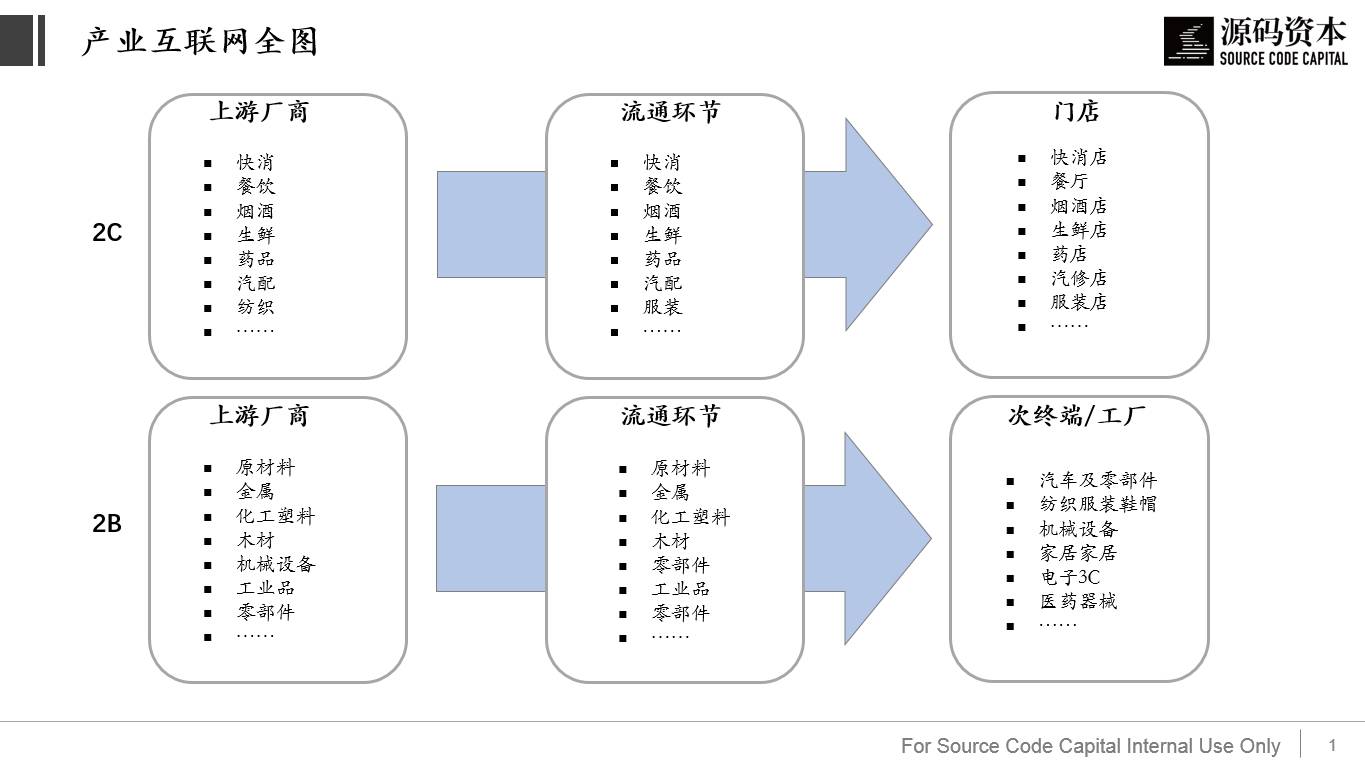
In the long run, the vast offline industry — from factory to retail terminal — will be fertile ground for venture capital. Industrial internet aims to help different vertical industries upgrade and evolve. Entry points may vary by stage, and paths are diverse. B2B is one such path.
2 Investment Practice and Observations
On this giant map, Source Code Capital has already made considerable investment bets, in both 2C and 2B categories. 2C has many large categories — clothing, food, housing, transportation — each massive in scale. "Food" alone breaks into numerous subcategories: dining, fresh produce, FMCG, alcohol, and more.
In the 2C space, YiJiupi is a typical representative, focusing on alcohol and beverages. Having achieved its阶段性 scale targets, it's now working to expand further while deepening its upstream and downstream influence. Zhangshang Kuaixiao focuses on FMCG in tier-2 through tier-6 cities, deliberately staying away from tier-1 cities where chain penetration and e-commerce penetration are both high. It supplies relatively fragmented convenience stores and small supermarkets that are distant from quality supply chains, and is growing very rapidly.
The 2B space includes everything factories need to purchase: bulk commodities, raw materials, components, MRO, machinery and equipment, electronic components, and more. Ruigu entered the MRO market through hardware and electromechanical products, integrating quality upstream manufacturers to serve terminal channels. Baibu leverages financing to mobilize upstream grey cloth, significantly improving upstream capacity utilization while supplying terminals directly to enhance distribution efficiency.
These are all B2B self-operating model companies, yet each has a completely different approach. Because industry characteristics differ, each has honed its own competitive edge. All have completed their first phase of rapid growth and deep upstream-downstream exploration, and have established or are establishing truly durable moats.
3 Investment Logic
The industrial map is enormous. Through continuous observation and research, our core investment logic is: work backward from a large goal to determine the development path. Industrial upgrading has two objectives: first, that end customers receive more, better, and more precisely targeted products and services; second, that retail and all stages before retail become more efficient. The ultimate goal is data-driven, intelligence-driven operation across the entire chain — the back-end serving and assisting the retail front-end, marshaling every resource to serve the end customer.
B2B e-commerce platforms are among the easiest paths to achieve this, because distribution is the most vulnerable link in the chain. It involves multi-tier distribution systems, multi-tier wholesale markets, warehouse and delivery infrastructure from trunk lines to last-mile, and massive volumes of supply-demand information. Look closely offline, and distribution tiers are rapidly shrinking, wholesale markets disappearing, markets becoming more transparent, and policy even pushing for consolidation of distribution companies.
This change reflects a major trend — distribution needs to serve terminal markets more efficiently. The movement of goods at every level requires unified warehousing and delivery to improve utilization and timeliness; supply-demand matching needs continuous optimization. B2B e-commerce platforms cut directly into the distribution stage through transactions, rapidly achieving onlineization and scale, accelerating offline distribution consolidation and efficiency gains. Back in 2015, we analyzed some B2B e-commerce platform logic around key metrics and a fulfillment cost-gross margin formula; we won't rehash that here.
After three years of land-grabbing, giants are beginning to enter. Simply running a decent B2B trading platform, merely playing a channel role, is no longer enough. You need to work upstream and downstream to build real industry barriers. Companies that can capture terminal channels or even terminal customers through distinctive methods, or obtain more terminal data, or build their own quality brands — these are the ones that can establish long-term moats.
4 Solving Four Critical Problems
First, in 2C categories, especially FMCG, startups generally face threats from JD.com and Alibaba. The threat comes from two directions: first, the online penetration rate of C-end retail keeps rising, eroding offline stores' share; second, they're also pushing into offline supply chains, going deep on B2B.
In the long run, the giants' goal is certainly to keep raising online penetration across all categories. For the offline portion that can't be shifted online short-term, they'll use supply chains, payments, and online traffic to empower and integrate. This empowerment looks devastating, seemingly poised to sweep the entire battlefield. But as startups, we should be encouraged to see that penetrating and transforming the offline B-end chain is necessarily a slow, long-term project — gritty, unglamorous work that may not suit e-commerce giants, but rather fits startups with persistence and staying power.
B2B companies looking to extend downward to offline stores — whether creating new chains or empowering existing ones — will face long-term competition from the giants. If you're going to do this, move accurately and move fast.
Second, in many vertical industries, upstream brands have unquestionable industry influence. How they deploy channels, how they plan their e-commerce strategy, their relationships with existing distribution systems, wholesale markets, and terminal retail, their connections with retail terminals, and how they compete with each other — all merit study.
In vertical industries with strong brands, existing B2B players have not yet reached the point of replacing first-tier distributors, and have barely begun engaging with brands. Finding the right pain points, coexisting with them, and jointly building a new distribution ecosystem — that's the right prescription.
Third, existing B2B platforms, beyond managing relationships with giants and brands, also need to navigate carefully with multi-tier traditional distributors. Traditional tier-2, -3, and -4 distributors create relatively little value and are easily replaceable, so they make the most noise. They often try to band together, and worse, badmouth B2B platforms to both brand manufacturers and downstream stores, spreading rumors in attempts to resist and strangle B2B platforms.
The recommended way to break this is not to fight head-on against organized resistance. Stay low, appear weak, find breakthrough points, and unite with distributors who still have category value, or look for opportunities to collaborate or convert within the ecosystem. In the long run, create genuine value for downstream stores and brand manufacturers.
Fourth, to avoid the impact of giants and brands on startups, another approach is to stay away from domains where C-end giants dominate and where upstream brands are mature. There are still many verticals where China lacks brands and where C-end giants can't reach. Establish strongholds in these areas, then gradually expand industry influence.
Finally, I want to emphasize that opportunities in the B-end space won't come quickly. You need to take the long view, see the game far enough ahead, and ideally have the ability to generate your own cash flow. Don't worry that moving slowly means someone else will steal the opportunity — it's the slow companies that dig deep that have the real chance.
5 Continuously Creating Enduring Real Value
Currently, we're spreading out the map and carefully studying different fields. Based on industry evolution progress, combined with industry characteristics, we're finding opportunities at different stages. Some opportunities come fast, some slow; some large, some small; some sooner, some later. You need perspective to see the big direction, and you need deep industry understanding to find the levers and fulcrums. We warmly welcome peers and entrepreneurs to come exchange ideas and jointly drive industrial transformation.
More Source Code Capital Insights
Issue 5 Convenience Stores: Under the New Retail Wind, Where Does China's 7-Eleven Go?
Issue 4 Mobile Going Global: Entrepreneurs Should Keep Eyes on Big Opportunities in Content Products
Issue 3 Targeting Unicorns in the Consumer Upgrade Wave
Issue 2 Profile of a "Reliable" AI Startup
Issue 1 Under "New Retail," Where Do Offline Stores Go?

Create Enduring Real Value
Long press to scan QR code and follow Source Code Capital