Guo Ruyi, Taihe Capital: Facing Cycles, Building for the Long Run | Code Meet 2018

"GO BIG OR GO HOME"
On April 20, Source Code Capital's 2018 Code Society annual meeting, themed "Open Source Iteration · Decoding the Future," was held in Beijing. Michael Mao, founding partner of Taihe Capital, delivered a keynote speech titled Facing Cycles, Iterating for Longevity.
Mao noted that before 2017, investment themes were concentrated and capital moved at a comfortable pace. In 2017, hot sectors fizzled quickly and big money grew cautious. Capital became rational, while policy turned punishing. A new trend emerged in Q1 2018, which he distilled into sixteen characters: "Capital shakeout, stockpiling for survival; embrace integration, iterate for longevity."
Cycles are objectively real, Mao argued. To navigate them calmly, entrepreneurs must achieve "four iterations" at the cognitive level: strategic iteration, organizational iteration, capital iteration, and policy iteration.
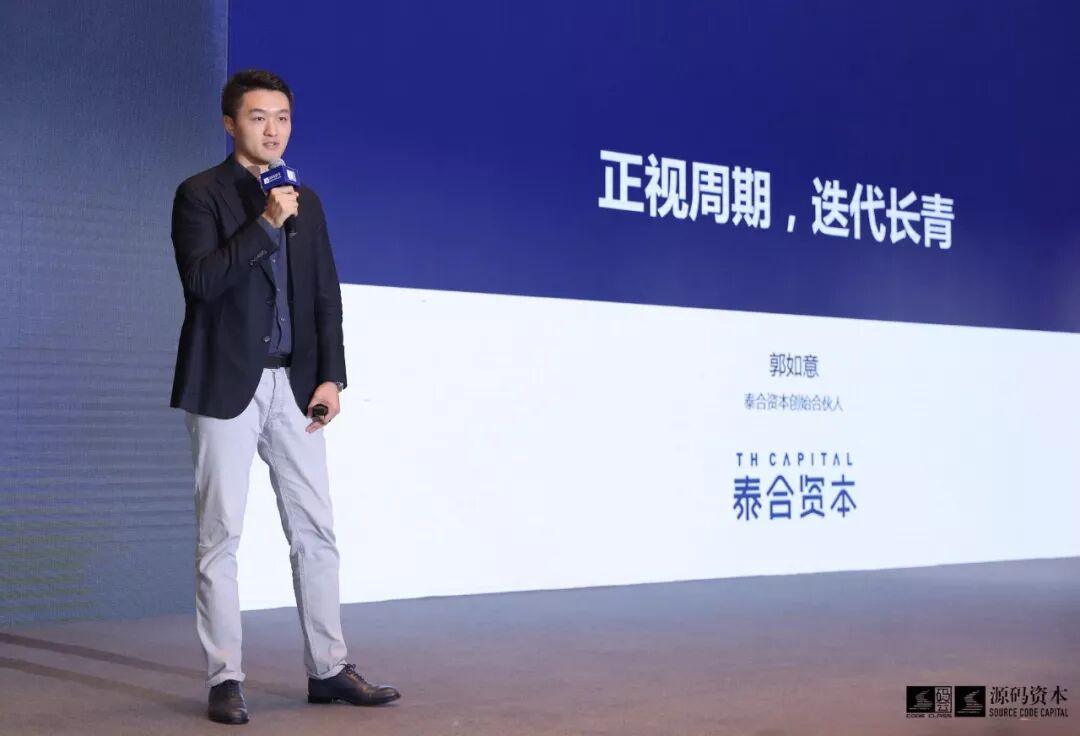
Michael Mao, Founding Partner of Taihe Capital
The following is the full text of Michael Mao's speech
Thank you to our friends at Source Code for the invitation. I was deeply moved by Mr. Hu's speech just now. Huawei's growth curve over the 30-plus years since its founding in 1987 is exactly the curve we want to help our entrepreneurs draw. What strikes me most is that through multiple setbacks and cycles, Huawei has maintained such a steep growth curve — thanks to the continuous vitality and iteration of its entire organization. There's a saying: "There are no great companies, only companies of their era." How to develop in sync with the times, how to prepare for the troughs and peaks of economic cycles — these are things we must all be ready for.
First, let me spend a few minutes introducing Taihe Capital. We've been around for over five years, completed 60 projects across more than 80 financing rounds, with cumulative fundraising of 55 billion RMB. In 2017, our team of 20 completed 20 billion RMB in private equity financing. For comparison, in secondary market IPO fundraising, our performance was second only to CITIC Securities (21 billion RMB in IPO underwriting). We serve mid-to-late stage TMT clients, typically with average single-round fundraising between 50 million and 100 million USD. Taihe Capital is actually the least FA-like FA out there. Some call us an external brain for companies; others say we're mentors and friends to founders. Our mission is to cultivate future business leaders and become partners with the most top-tier entrepreneurs and investors in the new economy. Beyond facilitating each round of financing, we want to see fundamental improvement in companies' intrinsic value, witness founders transform into true entrepreneurs, and hope that the collaborations we foster among entrepreneurs create unexpected chemical reactions.
To get to the point, today I want to share Taihe Capital's assessment of the 2018 capital market. Before 2017, hot sectors were concentrated and capital moved at a comfortable pace. In 2017, hot sectors fizzled quickly and big money grew cautious. Capital became rational, while policy turned punishing. A new trend emerged in Q1 2018, which we distilled into sixteen characters: "Capital shakeout, stockpiling for survival; embrace integration, iterate for longevity."
1 IPOs in U.S. Markets Routinely Break Issue Price
A-share new stock returns continue declining
At Taihe, we've long favored a "start from the end" methodology internally. The end means the ultimate purpose of primary market financing is exit, and IPO is a critical benchmark. Over the past half year, among 15 TMT-related companies listed in the U.S. with market caps exceeding 500 million USD, 12-13 were unicorns worth over 10 billion USD. Yet the word media used most at their listings was "broken issue."
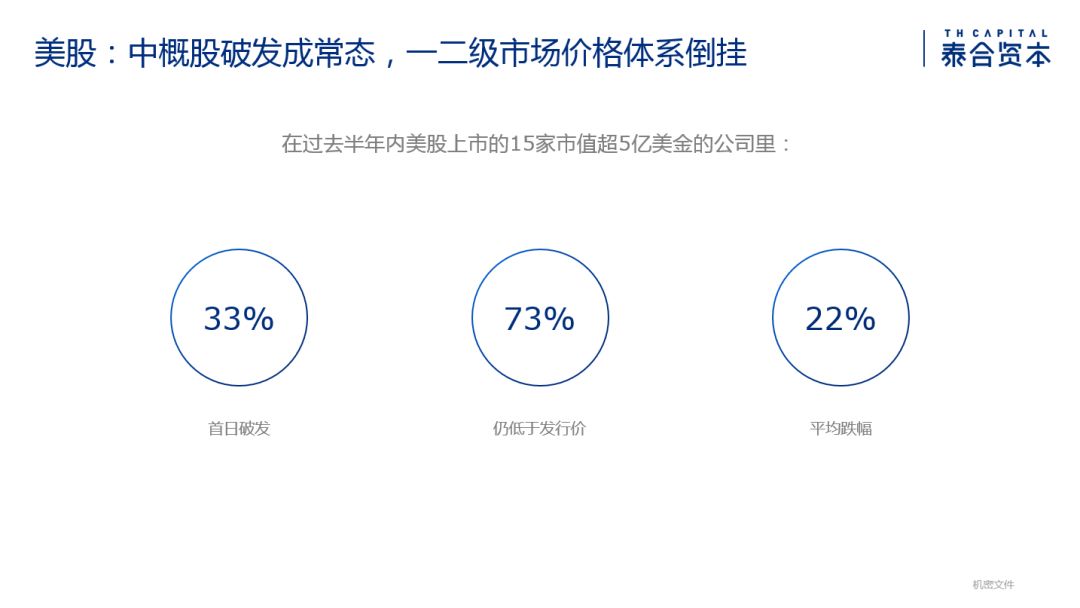
Image source: Taihe Capital
Looking at the data, over 30% broke issue price on listing day, and over 75% traded below their offering price. Of the three or four that didn't break issue, several only exceeded it by less than 10%. The 15 companies averaged over 20% decline in share price, with unicorn companies approaching 30%. This is terrifying. It means secondary market valuations are shrinking rapidly. If you invested at high prices in the primary market, going public could become a death sentence upon exposure. Especially with new regulations on individual investor compliance and asset management rules, individual investor returns are gradually shrinking, regulation is tightening, and financial capital is finding it harder to flow into the flood of emerging GP firms. These signs worry investment institutions.
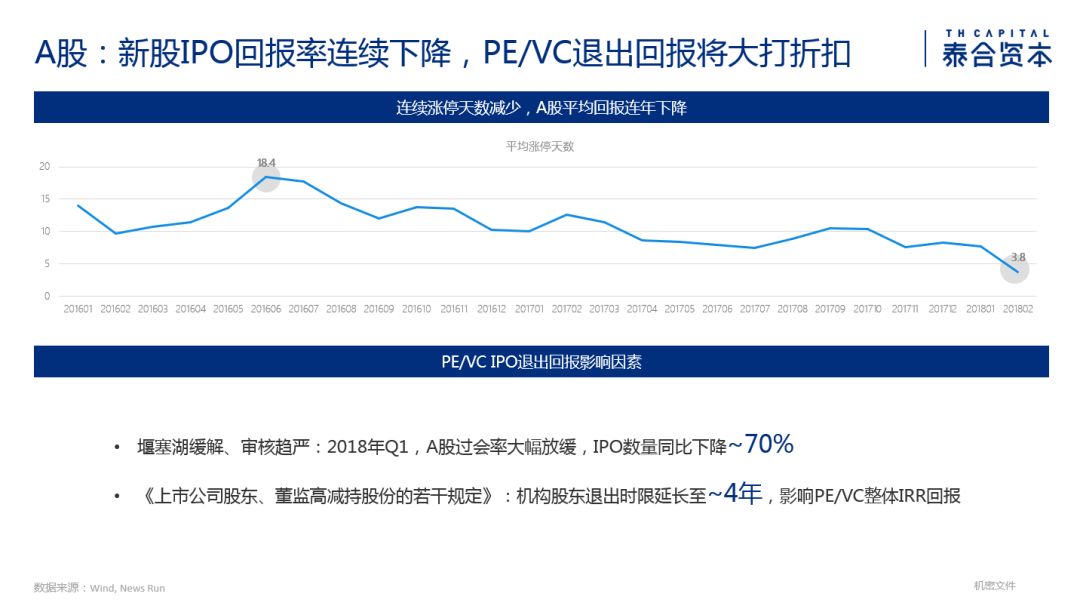
Image source: Taihe Capital
Turning to A-shares, from year-end 2015 to now, listing returns have fallen over 70%. The average number of limit-up days also reflects the A-share market's trend toward rationality. The reason is the easing of the A-share "dammed lake" — in 2017, the A-share market clearly accelerated listings, with massive capital inflows. Starting Q1 2018, A-share approval rates slowed dramatically, with IPO numbers down 70% year-over-year from Q1 last year, and large numbers of companies withdrawing their applications. This signals the IPO exit channel is gradually tightening. New reduction rules have made many GPs deeply anxious about exits; optimistic estimates extend the reduction cycle by 1-2 years, pessimistic ones by 4 years. Most GP firms only have 8-10 year lifespans, so uncertainty increases substantially, expected exit returns decline, and sensitivity to investment asset prices rises sharply.
2 Fundraising Matthew Effect Intensifies
Investment institutions face winter first, but transmission lags
From a fundraising perspective, annual fundraising scale has risen continuously over the past three years, exceeding 260 billion USD in all of 2017. Since the 2016 "Ten National Guidelines" for venture capital, over 13,000 fund management companies have registered. In Taihe's institutional database, we have over 2,000 institutions. When any company reaches its 100th institutional contact during fundraising, it generally means fundraising has become quite difficult. By this measure, institutions are redundant. Q1 2018 fundraising scale fell by two-thirds year-over-year, but this is actually a return to normal. What impact will this have on the primary market?
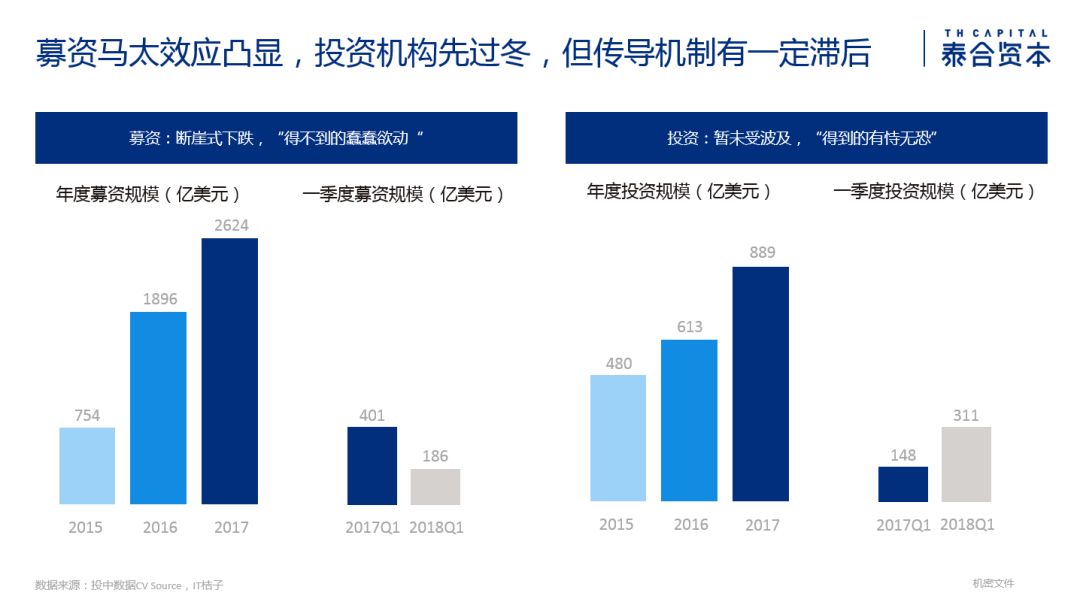
Image source: Taihe Capital
In absolute terms, Q1 2018 investment scale actually rose year-over-year, so there seems to be no direct impact. First, Q1 2017 was affected by the previous year's capital winter, with delayed recovery. Second, many top-tier capital institutions completed fundraising in the second half of 2017, making full preparations for 2018 and accelerating investment in Q1 2018. Third, many Q1 2018 disclosed cases were actually completed at year-end 2017, creating some data distortion. Based on this, in the coming six months, or by year-end at the latest, the overall funding shortage will lead to more cautious investment. With many GPs struggling to raise funds, existing GPs must exercise discipline and focus on investment returns, likely becoming more price-sensitive.
3 Facing the Objectivity of Cycles
Iterate organizational, strategic, capital, and policy cognition
With fundraising tightening and investment growing more cautious, how should entrepreneurs respond?
First, recognize the objective existence of cycles. In several financial crises over the past 30 years, we've found it difficult to identify triggering factors or make predictive patterns in advance, but expectations are certainly a key factor affecting capital markets. Why have U.S. stocks fluctuated so violently recently, with even Donald Trump's Twitter becoming a market weather vane? Because market sentiment is extremely sensitive, leading to cautious expectations that transmit to capital markets. Many investors ask us: U.S. stocks have risen for 10 years, exceeding the dot-com bubble peak — will they fall soon? From a fundamentals perspective, we don't see much bubble, but downward expectations do exist. Another interesting micro-cycle, or window period, is the TMT Chinese concept stock window. 2000: NetEase, SINA Corporation; around 2005: Baidu, Focus Media; around 2011: 360, Youku, SouFun; 2014: Alibaba, JD.com; recently iQIYI, and clearly anticipated listings like Xiaomi, Ant Group, Meituan. We remember these key moments precisely because capital markets and company development both have cycles — every quality asset takes time to emerge, and after quality assets concentrate in window periods to list, there's typically a 3-5 year gap. So we must rationally recognize that cycles are objective; only subpar assets fail to break through.
Second, achieve cognitive iteration in four dimensions.
1. Strategic Iteration
Build internal strength, emphasize efficiency; push deep, expand boundaries. For entrepreneurs in all sectors, you must build internal strength. Technical teams must productize quickly; commercial teams must optimize efficiency quickly. Prove it with data as soon as possible. From Taihe's internal 2017 data, not all projects were as hot as imagined. In intelligent technology, AI projects in mid-to-late stages averaged 6.5 months fundraising cycles, while big data projects were actually more sought-after. Why? Whether from productization or commercialization perspectives, big data projects were showing clear breakthroughs — fundamental improvement. Some AI projects had excellent technology and teams, but in later-stage fundraising, people still looked at scenario penetration, commercial landing, and productization. The consumer sector was similar: new retail was a hot theme, but post-Series C prospects were uncertain, with investor decision cycles exceeding six months, requiring examination of very granular metrics like single-store output, scale validation, and improvements in human efficiency and sales per square meter. Why did education projects have fundraising cycles as short as three months? Because education projects, whether online or offline, were experiencing unbelievable monetization explosion. Monetization opportunities appeared, monetization efficiency improved, many projects' numbers worked out or achieved scale validation — investors naturally loved them.
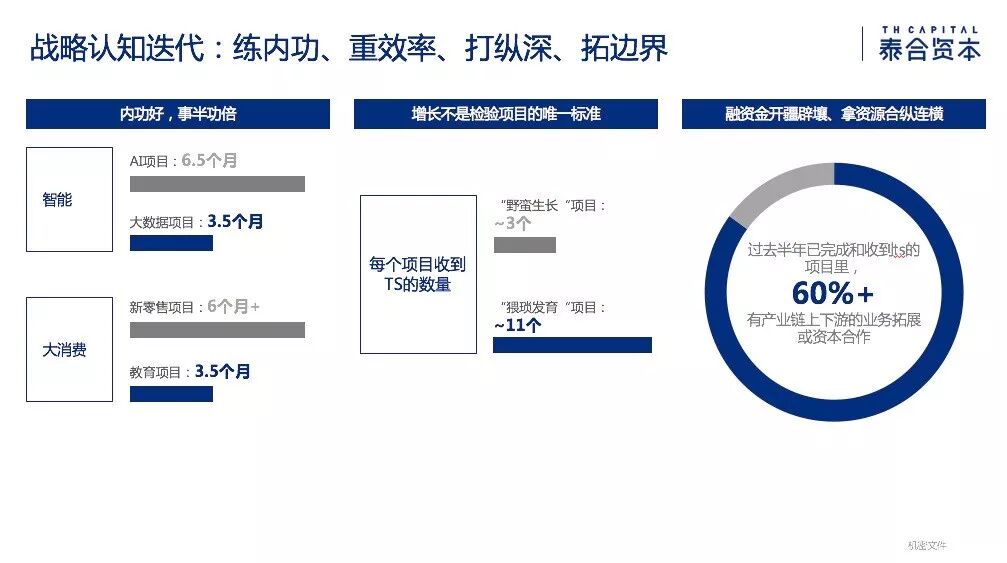
Image source: Taihe Capital
Growth is no longer the sole criterion for evaluating projects; efficiency matters. According to our internal statistics, projects growing wildly averaged 2-3 term sheets. People like projects with fierce growth momentum, but have reservations about such growth, scrutinizing growth efficiency — for example, how much cost is required for every 1 RMB of GMV growth. If losses gradually contract during growth, efficiency improves, and scale effects are validated — investors can't be stopped from such projects. Beyond scale metrics, you should value your efficiency metrics more. If entrepreneurs find their business growing rapidly, while celebrating they must promptly identify the core growth drivers, capture common factors, and see if they can be standardized and replicated.
Push deep and expand boundaries at the industrial chain and capital levels. Over the past half year, over 60% of projects we served began expanding into upstream and downstream industries, or pursuing capital partnerships. Some companies invested in relatively traditional sectors to complete transaction loops. For example, a logistics project invested by Source Code Capital conducted nationwide M&A integration — an interesting trend. Entrepreneurs must not only focus on single-point breakthroughs in their own business, but also work on strategic direction and rhythm, with greater vision to expand boundaries, use resources to open new territory, cooperate with upstream and downstream industries as allies, and optimize the industrial chain with an equal and open mindset — only then can industrial profit redistribution be achieved.
2. Organizational Iteration
It used to be said that early-stage investing is about people, late-stage about numbers. Actually no — late-stage also values people. For example, in Taihe's internal evaluations, typically only 2-3 projects in a given sector reach Series C, with funding and business volume not hugely differentiated. We most prefer teams with mild anxiety and healthy redundancy. Teams that while chasing performance still have bandwidth to think about innovation and management, that can incubate new businesses beyond internal business innovation — such teams still have room for sustained growth. Conversely, teams running ragged on existing business, firefighting everywhere, likely have significant problems in their internal organizational systems.
From the data, teams with versus without healthy redundancy receive roughly double the term sheets. Autocratic teams average 4 term sheets, because autocratic decision-making is efficient enough, and execution below is typically most efficient, so numbers won't be bad either. But we value "wolf pack" teams more — such teams may have dissenting voices internally, different ideas about business, but the organization allows vitality to exist and can withstand enormous challenges. Investors prefer such teams.
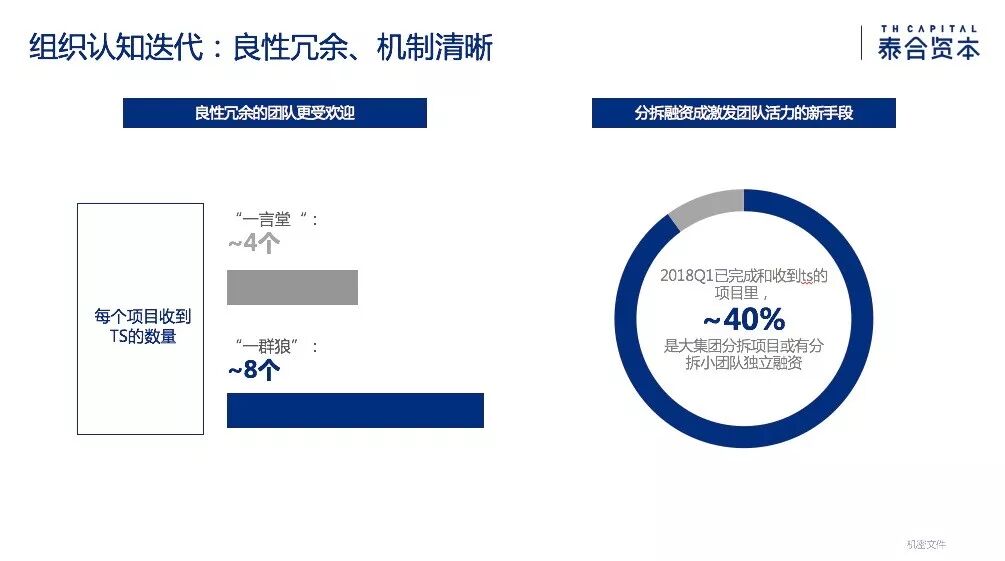
Image source: Taihe Capital
More and more teams value mechanism building. Even if initially crude — for example, front-end sales commission and rebate mechanisms — these get gradually optimized as business develops. We once served a company that was losing 10 million RMB monthly when we took it on, turned profitable by month three, and by year-end had annual profits exceeding 100 million. We found the team had a very clear internal horse-racing mechanism, with its own knowledge community, brand community, and interest community. Based on these communities, it gave front-end product managers sufficient innovation mechanisms, vitality, and support. On this foundation, 2 internal teams ran exceptionally well, contributing profits far beyond expectations — this is the value of mechanism vitality.
Another new trend: from Taihe's Q1 data on served enterprises, nearly 40% of projects were spin-offs from large groups or internal innovation incubations. On one hand this shows enterprises have sustained innovative vitality; on the other, it suggests a possible new trend in team incentives, such as equity redistribution, of which the best method is spin-off financing — where the incentive component may exceed the capital operations component.
3. Capital Iteration
Entrepreneurs used to view financing as a one-time transaction, with rounds unconnected. Now more and more entrepreneurs recognize financing as an important component of business strategy.
First, professional division of labor increasingly matters. For example, we're pleased to see rising FA usage in mid-to-late stage financing. From an organizational perspective, among AI projects we've served, 60% actually had dedicated fundraising leads — with considerable seniority and titles, mostly hired from Hong Kong investment banks. On one hand this shows Hong Kong investment banks are under pressure; on the other, it shows startups, especially early-stage entrepreneurs, clearly perceive capital's important strategic value and seriously seek so-called financing partners.
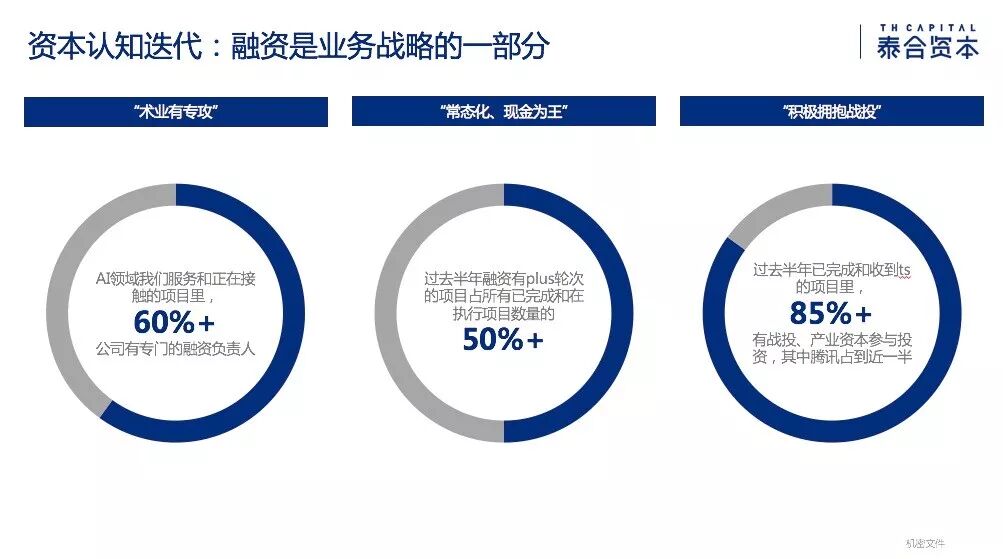
Image source: Taihe Capital
Second, financing normalization. When you sense market funding tightening, make financing arrangements quickly. Some founders say they don't need money now, but looking ahead twelve months, three to five years, they'll always need capital. The best approach is to secure as much funding as possible that's helpful for your development, ensuring some capital redundancy. Over the past half year, among Taihe-served enterprises, 50% of projects had plus-round financings, with financing frequency continuously accelerating.
Third, actively embrace strategic investment. In Taihe-completed projects over the past half year, 85% involved strategic and industrial capital, with Tencent accounting for nearly half. In the past, early-stage capital viewed them as bag-holders; now it's completely different. Strategic investment is moving increasingly early — most typically Tencent, including Toutiao, both very active.
Financial investors are anxious. Beyond money, they seem to have nothing to compare with strategic investors — feeling that before you took my exits, now you're stealing my lunch. Actually it's not entirely so; this also introduces healthy competition for financial investors. From the entrepreneur's perspective, we urge everyone to actively embrace good industrial and strategic investors.
First, they bring different industrial perspectives. Entrepreneurs may be small players with single-point breakthroughs on the industrial chain, but the entire chain is complex and lengthy. If you gain more macro perspective, or valuable experience from large industrial groups that have weathered cycles, it's extremely valuable. Second, for BATJ-type investors, keep an even mindset. Especially Tencent — we don't view it as purely strategic; its funding support and brand endorsement are actually more important. In some fiercely competitive sectors, entrepreneurs also make attracting Tencent investment an important financing strategy.
4. Policy Iteration
Starting 2017, so-called policy risk became important in capital markets. But policy itself carries no risk — non-compliance is the risk. In 2010-2013, many new projects emerged — were they compliant then? They were new species without new policies to constrain them. Now there's almost no such window for disorderly development.
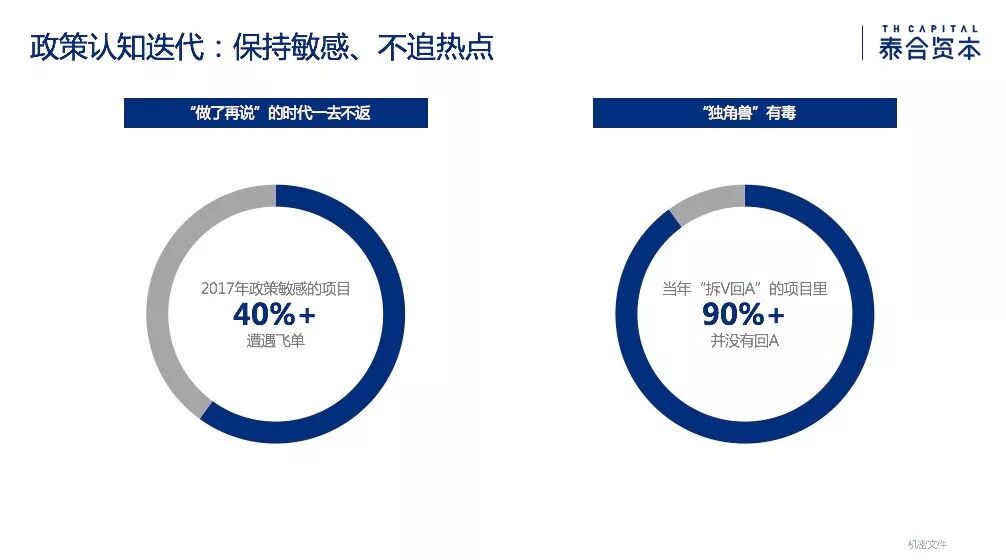
Image source: Taihe Capital
First, you must promptly follow developments and policies in your industry. Looking at results, 2017's three major policy-sensitive directions involved life-and-death medical matters, ideology-related content, and systemic-risk finance. Projects in these areas we more or less encountered serious deal failures (investors abandoning given offers), fundamentally because they couldn't pass policy muster, or policy was unclear, or policy was risky. Even if financing was ultimately secured, the project's own safety was insufficient. If capped by policy ceilings, first think about expanding to other markets, second consider how to operate with refinement in existing markets, improve efficiency, and capture your own profits. Of course policy also has benefits — for example, logistics and manufacturing have recently seen a series of tax reduction policies. They may seem to only have 1-2 percentage point impact, but placed across the entire industry, the profit space impact could be very large.
Second, don't blindly chase hot topics. For example, recent unicorns are actually just concepts and outcomes, not hot topics. What people typically understand as industry hot spots are driven by some industry or new technology emerging, not by some hot theme. Why do I say unicorns are toxic? Because it feels very much like 2015. Then capital markets were also hot; at end-2014 a VC partner asked us, with mobile internet fundraising and spending so aggressively, was there a bubble? We then required all Taihe projects to close before Spring Festival 2015. But after March 2015 came a wave of strategic emerging board expectations, with massive RMB fund activity, forming demolition squads. VIE dismantling for A-share return became an industry hot spot. Such hot spots demand extreme vigilance; in retrospect I still find the lessons painful — over 90% of projects that dismantled VIEs didn't return to A-shares. This year after the new unicorn policy, another wave emerged. But everyone must think clearly about their own capabilities — do you have the ability to be brought back to A-shares? The key is that unicorns are outcomes not causes, the natural result after you've built business value. If you're not on the first batch of returning unicorn lists, don't overthink it, don't join the crowd, focus on your own business, and thereby earn your place among them — this is most critical. Respect common sense: price fluctuates around value; building fundamentals and creating value is the root.
To summarize, cycles always exist. The market may become less optimistic in six months or three quarters — how do we respond? Having experienced several cycles in this industry ourselves, viewing economic cycles is like viewing historical cycles — the more historical scenarios you see, the calmer your mindset. When markets are good, they're not that good; when markets are bad, they're not that bad. Regardless of how external environments change, the only thing we can do is control ourselves as much as possible. As they often say in the NBA, "GO BIG OR GO HOME" — if you have the ability to continuously iterate, to adapt to the challenges this era brings you, you can become powerful. If you don't have this ability, sorry, you go home.
Thank you everyone!
Previous Code Society Articles
3rd Edition | Yiming Zhang: A CEO Must Avoid Rational Arrogance
3rd Edition | Lianjia's Hui Zuo: My Understanding of the Real Estate Industry
3rd Edition | Meili United Group CEO Qi Chen: The Difference Between Mules and Unicorns Is Focus
3rd Edition | Zhi Qin: The Things Only Entrepreneurs Can Teach Themselves
3rd Edition | Microsoft Research Asia's Yu Zheng: AI Applications in Urban Management and Business
3rd Edition | What Pitfalls We Stepped in During Three Years of Entrepreneurship
2nd Edition | Xiang Li's First Discussion of Chejiajia: Transforming Urban Mobility
2nd Edition | Yiming Zhang: Why I Don't Agree with Controlling Labor Costs
1st Edition | Chenchao Zhuang: How Should Startups Compete? How Should They Lose Money?
Source Code Capital
Creating Lasting, Real Value

WeChat: sourcecodecapital
More professional content
Follow our official WeChat