Code Brain | If Humanity Switches Primarily to Clean Energy, It Could Become a Type I Civilization Around 2371

#Code Brain Ecological Connection, Cognitive Resonance
We reach outward without limit,
Exploring the laws of the universe and the cycles of civilization,
And perhaps the universe has given us a better answer in return.
By: Yu Wang
A civilization's development is multifaceted — population, economy, military, culture, technology — any of these can serve as a yardstick for measuring its level. But these aspects often represent only the tip of the iceberg, and are difficult to quantify and compare. For physicists, that group of "lazy" people who don't want to get bogged down in details, the total energy consumption of an entire civilization becomes the most convenient parameter. On one hand, it reflects a civilization's ability to harness energy, which is intimately tied to its population, economic scale, and technological prowess. On the other hand, it's a concrete number that lends itself to quantitative analysis.
This is the logic behind the birth of the Kardashev Scale. Soviet astronomer Nikolai Kardashev proposed this concept in 1964, using energy levels to divide civilizations into three types: Type I, Type II, and Type III — civilizations that could respectively harness the energy of a planet, a star, and a galaxy.
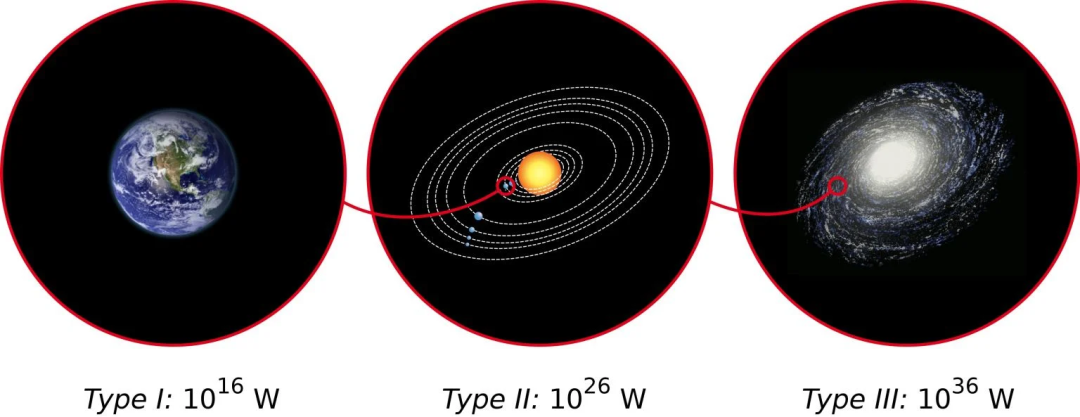
Image source: Wikipedia
A Type I civilization is a planetary civilization. Such a civilization can fully utilize the energy transmitted from its host star (for humans, the Sun) to its home planet (Earth), as well as the energy contained within the planet itself (fossil fuels, nuclear energy, etc.), corresponding to a power consumption of 10¹⁶ W.
A Type II civilization is a stellar civilization. Stars primarily transmit energy through radiation. The Sun's total radiative power is 4×10²⁶ W, so a Type II civilization's energy metric is 10²⁶ W. Calculating via E=mc², this is equivalent to every 11 seconds, this civilization consuming energy corresponding to the total mass of West Lake's water. To collect this much energy, a Type II civilization might construct megastructures like a Dyson Sphere. Such a sphere might also have computational functions; to fully utilize the energy, the structure could even be multi-layered, with the waste heat from one Dyson Sphere powering the next, forming a matryoshka brain. A Type II civilization would likely have mastered some far-flung, science-fiction-level technologies, such as antimatter annihilation engines and the creation of small black holes.
A Type III civilization is a galactic civilization. The Milky Way's total luminosity is 4×10³⁷ W. Given the galaxy's enormous scale, as long as a civilization's total energy consumption reaches 2.5% of the Milky Way's total luminosity — that is, 10³⁶ W — we can call it a Type III civilization. For civilizations at this level, perhaps even spacetime itself can be manipulated at will; they might be able to create wormholes or supermassive black holes. The technological capabilities of such a civilization would be completely beyond our comprehension — we likely cannot even imagine what technologies they possess.
The Kardashev Scale is not discrete and separate; it can actually be expressed through a logarithmic formula. If a civilization's total energy consumption is P, then its corresponding Kardashev level K can be expressed as:
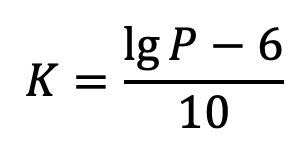
According to data from the International Energy Agency, global energy consumption in 2018 was 14,281,889 kilotons of oil equivalent (kTOE), approximately 1.90×10¹³ W. Using the formula above, human civilization on Earth currently ranks as a 0.728-level civilization.
Historically, human energy consumption has grown roughly exponentially — each year's increased energy consumption builds more machines, allowing us to consume even more energy the following year. If we crudely extrapolate based on past growth rates alone, we would find that we could become a Type I civilization around 2347, a Type II civilization in several thousand years, and a Type III civilization in several hundred thousand years.
The Energy Trap
However, this is only a very rough estimate. It projects the future based solely on past human energy growth rates, without considering practical constraints — far too optimistic. Moreover, the unit used by the International Energy Agency brings to mind something rather unsettling: the environmental threat of fossil fuels. Although it's merely oil equivalence, fossil fuels are indeed causing serious harm to Earth's environment. As American biologist Edward Osborne Wilson once said: "The real problem of humanity is the following: we have Paleolithic emotions, medieval institutions, and god-like technology." Our civilization is also facing a severe climate crisis. Some even believe that the process of a civilization advancing toward Type I status constitutes a "Great Filter" — that growing energy consumption will trigger drastic climate change, leading to civilizational collapse. Thus, no civilization can reach higher levels — this may be the explanation for the Fermi Paradox, and why no aliens have made contact with us.
Now, humanity, having awakened to the climate crisis, is attempting to limit its carbon emissions. For instance, China has proposed that national carbon dioxide emissions will peak by 2030; by 2060, non-fossil fuel energy consumption will exceed 80%, achieving carbon neutrality nationwide. The EU countries and developed nations such as the United States plan to achieve carbon neutrality by 2050. In the coming decades, humanity's overall energy structure may face a massive transformation.
Against this backdrop, we must re-examine the changes in various energy sources and recalculate when humanity might become a Type I civilization. Recently, an international research team published their findings on a preprint server. Based on the policies and recommendations of the UNFCCC and the IEA's projections for energy consumption in coming decades, they developed a more detailed impact model to estimate when humanity could become a Type I civilization under this framework. Their conclusion: if humanity transitions its primary energy sources to clean energy, we could become a Type I civilization around 2371.
The Test of Transition
The model shows that if all countries fulfill their commitments, humanity will rapidly reduce its dependence on fossil fuels during the 2040s. By around 2050, fossil fuel consumption will quickly drop to relatively low levels.
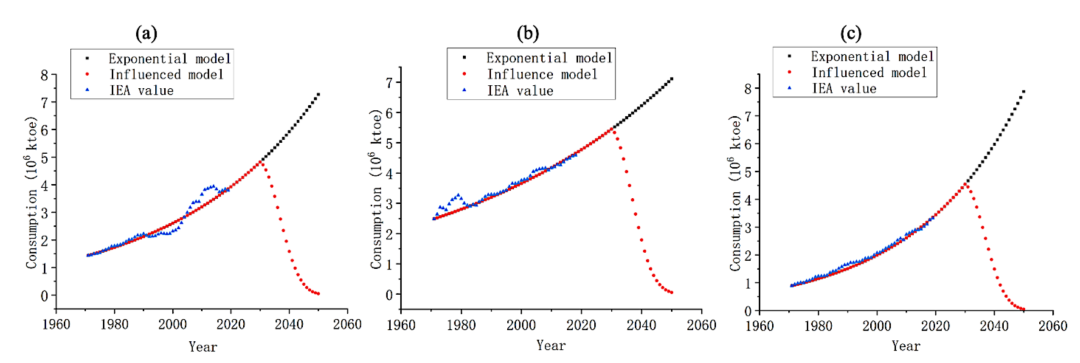
(a), (b), and (c) show human consumption of coal, natural gas, and crude oil respectively. Black represents the exponential model, red the impact model, and blue IEA historical data. Image source: Original paper
As fossil fuels rapidly decline, renewable energy sources such as solar, wind, hydro, and geothermal will largely maintain exponential growth patterns, and may even accelerate to compensate for the gap left by reduced fossil fuel use.
There is also an energy source that cannot be ignored yet remains highly controversial: nuclear power. The International Energy Agency states: "Historically, nuclear power has been one of the largest contributors to global carbon-free electricity, and it has enormous potential to help decarbonize the power sector." Over the past 50 years, nuclear energy has reduced carbon dioxide emissions by 55 billion tons — nearly equivalent to two years of total human CO₂ emissions.
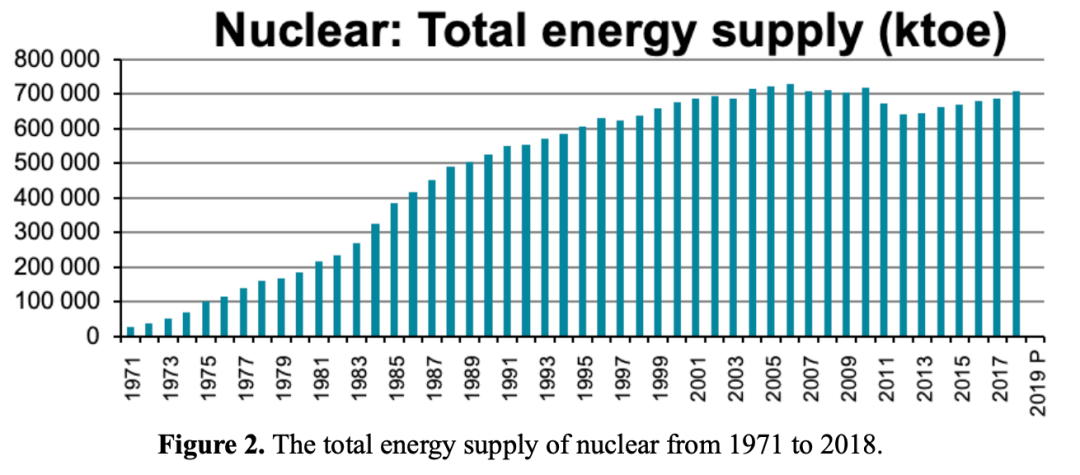
Global nuclear power supply from 1971 to 2018. Image source: Original paper
But in most people's minds, nuclear power remains a terrifying presence. The Chernobyl disaster in 1986 and the Fukushima accident in 2011 left everyone deeply shaken. After 1986, global nuclear power growth slowed; in 2011, global nuclear power generation even saw significant regression. Even though nuclear power is a very safe energy source, its development speed has inevitably been affected and slowed. According to the IEA's most optimistic Sustainable Development Scenario (SDS) estimate, nuclear power's average annual growth rate will be approximately 2.47%.
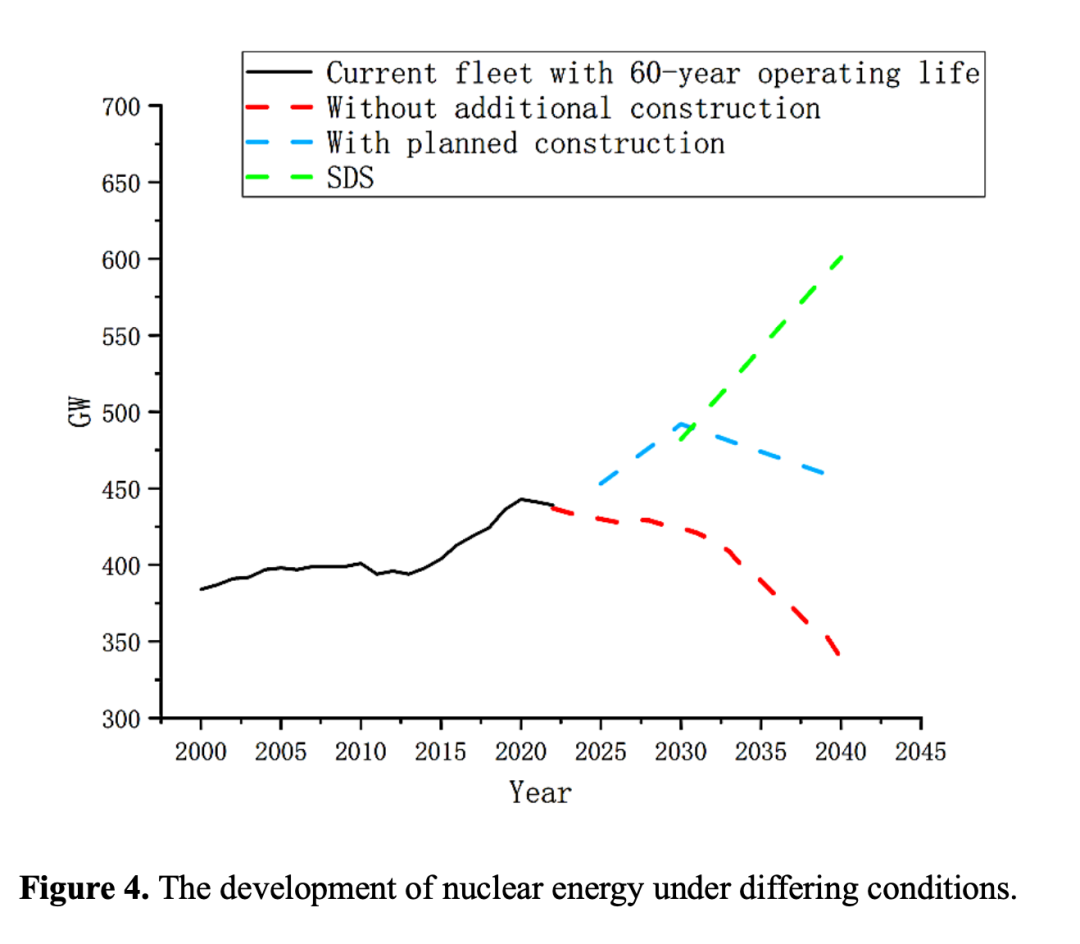
Nuclear energy development under different conditions. Black line represents existing data; red dashed line represents no new nuclear plants built; blue dashed line represents only building planned nuclear plants; green dashed line represents building nuclear plants according to IEA SDS planning. Image source: Original paper
Under these constraints, total renewable energy will reach roughly twice that of nuclear power.
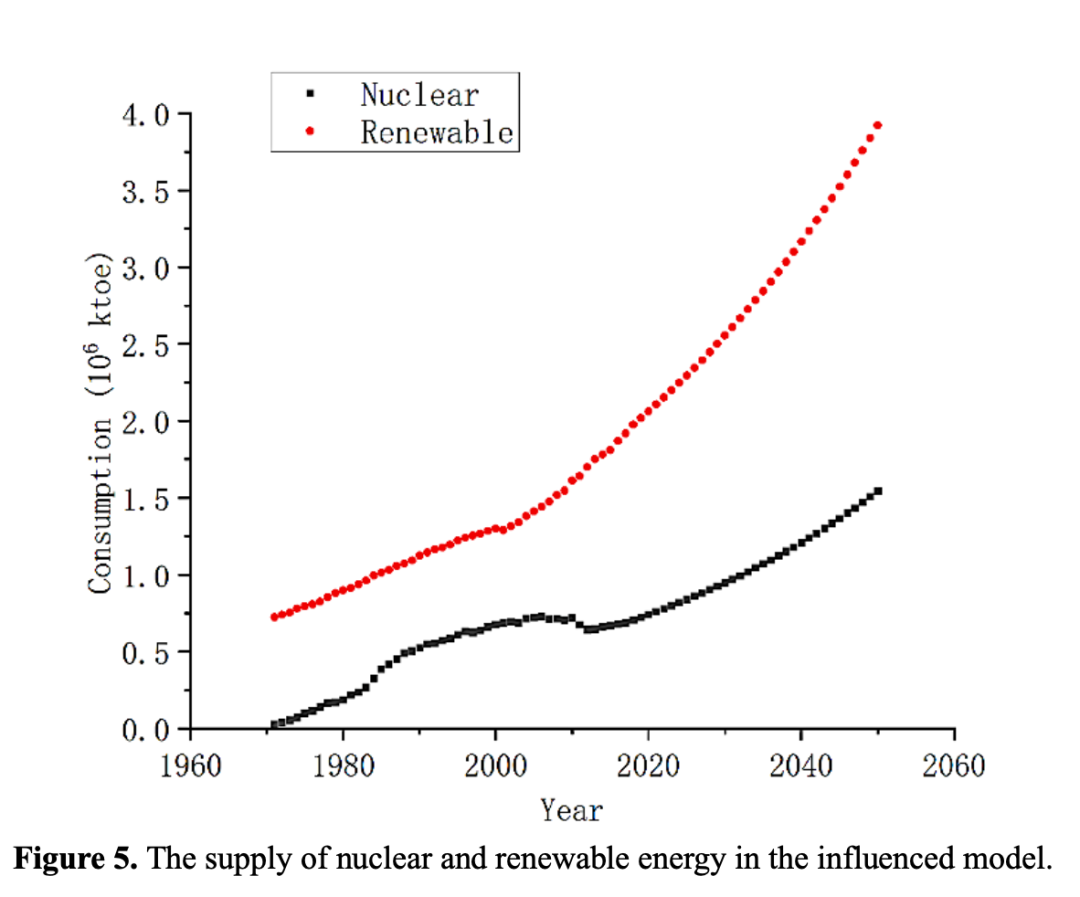
Red represents renewable energy, black represents nuclear energy. Image source: Original paper
Under these estimates, total human energy consumption may actually decline around 2030, reaching its lowest point around 2050. This is the pain of energy transition, but it is our only way to prevent global warming and keep humanity from falling into the "Great Filter." Afterward, human energy consumption may return to exponential growth. If the energy transition takes 20–30 years to complete, by around 2371 we may be able to safely become a Type I civilization.
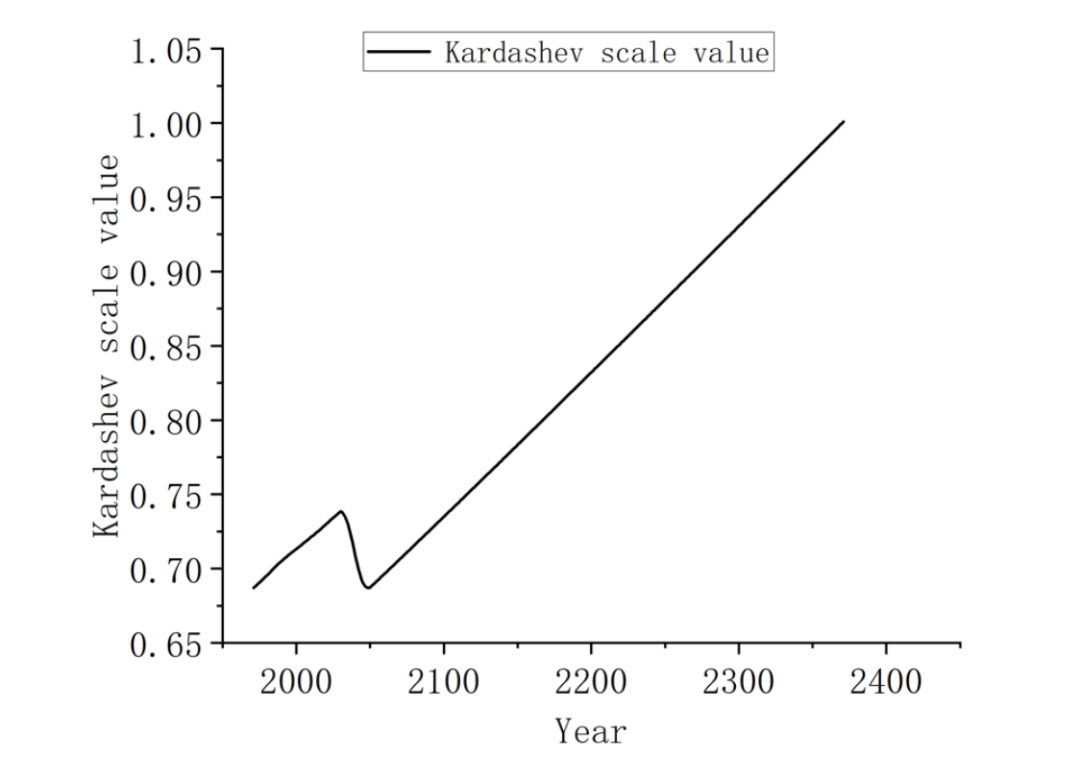
Predictions for the level of human civilization. Image source: Original paper
Although the Kardashev Scale is a very straightforward metric, it tells only half the story. We certainly need abundant energy, but energy use efficiency matters just as much. In today's push for green energy conservation, increasingly low-power technologies are being developed, achieving the same or even better results with less energy. Perhaps only when we no longer need to judge civilization's standard solely by the energy it commands can our civilization achieve true progress.

References
https://arxiv.org/abs/2204.07070
https://www.iea.org/data-and-statistics
This article is from the WeChat public account "Scientific American" (ID: huanqiukexue). For reprint requests, please contact newmedia@huanqiukexue.com

Issue 22: Tackling Supply Chains Amid "Volatility"
Issue 21: Clear Despair Beats Vague Hope — On ToB Sales During the Pandemic
Issue 20: Is Your Cash Flow Still Healthy During the Pandemic?
Issue 19: Entrepreneurs Must Learn to Let Go
Issue 18: Entrepreneurs' Time Management: "Two Must-Learns, Three Principles, Four Quadrants"
Issue 17: Your Core Startup Team Needs a "Deep Dialogue"
Issue 16: Three Keywords for Corporate Crisis Management from 3·15
Issue 15: The New Evolution of Insurtech
Issue 14: "Small" Trademark, "Big" Trouble — How Startups Can Effectively Avoid Pitfalls
Issue 13: Financial Opportunities in Industrial Internet
Issue 12: Strategic Thinking on Douyin Marketing for Consumer Brands
Issue 11: Inclusive Finance Under the New Economic Landscape
Issue 10: Brand: Meaning, Symbol, Value
More MaHui members can click "Read More" to view