One Table, 21 Actionable Tips: Here's Our Online Training Methodology

A methodology for 24-hour decision-making, initiation, preparation, and coordination, plus an eight-day, six-session online course series.
Over the past twenty-plus days, Source Code Capital sounded the rallying cry against the pandemic, taking active measures to help portfolio companies weather the storm and overcome difficulties. In response to topics of concern for member companies, Source Code Capital urgently planned and launched the Code Brain "Standing Together Against COVID-19" series: Compliance Guidelines for Employers During the Novel Coronavirus Outbreak (with Beijing, Shanghai, Guangzhou, and Shenzhen as examples); The Pandemic's Impact on the Funding Environment and Strategic Recommendations for Companies; ByteDance's Remote Work Practices During Extraordinary Times; Reverse Thinking — How Entrepreneurs Should View the Pandemic From a Different Angle; Macro Policy Interpretation and Industrial Logic Mapping Under Pandemic Shock; Cash Flow "Bloodline" Management in Crisis Moments; and more.
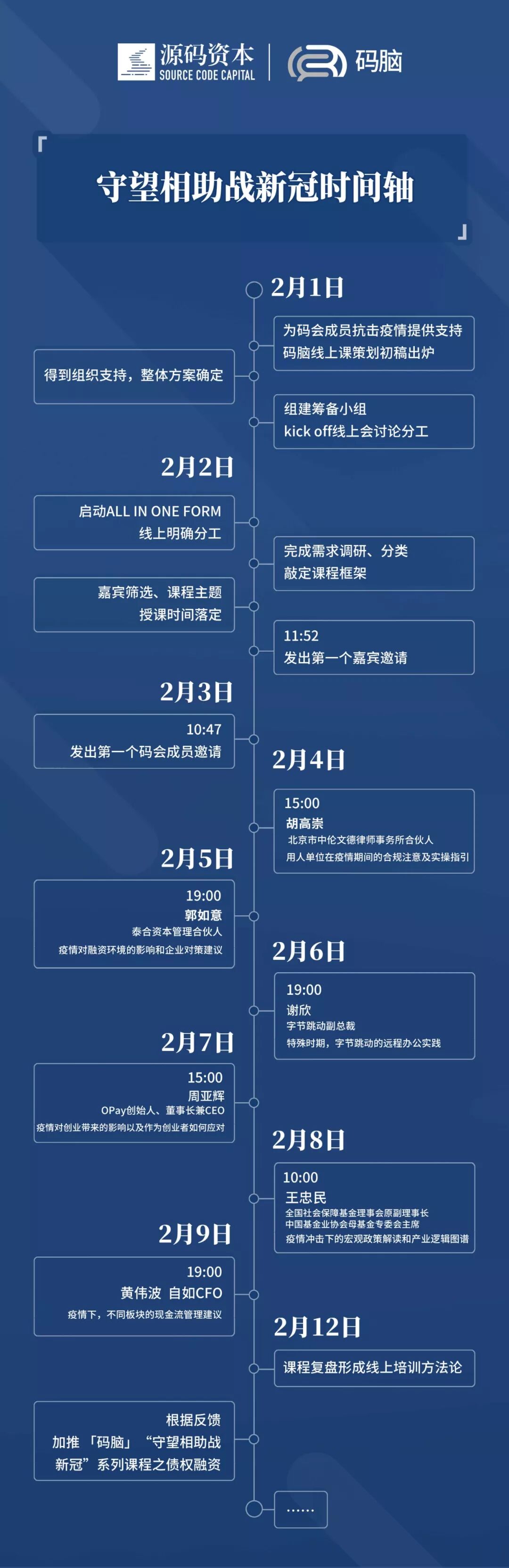
Remote collaboration and online training are challenges that mobile-era entrepreneurs must face at any time, especially under current exceptional circumstances. First company-wide remote work deployment, first fully online course series, six themes with six heavyweight guest speakers, hundreds of CEOs and senior executives, online sessions spanning different time zones and regions. As this series concluded, we've compiled and distilled our retrospective on this Code Brain online program to share for your reference.

At the start of this Code Brain online series, Source Code Capital team members were already scattered across China and around the world, still in the Lunar New Year holiday period. The entire team needed to be reoriented into combat mode to achieve synchronized collaboration. Meanwhile, the execution of this series involved guest invitations, topic curation, online delivery, poster and copywriting, and other disparate workstreams. To ensure efficient coordination and effective information flow across all these elements, "ALL IN ONE FORM" provided solid organizational infrastructure for the team.
As the name suggests, "ALL IN ONE FORM" is a single battle map for command and deployment, covering kickoff sheets, task division tables, event flowcharts, hardware and supplies lists, needs assessment surveys, guest rosters, communications plans, retrospective feedback forms, and more. This "ALL IN ONE FORM" capable of answering virtually any question enabled every team member to have complete command of information about this training program. At the same time, the online spreadsheet broke down the information silos of multiple offline forms of the past; team members could quickly access information according to their work assignments, taking what they needed. For example, once Professor Wang Zhongmin's time and topic were confirmed, poster information was simultaneously reflected in the course schedule; and while Professor Wang's poster was being designed, online meeting tool testing, WeChat group warm-ups for participants, and pre-set questions for the guest Q&A session all proceeded in rapid succession.
"ALL IN ONE FORM" not only aligned the team's collective understanding on a single spreadsheet; more profoundly, the free flow of information fostered an open team mindset. Many previously inefficient communications now evolved toward greater efficiency, and more issues could be anticipated and addressed in advance. "ALL IN ONE FORM" fundamentally transforms a team into "ALL IN ONE TEAM."

Whether online or offline, the key to effective training is understanding audience needs with precision. To this end, we proactively collected input from both guest and participant perspectives at different stages before and after sessions, maintaining the professionalism and substance density of Code Brain content, thereby earning positive reviews from both guests and entrepreneurs and sustaining Code Brain's virtuous cycle where "guests want to share, entrepreneurs want to listen."
Six Steps Before the Event
1. Map user needs: Use surveys, group interviews, and one-on-one conversations to centrally research the near-term, medium-term, and long-term challenges facing portfolio companies. After gathering data, synthesize and refine needs, merge similar items, identify core tensions, and formulate targeted themes accordingly.
2. Define training objectives: Based on entrepreneur needs, clarify the purpose of the training and problems to be solved, set expected outcomes, and design post-session feedback surveys.
3. Curate and invite speakers: Based on entrepreneur needs, evaluate potential speakers' professional backgrounds, past teaching experience, and relevance to the topic.
4. Agree on format: Share participant demographics — age range, gender, background, industry, and pressing problems — with speakers so their course design and content can be more precisely targeted.
5. Build the event plan: Based on staff division of labor, assign on-site coordination and contingency response; refine event protocols, rehearse in advance, and identify potential issues.
6. Launch the course: Book online meetings with identity verification; open registration, create groups, and notify participants of course information; establish and enforce attendance discipline.
Three Steps After the Event
1. Immediate process iteration: Based on new issues and situations arising during each session, immediately iterate processes, codifying them as reusable algorithms to improve the experience for subsequent guests and participants.
2. Gather event feedback: Immediately after each session, collect speaker and participant opinions and suggestions on topics or event organization through one-on-one conversations or surveys.
3. Capture updated needs: Based on follow-up conversations and survey data, conduct qualitative and quantitative analysis to understand emerging needs from speakers and participants. For example, after a funding-focused session, one CEO expressed interest in debt financing information; the Source Code team promptly added a dedicated debt financing session.

Under this pandemic emergency, online training became the only viable format. Online delivery enables rapid response between guests and participants, unconstrained by location or space, keeping the focus on knowledge and information transfer itself while saving preparation effort and financial costs. But the challenge lies in compensating for the warmth of in-person exchange — audio-only, one-way output doesn't foster collective atmosphere, and maintaining content depth and participant attention is difficult. This requires strong process management during the course, with an emphasized "host" role to positively shape the energy of online interaction.
Four Nodes of Process Management
1. Before sharing begins: Manage attendees effectively, grant the host admin privileges for managing speaking permissions; log attendees in the backend; and ask the speaker to join early for voice and PPT testing.
2. After sharing begins: The host introduces the speaker and reiterates question rules and attendance discipline; during the speaker's presentation, control attendee muting and speaking permissions as needed.
3. During Q&A: Control overall pacing, assist with questions to deepen understanding when necessary; design anonymous question mechanisms to guide participant inquiry.
4. At event conclusion: Manage timing carefully — end early if there are no further questions, exercise caution if extending; before closing, thank the speaker, preview follow-up actions and future training information.
Who Can MC Online Training?
1. MC must know the process cold: The online training host must be thoroughly familiar with event flow and able to mobilize relevant resources and personnel at any time.
2. MC needs solid domain expertise: Venture capital topics tend to be specialized and span multiple fields; the host should ideally be familiar with course content to facilitate communication.
3. MC must manage the vibe: From an online atmosphere perspective, the host should ideally be someone attendees know well, making it easier to energize the room and maintain control; a warm, engaging voice and style with strong improvisational ability are added bonuses.
Common Process Management Issues and Solutions
1. Unable to connect audio: Provide multiple options in advance — network connection, phone dial-in, etc. — with written connection guides; IT staff should remain online throughout to provide assistance.
2. Lack of effective questions: Prepare questions in advance from research; or invite participants familiar with the topic to ask good questions to "seed" interaction.

Another major challenge of online training is effective real-time information delivery. In this online series, information flow existed primarily between team members, between internal staff and external vendors, between participants and guests, and among participants themselves. To ensure smooth flow across all these information channels, reduce interference and cross-talk, and avoid information loss, the Source Code team used three online real-time communication tools:
-
Zoom: Main venue for online training sessions, handling guest presentations, PPT display, interactive Q&A, and live online exchange;
-
Lark: Main platform for ALL IN ONE FORM, collaborative work, meeting organization, information sharing, and team coordination;
-
WeChat groups: For post-training exchange among participants.
Zoom suits the lecture-plus-Q&A sharing format; after multiple simulation runs, we settled on a "primarily lecture, secondarily Q&A, two-to-one ratio" content mix. But note the need to schedule online meeting rooms in advance, send meeting IDs ahead of time, and prepare a first-time user guide. For closed-door sessions, the host should manage attendee verification and permissions to prevent information leakage.
As Source Code Capital's own business and internal communications platform, Lark's powerful online documents and collaboration features enabled seamless integration of text, comments, reminders, calendars, and other information types throughout preparation and execution.
Having gone through this pandemic, remote work and online collaboration will only mature further in enterprise applications going forward. We hope that through this Code Brain online series, learning together with entrepreneurs, we can collectively upgrade our methodologies across all dimensions.
Wind and rain send spring away; flying snow welcomes spring's return.
See you at the next Code Brain online session!
Comments and Discussion
If you have more good suggestions about online training, welcome to connect and learn with Source Code Capital through comments — we will keep iterating!

Code Brain "Standing Together Against COVID-19" Series Content
"Cash Flow 'Bloodline' Management in Crisis Moments"

"Macro Policy Interpretation and Industrial Logic Mapping Under Pandemic Shock"

"Reverse Thinking — How Entrepreneurs Should View the Pandemic From a Different Angle"

"The Pandemic's Impact on the Funding Environment and Strategic Recommendations for Companies"