Code Brain | The "Changes" and "Constants" of Equity Financing

Code Brain: Ecosystem Connection, Cognitive Resonance
On June 2, Ruyi Guo, Managing Partner at Taihe Capital, joined Source Code Capital's "Code Brain" event for an online session titled "The 'Change' and 'Constancy' of Equity Financing." Addressing topics top of mind for founders — the current state of capital markets, concrete shifts in corporate fundraising, and present-day financing strategies — she shared her perspectives with an entrepreneurial audience.
Guest Presentation
- For secondary markets, face reality and abandon illusions: for Chinese companies, the US stock market is no longer a viable near-term option;
- Everything in the primary market has changed — dollar institutions have pulled back, decision-making has slowed, and "national team" funds have become the main investment force, though they won't make "short, flat, fast" decisions;
- For fundraising, founders should prepare for "123": expect capital markets to remain cold for a full year, stockpile enough cash to survive two years, and aim to reach a relatively healthy state within three years;
- Timing and partner selection matter — raise at business or capital market inflection points, and find investors and partners who can genuinely add value and weather the downturn with you;
- "3 E's" for founders: hold the bottom line (Earning), focus on the long game (End-game), and exercise entrepreneurial spirit (Entrepreneurship).
Below is the full transcript of the session.
Thank you to Source Code Capital for the invitation. We're nearly halfway through 2022, and I'm sure everyone has developed some intuition about this year's capital markets. Surface phenomena shift endlessly, yet underlying logic remains consistent. Amid all this change, we hope to grasp what is constant and fundamental, and thereby offer practical, actionable guidance on financing.
Markets Are Turbulent; the Only Constant Is "Making Money"
Taihe was founded in a rather unusual year — 2012, at the tail end of the "thousand-group buying wars." Over the past decade, we've witnessed the rise and fall of numerous investment trends and the transformation of different industries. In capital markets, I've personally experienced cycles large and small: the 2008 global financial crisis, the 2015 A-share market crash, the 2018 capital winter, and the 2021 resurgence.
Only after living through cycles do you truly understand one thing: capital markets ebb and flow, rise and fall, yet the underlying economic laws never change. For now, the risk of a global financial crisis hasn't been resolved, and叠加 war, geopolitics, and other uncertainties may bring even greater risks to the market.
Secondary Markets: Abandon Illusions
Let's start with secondary markets. Over the past two years, the Federal Reserve injected massive liquidity into markets, creating an oversupply of low-cost capital. Many companies, having accessed cheap money, proceeded to squander it. This year, as the Fed embarked on a new rate-hiking cycle, compounded by war and great-power rivalry, market liquidity was rapidly drained.
In the chart below, the gold line represents the NASDAQ index, the white line the overall valuation multiple of the NASDAQ. The white line shows that from end-2019 to the 2021 peak, the NASDAQ's overall valuation multiple rose 50%, reflecting strong market confidence in future growth. The gold line shows that from November 2021, the NASDAQ pulled back 30% over six months — the third-largest retreat in the past 20 years, after the 2000 dot-com bust and the 2008 financial crisis.
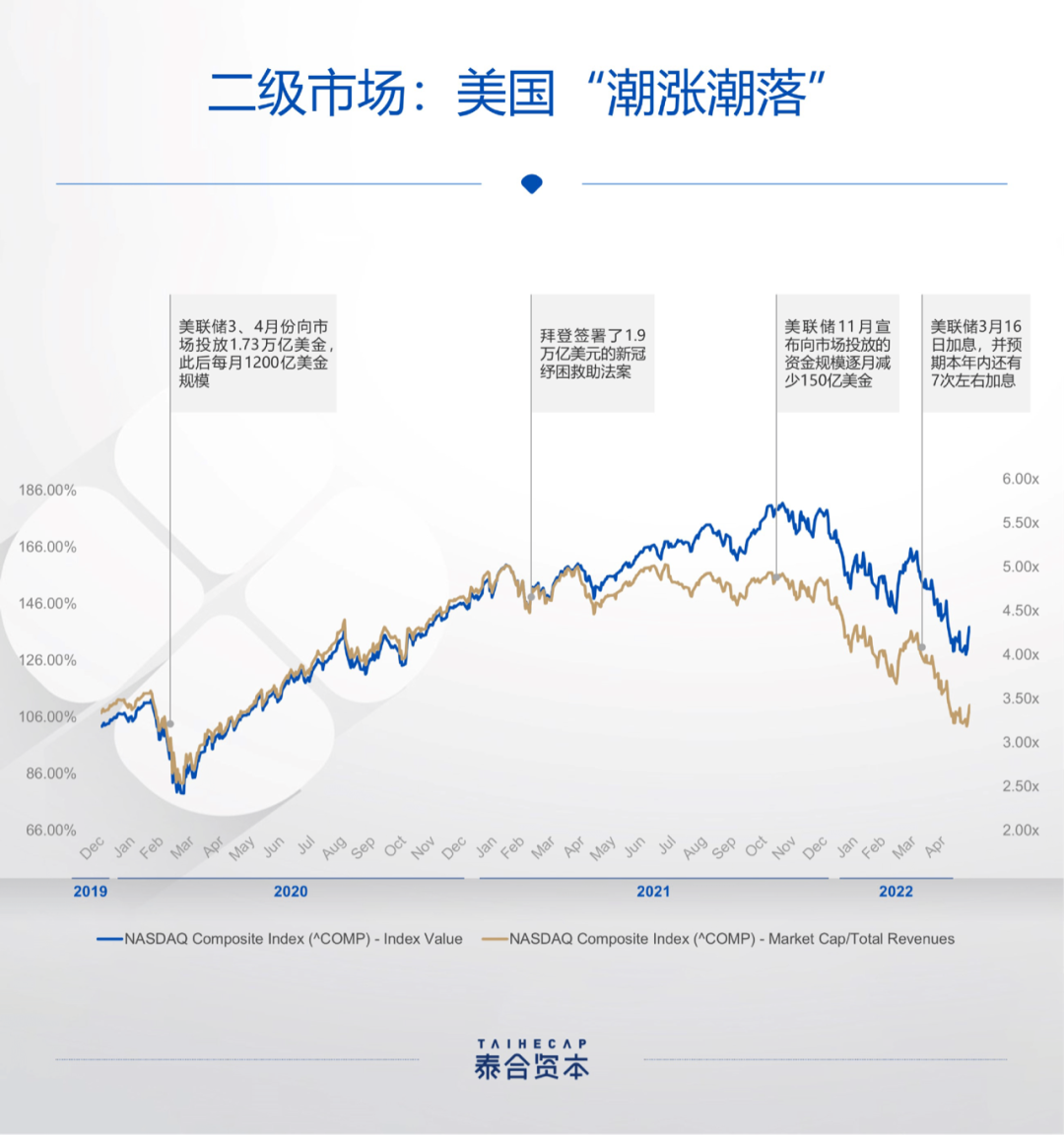
With market liquidity nearing exhaustion, stock prices propped up by cheap money could no longer be sustained. Investors began hitting the brakes, focusing more on near-term certainty rather than future expectations.
For Chinese companies, the US stock market is no longer a viable near-term option. Over the past year, more than half of Chinese concept stocks have retreated over 80% from their highs, and the SEC's provisional delisting list has expanded to roughly 180 companies. Negotiations between China and the US on audit oversight are destined to be a winding road, and any domestic company would be unwise to fantasize about a speedy US listing.
What about listing on domestic A-shares or the STAR Market? China is currently undergoing industrial restructuring, capital market reforms, and other measures — sound long-term medicine for economic health, but inevitably creating short-term turbulence that will directly impact many companies. Of companies listed on the STAR Market this year, over two-thirds have fallen below their IPO price to date, with average declines around 30%. Everyone must fully recognize that the A-share market is one that heavily weighs fundamentals and profits — a very pragmatic market.
We are in an overall declining capital market environment, where short-term secondary market volatility transmits more rapidly to primary markets, directly affecting primary market fundraising.
Primary Markets: Everything Has Changed
From 2010, China's primary market equity fundraising total basically trended upward year by year (2019 saw a slight decline due to the preceding capital winter and changes in statistical methodology). Everyone could feel that the past decade was absolutely a period of vigorous primary market growth in China.
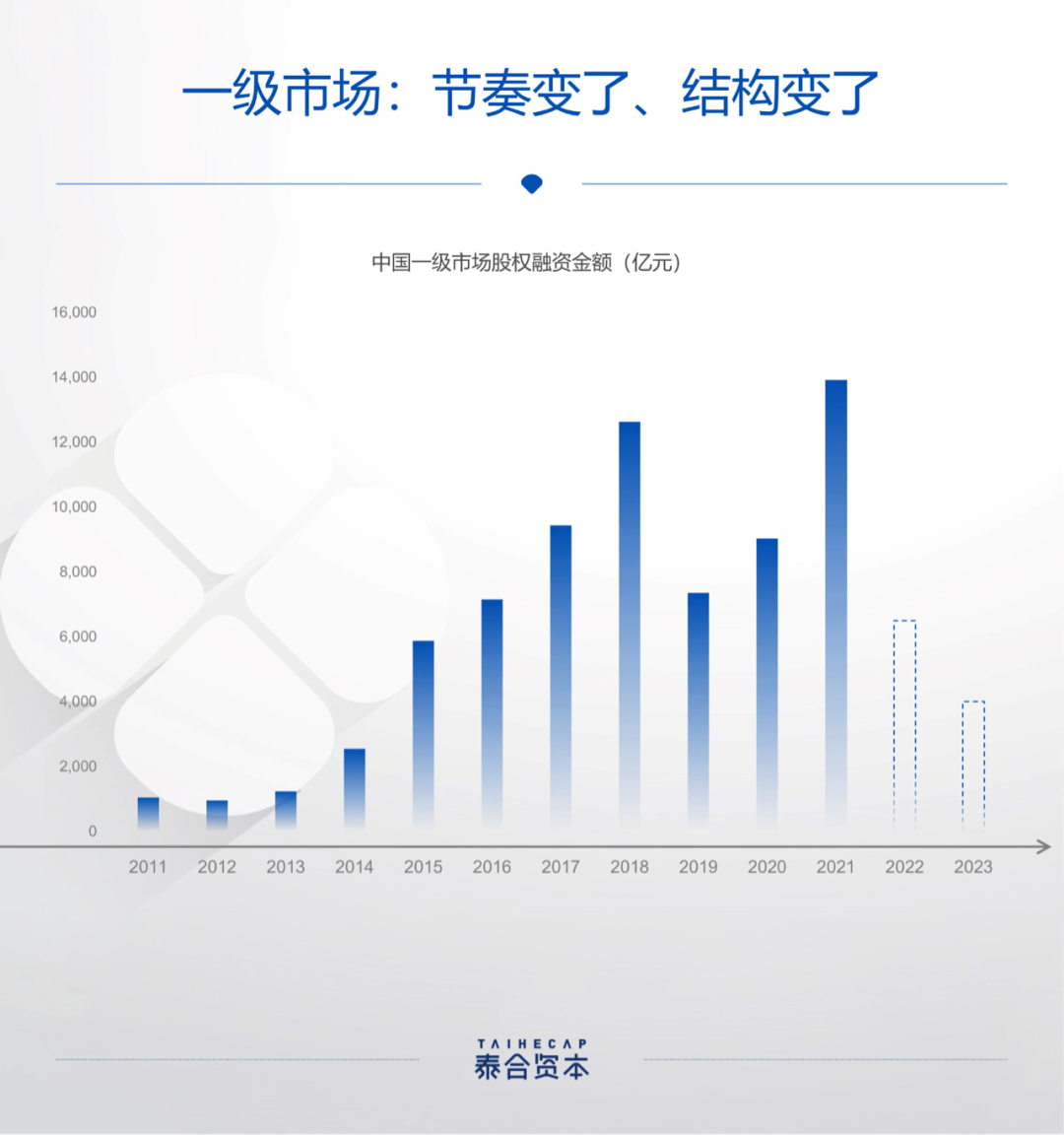
But this year, we've clearly felt shifts among market investors:
- 90% of pure dollar institutions have pulled back; large institutions are pivoting toward privatization, M&A, and other directions that require "big money, slow going." Previously active top dollar institutions have slowed their pace; some have even shifted attention to other Asian countries;
- 90% of investment institutions have slowed decision-making and pace. In the early days of the pandemic in 2020, we often heard stories of investors overcoming obstacles to meet founders and close deals — such tales have become rare this year. If last year's primary market was "invest whenever eligible," this year it's become "don't invest unless necessary";
- Who is still deploying capital? More conservative national team funds, government guidance funds, and the like — with their own distinct decision-making discipline and rhythm, focused on the numbers and exits.
Under the dual shifts in capital structure and investment pace, I judge that total primary market equity fundraising in 2022 will likely be cut in half. The main forces propping up this year's total will be "national team" funds, government guidance funds, industry capital across sectors, and financial institutions with relatively low capital costs such as securities firms, banks, and insurers.
Beyond changes in investors, the entire market's investment paradigm and aesthetic preferences have shifted. Today's primary market can be summarized by "two tendencies":
- Primary markets becoming secondary-like. In many current fundraisings, especially at later stages, fewer institutions are willing to lead independently; individual institutions' decision-making independence has declined. Everyone cares about who else is co-investing, whether industry players bring resources, whether existing shareholders continue supporting, and so on. Without one-on-one pricing, the fundraising process increasingly resembles secondary market "subscription for shares";
- Term Sheet NDA-ization. The seriousness of term sheets institutions issue has declined, with decision-making pushed later — an operational necessity for institutions to be more cautious in a down market. Previously, issuing a TS essentially confirmed investment intent; now it's merely a way for some institutions to obtain more information, with seriousness comparable to an NDA. Many fundraisings can see changes up until the final wire transfer. In this situation, founders can only try to collect more TSs to ensure fundraising security — where previously one might collect TSs for 1.5x the raise amount, now it's 2-3x, yet final closings may still only reach 80% of intended amounts.
As overall market uncertainty increases, investor attention naturally returns to companies' own health — focusing on "health indicators," fundamentals, and the like. Market investment aesthetics have become "three must-haves": growth, profit, and cash flow, all together.
Founders might say: if I've achieved all that, why do I need your money? Fair point. But market fortunes turn. In good times, many founders' demands of institutions were also "three must-haves": brand, valuation, and resources.
In such a rapidly changing market, some things remain constant.
For instance, early-stage project fundraising rhythms have been relatively less affected. From our frontline sense, currently 90% of Series A and Pre-A projects have seen basically no impact on fundraising pace. This is partly because early-stage investments are further from exit, with overall more reasonable pricing, so investor enthusiasm hasn't changed much.
Another constant: the ultimate purpose of investment institutions is always "making money." All investment institutions ultimately exist to generate returns for LPs; in down markets, if exits are poorly managed, the next fund becomes harder to raise.
For institutions to hold the "making money" bottom line, they necessarily require their portfolio companies to be healthier (ideally with self-sustaining profitability) and safer (cheaper entry prices mean higher probability of returns). Consequently, institutions increasingly emphasize post-investment management, hoping to provide more help to companies in their portfolios.
The "123" Rule and "3 E's" Toolkit for Fundraising
I've always held that all fundraising strategy adjustments are tactical, and tactics must always serve strategy. Strategically, companies should be fundamentals-centric: maintain strategic resolve, execute on fundamentals, and respond to change through constancy.
Company: 1 Year Winter, 2 Years Provisions, 3 Years Health
From a pure company fundraising perspective, founders should best prepare for "123": 1 year winter, 2 years provisions, 3 years health. These three numbers mean: expect capital markets to remain cold for 1 year; stockpile at least enough cash for 2 years of operations; and aim to reach a relatively healthy state within 3 years.
1
The "1 year winter" judgment is somewhat empirical. Looking back at major market shocks I've experienced — whether the 2008 financial crisis or the 2015 A-share crash — the blow to market confidence was so severe that primary markets tightened for over a year each time. From a macro perspective, the Fed's planned rate hikes mark the beginning of a new liquidity tightening cycle, and with China-US friction ongoing, no near-term window for market warming is visible.
So, facing a potential winter exceeding one year, I advise founders to choose the right timing and the right people.
Choosing the right timing means ideally fundraising at your company's own business inflection points or capital market windows. Every founder should carefully map out their company's key milestones over the coming year — product mass production, customer lock-in, commercial deployment, and so on — and initiate fundraising around a compelling node when you can show something real. That's relatively the better choice.
Capital market windows refer to smaller openings. I judge two may appear this year: first, June-July, as some regions emerge from lockdown, institutions will have pent-up investment demand; post-resumption, some industries will see shakeouts, and some companies will experience growth from supply chain recovery and changed fundamentals — investors need to see projects and deploy, creating a revenge rebound. Second, around October, policy may release new certainty, and newly raised funds needing to deploy within the year may also position in suitable sectors.
Choosing the right people means selecting the right investment institutions and partners. The right people matter enormously. For industry investors who can provide upstream and downstream resources, companies can appropriately lower valuation in exchange for genuine business support; for institutions you want to target — say, if you specifically want to attract "national team" or government guidance funds — you can pursue targeted outreach, or maintain long-term contact and gradual cultivation to eventually succeed.
In poor markets, your partners themselves must be fully prepared for hardship and willing to weather it with you — don't find partners who might abandon ship at any moment.
2
"2 years provisions" isn't an absolute number; rather, if you need three years in winter to reach healthy development, then leaving yourself 18 months to two years of cash flow would be relatively comfortable, while one year is the red line. Founders can add insurance to company cash flow from several angles:
- Increase non-business cash flow sources, such as renegotiating payment terms with upstream and downstream industry partners, or adding financial cushion through venture debt during fundraising — all good potential "revenue-opening" options;
- Reduce unnecessary business exploration; spend less on cross-boundary expansion. This is an age-old topic, but founders must not overestimate their ability to expand and manage multiple business lines. Don't lightly initiate a second curve. In down markets, capital should mainly go to strengthening core business moats and enhancing risk resilience;
- Reduce inefficient human capital investment. For instance, if your product isn't good enough yet, don't spend broadly to build a sales team. With talent currently expensive across the board, founders should more carefully consider what talent they truly need and what short- and long-term incentive tools to use to attract it.
3
"3 years health" requires defining what "healthy" means.
Getting a company to healthy status means: if you have no product now, you must actually build it within three years; if you have no major customer contracts, you must hold onto customers and land your key orders; if you have some revenue now, you must maintain basic growth while narrowing losses or even achieving profitability — stop spending two yuan to earn one yuan.
This is very pragmatic. As the company's number one, in a down market you'll likely have to grope forward largely alone. You must think through where demand lies, who your customers are, and clearly know who your first customer is, what your first product is, where your first yuan of revenue and profit will come from — absolutely no "take it one step at a time." In bad markets, without capital to accompany your "one step at a time," your groping becomes far more difficult.
"3 E's": A Toolkit for Founders
The above covered the "123" guidelines for company fundraising; what follows is for founders themselves. I've prepared a "3 E's" toolkit for all founders grinding through down markets — hope it's helpful.
Bottom-line consciousness — Earning
A commercial organization must take profitability — Earning — as its purpose, and the core of profitability is delivering value to customers.
Company valuation is price; price fluctuates around value. Value is what a founder truly creates. At Taihe we often say: "No merit, no reward; with merit, reward must come." All real Earning starts from customer needs. Understanding customer needs, solving customer pain points, retaining customers — these are all processes of delivering value to customers, and thus holding the bottom line.
The metric most directly affecting your "Earning" is gross margin. Your gross margin represents your pricing power in the industry chain; where there's value, there's pricing power.
Of course, gross margins vary by industry — don't obsess over an especially high margin. But you must have this consciousness of holding the bottom line and creating value.
Long-term thinking — End-game
End-game means the final state of the game. Entrepreneurship is often a process of reasoning backward from the end.
I believe many founders get asked about TAM (Total Addressable Market) during fundraising. It seems like a routine question, but our Taihe team sits down seriously every time, pressing the founder to work through it properly. Some founders might directly say it's a 10-billion or 100-billion-level market, but you must do serious market research, ask customer needs, grab data, find benchmarks, and get the numbers right.
This is the most important strategic step for any founder: you must know what battlefield you're on, whether it truly exists, whether it's large enough, and what格局 the market will ultimately take — winner-take-all or a hundred flowers blooming?
Under different inferred outcomes, you'll set different growth strategies and profit targets for your company, working backward level by level to form the most important strategic decisions for a startup at this moment.
Recently, chatting with an excellent founder in the automation space, he mentioned that before doing anything, he likes to think: what will my industry and my company look like in 10 years, and reason backward from there for present decisions. I think this is an excellent mental model, and recommend it to every founder: what will your market look like in 10 years? What demands will persist unchanged? Will your company survive to its eleventh year? These are all fascinating questions.
Entrepreneurial spirit — Entrepreneurship
At this point, many friends may be frowning, thinking entrepreneurship is simply too hard — needing to think about earning with feet on the ground, and end-game while looking up at the stars. Who says it isn't? But this may be precisely where entrepreneurial spirit (Entrepreneurship) shows its power: the harder the times, the more they test founders.
My understanding of entrepreneurial spirit starts with responsibility — to customers, employees, and shareholders. Responsibility is not compliance; it's not doing whatever shareholders say, kowtowing to customers, or pandering to employees. Rather, it's earning equal respect from shareholders, winning customer support, having the ability to define the team's mission, vision, and values, and leading the team to overcome difficulties and emerge from困境 together.
Second is passion. Over my decade in entrepreneurship, what I love most about this work is constantly encountering excellent entrepreneurs full of passion and infectiousness, and being fully inspired by them. A founder's passion for their undertaking must be written on their face and shining in their eyes — this passion can ignite a group of like-minded people.
Additionally, I believe an important aspect of entrepreneurial spirit is resilience. Resilience means being able to bend and stretch. For truly resilient founders, what's a temporary valuation haircut? What's momentary loss of face? My enterprise surviving and outlasting others — nothing matters more. Every extra day of survival means infinite possibilities compared to those who didn't make it. This直面 reality,坦然 acceptance, and hard-wearing toughness is, in my view, the most important entrepreneurial spirit.
I wish all founders can hold their company's bottom line, focus on long-term questions, exercise entrepreneurial spirit, make full preparations for difficulties, maintain healthy bodies and good心态, and take their enterprises farther and help them live longer.


Issue 23: Eight Questions on Going Global: Where Are the New Business Opportunities?
Issue 22: Dealing with Supply Chains Amid "Turbulence"
Issue 21: Clear Despair Beats Vague Hope — On ToB Sales During the Pandemic
Issue 20: Is Your Cash Flow Still Healthy During the Pandemic?
Issue 19: Founders Must Learn to Appropriately Let Go
Issue 18: Founders' Time Management — "Two Learnings, Three Principles, Four Quadrants"
Issue 17: Your Core Startup Team Needs a "Deep Dialogue"
Issue 16: Three Keywords in Corporate Crisis Management from 3·15
Issue 15: The New Evolution of InsurTech
Issue 13: Financial Opportunities in Industrial Internet
Issue 12: Strategic Thinking on Douyin Marketing for Consumer Brands
Issue 11: Inclusive Finance Under the New Economic Situation
Issue 10: Brand: Meaning, Symbol, Value
More MaHui members can click "Read Original" to view