Lianjia's Zuo Hui: The Changing and Unchanging Real Estate Market

Decoding the Future of the Real Estate Market
On April 20, Source Code Capital's 2018 Ma Hui annual meeting, themed "Open Source Iteration · Decoding the Future," was held in Beijing. Zuo Hui, Chairman of Lianjia Group, delivered a keynote speech titled Change and Constancy in the Real Estate Market.
Zuo Hui noted that turbulence in the real estate sector is intensifying, driven by shifts in China's demographic structure and population concentration. An increasing number of cities are experiencing premature aging and rapid decline. However, population concentration does not necessarily lead to lower resource utilization efficiency.
For example, Lianjia's research shows that with the emergence of bike-sharing, rents around subway stations have indeed declined, while rents three kilometers away have converged toward subway-adjacent levels.
Amid these trends of change and constancy, the digitization of the real estate industry and the operation of public spaces present significant growth opportunities. China's annual new property development amounts to roughly 10 trillion RMB, with approximately 1 billion square meters delivered. Looking ahead, developing residential properties better suited to mobile internet trends also holds enormous potential.
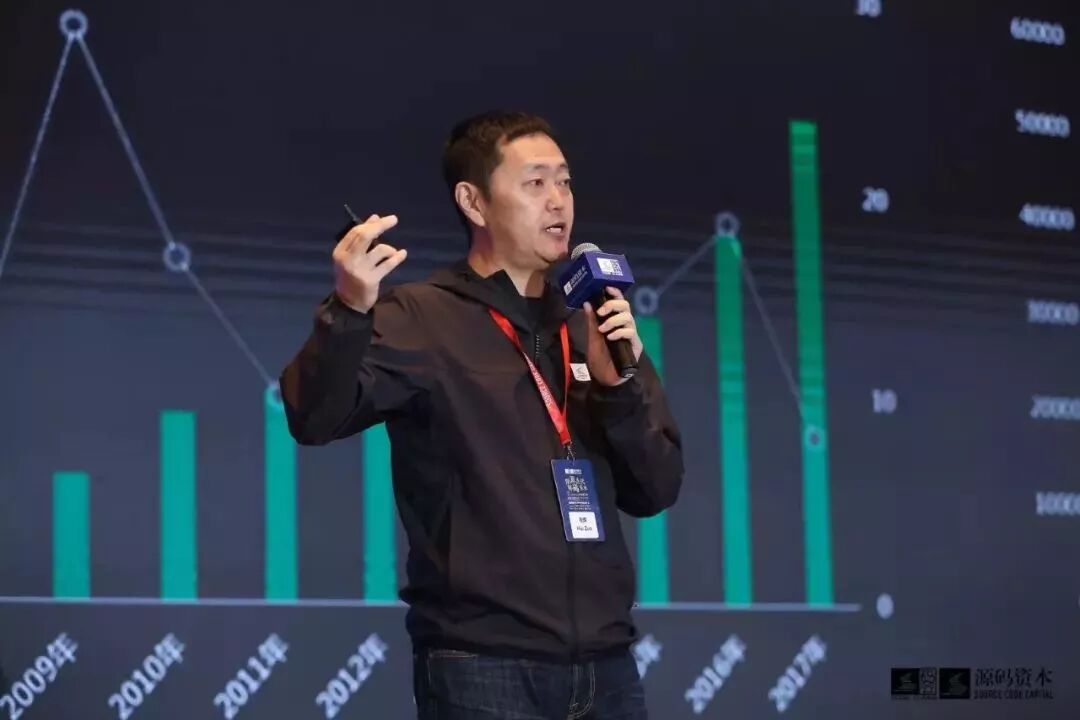
Zuo Hui, Chairman of Lianjia Group
Full text of Zuo Hui's speech below
Good morning, everyone. Real estate is a fairly large-scale industry, and for capital, it's often impossible to bypass. Last year, we saw SoftBank's Vision Fund invest several billion dollars into the real estate sector, including Airbnb and many other categories. What changes are happening across the entire real estate domain? This is something people have consistently cared about.
1 Changes in the Real Estate Sector
We can see that turbulence across the real estate sector is becoming increasingly intense. In recent years, what we've focused on most is what China's residential transactions will look like in the future.
Looking at global comparisons, one useful metric is the home purchase rate per thousand people — how many transactions occur on average per thousand urban residents, and what those transactions look like. From what we've observed, this rate should be a constant. For China, the oscillation around this constant has grown larger over the past decade.
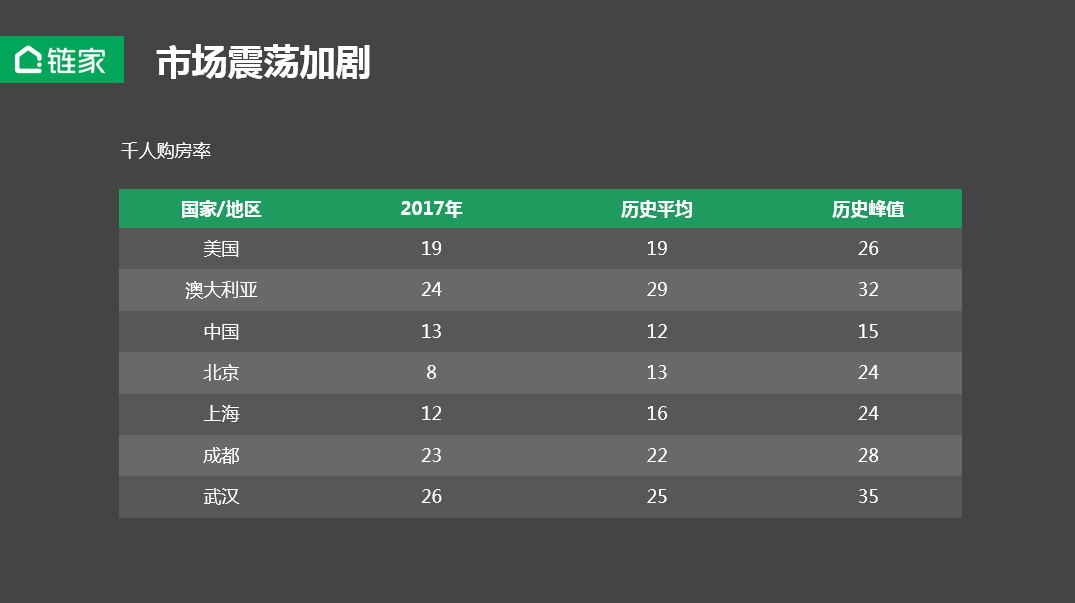
Image source: Lianjia Group
We can see that over the past decade, Beijing's home prices rose 5x, Shanghai roughly the same. Behind this 500% growth lies extremely sharp market volatility. At the same time, we can see other cities like Chengdu and Wuhan where prices appear more stable, with correspondingly steadier changes in the home purchase rate per thousand people. In fact, we've examined data from many regions, including Japan, the United Kingdom, and the United States. Relatively speaking, markets with smaller fluctuations in the home purchase rate per thousand people also experience smaller home price volatility. From an organizational management perspective, how do we counter these fluctuations? In truth, such volatility occurs not just in real estate but across many other sectors as well.
Looking back at how returns on various asset classes have changed over the past decade — for instance, returns on mainland China's stock market have ranked first among all asset classes one moment, then last the next — this illustrates the intense volatility across asset classes. For us, this translates into market volatility. Whether we're making investments or running businesses, our core challenge is how to respond to this volatility. This is a crucial proposition we must address.
Reviewing Beijing's month-over-month home price changes over the past decade, we can see that within this 500% increase, the truly dramatic fluctuations occurred across just 12 months, which contributed nearly half the total gains. This is a very strange phenomenon. In other words, our changes are not uniform but rather occur as sudden shifts during certain periods. These sudden shifts trigger many reactive responses.
Lianjia is already a fairly large residential transaction platform today, and we need to consider how to respond to various reactive responses. Of course, we also need to consider whether Lianjia has the capacity to contribute to smoothing out these fluctuations — this is a very important direction for our future thinking.
2 Changes in Demographic Structure and Population Concentration
The second factor: China's overall population is undergoing very significant changes. This chart shows how the proportion of population aged 0-14 has changed over the past 50-plus years. You can see that the proportion of young people in China today is declining very rapidly — far faster than GDP growth. This is frequently discussed, but when you actually see the data, it's still quite shocking.
We can see that the proportion of young people in China today is already far below that of middle-income countries and very close to high-income countries: China's average age is now 10 years older than India's and 15 years older than Vietnam's. This situation will have some fundamental impacts on real estate and other businesses going forward.
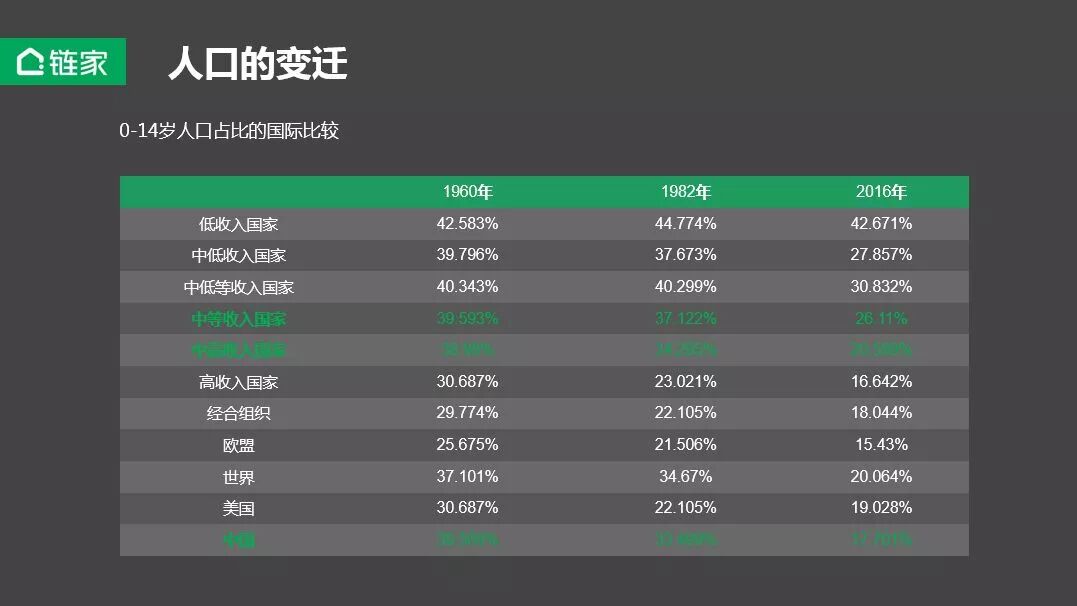
Image source: Lianjia Group
While our demographic structure is changing dramatically, population concentration is undergoing even larger shifts. Among the roughly 300 cities we can observe at the first-tier level, an increasing proportion are experiencing population decline. More and more cities are in a state of premature aging, decaying rapidly.
In other words, population is still concentrating rapidly toward central regions. This is the 2016 dependency ratio data by province (the ratio of working-age population to dependent population). Guangdong's dependency ratio exceeds 9, indicating that the Greater Bay Area is attracting more and more young people; meanwhile, the three northeastern provinces, including Inner Mongolia, have ratios of only around 1-point-something — a very alarming situation.
We can see that much of the change in China's population concentration today is being driven by a wave of major second-tier cities. Some of these situations are quite rare in the entire history of real estate: residential supply can be divided into three main portions — for C-end consumers, for B-end businesses, and government-provided. Typically, government provision targets low- and middle-income groups. But today, a major wave of provision initiated by certain second-tier Chinese cities is effectively subsidizing talented, capable young people, including cities like Wuhan, Hangzhou, Nanjing, Xi'an, and others. There was a joke circulating recently that Xi'an police were stopping people on major roads to ask if they were college graduates — if so, they'd help them get household registration.
In this process, we're also examining what changes might occur in various cities' attractiveness to young people, and which cities might prove more appealing. This has much to do with urban environments, management philosophies, and even inherent city characteristics. Take transportation, for instance — congestion is severe across all of China, and third- and fourth-tier cities today are no better than Beijing. What changes might occur in people's living conditions within a city, or what variations might exist between cities, are all closely tied to future population flows.
We have one judgment: population concentration does not necessarily lead to lower resource utilization efficiency. We have a very valuable metric: the number of intersections per square kilometer in various cities. We can see that in Shanghai's Pudong district and Beijing, there are only about a dozen or so intersections per square kilometer, while Tokyo and Paris have roughly around a hundred. This is quite interesting, because the distance between intersections affects a city's efficiency and services. Even within China, the variance in this data is substantial — Shanghai's Puxi area has about 80, making Pudong and Puxi completely different. Many Chinese cities are building new districts, and typical new districts feature very wide roads with hardly any people and few street-facing shops. Looking at Tokyo: over the past decade, Tokyo has experienced further population concentration, and now the daytime-to-nighttime population ratio in Tokyo's eastern and western districts has reached about 85% — meaning that during daytime, 85 out of 100 people don't leave. What changes occur in the city itself under this trend will also have significant implications for our commercial real estate.
We recently conducted research on how infrastructure changes — such as bike-sharing — affect urban rents. What we found is that with the emergence of bike-sharing, rents around subway stations have indeed declined, while rents about three kilometers away have converged toward subway-adjacent levels. This shows how talented young people distribute themselves across China's urban areas is also a very significant variable going forward.
3 The Digitization Trend in Real Estate
Another important trend is digitization. In my view, real estate is one of the last, or among the last few, industries in China that are still struggling to move online. Why is it so difficult? Because the entire chain is too long. Under such circumstances, genuinely driving consumers toward substantial online consumption is quite challenging.
This is the PV and UV data behind each real estate transaction that we've observed. Don't look at the United States — American real estate transactions are a very special case because they have MLS (Multiple Listing Service), which has suppressed development across the entire sector. But we can see many other countries, including the United Kingdom, Australia, and others, have fairly clear digitization processes. From Lianjia's data, each transaction corresponds to 10,000 PVs, and in Beijing, 20,000 PVs. This far exceeds the industry average of roughly 3,000 PVs. This means that the first wave of online users and related data in real estate is emerging — this is the beginning of online real estate transactions. Many industries today, from manufacturing to transaction platforms to services, are undergoing a process of data digitization, and we ourselves believe this represents a major opportunity going forward.
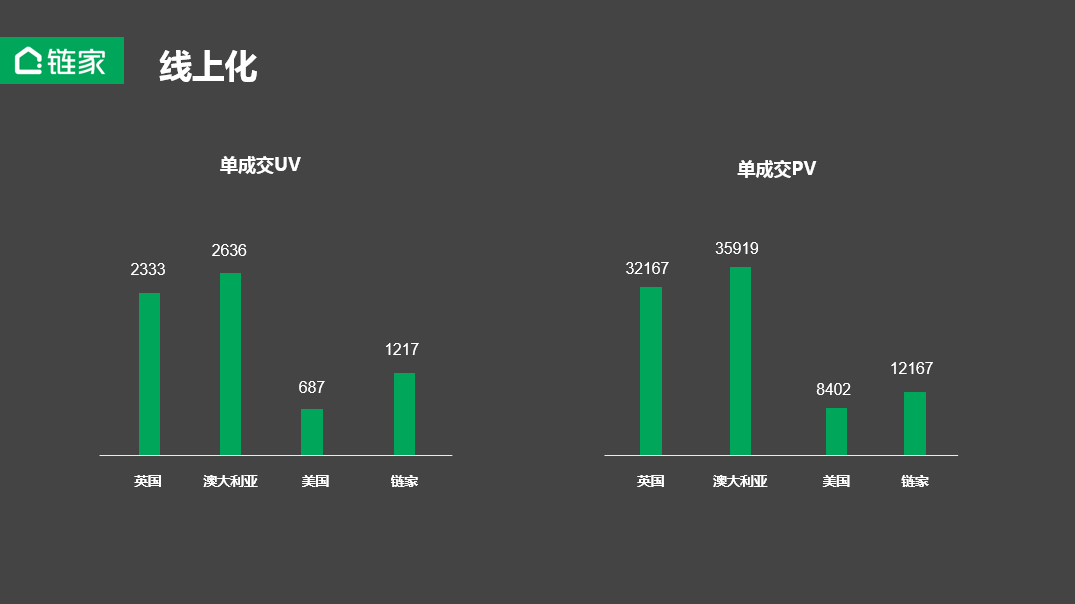
Image source: Lianjia Group
Additionally, China's annual new property development amounts to roughly 10 trillion RMB, with approximately 1 billion square meters delivered. Yet we see very few developers creating residential properties better suited to today's new era, to mobile internet — food delivery and so forth.
We see that compared to decades ago, today's residential properties have increasingly grand entrances, but the fundamental usage of residential space hasn't essentially changed from 10 or 20 years ago. In other words, our physical structures are becoming increasingly inadequate at accommodating the changes of our era, which of course also creates new opportunities.
There's a new construction technology company in the United States called Katerra, also backed by SoftBank. I believe many construction technology companies will emerge in China as well, such as BIM technology, ultimately digitizing the foundational data of real estate's physical structures — this is a major trend we see today.
Relatively speaking, the real estate transaction chain is extremely long. Today we see many long-chain industries — real estate transactions and home renovation/furnishings are very typical examples, both with GMV in the trillions. Yet within the entire real estate transaction market, the highest-valued company today is worth less than $10 billion, and companies in the renovation/furnishings industry are even smaller and more fragmented. Why is this? Looking at it now, the relatively simple things in commercial delivery have already been done by the internet; what remains are complex delivery formats. In these complex delivery domains, where does new value creation come from? This is something we ourselves are very focused on.
From our perspective, the main problem across complex delivery formats is coordination among multiple roles — how do we create new roles, how do we eliminate old roles, and among these multiple roles — between so-called platforms and B and C parties — how do we create more valuable coordination, how do we get all data to manifest online? These are the core changes we hope to see going forward. Such changes are already occurring in real estate transactions, while in the renovation/furnishings industry they're just beginning, and there will be substantial directional changes ahead.
We can see that startups in both China and the United States are working in this direction, attempting to decompose the multiple roles within long value chains more clearly and make coordination more efficient. So I believe this is an important direction of change for real estate and related industries going forward.
4 Public Space Operations
Finally, I feel there's another major direction going forward: the operation of public spaces. We can see that commercial complexes in various cities are becoming increasingly large, and commercial complexes have become a core standard feature of cities; they aggregate massive amounts of commerce, including various dining, entertainment, and art offerings, and are becoming increasingly diverse — essentially functioning as a city's public space. Another example is co-working spaces; the core difference between co-working and traditional offices lies primarily in the operation of public spaces.
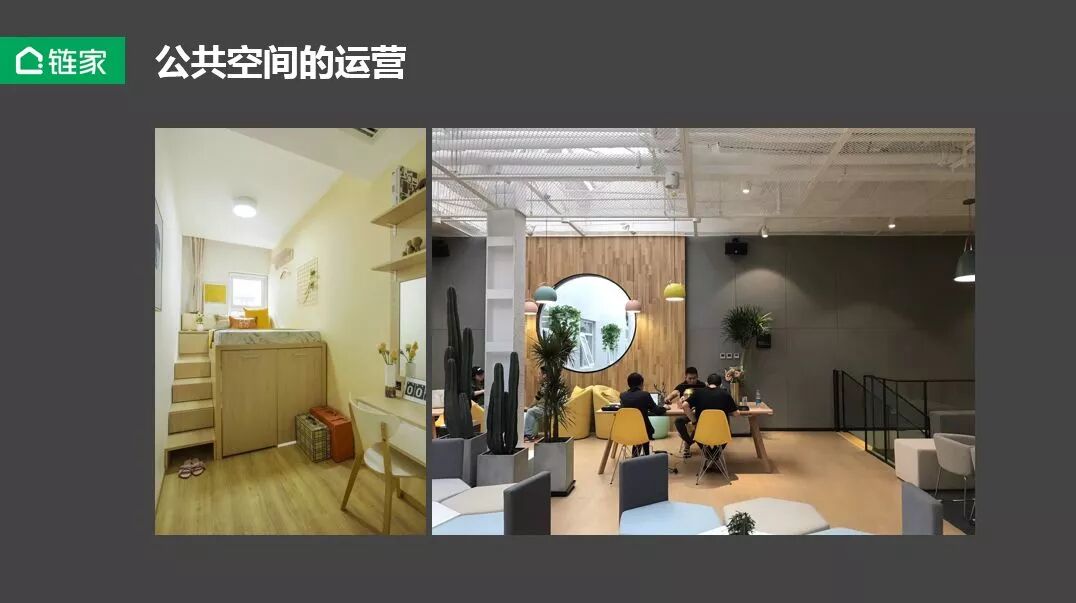
Image source: Lianjia Group
To operate public spaces well, there are two core characteristics: one is public space operation itself, the other is membership operation. In a city like Beijing, there are roughly 8 million floating population, and most of these are blue-collar workers — how to address their housing is actually a very significant problem. Previously we addressed this through various non-standard residential options, but we'll face many problems going forward.
Today people frequently discuss how to get the market to provide standard residential units at 1,000–1,500 RMB per month in rent — this is a very substantial problem. You can see in the image the rooms in the blue-collar apartments we've developed — very small, only about 8 square meters, and achieving 1,500 RMB rent for 8 square meters is already very tight — this is China's reality, there's no way around it. In an 8-square-meter room, aside from a 1.2-meter bed, remaining space is quite limited, but outside the room is the public area. In lower-end products like blue-collar apartments, how to use small private spaces paired with effectively operated public spaces to improve the overall product experience — this is also a very significant change. There are many similar changes; for instance, our communities today basically have no public space. In the future, communities will also give rise to new public spaces, and how exactly to operate within these public spaces remains to be addressed.
To briefly summarize, we feel that the entire real estate industry is still undergoing very substantial changes, and more money will flow into this sector. Taking this opportunity, I'd like to offer some directional reference points for everyone.
Thank you, everyone!
Past Ma Hui articles
3rd Edition | Yiming Zhang: What CEOs Should Avoid — The Arrogance of Rationality
3rd Edition | Zuo Hui of Lianjia: My Understanding of the Real Estate Industry
3rd Edition | Chen Qi, CEO of Meili United: The Difference Between Mules and Unicorns Is Focus
3rd Edition | Qin Zhi: The Things Only Entrepreneurs Can Teach Themselves
3rd Edition | Zheng Yu of Microsoft Research Asia: AI Applications in Urban Management and Business
3rd Edition | What Pitfalls We've Stumbled Into During Three Years of Entrepreneurship
2nd Edition | Xiang Li's First Discussion of CHJ Automotive: Transforming Urban Mobility
2nd Edition | Yiming Zhang: Why I Don't Agree with Controlling Labor Costs
1st Edition | Zhuang Chenchao: How Should Startups Compete? How Should They Lose Money?

Source Code Capital
Creating Lasting, Real Value

WeChat ID: sourcecodecapital
More professional content
Follow our official WeChat