Code Brain | Clear Despair Beats Vague Hope: On ToB Sales During the Pandemic

Together for a Shared Future
#Code Brain Ecosystem Connection, Cognitive Resonance
Since the beginning of this year, international dynamics have shifted profoundly, while domestic COVID pressures have intensified. In response, Source Code Capital designed the "Together for a Shared Future" lecture series. From April to June 2022, we hosted online sessions covering macroeconomics, industry trends, and company operations — standing firm with founders on entrepreneurial conviction, strategic steadiness, and sustainable progress toward the future.
*Content from the "Together for a Shared Future" series will continue to be shared.

Zhao Lei | VP of Sales at a Pre-Unicorn Company
Former General Manager of Oracle North China Region
Zhao Lei is VP of Sales at a pre-unicorn company and former General Manager of Oracle's North China Region. He brings 20 years of sales and sales management experience in enterprise services, with deep expertise in financial services and manufacturing. He joined Oracle's middleware business unit in 2008, rising from frontline sales to Director of Large Enterprise Industries for North China, National Sales Director for Financial Services, and ultimately General Manager of the North China Region over a decade.
Guest Presentation
- To B sales during COVID: brutally hard
- Before problem-solving, align on what a sales organization actually is
- Where do new customers come from during COVID?
- How to set annual targets
Clear despair beats vague hope. I've lived by this motto; it's etched into my bones across my entire sales career. Sales is often driven by emotion and subjectivity. The challenge is stripping that away to see what's real — this matters enormously for sales management and serves as a guiding principle that I apply to every concrete task.
To B Sales During COVID: Brutally Hard
The challenges facing To B sales teams under COVID are plain to see. Marketing events are hard. Client visits are hard. POCs are hard. Budgets are hard. Collections are hard...
Marketing events are hard. Events and conferences have been hit hardest — previously essential for To B marketing, whether through participation or hosting, these activities are now impossible.
Visits and communication are hard. Without face-to-face interaction, communication costs spike dramatically. You can't physically sense client needs, and efficiency plummets.
POC testing is hard. POC testing, or Proof of Concept, is the industry-standard validation test for client-specific applications. To B business regularly requires POCs, which demand extensive upfront communication, requirements alignment, presentation, and reporting — bringing us back to the communication problem.
Budgets are hard. Many companies have tightened budgets amid the broader environment, heavily impacting To B sales.
Finally, collections are hard. The critical post-sale step is now universally slower.
Summed up professionally: customer acquisition channels are blocked, sales efficiency is down, and financial risk is up.
Two formulas can objectively capture how these pain points affect sales. Transaction volume, deal size, win rate, and sales cycle length are the four critical factors across the sales cycle. Transaction volume means number of closed deals. Deal size is the value per deal. Win rate is conversion rate — out of 100 deals, is it 30% or 50%? How accurate is that forecast? Sales cycle length is days from first client visit to closed deal.
Per the formulas, if through various efforts we increase transaction volume and win rate by 10% each and shorten sales cycle by 10% in a given period, company revenue grows substantially. Conversely, if factors push all metrics down 10%, even single-link decreases create major overall impact. This is the severe predicament facing To B sales today.
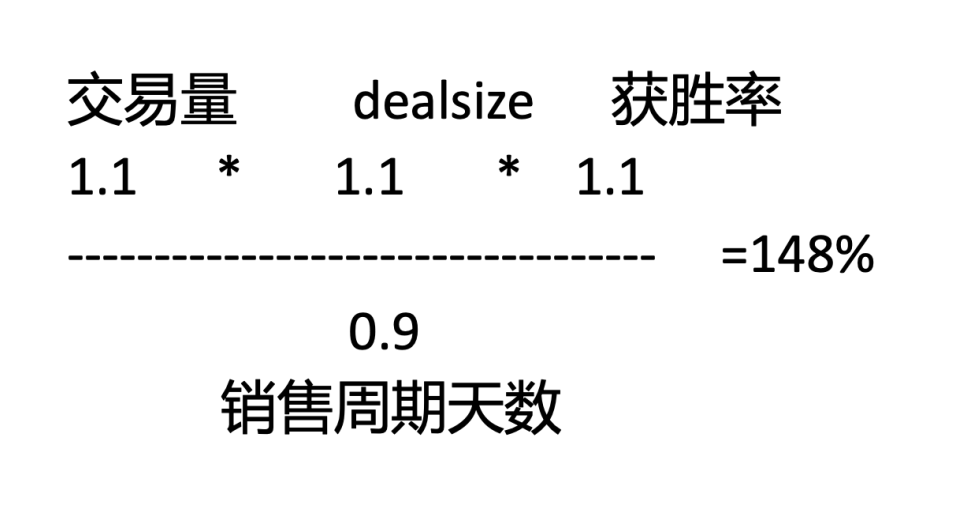
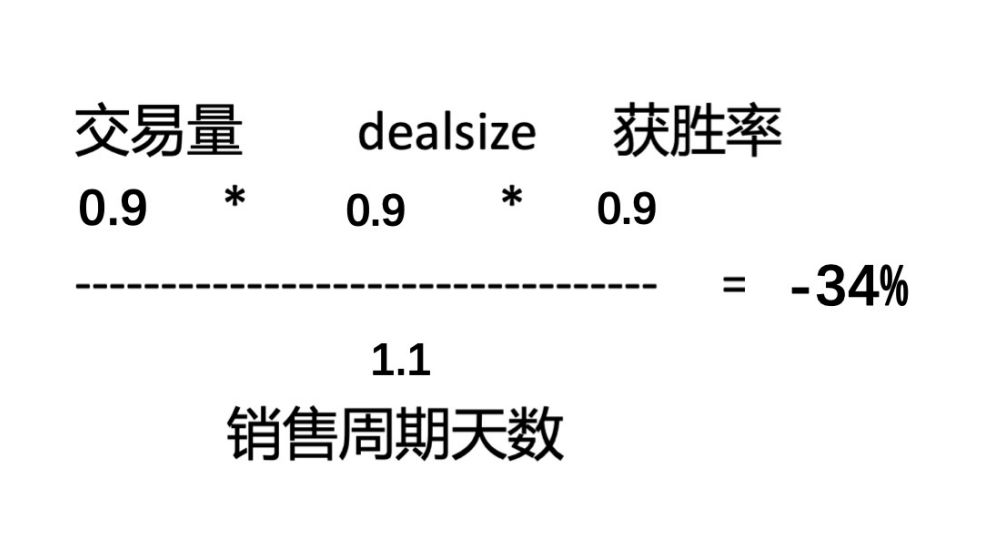
Image source: Guest presentation slides
Before Problem-Solving, Align on What a Sales Organization Actually Is
Will transaction volume shrink? Will deal size shrink? Will win rates drop? Will cycles lengthen? All these questions point to one thing: per-person efficiency. Under COVID, how do we protect "per-person efficiency"? I believe the key is building a sales organization that can match growth.
Organization ensures every link isn't isolated — people become interdependent, coordinated, and efficient. So before discussing how to solve for "per-person efficiency," first ensure you can build a growth-matching sales organization. Several dimensions matter:
1. Standardize metrics and what you measure. Simply put: what exactly are you monitoring in sales management? Often people jump straight to final results — collections, signed contracts — but this fails because it leaves the CEO blind to process. You need "process values." But before setting process values, standardize metrics and measurement targets. What are the links in the sales chain, and what are their objects, responsibilities, and relationships? In my team, I weight "test volume" heavily because I've found: when test volume rises, win rates hold. Every business differs; identify where to measure based on your business characteristics.
2. Consistent communication language. Inside the company, is there precise description of the same problem? This is prerequisite for efficiency. Salespeople often say "Focus" and "forecast" — what do these actually mean? When different departments use them, is everyone picturing the same thing? Unified language across front, middle, and back office enables consistent, efficient communication.
3. Standardize customer acquisition motions. Sales is repeating one method, repeatedly, not innovating. Make sales follow the same method repeatedly to test its validity and iterate continuously. At least 80% of everyone's actions should be consistent. Leave innovation to pioneers, not current salespeople. Don't make salespeople figure things out — they need to test process.
4. Standardize sales process data. The sales process is the sales funnel. Every funnel stage has process data that truly reflects organizational health.
5. Conversion efficiency. From getting contact info to closed deal — some say seven steps, some five; no fixed formula, depends on business model. Conversion rate at each step represents its efficiency. We must obsess over conversion rates.
6. Crystal-clear business objectives. What are we measuring sales against? Every item must be explicit. Every leader and every salesperson must clearly know the gap between required tasks and completed tasks at each stage.
7. Insist on data-driven decisions. Don't intuitively guess "roughly" what this month, quarter, or fiscal year will bring. Break it down and use actual data to describe current state. Human intuition is unreliable — a taboo in sales. This intuition trap needs platforms and systems to solve.
8. Build a company-wide dashboard. Not just sales — company-wide. Include SEs, CS, product, and marketing supporting sales. Everyone aligned, everyone sees it: where is data stuck? Where are blockages? Who's underfed? Who's overwhelmed? Crystal clear, not gut-feel discussion.
9. Build a closed-loop customer success system. This loop runs from new signings through delivery, renewal, and upsell — a seamless, role-differentiated flow from first contract to re-contract.
Simply put, building a growth-matching sales organization — these nine steps are explicit. Form them into systems, into standard SOPs. Build first, then optimize daily. These are what I consider the most important considerations for building a sustainably growing sales organization.
Where Do New Customers Come From During COVID?
Sales must solve two core problems: 1) how to acquire customers, 2) how to continuously improve individual efficiency.
In To B, opinion leader amplification or small-scale customer-educates-customer communication works extremely well. Find industry opinion leaders or "big brothers" and leverage their power and influence for events. Having them share experience works far better than us simply pitching product.
Since last year, large events became nearly impossible. We split budgets into smaller chunks with one paramount goal: get a trusted client to speak for us — not just about product, but about scenarios, problems encountered during solution implementation, and results. Have them invite their peers to listen or co-create. New customers understand and accept this much more easily. On this foundation, building your own community becomes crucial — communities expand circles and influence, making acquisition easier and more efficient. Future product launches become much smoother. So building your own community is an excellent approach for industry deep cultivation.
With efficient acquisition, how to boost individual salesperson efficiency? This seems broad; several angles help:
1. Trustworthy sales process data, growing volume, and accelerating speed prove strengthening sales organization capability. First clarify which process data to track. Then examine this quarter or half-year's data, including projections for the next three quarters — is there relatively stable growth versus last year? If yes, the sales system's self-sustaining capability and organizational core strength remain; don't panic. If major variance appears, something's wrong; investigate carefully.
2. Simplify incentives and make them immediate. Sales behavior is fundamentally about making money — people do sales to earn. From the sales perspective: make it easier to calculate earnings, provide environment and support to earn more easily — this is the strongest positive pull. Companies want many metrics completed, but overly scattered metrics confuse salespeople. Which metrics are truly core? How to link multiple metrics for coordinated pull? This tests managers.
Under COVID, we need salespeople working more proactively, so we incentivize for greater motivation to improve methods and efficiency. But long-cycle incentives (half-year or year) barely stimulate process behavior. So shorten incentive cycles, or make them immediate. My "immediate" doesn't necessarily mean cash — many can be spiritual. Money is more direct, but sometimes recognition works well too. This requires managers to be creative in finding suitable motivation methods.
3. Continuously iterate business processes with unified language, unified motions, unified data. Managers must recognize: sales activity isn't creative work, it's repetitive work. Repetition upon repetition of motions yields highest efficiency — never leave problems for salespeople to figure out themselves. For example, telling salespeople "you can't find clients, that's your responsibility, go find them yourself" is extremely inefficient.
Standardized sales process should be extracted and standardized internally based on business characteristics, with results handed to salespeople — not making them figure it out, or bringing habits and shadows from previous employers that may be irrelevant or contradictory to your business.
Build a strong sales operations team. Let data speak. Data decides many issues, especially for managers. This data isn't result data but process data — process data represents current state and efficiency of everyone. Only real data reveals where problems lie, identifies true bottlenecks, and solves them.
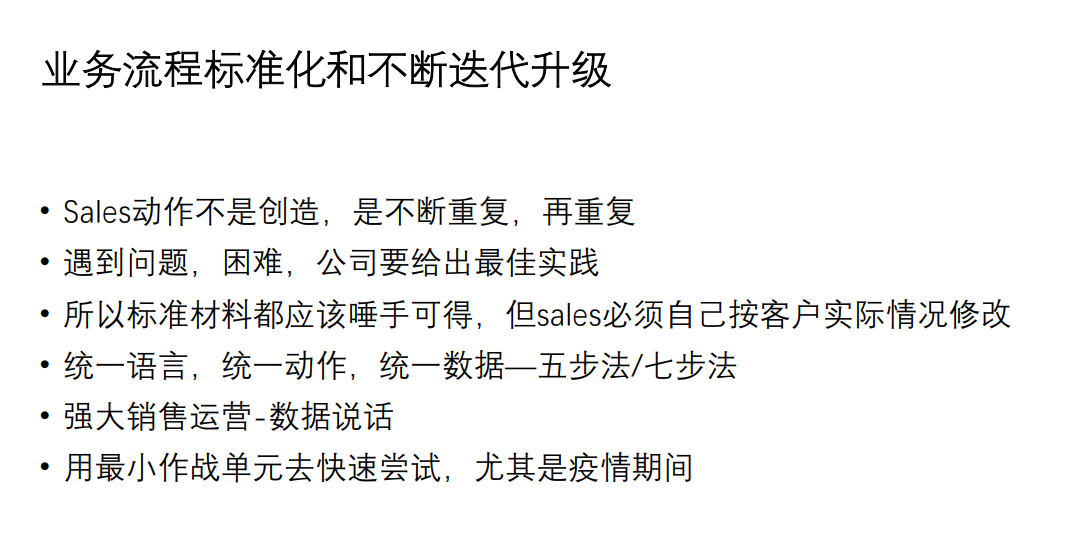
Image source: Guest presentation slides
4. Standardize remote customer engagement.
First, create ritual whenever possible. We require salespeople to enable video in client meetings — even if clients don't, you must, and wear formal attire. Let clients see you; this itself creates formal ritual. Also, salespeople should use language requesting clients enable video. Video-on signals client seriousness about this exchange. Other methods can create ritual too.
Second, establish internal standards for online communication — even if simple initially, continuously enrich and refine. Execution by everyone matters. Build good habits: even without COVID, solve online what can be solved online, skip the site visit.
Third, standardize language and methods for advancing matters. Take POC: we often hear "let's wait until COVID eases" or "can't go to office, can't do POC." We need to give salespeople standard scripts and ammunition — like recording peer POC results as video, or using rich charts to clearly present POC outcomes — helping them overcome these objections, showing clients they can start now, see results now, not wait for post-COVID.
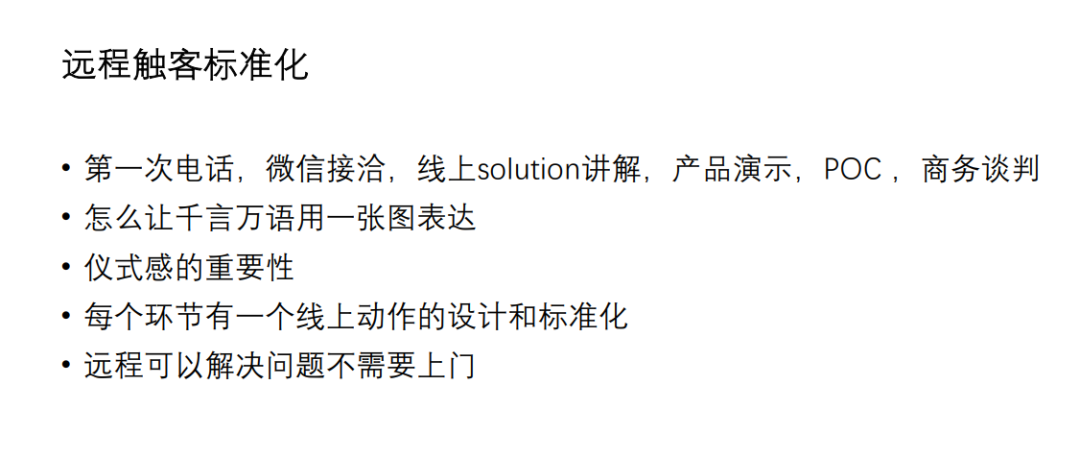
Image source: Guest presentation slides
How to Set Annual Targets
Finally, on setting annual sales targets — a very common challenge. Typically two problems arise: targets set too high, unachievable; or targets set too low, easily reached with minimal effort.
What's the optimal target? I believe the best state is drawing 100% effort while achieving 150% of expectations.
What factors influence target-setting?
1. Data decomposition. Before discussing any number, decompose it — by unit, by region, by salesperson.
Image source: Guest presentation slides
2. Growth strategy. What strategy drives growth? How much revenue does each strategy generate? Strategy must decompose from target to execution path. Is it effective? Validated? What's the cost? How to ensure achievement?
3. Clear organizational support. If headcount expands, can current organizational structure support? Need organizational upgrade? What's the supporting performance system? These must be explicit. Also know: to hit this target, when must supporting teams beyond sales join and what must they do?

Follow the "Together for a Shared Future" series
- Cash flow management
- How startups can maximize their HR lead
- Macroeconomic trend analysis
- Macro strategic environment analysis and PA strategy discussion
- Equity financing market trends and response recommendations
- Industry trend sharing and discussion
- Marketing strategy and traffic trends
- Cloud office + cost reduction and efficiency improvement: maintaining team morale
- Individual stress relief and emotional management

Issue 20: Is Your Cash Flow Still Healthy During COVID?
Issue 19: Entrepreneurs Must Learn Appropriate Letting Go
Issue 18: Entrepreneurs' Time Management: "Two Learnings, Three Principles, Four Quadrants"
Issue 17: Your Core Startup Team Needs a "Deep Dialogue"
Issue 16: Three Keywords in Corporate Crisis Management from 3·15
Issue 15: The New Evolution of Insurtech
Issue 14: "Small" Trademark, "Big" Trouble — How Startups Can Effectively Avoid Pitfalls
Issue 13: Financial Opportunities in Industrial Internet
Issue 12: Strategic Thinking on Douyin Marketing for Consumer Brands
Issue 11: Inclusive Finance Under the New Economic Landscape
Issue 10: Brand: Meaning, Symbol, Value
More MaHui members can click "Read Original" to view