Enlightenment Weekly | Why Read Warren Buffett's Shareholder Letter Every Year? Here Are 6 Reasons
What's scarce isn't knowledge — it's wisdom.
💡
"Inspiration Weekly" is a column I'll update every week.
Here, I'll record five people or things that inspired me this week — to help me reflect, grow, expand my intellectual boundaries, and become freer and happier.
WeChat Official Accounts remain the best platform for in-depth content quality on the Chinese internet today. Full stop.
The more short videos bombard us, the more precious long-form articles become — they're the most efficient vehicle for intellectual transmission.
All five of my inspirations this week came from WeChat Official Account articles.
This week's five:
❶ [Investment Wisdom] Warren Buffett's 2023 Letter to Shareholders
❷ [Tech Frontier] The New Moore's Era: 2024 LLM Predictions
❸ [Innovation in Practice] Building a Perplexity from Scratch
❹ [Personal Growth] Why I Recommend You Keep a Journal
❺ [Bird Nerd] Wild Peacock-Pheasants: So Beautiful, a Miracle of Creation
❶ [Investment Wisdom]
Warren Buffett's 2023 Letter to Shareholders

📰 Source: WeChat Official Account "Investor 33"**
👦🏻 Koji:
Buffett's annual letter to shareholders is always worth reading carefully.
Early last year, I earnestly followed Buffett and Charlie Munger's "value investing" advice and adjusted my investment strategy: buy index funds, only buy good companies I understand, and then — hold steady.
Thanks to Buffett, my US stock returns hit 52% last year — a number worth feeling proud and happy about. Anyway, no need to stay happy for too long. Investing is an infinite game; every day is a new day, and every year is especially a new year.
Last week, Berkshire Hathaway's official website published its 2023 annual report, along with the shareholder letter Buffett personally writes every year.
Throughout Buffett's latest letter, you can see "Charlie's soul" everywhere. This is the first shareholder letter Buffett wrote after losing his "soulmate in business," Charlie Munger. The letter writes with full emotion:
"While to some extent he was like an older brother to me, he was also a father figure. Even when he knew he was right, he let me have the reins; and even when I made foolish mistakes, he never nagged me about them."
💡 Why read Buffett's shareholder letter every year?
1) Investment philosophy and wisdom: Buffett is known as the "Oracle of Omaha," and his investment philosophy is deeply revered. His letters not only share the past year's investment results but also explain the logic and principles behind his decisions — value investing, long-term holding, finding opportunities in panic — invaluable knowledge for anyone wanting to learn rational investing.
2) Market and economic insights: Buffett offers deep analysis and unique perspectives on market dynamics, macroeconomics, and industry trends. His letters often include commentary on the economic environment, policy changes, and market trends, providing investors with macro-level insights.
3) Business operations and management wisdom: As Berkshire Hathaway's long-time leader, Buffett shares extensive experience in corporate management, culture building, leadership, and decision-making — highly practical value for entrepreneurs and managers.
4) Risk management: Buffett's investments emphasize not just returns but risk control. His strategies and methods for assessing risk and avoiding losses are detailed in his letters, excellent learning material for anyone wanting to improve their risk management capabilities.
5) Education and inspiration: Buffett makes complex investment concepts accessible through simple, clear, yet wise language. His letters are not just investment guidance but mental training, stimulating readers' deep thinking about business, investing, and economics.
6) Integrity and transparency: Buffett hides nothing about Berkshire's performance in his letters, sharing successes and failures with openness and transparency. This integrity sets an example for the business world and is a key reason Buffett is so widely respected.
❷ [Tech Frontier]
The New Moore's Era: 2024 LLM Predictions
The best way to predict the future is to create it
📰 Source: WeChat Official Account "Overseas Unicorn"
🔗 The New Moore's Era: Shi Xiang's 2024 LLM Predictions
"Shi Xiang" is an investment platform founded by former HSG investor Guangmi Li, with over $1 billion in assets under management. Their WeChat Official Account "Overseas Unicorn" consistently produces high-quality content.
At the beginning of the year, they released ten predictions for LLMs in 2024.
What's the most important trend for the next 5-10 years? ChatGPT's arrival answered this question and sent a clear signal about the future digital ecosystem: AI will undoubtedly be the core of future technological innovation and business model transformation.
I believe predictions #3 and #5 have basically already come true, with representative milestones being NVIDIA's release of Chat with RTX and OpenAI's release of Sora respectively.
- The first half of 2024 is a critical juncture in the LLM arms race; once the landscape forms, it will be hard to change
- Data scarcity becomes a model bottleneck; synthetic data is the key solution
- 2024 will see on-device LLM hype, with open-source model teams being acquired by hardware manufacturers
- Multimodality becomes the mainstream narrative for LLMs in 2024
- Video generation will have its "ChatGPT moment" in 2024
- The new Moore's Law will unlock more new application possibilities; LLM-Native Apps will see large-scale explosion in the next 6-12 months
- In 2024, products with $100M+ ARR will emerge in batches, with more companies seeing 5%+ revenue contribution from AI
- 2024 is an important time to invest in data centers; opportunities exist in computing power, cooling, and interconnects
- A significant cybersecurity incident will occur around LLMs
- Embodied intelligence still needs 1-2 years before a true breakthrough
❸ [Innovation in Practice]
Building a Perplexity from Scratch
Curiosity Never Ends
📰 Source: WeChat Official Account "MindStorm"
🔗 I Built a Minimalist Perplexity from Scratch with Coze (Basically Replaces Google Search)
👦🏻 Koji:
"Shou cuo" (hand-built) has been trending lately. It means building an AI bot or program with minimal code, mainly through natural language commands combined with configuring functional modules.
Perplexity is a closely watched product in the AI space, currently valued at $500 million. Its design philosophy is based on the latest large language models, using search and synthesis to provide users with a completely new way to access information.
With Perplexity, users can get search results faster and more clearly.
The author of this article built their own Perplexity "from scratch."
💡 Excerpt:
The democratization of AI is a good thing.
While building this bot, I experienced the joy of low-code for the first time.
Writing very little code, you can quickly turn an idea into reality, make it into a product, and release it for yourself and others to use.
On one hand, this is of course thanks to the development of AI technology — by combining AI with traditional technology, you can create very powerful software tools.
On the other hand, platforms like Coze lower the technical barrier while still providing considerable customizability.
Coze is more flexible than OpenAI's GPTs, so you can build more complex applications. Especially when combined with chat platforms like Discord, the possibilities are quite fun.
❹ [Personal Growth]
Why I Recommend You Keep a Journal
Writing makes one rational
📰 Source: WeChat Official Account "sspai"
🔗 From "Why" to "What to Write": A New Year, A New Understanding of Journaling
👦🏻 Koji:
I've been keeping a journal since 2019, and it's benefited me tremendously.
First, writing requires engaging rational thinking, so journaling always helps me soothe my emotions and then helps me analyze and think more comprehensively.
Second, "the palest ink is better than the best memory." People I've met, information I've received, perspectives I've gained — if I don't write them down, I'll likely completely forget them within days, vanishing from my mind without a trace.
With AI augmentation, the value of journal-keeping will only increase. I journal in Notion, and Notion AI recently added an "Ask AI" feature that lets you query all your historical notes in natural language, summarizing and extracting answers.
While this will quickly become standard across apps, experiencing it first in Notion was genuinely moving.
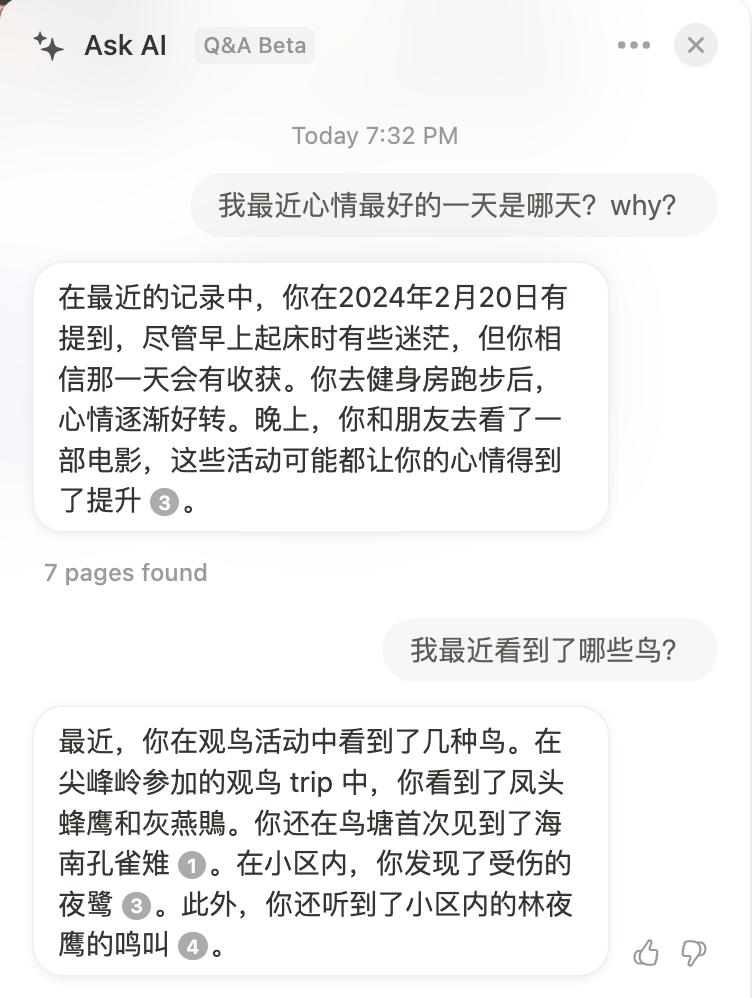
The screenshot above shows two simple examples of my conversations with Notion AI — very basic information queries where the AI just needed to briefly summarize to provide highly satisfactory answers.
Going forward, we can also ask it more complex questions requiring synthesis and induction, like:
- "What was my initial assessment when I first learned about [X] project?"
- "How many times have I met [so-and-so]? What did we discuss each time?"
- "Of all my interviews this year, who were the top three candidates with the highest ratings in my interview notes?"
- ...
A personal AI think tank, essentially.
This article about journaling from "sspai" is highly recommended:
💡 Excerpts:
①
When feeling panicked or anxious, journaling can be a huge help.
Write your panic and anxiety on paper, and you'll easily see how your brain is deceiving you.
In fact, when you concentrate on putting your thoughts on paper, the brain's intimidation instantly loses power. Because writing requires engaging rational thinking, when the act of writing takes priority over emotion, the language and writing areas of the cerebral cortex take over, and negative emotions get buffered.
Jamie Pennebaker, author of Opening Up, also found through happiness experiments that people who use writing to express their emotions are healthier.
②
Journaling doesn't aim for exhaustive detail; you should selectively choose what matters to you. For example:
- New skills learned or new people met
- Achievements completed (even small ones count — eating breakfast, waking up early)
- What was the most impactful thing yesterday and why?
- What triggered your emotional fluctuations?
③
Write your worries and fears honestly on paper or screen.
Cognitive Awakening discusses: real difficulties are always much smaller than imagined. The root cause of procrastination, indecision, and fear is often not how hard the thing itself is, but how vague the internal thoughts become.
Once a specific matter becomes vague, its boundaries expand infinitely. Originally not-so-difficult small tasks become seemingly insurmountable in the fuzzy subconscious.
To break this barrier, you must drag out the vague awareness and make it clear. Ask yourself these three questions in order:
- What am I afraid of right now? Why does it scare me?
- What can I do about this?
- If I don't do it well, what's the worst outcome?
No matter how unspeakable the problem, reflect it honestly. Once you write it on paper, something magical happens — you'll discover the problem troubling you isn't as serious as you imagined, and your thoughts are just thoughts. This force compels your brain to calm down, and all intimidating illusions vanish.
Fear works like this: the more you avoid it, the stronger it grows; face it head-on, and it weakens.
Wild Peacock-Pheasants: So Beautiful, a Miracle of Creation
📰 Source: WeChat Official Account "Institute of Planets"
🔗 To the Great Love of the Phoenix
👦🏻 Koji:

During Spring Festival, I went to a bird blind at Jianfengling Forest Park to wait for the "Hainan Peacock-Pheasant" — my first bird blind experience.
I followed the blind keeper through a winding path cut through primeval forest, climbing uphill the whole way, out of breath, deep into the woods, and into a simple camouflaged observation shelter.
Together with several fellow birders I'd never met, we "peeped" through small slits in green woven tarp — like crouching in a trench. No one spoke; all was silent. Everyone held their breath together, waiting for fortune to strike.
The peacock-pheasant appeared suddenly. He emerged slowly from dense undergrowth, relaxed and at ease, walking and pausing, then hopped a few steps onto a small open clearing. Right then, sunlight poured down onto his blue feathers, refracting sapphire brilliance.
I'd seen countless peacocks in zoos, but they were caged, utterly spiritless. This time, when the peacock-pheasant appeared in the wild forest, so natural yet so supernatural — it simply took my breath away.
Image source: Internet
💡 Check out this article from Institute of Planets — a feast of gorgeous images for your eyes.
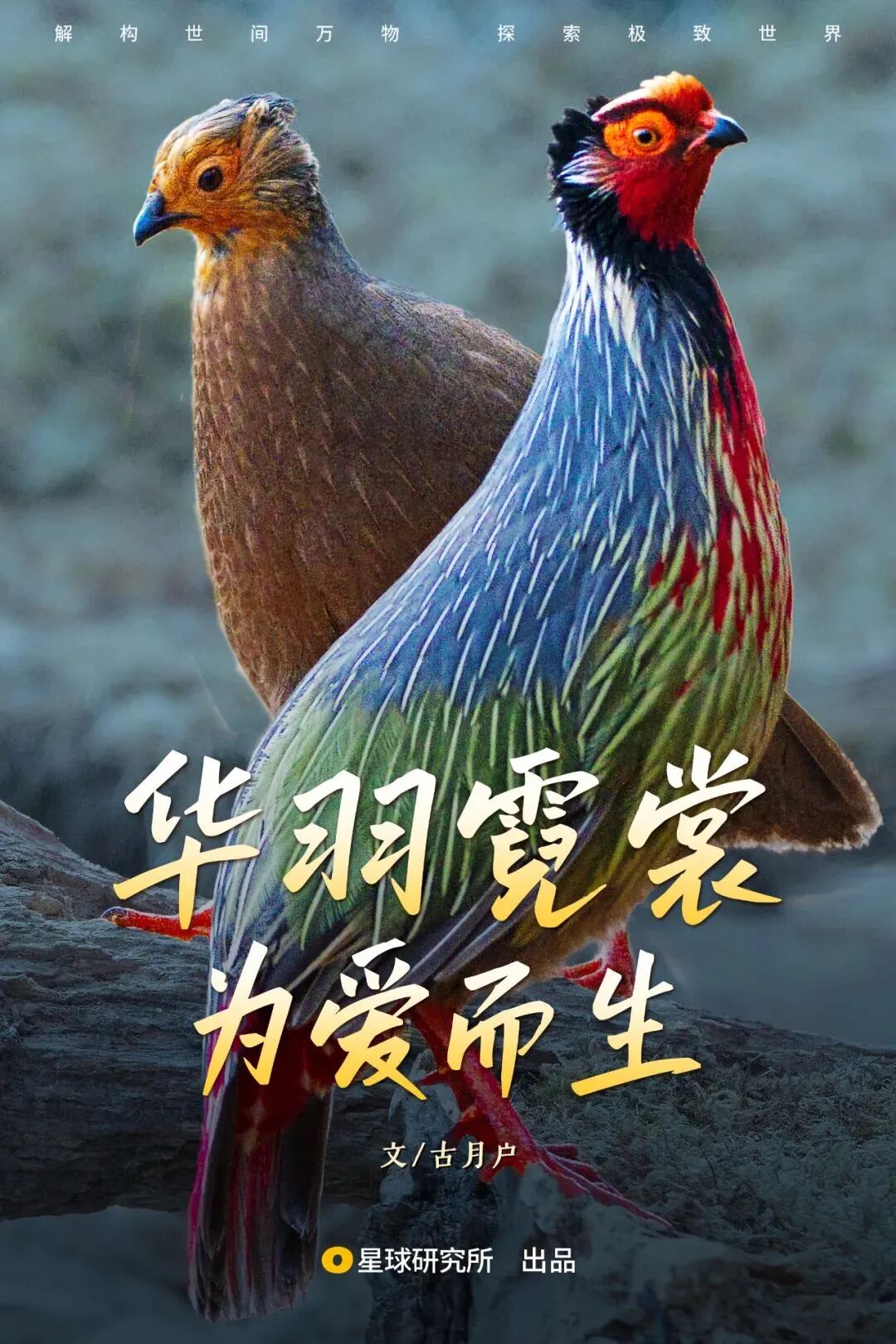

A male Lady Amherst's Pheasant, desperate for love
Wishing he could plaster his gorgeous, dazzling colors directly before his lady's eyes
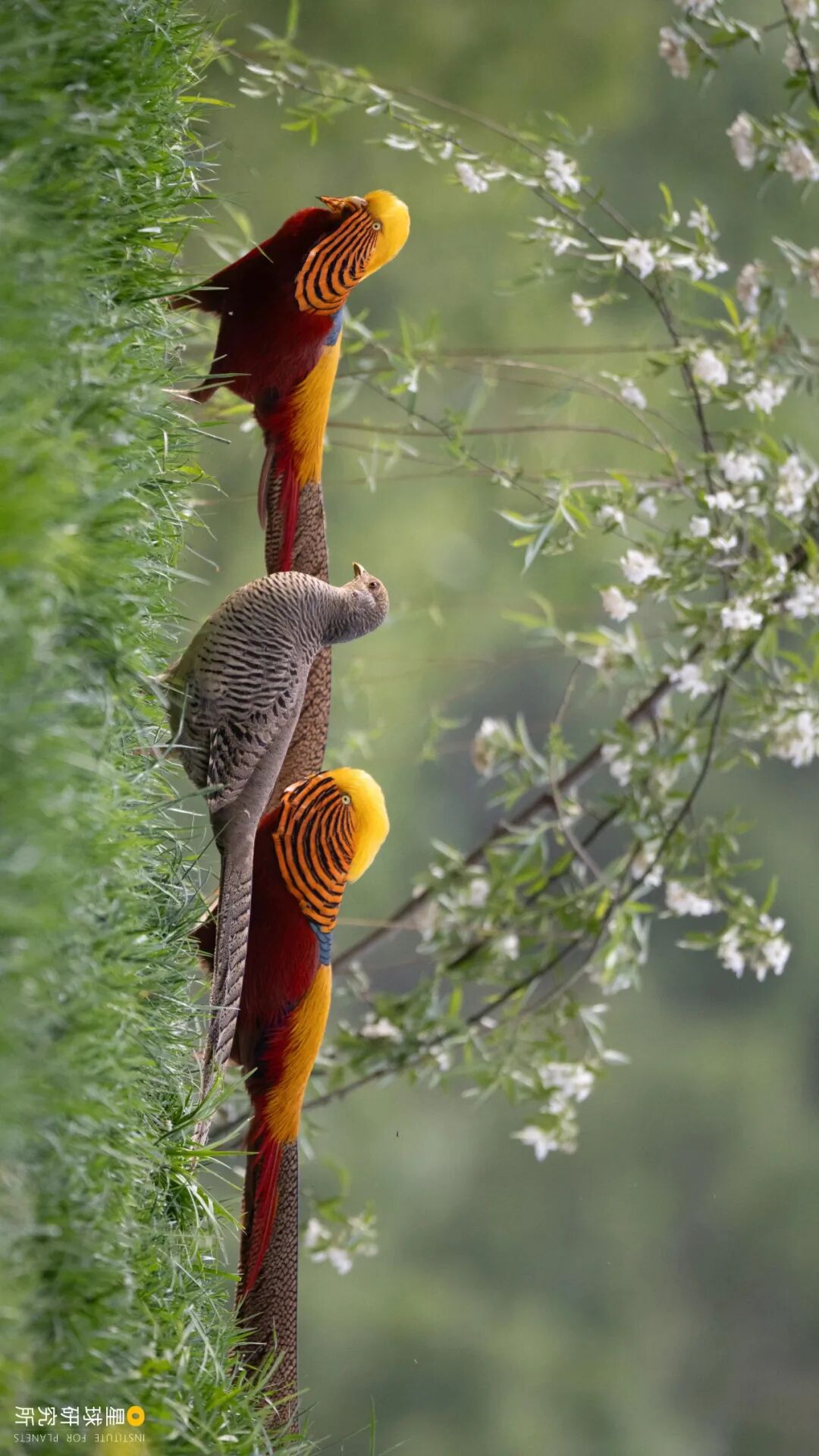
When a Golden Pheasant meets his beloved
His golden cape feathers fan out like a folding screen
Performing a "half-hiding behind the pipa" act
💡
Recent "Inspiration Weekly" updates:
Inspiration Weekly Vol 01: Other People's 30s, How to Improve Your Luck, Good Things Will Happen

Hi, I'm Koji Yang, and "Crossing" is my personal WeChat Official Account. "Crossing" comes from a Steve Jobs quote about standing at the intersection of technology and the humanities.
I'm co-founder of sleep environment brand Tangdao and content company The Fair. I previously founded the Jiepang app and was involved in the early days of Fanfou and Jumei International Holding Limited.
As a typical cross-disciplinary entrepreneur, from mobile internet to e-commerce, from content to consumer goods, I let my curiosity roam across various "crossings."
Welcome to add me on WeChat: YuanchengYang