"Code Brain" "Standing Together Against COVID-19" Series Session 8: Financing Strategy Recommendations for Businesses During the Pandemic

Speaker: Zhao Weixing, President and Executive Director of Sichuan XW Bank
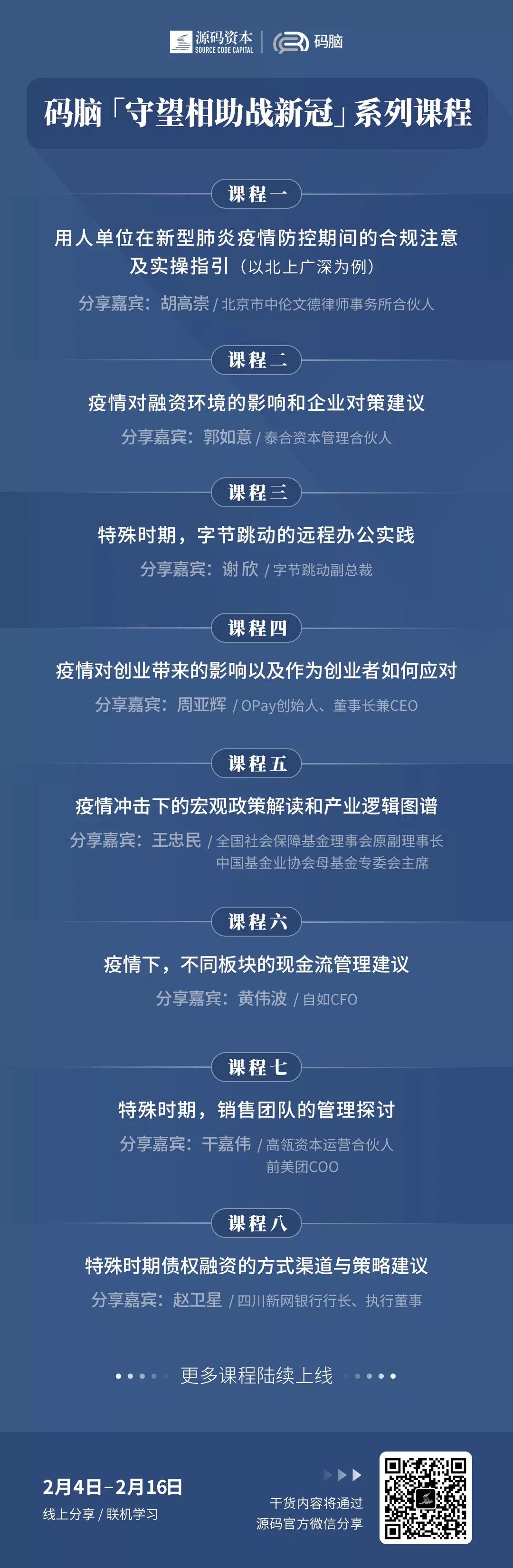
As the pandemic deepened, every sector of the national economy came under enormous pressure. On one hand, healthcare systems and logistics supply chains urgently needed expanded capacity; on the other, online education and remote work became essential needs. Market demand and business models were quietly shifting — new opportunities were emerging from the crisis. To respond to this new landscape, Source Code Capital's post-investment services team organized the Code Brain "Standing Together Against COVID-19" webinar series. From February 3 to 16, we invited leading experts to share insights online on topics including employee leave and return-to-work policies, startup financing, remote collaboration, cash flow management, policy analysis, and sales team management. We hoped to provide intellectual support to Source Code Capital community members from every angle, easing anxieties and facing challenges together.
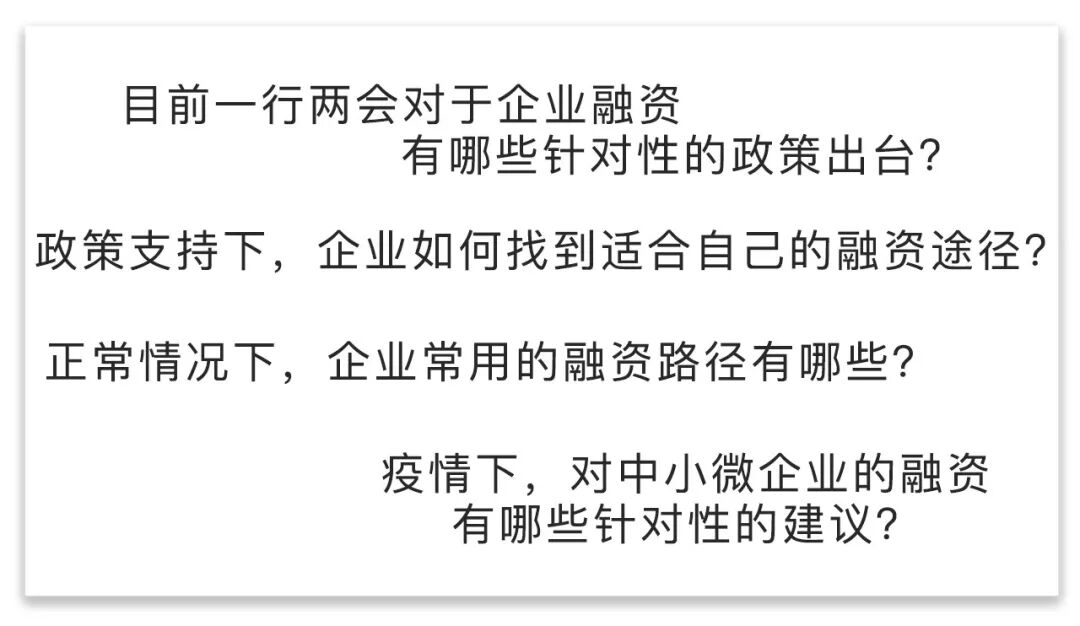
Beyond equity financing, entrepreneurial companies during the pandemic should also seek financing from banks and other financial institutions to withstand the impact. For this session, we specially invited Zhao Weixing, President of XW Bank, to analyze the various enterprise financing policy supports available during the pandemic, starting from the latest national policies. He provided a comprehensive roadmap of financing options from three angles: special financing methods during the pandemic, conventional financing methods, and other financing methods. On a practical level, President Zhao also offered four recommendations for the financing process, clarifying what banks and financial institutions look for in an ideal borrower.



PBOC, CBIRC, and CSRC Take Multiple Measures
to Provide Policy Support for Enterprise Financing
This pandemic has posed an enormous challenge to business survival. We've been following it closely, and so have financial institutions. Since the outbreak, the PBOC, CBIRC, and CSRC have announced numerous measures to support enterprise financing. The specific policies are as follows:
On February 1, the PBOC and CBIRC jointly issued the Notice on Further Strengthening Financial Institutions' Support for Epidemic Prevention and Control, which contained four key points:
First, increase financing support by appropriately lowering loan interest rates, increasing credit and medium-to-long-term loans, and other methods to help relevant enterprises withstand the pandemic's impact. If loan repayments become difficult due to pandemic impact, extensions or renewals may be granted.
To date, virtually all banks have begun lowering lending rates for companies and enterprises, with maximum adjustments exceeding 15% and averaging around 10%. At the same time, they're increasing credit loans and medium-to-long-term loans (three to five years, or even longer) to extend repayment cycles and support enterprises in fighting the pandemic. Enterprises whose financing has been affected can directly apply to relevant financial institutions for loan extensions or renewals. During the pandemic period, enterprises' credit records will not be affected.
Second, for industries heavily impacted by the pandemic — wholesale and retail, accommodation and catering, logistics and transportation, culture and tourism — as well as enterprises with development prospects but temporarily facing difficulties due to the pandemic, particularly micro and small enterprises, financial institutions must not blindly withdraw, cut off, or compress loans.
If any financial institution proposes to stop lending, reduce loan amounts, or withdraw loans, you can appeal to regulatory authorities (the PBOC or CBIRC) to continue support, and financial institutions will certainly follow the requirements outlined in this official notice.
Third, establish financial services "green channels" to simplify business processes and improve the efficiency of approval and disbursement services.
Typically, a corporate loan requires a review cycle of one to three months. But under this pandemic, regulators have required simplified business processes. After simplification, different loan types can be processed very quickly — especially credit loans, where some businesses can be completed in days.
Fourth, for epidemic prevention units and enterprises facing financing difficulties, development and policy financial institutions should adjust their credit arrangements according to their business scope to reasonably meet epidemic prevention and control needs.
Development and policy financial institutions — for example, China Development Bank — have long provided policy-based support for agriculture and micro and small enterprises. Currently, to my knowledge, CDB has adjusted its operations so that 90% of its credit is directed toward meeting pandemic-related enterprise financing needs.
On February 14, Li Junfeng, Director of the CBIRC's Inclusive Finance Department, also introduced the CBIRC's policy arrangements for micro and small enterprises affected by the pandemic, covering four points:
First, regarding loan classification: if loans become overdue due to the pandemic, repayments made within a certain grace period will not be classified as non-performing loans and will not affect micro and small enterprises' credit records. Currently, most banks are adjusting for one to three months, with no impact on micro and small enterprises' credit records during this period. As the pandemic and return-to-work situations evolve, this grace period may be gradually extended based on conditions.
Second, banks are permitted to further increase their tolerance for non-performing loans. This means that whereas a company's previous non-performing rate might have been 2%, it could rise to 3% or 5% during the pandemic period — meaning banks can be bolder in their credit deployment.
Third, further implement the requirement of due diligence exemption: if there is sufficient evidence that a micro or small enterprise cannot repay due to pandemic impact, this is treated as force majeure. This means banks will not pursue accountability against the handling personnel and relevant managers, so frontline bank managers dare to extend loans.
Fourth, for losses from non-performing loans formed due to pandemic impact on micro and small enterprises, banking financial institutions are encouraged to appropriately simplify internal recognition procedures and increase autonomous write-off efforts. All these points are designed to loosen banks' regulatory indicators and due diligence exemption clauses to encourage credit financing to pandemic-affected enterprises.
On February 15, CBIRC Vice Chairman Liang Tao stated that around the overall requirements of increasing volume, expanding coverage, lowering prices, and improving quality, they would ensure that the overall credit growth for micro and small enterprises is not impacted by the pandemic. He proposed five policies:
First, increase support for micro, small, and private enterprises in difficulty, ensuring that overall credit growth for micro and small enterprises is not impacted by the pandemic. To date, in January and February, the PBOC has imposed monthly credit quota controls on each financial institution. Currently, these PBOC credit quota controls are relaxed, with no month-by-month credit controls, in hopes that banks will increase credit deployment.
Second, strive to ensure that this year's inclusive finance loan costs for micro and small enterprises continue to decline from 2019 levels.
The PBOC and CBIRC have made this a mandatory requirement: each institution's loan financing costs must continue to decline quarter by quarter.
Third, focus on financing changes for micro and small enterprises responding to the pandemic, and reasonably optimize and simplify business processes.
Fourth, more precisely manage renewal financing.
Fifth, in line with pandemic needs, further implement risk management and due diligence exemption systems to improve frontline branches' willingness and courage to lend. At the same time, moderately increase tolerance for non-performing loans.
Under These Policy Supports,
How Can Enterprises Find Financing Approaches That Suit Them?
I. Special Financing Paths During the Pandemic
We've seen that in Q1, the PBOC announced it would provide a total of 300 billion RMB in low-cost special re-lending funds to major national banks and key provinces and cities including Hubei. So-called special re-lending refers to the PBOC providing loan funds to banks to meet their capital deployment requirements to enterprises. Re-lending is priced very cheaply, basically between 2% and 3.5%. I've calculated that this can reduce enterprises' average debt costs by 1%. Special re-lending funds are for key enterprises to support production and operations needed for epidemic prevention and control. What are key enterprises? Mainly those ensuring medical equipment needed for the pandemic and livelihood-safeguarding enterprises.
In recent days, I've checked with several major banks and joint-stock commercial banks — their re-lending deployment is proceeding intensively. For example, some farmers and breeders in Chengdu, Sichuan have already received re-lending funds from the Big Four banks or joint-stock banks (SPD, Minsheng, China Merchants); those who haven't received them are in the review process. The speed of re-lending fund disbursement far exceeds our imagination. I estimate that nearly 100 billion RMB in re-lending has already entered commercial banks nationwide, and commercial banks have begun deploying it. The 300 billion figure is not just a number on paper.
II. Commonly Used Enterprise Financing Paths
There are three paths in total: credit-based financing, guarantee-based financing, and collateral/pledge-based financing.
Credit-based financing refers to loans issued based on the borrower's credit, without any collateral requirements. However, since banks operate on risk pricing — high risk, high pricing; low risk, low pricing — credit loans, lacking mortgage or pledge guarantees, carry slightly higher interest rates. The advantage is that no collateral is required, and the application process is relatively simple.
Collateral-based loans refer to loans obtained from banks by enterprises or individuals using collateral as security. Generally, real estate, land, production equipment, and raw materials are relatively easy to get approved as collateral.
Guarantee-based financing is similar to obtaining guarantees from guarantee companies or having other enterprises act as guarantors.
Below, I'll explain how to access each of these three financing methods.
Credit-based financing methods. Taking XW Bank's Maker Loan as an example, it uses a purely online, unsecured, credit-based approach. It primarily supports grassroots entrepreneurs at the core of the private economy. Current customers include training institutions, utilities service providers, mom-and-pop shops, restaurants, and wholesale and retail stores. Because these businesses lack collateral, generally operate from leased premises, or even operate entirely online, they cannot meet banks' traditional financing conditions. At the same time, they have substantial working capital needs — paying salaries, purchasing raw materials, buying inventory — with loan characteristics of short duration, small amounts, high frequency, and urgent need. Domestic businesses of this type are all enabled through digital online technology, using data left behind from enterprises' daily operations (business registration information, tax information, supply and procurement information, and sales information from e-commerce platforms) to conduct risk assessment.
This model creates several distinctive features. Because operating costs are low, there's extensive use of borrow-and-repay-on-demand functionality. Businesses can borrow whenever they need through the application portal, and repay whenever funds come back — no fixed loan terms tying them down. Loan amounts tend to be relatively small. The Chuangke Loan, for instance, ranges roughly from RMB 5,000 to 1 million. Most online credit loans on the market today fall within this range. Interest rates vary by bank, generally landing between 9% and 12%.
Access channels: These are available through various online entry points — local government websites, tax bureau sites, business registration portals all have integrated access. You can also proactively search through bank apps, bank WeChat official accounts, or enter through the online portals banks provide.
Collateral-Based Financing. Using China Minsheng Banking Corp. as an example. Minsheng focuses primarily on trading and service industries, with manufacturing as secondary, giving priority to sectors closely tied to daily consumer life. It targets growth-oriented leaders in the consumption upgrade space, while closely monitoring industries facing declining high-end consumption markets and intense low-end competition, particularly those hit by e-commerce disruption. It also pays close attention to industries affected by "excess capacity reduction" policies, especially the "five smalls" (small chemicals, small hydropower, small hardware, small textiles, small agricultural machinery), as well as industries with high supply-demand elasticity and strong cyclical volatility. These industries rarely qualify for direct bank lending — supply chain financing being the exception (they may fall outside a bank's direct purview but still sit within a supply chain's scope).
Under these industry categories, each bank will designate exit and restricted industries, establishing sector-specific policies for each. Here's the unusual part: for restricted industries, collateral business actually isn't constrained by sector limitations. This means collateral-based lending eases as industry restrictions tighten.
Collateral requirements vary. Most banks set residential property loan-to-value ratios between 60% and 80%. China Minsheng Banking Corp. doesn't accept second-priority mortgages — meaning if a property is already mortgaged to one bank at 60% LTV, leaving 40% equity, some other banks would accept a second-priority mortgage on that remaining value (at a further discount). In standard collateral business, whether residential or commercial property serves as collateral, loan amounts are set based on the collateral's attributes while satisfying LTV requirements. Whether it's ordinary versus luxury residential, street-level retail in prime locations versus mixed-use, or office buildings — each bank sets different LTVs based on collateral type.
Meanwhile, China Minsheng Banking Corp. has launched "Cloud Mortgage," an online mortgage lending product designed to serve multiple scenarios and business contexts. Maximum loan amounts can reach RMB 15 million, with terms extending up to ten years. "Cloud Mortgage" represents Minsheng's innovation and core business. The bank has also introduced "Cloud Quick Loan," a comprehensive credit facility secured by ordinary residential property 100% owned by the borrower and their spouse. Applications go through internet channels, with system-based approval and manual processing of mortgage procedures, capped at RMB 6 million.
Land, factories, and equipment can also serve as collateral. But different collateral types carry different discount rates based on liquidation timelines, disposal values, timing differences, and lenders' willingness to accept them. Most banks offer similar products with comparable limits.
Supply Chain Financing. Using Xiaomi Finance + China Merchants Bank as an example. Supply chain financing is how banks address working capital needs for companies upstream or downstream from a core enterprise in the procurement or sales chain. Xiaomi's supply chain finance process works roughly as follows: Xiaomi Group's supply chain finance arm recommends quality enterprises to China Merchants Bank; the bank reviews daily transactions of Xiaomi and Xiaomi ecosystem companies, along with total transaction volumes and average daily credit amounts, for approval and fund disbursement to Xiaomi ecosystem companies; these companies then pay for goods or sell through sales channels, while simultaneously sending customized goods to Xiaomi or completing sales through sales channels; Xiaomi then repays China Merchants Bank.
Supply chains generate numerous financial product combinations to meet procurement or sales needs, deferring payment collection or accelerating fund receipt. In this process, the core enterprise designs financing solutions with the bank; provides supply chain credit to the bank; signs framework agreements; recommends financing enterprises from upstream and downstream chains; and feeds order information and data to the bank directionally, with system integration. Within Xiaomi's ecosystem, credit terms and amounts are set based on previous period payment amounts and cycles, matching funding and usage periods. This makes supply chain business relatively well-aligned with enterprise capital turnover.
Generally, each bank sets admission thresholds. Using China Merchants Bank as an example: loan limits are based on annual procurement volume,原则上 not exceeding 50% of one year's procurement; each drawdown cannot exceed six months; overall loan pricing generally falls between 5 and 7 percentage points; with credit enhancement measures, such as additional collateral or guarantees, pricing can drop another 1 to 2 percentage points; credit conditions include no outstanding balances from other businesses, and cooperative financial institutions not exceeding two, among others.
Throughout supply chain financing, loans are just one approach among many others. There are also credit payment products, bank acceptance bills, and more. Bank acceptance bills let enterprises make payments in bill form upfront, with deferred payment upon goods arrival or sales completion — a very commonly used method.
III. Other Financing Pathways
Bond Financing. Bond financing breaks down into: enterprise bonds, corporate bonds, and non-financial enterprise financing instruments (super short-term commercial paper, short-term commercial paper, medium-term notes, etc.).
During the pandemic, special bond issuance policies emerged. CSRC Vice Chairman Yan Qingmin noted that companies affected by the pandemic would receive expedited treatment for corporate bond issuance. For fundraising directed toward epidemic prevention and control, assets involving epidemic prevention uses, and enterprises heavily impacted by the pandemic, bond issuance was supported. Rating fee reductions or deferred collection could also be granted case by case.
Asset Securitization. Ordinary enterprise loans achieving financing through special purpose vehicles (SPVs) represent another viable option.
A typical transaction structure appears below, with plan managers implementing asset-specific plans, and custodian and supervisory banks executing the overall asset securitization transaction structure. This structure can incorporate tranching — for instance, priority holders issuing instruments themselves.
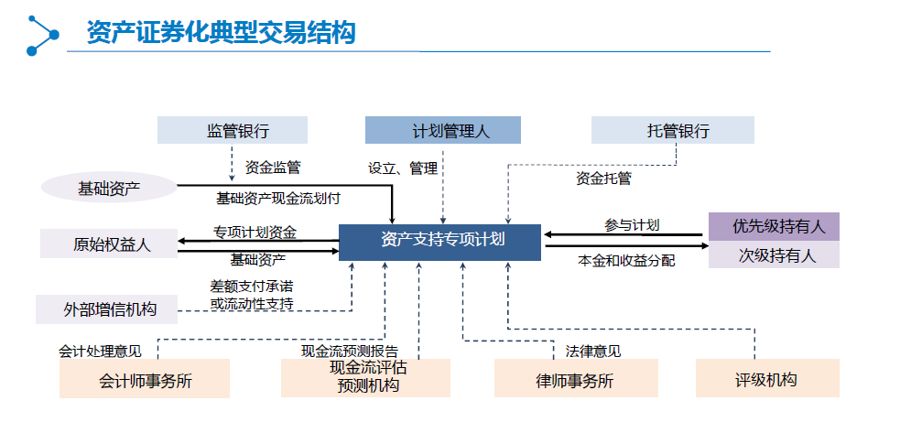
Image source: Speaker Zhao Weixing
Asset securitization divides into credit asset securitization, enterprise asset securitization, and trust-type asset-backed notes. Under enterprise asset securitization, approval comes through exchange-issued filing and no-objection letters from the Asset Management Association of China, with securities companies and fund subsidiaries serving as underwriters for enterprise issuance; underlying assets can include financial leasing receivables, accounts receivable, microloans, revenue rights, and commercial real estate.
Beyond these, numerous other financing methods exist. These include financial leasing (production equipment acquired through lease-first, installment-repayment structures); factoring financing; stock pledge, employee stock ownership plans, private placements, and more.
Four Financing Recommendations for Small and Micro Enterprises
What does a "good kid" look like in a bank's eyes? Banks actually care less about collateral than you'd think. They always prioritize the primary repayment source. The so-called primary repayment source means sustainable enterprise development, normal operating conditions — especially normal operating income and cash flow — with limits and pricing determined by the company's capacity and willingness to repay. This encompasses solid operations, quality business owners, good cooperation willingness, strong social reputation, effective risk mitigation, and robust sales and procurement chains. This is the enterprise profile banks find most acceptable.
The profile banks find least acceptable stems from six factors: business owners with no clear plan for their operations and no concept of appropriate bank financing amounts; excessive credit inquiry records for both owner and enterprise, with delinquency histories; owners investing in finance-leaning enterprises with non-operational preferences; declining industry returns with owners blindly investing in unfamiliar projects; loan purposes that can't be verified, with funds heavily directed toward fixed asset construction. These are the characteristics of high-risk customers in banks' eyes.
Four recommendations:
First, pick one bank and commit for the long haul. Enterprises need the courage to walk through a bank's door, strengthen communication with banks, and maintain long-term close business relationships. Choose a primary bank; if you want to borrow from a particular bank, concentrate your settlements there as much as possible to build credit history; actively try the bank's innovative products.
Second, operate with integrity. Good faith is the foundation of stable cooperation. Enterprises must value integrity's market worth.
Third, stay steady and methodical, advancing step by step. Solid operating performance is the key metric for small and micro enterprises to obtain loans. Enterprises need focused main businesses, clear development direction, moderate financing amounts, and conscious standardization of financial management. Avoid participating in informal high-interest lending at all costs.
Fourth, master various tools and apply them flexibly. Every founder holds different tools in hand. Determining which tools or financial products to combine to continuously reduce financing costs, extend financing terms, and align with your operations — this is critically important.
Beyond these recommendations, government support for small and medium enterprises is actually substantial, particularly for high-tech and labor-intensive SMEs. Local governments at all levels offer certain financial subsidies. If an enterprise can secure relevant government special subsidy funds, obtaining bank financing becomes easier; accumulated operational data can also help enterprises effectively access financial products.

Question 1: As a startup with no prior loan record, what bank and product type is generally best to start with?
Zhao Weixing: For startup enterprises with no loan history, the most accessible options are collateral or guarantee-based loans. Having some land, factory buildings, or production equipment to pledge, or finding a guaranteeing enterprise or guarantee company for initial financing — this is the most ideal path. The second most viable approach is online channels, engaging with online banks. Internet banks like XW Bank, WeBank, and MYbank all offer online enterprise loans. They evaluate operational data rather than seeking collateral or pledges. Both approaches are viable options.
Once initial financing is completed, the enterprise will have a credit record in the central bank's征信 system. For second and subsequent financings, things become relatively straightforward. Commercial banks can all see the enterprise's normal borrowings and repayment cycles, making them more comfortable with re-lending.
Question 2: How does this year's overall funding situation compare with last year's?
Zhao Weixing: The funding chain is definitely tightening, but there are a few major developments worth noting. Earlier on, regulators called for more enterprises and individuals to enter the securities market, using it as a channel to drive national economic growth toward real-economy companies. This should be a relatively strong year for the securities market overall. Additionally, this year has seen meaningful growth in the insurance industry. Following this wave of the pandemic, both enterprises and individuals have shown increased demand for protection-oriented products.
That said, among financial institutions extending credit to enterprises — including banks, microloan companies, and guarantee companies — the overall funding chain will be somewhat tighter. Under the current economic cycle, liquidity is lower than in previous years. I judge that overall bank lending will be down year over year. The good news is that regulators made proactive policy arrangements early this year, encouraging banks to lend to enterprises. On this point, I don't believe banks will pull back on lending even with tighter funding conditions.
Question 3: Director Zhao, you said to pick one bank and stick with it through thick and thin. Doesn't that create concentration risk? From the enterprise's perspective, what financing channels should it maintain to stay safe, reasonable, and effective?
Zhao Weixing: I was referring to early-stage startups, because companies just starting out rarely have operating cash flows or financial statements they can present to banks. Banks care more about whether the business is sustainable, and they judge this by building ongoing relationships to assess whether the company's direction is credible. Long-term engagement with a bank, establishing a durable partnership, helps secure corresponding financing and access to various financial instruments. For a company that has moved past the startup phase and is performing well, it can then employ a portfolio approach using multiple financial institutions and instruments.
Question 4: Taking Sichuan as an example, how do enterprises directly involved in pandemic prevention apply for the special loans that the central bank has allocated to banks? What are the application channels?
Zhao Weixing: Several enterprises in Sichuan's breeding and livestock industry, such as New Hope Group and Tongwei, applied directly to local lending banks — for instance, ICBC, China Minsheng Banking Corp., Ltd., SPD Bank, Chengdu Rural Commercial Bank, and Chengdu Bank. These applications were then reported by each bank to the local central bank office, such as the Chengdu branch of the People's Bank of China. After approval by the branch, the funds were disbursed. The application needs to specify pandemic-related impact or pandemic-support purposes, such as connections to livelihoods, equipment, logistics, and so on. The lending bank reports this to the local PBOC office through this channel to complete the process.
Question 5: Director Zhao just mentioned that financial institutions are beginning to serve enterprises through online channels. What fintech innovations can micro and small enterprises expect to encounter in the coming year? How should enterprises better embrace these products?
Zhao Weixing: We're clearly seeing several financial innovations. First, the central bank is pushing forward with digital currency, and this technology is gradually being applied across supply chains — blockchain technology, for example. Taking Xiaomi Financial as an example, under blockchain technology and supply chain frameworks, it has already launched products similar to Mi Credit, a blockchain-based credit payment product. This application has already connected with traditional financial institutions. Mi Credit has been integrated with the four major state-owned banks — ICBC, China Construction Bank, and Agricultural Bank of China — and roughly 80% of joint-stock banks are also connected. It's now connecting with some local commercial banks and rural commercial banks. This kind of fintech and online technology allows enterprises to conduct financing directly within their production or sales chains. In 2020, applications using technologies like blockchain and digital currency will develop rapidly, as digital currency has already begun pilot programs in select scenarios and regions.
Second, digital risk technology. Enterprises may not feel this as directly, but one very noticeable change is that they no longer need to prepare massive amounts of documentation to help banks conduct credit assessments. In 2020, people will feel banks doing more big data integration — connecting with industrial and commercial tax data, with industrial parks and local policy subsidies, with long-term operational data from sales chains, production chains, and procurement. This forms a fully digitized risk control system that improves approval rates. As digitization advances, risk identification and standardization will improve accordingly. These changes will accelerate the securitization and circulation of assets, thereby enhancing capital liquidity and further reducing pricing.
Question 6: Beyond the special re-lending facilities, based on Director Zhao's experience, will there be additional financial policy support for the pandemic going forward?
Zhao Weixing: There should be. Regulatory policies tend to be more oriented toward providing safeguards for banks. The asset securitization, due diligence exemptions, and tolerance for higher non-performing loan ratios I mentioned earlier — these are primarily relaxations directed at banks from the regulatory level. Only after banks receive these policies do they transmit them to enterprises. Don't worry too much about funding conditions, because the central bank has been continuously releasing liquidity, easing pressure and lowering overall costs. The regulatory relaxation of NPL ratio assessments will give financial institutions the confidence to lend aggressively to enterprises, without cutting off or suspending loans. Any forthcoming policies will likely continue to be oriented toward regulatory easing for financial institutions, since it's still the financial institutions that interface directly with enterprises. The regulators simply need to ease policy toward the financial institutions.
Question 7: The restaurant industry has been severely impacted by this pandemic. What financing channels should similar small and medium-sized enterprises choose to bridge larger funding gaps?
Zhao Weixing: Needless to say, this round of the pandemic has hit the restaurant industry hard. Two changes in restaurant industry lending are notable: applications for online loans have dropped by nearly 70%, and non-performing loan ratios have risen relatively quickly. As for financing instruments, I've already covered this fairly comprehensively. If you hold real estate, property, production equipment, leasehold rights during the lease term, or the enterprise owner's accumulated personal credit history, you can apply for loans directly — this isn't a major problem. You can also negotiate with banks about whether you have equity stakes or other liquidatable real assets. These are the fastest and most feasible ways to raise capital. Beyond that, there are online operating platforms like Meituan and Ele.me. These platforms contain many long-serving financial institutions that are very familiar with the operational characteristics of these enterprises and industries, with strong readability of their business models. You can choose to raise financing through these platforms. Once the pandemic passes, the use of other financial institutions and instruments will become active again — no need to worry on that front.
Question 8: As a light-asset internet company, how can we better help banks understand and recognize our business?
Zhao Weixing: For a long time, banks haven't well understood light-asset enterprises, making it difficult to extend credit to them. Financial institutions struggle to read the operational models of light-asset companies. Initially, lending was based on the enterprise owner's personal credit. The biggest problem with this approach is that the overall credit limit is relatively small and pricing is relatively high.
The second approach comes from online digitization. Starting last year, large numbers of banks began connecting with government-operated business data. Light-asset companies tend to have relatively complete government data — taxes, judicial records, employee social security and industrial/commercial registration data. This series of data can convince banks that the enterprise is in a state of sustained, healthy, stable development. These financial institutions can be accessed through government open platforms for direct financing.
The third approach: consider whether the light-asset company sits within a digitized chain. The e-commerce platforms we all know, for example, occupy a position in the sales chain. The data accumulated in this position will be a core focus for this wave of financial institution financing. I believe all three approaches can enable cooperation with financial institutions.
Comments and Discussion
Additionally, we welcome entrepreneurs to engage with us in the comments section. Leave your questions and concerns, and we will select representative questions for Director Zhao Weixing to answer in follow-up.

"Code Brain" "Standing Together Against COVID-19" Series
"Special Times: A Discussion on Sales Team Management"

"Cash Flow 'Blood Line' Management Thinking in Emergency Times"
"Macro Policy Interpretation and Industrial Logic Mapping Under Pandemic Shock"

"Counterintuitive Thinking: How Entrepreneurs Should View the Pandemic From a Different Angle"

"Impact of the Pandemic on the Funding Environment and Strategic Recommendations for Companies"