Code Brain | Your Startup's Core Team Needs a "Deep Dialogue"

Practical Leadership Study Society
#Code Brain
Ecosystem connection, cognitive resonance.
Entrepreneurship is an endless journey of self-discovery. Only through continuous individual growth can a company grow.
Founders and core executives of startups constantly face challenges on multiple fronts: product and service innovation, business model iteration, efficient team collaboration, organizational capability building... These challenges demand extraordinary mental fortitude, intellectual capacity, and physical stamina. Beyond continuously attracting better talent, "looking inward" is an essential practice.
For this installment of Code Brain's "Practical Leadership" workshop series, we invited Freeman Xu, partner at Chief Organization Officer, who brings over 20 years of HR experience. Using the "manager mindset model," he helps founders better perceive their role within the company, understand how to allocate time and energy, and—while continuously elevating their own cognition—enable their core teams to break through and achieve collective intelligence.
This article focuses on a highly effective meeting methodology for startup core teams: "Dialogue," written by Freeman Xu.

Freeman Xu, Partner, Chief Organization Officer
About the Speaker
Freeman Xu is currently a partner at Chief Organization Officer. He spent nearly 20 years at Procter & Gamble, serving as Senior HR Manager, Sales HR Director, and Senior HR Director. He later served as Head of Human Resources at Qian Ding Internet and Chief Human Resources Officer at Fanpu Jinke. With over two decades of HR experience, he has extensive experience as the HR leader at both multinational corporations and local internet startups. He has navigated different organizational development stages at excellent foreign and private enterprises, combining Chinese and Western organizational theories with hands-on practice. He is well-versed in organizational practices for the internet industry and B2B businesses, and specializes in strategic-organizational alignment methodologies, top-level organizational system design, and optimization.
Article Preview
- Why do startup executive teams need "Dialogue"?
- 4 mental prerequisites for achieving "Dialogue"
- 5 keys to successful high-quality "Dialogue"
Why Startup Executive Teams Need "Dialogue"
The term Dialogue comes from the Greek dialogos, whose original meaning is "the passing or flowing through of meaning, the free flow of meaning between people, like a river flowing between its banks." This concept was introduced by physicist David Bohm in On Dialogue and popularized by Peter Senge through The Fifth Discipline.
The purpose of Dialogue is to help participants recognize the discontinuities in their own thinking through mutual assistance, thereby making collective thought increasingly coherent and consistent. It is particularly suited for teams discussing complex issues. Extending the "blind men and the elephant" parable: everyone needs to recognize that their individual perspective is incomplete, and through good conversation, all participants can "puzzle together" their respective understandings to form a more complete picture of complex problems.
Influenced by thousands of years of traditional culture (such as "the ruler guides the subject"), this method is not easily implemented in China. A common scenario: a group of executives discusses complex or sensitive company issues—organizational restructuring, incentive mechanisms, delegation of decision-making authority. The #1 leader enthusiastically encourages everyone to speak freely at the outset, yet the final result is the boss talking nonstop while most remain silent or insincere, at best offering perfunctory agreement with the subtext of "the boss is brilliant."
Of course, there's another very different scenario: a noisy group arguing with each other, perhaps to persuade opponents or shift blame, resulting in no one convincing anyone. In extreme cases, people slam tables or throw shoes, completely disregarding the boss's feelings. Objectively speaking, debate isn't entirely without merit, but once it degenerates into meaningless quarreling, it wastes time and damages team relationships and bonds.
Although reality often presents either the boss monologuing or devolving into arguments, this doesn't mean our executive teams are incapable of Dialogue.
When serving as facilitator in the "Building a True Executive Team" intensive, I accompanied different companies' executive teams through Dialogue exercises. Whenever I see team members' eyes light up with joy after a high-quality discussion and exploration, I'm convinced this is what everyone craves.
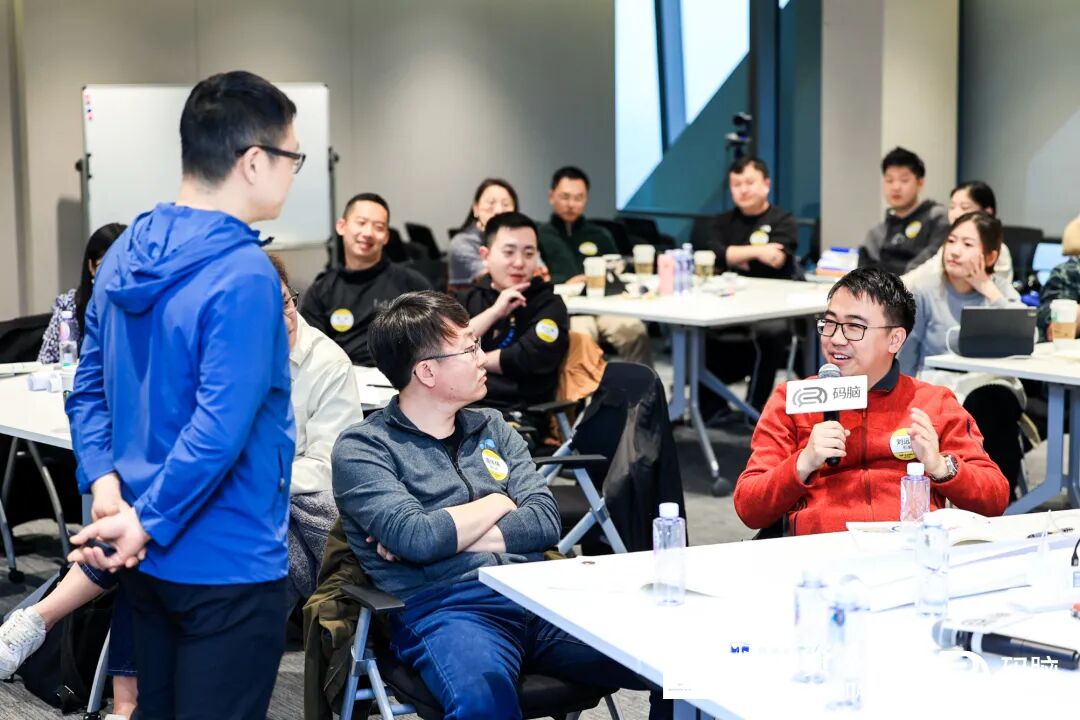
Image source: Practical Leadership Workshop, on-site photo
4 Mental Prerequisites for Achieving "Dialogue"
So how can we achieve high-quality Dialogue? I'll elaborate from two dimensions: mental models and process essentials.
In this Practical Leadership Workshop sharing, I mentioned that mental models are characterized by being "deeply rooted and unconsciously held." The core of achieving Dialogue is possessing a mental model of mutual exploration, so everyone first needs to understand and practice the following mental models:
1. Abandon "habitual self-defense." Teams engage in habitual self-defense during communication (fear that one's views will be ridiculed), which unconsciously leads people to defend their positions rather than confront facts or truth.
2. Distinguish between "personal assumptions" and "truth." Most people habitually inject their subjective biases into their understanding of current situations. In other words, much of what you consider truth is merely personal assumption.
3. Recognize "learning inertia." People tend to rely on their existing cognition to explain what they encounter: if the truth of a situation resembles our ideas, it's far less effort than re-observing and rethinking.
4. View team members as partners and comrades-in-arms, not opponents who must be defeated. Everyone advances toward a shared vision and goals, jointly exploring truth. (Does this remind you of "win-win thinking"?)
Additionally, whether a team can engage in Dialogue is highly related to the #1 leader's leadership style. If the #1 leader can actively balance "courage" and "humility," treating every participant equally, the probability of the team achieving true Dialogue increases substantially.
5 Keys to Successful High-Quality "Dialogue"
Once there is awareness of these fundamental "mental model" level understandings, we need to continuously practice in real scenarios. Next, I'll discuss the process essentials for practicing Dialogue:
1. Express your inner voice while suspending assumptions. You need to speak truthfully. Expressing your genuine thoughts requires courage and may make others uncomfortable, but this is the essence of Dialogue. At the same time, you must treat your personal views as merely assumptions and possibilities, not absolute or sole truth, to stimulate other members' thinking. Suspending assumptions doesn't mean changing your views, but maintaining an open and welcoming posture toward questioning and critique.
2. Listen attentively when others speak, treating other members as partners in jointly exploring truth. Genuine listening is actually very difficult to achieve, and surveys show we almost never intend to be good listeners. The first step to mastering listening: stop talking, and actively restrain your desire to express. The empathy-driven listening mentioned in this sharing—listening with the purpose of understanding the other person—represents the highest level of listening and requires "deliberate practice."
3. Respect others' viewpoints. Constantly remind yourself: what matters is not "who's right or wrong," but "what is right, what is wrong." Give space for those with different opinions to express their views, respect others, encourage them to speak, rather than always thinking about "changing" them. Without respect, the conversational atmosphere easily becomes unbalanced.
4. Avoid escalating from defense to quarreling. Many issues don't have a single correct answer. When opinion conflicts arise, lay everything out fully, treating conflicting viewpoints as an opportunity to recognize the multifaceted nature of a problem. Neither avoid or fear conflict, nor suppress conflict with power and intimidation, and certainly don't let it devolve into verbal violence. Achieve balance among stating your views, defending your views, listening to others' views, and changing your views. That is, balance "advocacy" and "inquiry,"兼顾 "holding your position" and "listening to others' positions."
5. Respect and follow the organization's final decision. The purpose of Dialogue is to reach organizational decisions. These decisions may not always gain every member's approval, and many good decisions are non-consensus. As an organizational member, even if you don't agree with the decision after Dialogue, you must strive to execute it.
Some founders may ask: What's the difference between Dialogue and brainstorming?
Brainstorming aims to generate many different ideas, while Dialogue focuses on achieving better decisions through deep exploration. Additionally, brainstorming suits all groups, whereas Dialogue is better suited for core management teams discussing complex problems—it can establish positive interactive relationships among members, surface collective intelligence, and improve decision quality.
How to judge whether a team has truly achieved "Dialogue"? Borrowing a phrase: "You can't remember who said what, but you know you've truly reached consensus."
Only with the capability for Dialogue can an executive become a "true executive"; only when an executive team possesses the capability for "Dialogue" can it become a "true executive team."
Recommended Reading

Part Three of Peter Senge's The Fifth Discipline, including Chapter 8 "Personal Mastery," Chapter 9 "Mental Models," Chapter 10 "Shared Vision," and Chapter 11 "Team Learning."


More Code Brain Content
Issue 16: Three Keywords in Corporate Crisis Management from the 3·15 Perspective Issue 15: The New Evolution of Insurtech Issue 14: "Small" Trademarks, "Big" Trouble — How to Effectively Avoid Pitfalls on the Entrepreneurial Journey Issue 13: Financial Opportunities in Industrial Internet Issue 12: Strategic Thinking on Douyin Marketing for Consumer Brands Issue 11: Inclusive Finance Under the New Economic Landscape Issue 10: Brand: Meaning, Symbol, Value Issue 9: Stoking the Fundraising Fire Issue 8: Digging for Gold in India — Battle-Tested Insights