Four Dimensions to Map Innovation Opportunities in InsurTech | Source Code Capital Internal Reference

InsurTech, the next big thing? Exclusive: Issue 9 of *Source Code Capital Internal Reference*
Author Bio
Tong Sun
Vice President, Investment

Tong Sun joined Source Code Capital in 2014, focusing on financial insurance, real estate services, agriculture, and innovative business models. Her investment and portfolio management experience includes Asset360, Nongfenqi, Hui Fenqi & Huizhaofang, among other quality companies. Prior to Source Code Capital, she was a veteran media professional at Business Value magazine and a co-founder of GeekPark.
Contact: st@sourcecodecap.com
[Editor's Note]
We have mapped InsurTech across four distinct dimensions, each with the potential to produce valuable companies. These dimensions can also be linked and stacked in combination to forge new competitive positioning. So if a company could串联 all capabilities from one dimension through four, would you believe a new giant on par with traditional insurers might emerge? Following its analysis and research, Source Code Capital presents the ninth installment of "Source Code Insider" exclusively.
Perspective
Four Dimensions for Mapping InsurTech Innovation Opportunities
Research by/Source Code Capital
- The insurance category should ideally be large enough with high growth potential;
- New value creation along the industry chain must be achievable;
- 2C versus 2B is not a choice but a path;
- InsurTech capabilities are the infrastructure of the future.
In the second half of 2017, the InsurTech sector continued heating up on several industry developments: In November, WeChat launched its "WeSure" platform, with WeMed and WeAuto products leading the charge; on September 28, ZhongAn Online listed in Hong Kong with a market cap exceeding RMB 100 billion, while its ZhongAn Technology unit focused on InsurTech R&D; in July, Ant Group announced it would open its "Dingsunbao" technology product to the entire industry, using AI to enable automated auto insurance damage assessment.
When traffic giants begin actively laying groundwork in insurance and cultivating the market, when investment and financing activity among insurance startups grows increasingly vibrant — this signals that the soil for InsurTech transformation is ready, and the change will come faster than imagined.
As a component of internet finance, InsurTech is also a key focus area for Source Code Capital. Over the past year, we have evaluated 100+ InsurTech-related startups. Our understanding of the insurance industry has undergone a spiral ascent — from single-dimension to multi-dimensional capability stacking, from opportunity to challenge to new opportunity — gradually clarifying some frameworks for judgment.
Like other financial sectors, insurance is heavily regulated. As a financial platform that can reach retail customers at scale — second only to banking — insurance must be operated by licensed institutions, making the license a rigid industry threshold.
Meanwhile, many non-standardized products with strong renewal characteristics give insurance a somewhat "anti-internet" quality, making online sales less straightforward. These factors have prevented rapid volume explosion in the internet transformation of insurance, requiring more time for exploration and iteration.
Yet several clear macro trends are creating new opportunities for entrepreneurs. Consider a few shifts.
- From "60s/70s" to "80s/90s"
The fundamental shift originates on the user side. The insurance customer base is undergoing a major upgrade. According to data jointly released by Ant Group and CBNData, internet insurance consumers are predominantly young people, with post-80s accounting for 47% and post-90s for 33%.
This is happening faster than we expected. In fact, it reflects the symbiotic effect between insurance and consumption — insurance enables new consumption, and new consumption stimulates demand for insurance, accelerating insurance awareness among those born in the 1980s and 1990s. This is a dividend of new users.
- From "Passive Selling" to "Active Inquiry"
Changes in user profiles have transformed both spending power and willingness in insurance selection. As the insured population skews younger, their genuine demand for insurance products begins to surface. This cohort's cognitive level and consumption habits have fundamentally altered how insurance is purchased.
That is, the evolution from being sold to by insurers' mass-army tactics toward more rational, information-transparent choice. They need higher cost-performance products and more neutral recommendations. This is where the internet-plus opportunity lies in moving insurance from offline to online.
- From "Traffic Aggregation" to "Distribution Hub"
Insurance's front end can be understood as a funnel requiring continuous user traffic to drive policy conversion. But this is only step one.
From global experience, insurance functions more like a connector. It naturally extends into many scenarios — from travel, health, and eldercare down to cracked screens and product returns. If there is opportunity to transform "insurance liability" into "associated services", greater value creation will emerge across the industry chain.
Internet and technology capabilities are enabling richer scenario construction and tighter linkage. As front-end traffic innovation gradually systematizes, back-end distribution value and dividends will emerge.
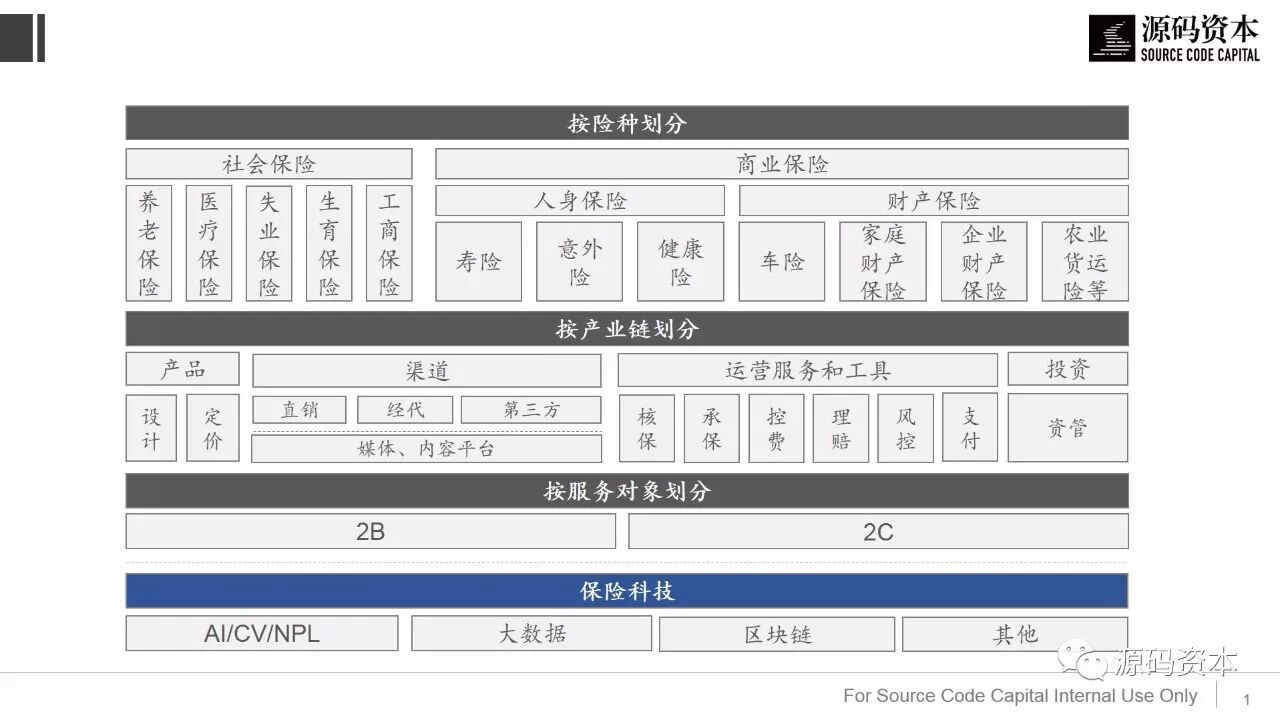
Synthesizing these threads, Source Code Capital has structured its analysis as follows: we first divide internet insurance across four different dimensions — horizontal and vertical — where linkage and stacking between dimensions can pinpoint different sub-sectors.
We can simultaneously envision: where do the major opportunities driving industry transformation lie? What kind of company possesses the capability to串联 all four dimensions? And might it become a new behemoth?
1
By Insurance Category
Understanding category segmentation helps identify potential opportunities in each sector.
According to CIRC data, China's premium income has maintained rapid overall growth, reaching RMB 3,095.908 billion in 2016 with 27.5% growth. Property insurance premium income was RMB 872.449 billion with slower growth, while life insurance reached RMB 2,223.4 billion — a 40.2% year-on-year increase and the first time exceeding 40% in five years.
Compared to social insurance within the national basic security system, we focus more on commercial insurance opportunities, primarily in property and life insurance markets.
1. In property insurance, auto dominates, with innovation space in liability insurance.
Auto insurance is a red ocean of price wars. Channel fees are high but largely rebated to users, and with commercial auto insurance fee reform policy, margins are thin at every layer with limited space. The focus should be on service and claims — using AI and data, opportunities exist in underwriting and claims anti-fraud for vehicle damage and personal injury; with the advent of autonomous driving and other new technologies, whether auto insurance will gradually be replaced by liability insurance warrants continued consideration.
Supplemented by home/enterprise property and agricultural insurance — the former two have small share, while the latter currently relies mainly on state subsidies, requiring near-term observation.
2. In life insurance, life products dominate by share, but health insurance grows faster.
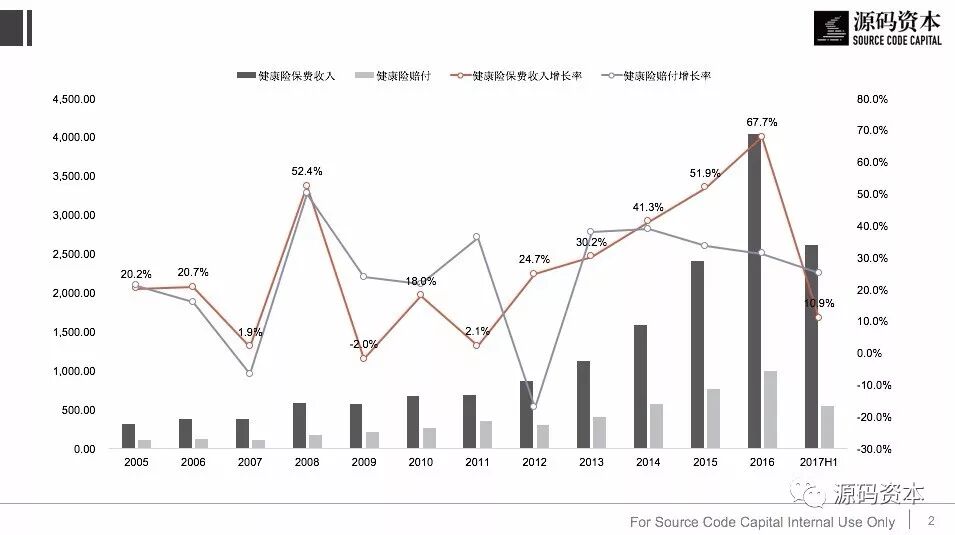
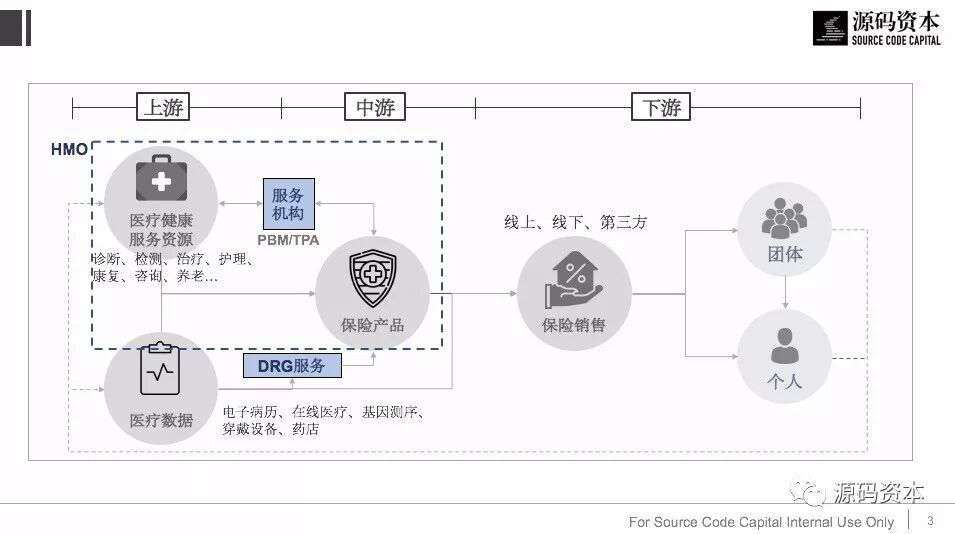
We are more bullish on major opportunities in health insurance. Medical expenditure structure has room for improvement, while domestic insurers lack experience in health insurance operations — deficient in data acquisition, actuarial capability, cost control, and resource integration — creating opportunity for third-party service providers to fill gaps. Within this, we can also watch upstream and downstream data and service companies, as well as domestic adaptation of the relatively mature HMO model in the United States.
2
By Industry Chain Value
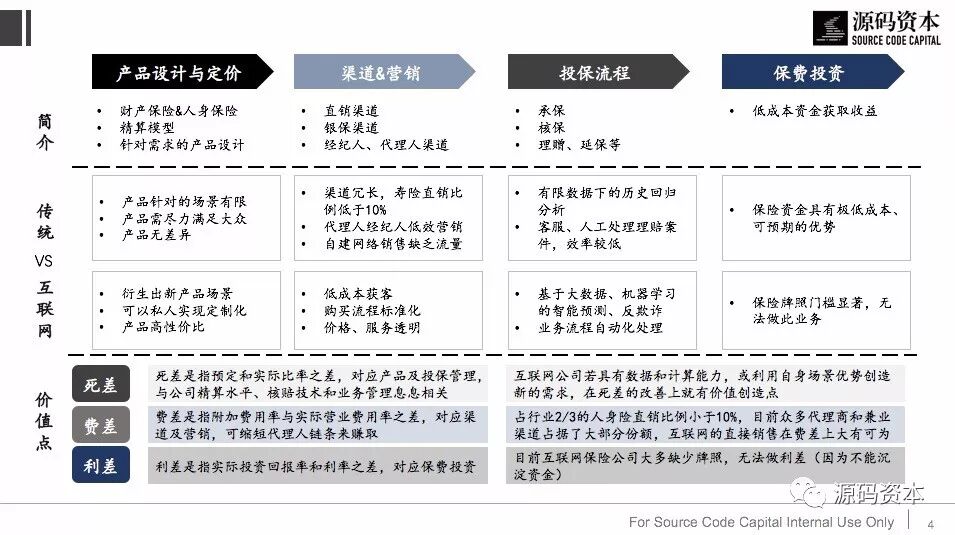
This is the most important dimension.
Insurance operates underwriting and asset management. Looking at how insurers make money: primarily through mortality margin, expense margin, and interest margin. Interest margin is investment returns — the value of the license, difficult for startups in the near term; mortality margin can be broadly understood as claim/loss ratios, requiring product design and data expertise; expense margin is the difference between loading charges and actual operating expenses, requiring cost reduction and efficiency improvement in intermediate links. So we attempt to unpack the interlocking industry chain nodes to identify value points and new opportunities.
1. Product Innovation:
One of insurers' main functions is product design — the daily work of actuaries. That is, insurers are not actually lacking in insurance design capability, and once any well-selling standardized product appears in the market, replication by competitors happens quickly — not a strong moat.
We believe true product innovation comes from two sources. First, mining entirely new scenarios where startups understand certain contexts better than insurers, or using heavier approaches to aggregate fragmented scenario demands to avoid competing directly with insurers' core strengths. Second, unique data acquisition capabilities that can reverse-support actuarial models and pricing, creating genuine cost-performance advantages. Many insurance products remain relatively expensive today; if startups can use data to lower product barriers, insurers may not easily replicate this.
2. Channel Efficiency:
Insurers are most focused on channel sales. In the traditional era, because insurance products generated from conservative actuarial assumptions were nearly undifferentiated, sales relied on stacking manpower, with higher premiums requiring higher labor costs. In life insurance, beyond bancassurance channels with lower sales costs, most agents capture 20-35%, with 40% going to intermediate layers; in auto insurance, with 40-50% loss ratios, insurer profits are only 5% with the rest as sales costs. Redundant chains make the sales process uneconomical — so how to reduce costs and improve efficiency?
For example, low-cost customer acquisition through content, enabling users to better understand and familiarize themselves with insurance products as information gradually symmetrizes; simultaneously achieving standardization of the product purchase process, layering in technical capabilities to make the closing process smoother and faster, reducing redundant links and manpower, simplifying user choice — all present efficiency improvement opportunities.
Another example: empowering excellent broker-agents. This salesforce is undergoing self-upgrade alongside industry development; better user acquisition, management, and service is efficiency improvement. And looking at channel-oriented agency/brokerage companies themselves, this intermediary organizational structure can also be flattened by the internet.
3. Service Optimization:
From underwriting to claims and extended warranty, insurance products require service support from sale to claim. Insurers' claims departments are mostly cost centers rather than profit centers, hence subject to headcount constraints that prevent fully adequate service.
We believe subsequent opportunities are shifting from sales channels toward service-driven models. Whether TPA companies or InsurTech-based data and technology companies, if they can help insurers achieve more efficient underwriting and claims, automated data and image recognition and processing, anti-fraud early warning, and claims cost control — all align with the major trend and hold value. For investors, however, metrics for value realization and ceiling height need consideration.
If a company can build excellence across all three directions above — from front-end product design through middle-channel sales to back-end claims service — with the insurer merely playing its license value for policy issuance, the opportunity exists to create an MGA (Managing General Agent) model. We similarly look forward to outstanding companies in this model.
3
By Service Target: 2B/2C
Early on we evaluated many direct-to-consumer "scenario insurance" products, with logic mostly that the 2C market is large enough to acquire and convert users at relatively low cost within some high-frequency traffic scenario. But we quickly found that traffic belongs to the scenario; without controlling the scenario means not controlling the user, and once scaled, substitution risk emerges. Meanwhile, users acquired at extremely low cost partially skew toward "bargain hunters" rather than those with genuine insurance purchasing power and willingness, making future conversion difficult.
We then intensively evaluated 2B products, mainly two types: one serving insurers or agencies/brokerages, such as SaaS systems or tools for agents; one serving B-end enterprises (indirectly 2C), designing products贴合 to scenarios. The commonality of such 2B businesses: at the product and technology level, competitive differentiation is modest; the value of landing top-tier B clients significantly exceeds long-tail small B, yet the more top-tier the client, the greater the negotiation difficulty and longer the integration cycle. While cooperation efficiency is not high, startups also face various risks from "department head changes, leadership changes." Especially cooperating with highly concentrated large insurers, powerful relationship networks exhaust many startups.
So we returned to seeking 2C opportunities. As mentioned above, a subtle yet不可忽视 trend is that user-side demand is shifting from passive purchasing toward active inquiry. In fact, due to "lack of cost-effective products" and "long-term information asymmetry about insurance purchasing knowledge," much user demand was suppressed for extended periods. And the "internet-plus" process for financial products and services will inevitably extend from lending to insurance, wealth management, and beyond. If someone can solve the above problems — such as having better-priced products, or sufficient neutral content and consulting services — to gradually penetrate and educate the market, we believe 2C high-conversion opportunities exist.
Of course, we are also re-examining 2B opportunities: which players can quickly打通 industry脉络; or whether all sectors are relationship-bound, which scenarios can avoid top-tier tactics while possessing data acquisition, easy integration, and easy education capabilities; and whether more clever product entry points can make B-end institutions urgently need them, and so on.
By InsurTech Infrastructure
Like FinTech, InsurTech is an innovation catalyst for industry development — infrastructure and general-purpose leverage, like the internet to the Industrial Revolution. In this area, given remaining gaps in China's insurance system and frontier technology accumulation, we need a more global perspective to capture cutting-edge technologies and domain applications.
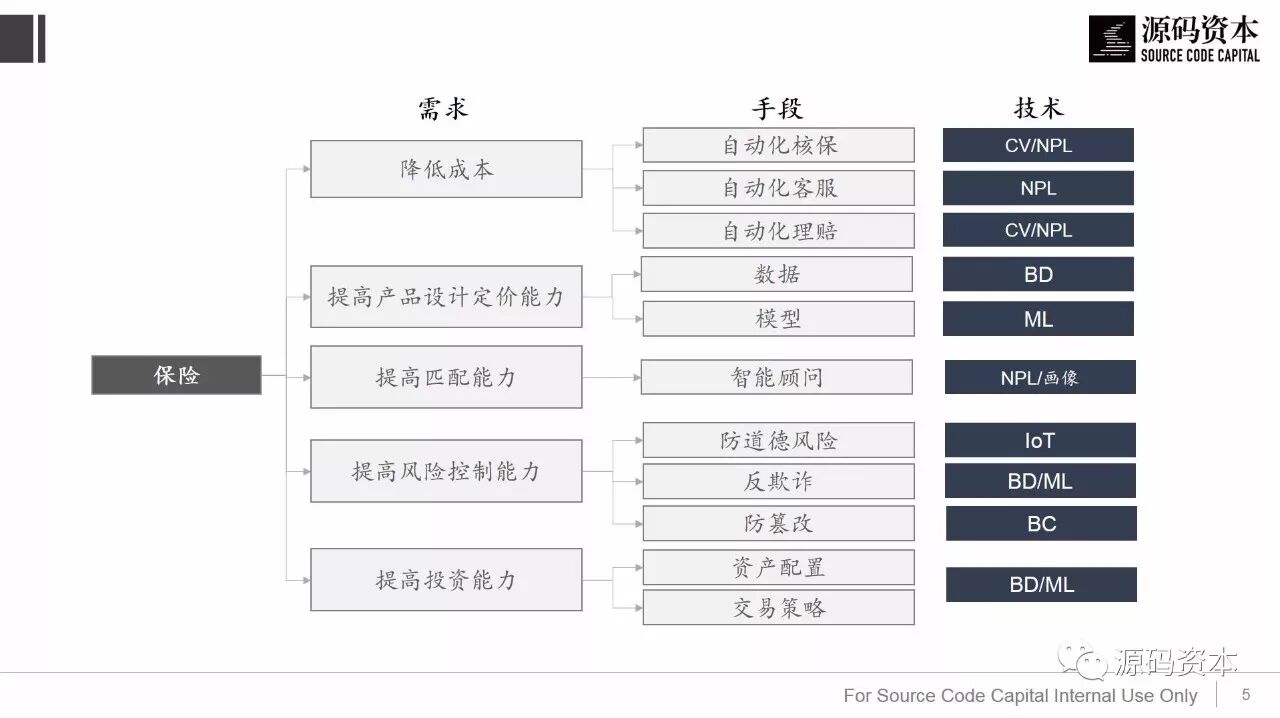
Main directions to watch:
1. AI + Insurance: e.g., Lemonade, Tractable, Insurify
Role replacement: In underwriting, customer service, and claims, image recognition and natural language processing can substitute human labor to reduce costs.
Intelligent insurance advisory: Data and algorithms can more accurately recommend insurance products to users, enabling more efficient consultation and customized solutions.
Anti-fraud: Leveraging image recognition, facial recognition, and other technologies.
Investment capability: Using data and deep learning to improve insurance capital asset allocation efficiency and trading strategies.
2. Blockchain: e.g., Tradle, Safeshare
Blockchain will fundamentally change how the insurance industry operates.
Main focus areas: smart contracts for identity verification, claims anti-fraud, real-time insurance based on sharing economy, and others.
3. IoT & Data: e.g., Aviva, RiskGenius
New data source acquisition based on Internet of Things, coordinating interests between insurers and insureds, bringing entirely new risk control capabilities. This requires time to accumulate.
Underwriting risk: Such as chronic patient data, or UBI-collected driver data.
Claims risk: Facial recognition, image deduplication to prevent fraud, etc.
Summary:
The above represents Source Code Capital's perspective on this domain; space constraints prevent exhaustive detail. But the industry is deep and sophisticated, and we will maintain iterative understanding alongside thirst for knowledge about all changes and new opportunities. If you share these interests, please contact us — we look forward to exchanging and learning together.
More Source Code Insider
Issue 8: Opportunities in New Finance Through an Asset Management Lens
Issue 7: The Pitfalls of Tech Prophecy
Issue 6: Industrial Internet Investment Landscape
Issue 5: Convenience Stores: Domestic 7-Eleven Paths Under the New Retail Wind
Issue 4: Mobile Going Global: Entrepreneurs Eye Big Opportunities in Content Products
Issue 3: Targeting Unicorns in the Consumer Upgrade Wave
Issue 2: Profile of "Reliable" AI Startups
Issue 1: Under "New Retail," Where Do Offline Stores Go

Create Enduring Real Value Create Enduring Real Value
Long-press to scan QR code and follow Source Code Capital