Qidi Weekly | The AI Face-Off Between Zhilin Yang and Allen Zhu
"Inspiration Weekly" is a column I'll update every week. Here, I'll record five people or things that inspired me during the week — to help me reflect, grow, expand my intellectual boundaries, and become freer and happier.
💡
"Enlightenment Weekly" is a column I'll update every week.
Here, I'll record five people or things that enlightened me this week — helping me reflect, grow, expand my boundaries, and become freer and happier.
This week's five:
❶ Tencent Technology's interviews with Zhilin Yang and Allen Zhu
❷ Are you Talking Tom?
❸ WeRead got even better
❹ Four thousand vinyl records and a pure space
❺ Gurnah: "Who am I"
❶
Tencent Technology's interviews with Zhilin Yang and Allen Zhu
Moonshot AI vs. the Bright Side of the Moon

📰 Source: WeChat official account "Tencent Technology"
🔗 Dialogue with Moonshot AI's Zhilin Yang: Advancing Toward the Uncharted, Snow-Capped Mountains
🔗 Allen Zhu Tells a Chinese Realist AIGC Story
👦🏻 Koji:
Tencent Technology recently published two substantial interviews back-to-back — one with Zhilin Yang, founder of Moonshot AI, currently China's highest-valued large model company, and another with Allen Zhu, a closely watched early-stage investor. What's fascinating is that these two interviews, two distinctly individual personalities, reveal two fundamentally different mindsets and postures.
The young Zhilin Yang represents idealism and a technologist's faith in AGI and Scaling Laws; the older Allen Zhu sits at the opposite pole, believing only in what can be commercialized immediately.
Some netizens even had ChatGPT compile a side-by-side comparison of their views:
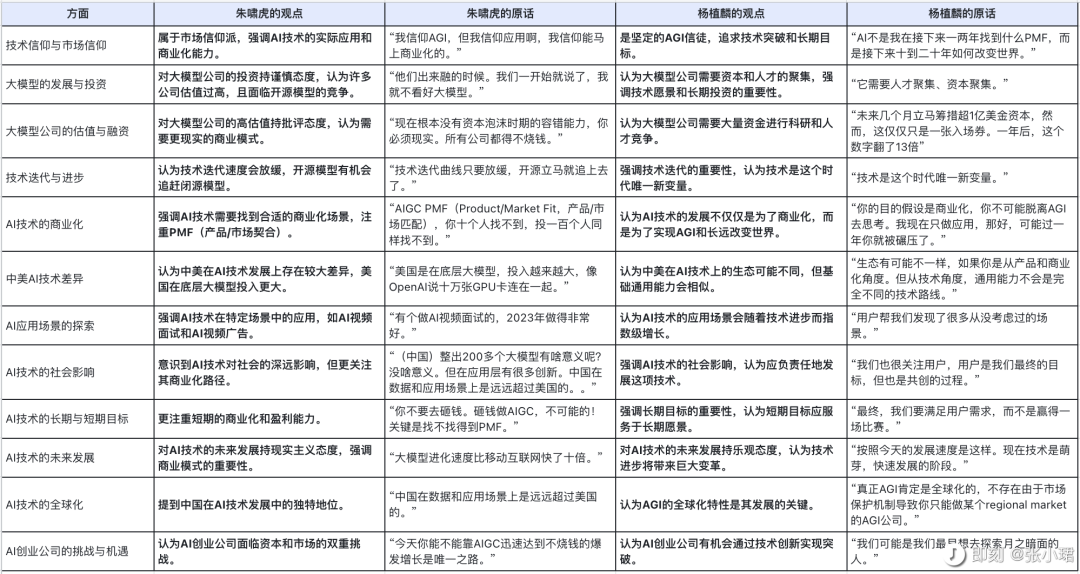
Two reasons I recommend these interviews:
- For the business perspective. Their respective judgments on commercial value, timing, and strategic paths differ significantly — yet each forms a coherent, self-consistent school of thought.
- For the career perspective. Both occupy different positions with different motivations, and both are skilled communicators. They share their attitudes toward opportunity, risk, challenge, and organization.
Whether the GenAI wave ushers humanity into a new era or someday proves to be one of history's biggest bubbles, it has already become an undeniable milestone in tech history.
"Living through history" is a fascinating thing.
The two articles total roughly 20,000 Chinese characters, packed with information. I recommend setting aside some quiet time to read them.
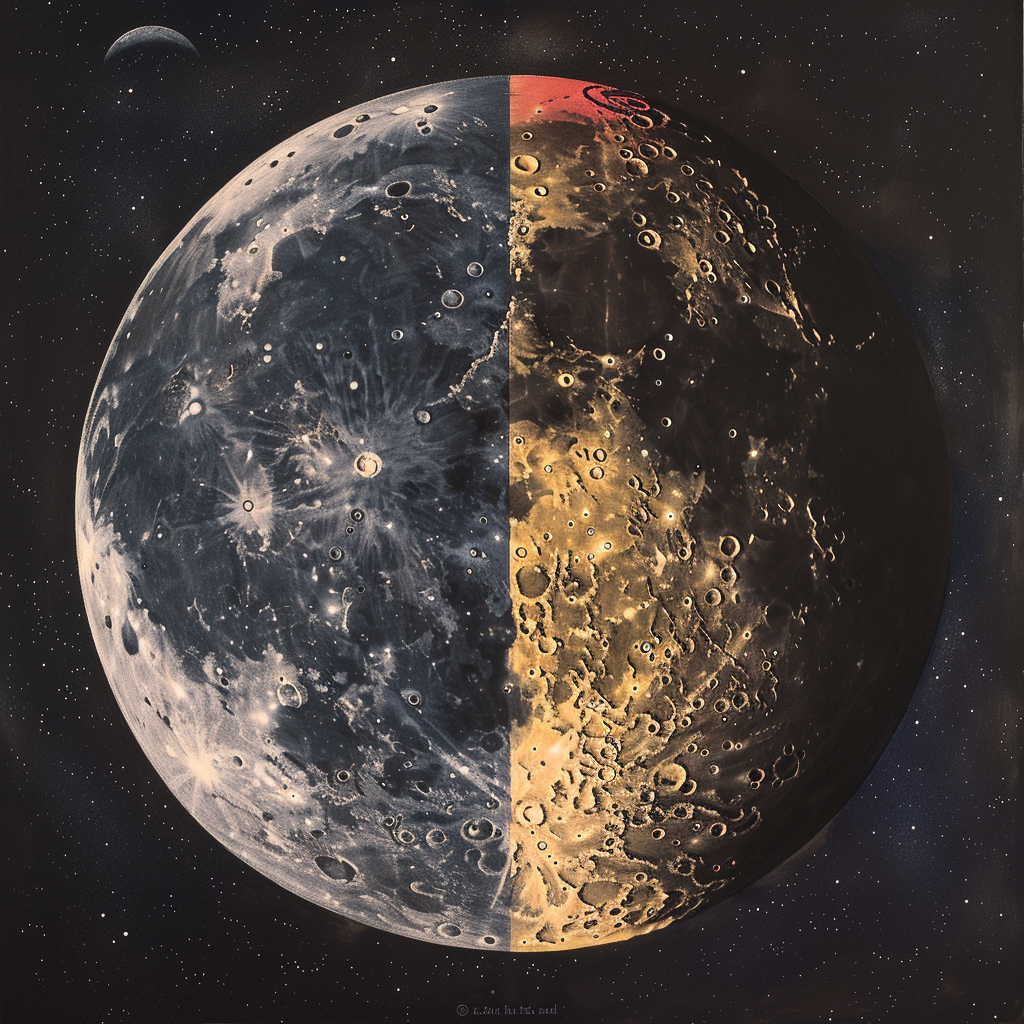
MidJourney-generated image: Dark Side of the Moon vs. Bright Side of the Moon
💡 Excerpt:
China's tech community has split into two camps on large language models. One is the technologist-faith camp, mostly engineers by background, who believe — like OpenAI — in AGI and in scaling laws, with a mindset leaning toward Silicon Valley. In their view, as model capabilities leap forward and costs drop, rich applications will naturally emerge. If you don't pursue "bigger, stronger AI," once someone else's model makes a quantum leap, it will crush your existing position and moat.
The other is the market-faith camp, who believe steep technology curves eventually flatten, and that "sufficient AI capability" should be poured into quickly monetizable business scenarios, using China's massive and unique data to build barriers. These people tend to have spent longer in China's jungle-like business environment, with a more locally grounded mindset.
A fundamental disagreement in their technical judgment: will open-source models someday narrow or even close the gap with closed-source models? The technologist-faith camp says absolutely not — the gap will only widen. The market-faith camp says definitely yes — meaning your closed-source bet today will end up awkward. This divergence in worldview makes both sides utterly convinced of their own judgment.
Interestingly, Sora's emergence didn't bridge this cognitive gap — it only reinforced each side's position.
We attempt to present both attitudes. Zhilin Yang represents the technologist-faith camp, while Allen Zhu's views sit at the opposite extreme.
In fact, the market-faith camp has more adherents in China, especially amid the current deflated capital bubble. Yet they sometimes hesitate to voice their true thoughts — fearing they'll be dismissed as "not believing in AGI," or as not fighting for humanity's ideals — so they mostly stay selectively silent.
Allen Zhu shows no such hesitation. He seems lately fixated on one line: "AIGC PMF (Product/Market Fit) — if you can't find it with ten people, throwing a hundred at it won't help either." To some extent, his view presents a more realistic Chinese AIGC story.
❷
Are you Talking Tom?
📰 Source: WeChat official account "AI Grand Voyage" by Bingjian Wu
🔗 The Path of AI Applications: Doubting Talking Tom, Becoming Talking Tom, Surpassing Talking Tom
👦🏻 Koji:
How should we understand the present moment amid the AI wave? It's a well-worn topic.
This article uses Talking Tom as a metaphor, and finds something fresh to say.
What is Talking Tom? It was an app from the early mobile internet era, circa 2010 — a cat that repeated your words in a funny voice. The app went viral, then faded from view. Hence, "Talking Tom" has become shorthand for products that become phenomena but lack long-term retention. Recent examples include Miaoya Camera and HeyGen's videos of Guo Degang doing English comedy.
Talking Tom invites dismissal, especially from those of us who've lived through previous cycles. But this article's core message is a warning against contempt. Many platform-level products we now take for granted started as Talking Toms.
But because they became Talking Toms, the company secured passage to its next journey, the team developed intuition, and Talking Tom became the stepping stone for crossing the river. Without becoming Talking Tom, there is no later story of surpassing Talking Tom.
This is: understand Talking Tom, become Talking Tom, surpass Talking Tom.

MidJourney-generated image: Humanity has become Talking Tom.
💡 Excerpt:
Everything follows its own laws; no one skips from age 1 to 17 and arrives straight at 18. We all know AI's opportunity is massive — that's consensus. Judgment of current timing, understanding of model capability boundaries — these remain non-consensus, and that's the real test for entrepreneurs.
When the wave comes, what matters is standing in the water, learning to swim early, and getting used to the taste of seawater.
❸
WeRead got even better
👦🏻 Koji:
Recently the WeRead app added three more reasons worth recommending:
- AI-generated outlines for every book. I've always advocated reading the table of contents first — grasping the big picture, then maintaining that panoramic framework throughout — which greatly improves reading efficiency and effectiveness. Now with AI outlines, it goes a step further than the table of contents. I even suspect that for some books in the future, reading just the AI outline may suffice. Humans tend to ramble; AI gets straight to the point.
- You can import local English books (epub and txt formats) for automatic translation, with bilingual paragraph-by-paragraph alignment. Thanks to AI translation's magical quality, I now believe business, finance, and management books — even some nonfiction — can be read directly via AI translation. Perhaps only literature and poetry still need human translators.
- You can now read Caijing magazine and Harvard Business Review here.
❹
Four thousand vinyl records and a pure space
📰 Source: WeChat official account "LatePost"
🔗 Four Thousand Vinyl Records and a Pure Space
👦🏻 Koji:
Lao Jin, Jin Pengyuan, is a long-time close friend who's done so many things I wanted to do but didn't, and probably couldn't.
I first heard his name when the Weibo account he ran for Durex kept going viral — one creative hit after another, one brilliant execution after another.
Recently, Lao Jin opened Space687211 in Beijing — a space with four thousand vinyl records — and held an exhibition of 178 vintage Braun products from his personal collection.
It's a distinctive space: a fully public first-floor café, a semi-public second-floor gallery, and deeper on that floor, his private room. Here, Lao Jin can choose social connection or solitude at will.
LatePost recently launched a weekend edition covering various kinds of creators. Their choice to feature Lao Jin's Space687211 surprises me not at all. Borrowing Faye Wong's "arrogant" acceptance speech at a Golden Melody Awards: I endorse your endorsement of him.
I envy Lao Jin. I need to work harder too.
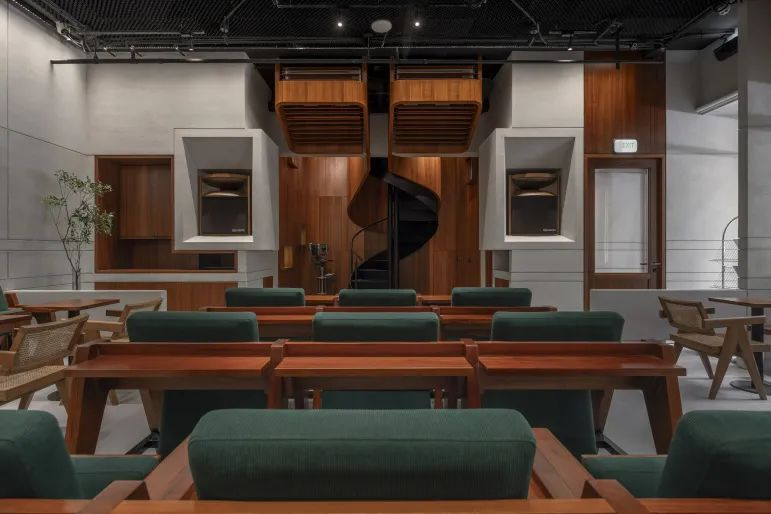

Inside Space687211.
Photography: Jin Weiqi; Photo copyright: Space Station Architects.
Gurnah: "Who am I"
📰 Source: WeChat official account "Esquire"
🔗 Masters and Masterpieces | Gurnah: "Who Am I" Has No Either/Or Answer
👦🏻 Koji:
Last week, the writer Abdulrazak Gurnah came to Shanghai. He's the 2021 Nobel Prize in Literature laureate. Last year I binge-read the first five of his novels translated into Chinese; currently he ranks just below Haruki Murakami, Alice Munro, and Raymond Carver in my personal pantheon of novelists. Thanks to a friend's help, I met Gurnah last Wednesday in Shanghai — I'm still buzzing with excitement.
If you asked me to write an article recommending Gurnah, or any novelist I love, it would be an extremely challenging task. So instead I've selected an interview with him, hoping it can serve as your entry point.
All 10 of Gurnah's novels in Chinese translation published by Shanghai Translation Publishing House
💡 Recent "Enlightenment Weekly" updates:
Enlightenment Weekly Vol 01: Other people's 30s, how to improve your luck, good things will happen

Hi, I'm Koji, and "Crossing" is my personal newsletter. The name comes from something Steve Jobs said about standing at the intersection of technology and the humanities.
I'm co-founder of the sleep environment brand Tangdao and the content company The Fair. I previously founded the Jiepang app and was involved in the early days of Fanfou and Jumei International Holding Limited.
As a typical cross-boundary entrepreneur, from mobile internet to e-commerce, from content to consumer goods, I let my curiosity roam across various "crossings."
🥳 Add assistant WeChat Rwkfbcianvd to join the "Crossing" reader and listener community.
This group has one and only one goal: helping everyone meet new friends and become fellow travelers toward the future.