Code Brain | Entrepreneurs' Time Management: "Two Learnings, Three Principles, Four Quadrants"

Mission, Role, Goal
#Code Brain
Ecological Connection, Cognitive Resonance
Entrepreneurship is an endless journey of self-discovery. Only through continuous personal growth can one drive a company's growth.
Founders and core executives of startups constantly face challenges on multiple fronts: product and service innovation, business model iteration, efficient team collaboration, organizational capability building... These challenges demand extraordinary mental resilience, intellectual capacity, and physical stamina. Beyond attracting better talent, "looking inward" is an essential discipline.
This edition of Code Brain's "Practical Leadership" workshop series (Session 3) specially invited Xu Yifeng, partner at Chief Organizational Officer, who brings over 20 years of HR experience. Using the "Manager Mindset Model," he helps founders better perceive their role within their companies, and in turn, understand how to allocate their time and energy. This article focuses on time management for entrepreneurs, with content excerpted from Xu Yifeng's session.
Article Preview
- What is the key to time management?
- The "two skills to master" in time management
- Principles and methods of time management
- Analyzing time investment through the "Time Management Matrix"
- A practical tool for time management: weekly planning

Xu Yifeng, Partner, Chief Organizational Officer
What Is the Key to Time Management?
Time management is a persistent and critical challenge for many entrepreneurs. Consider this: if a good entrepreneur can't even manage their own time, how can they manage a team of dozens, hundreds, or thousands, let alone an entire enterprise?
Manage yourself first, then you can manage your company.
But many people misunderstand time management: they think it's about getting things done faster. For example, if you have 10 things on your plate, are you thinking about how to complete all 10 more quickly and efficiently? But what you should really be asking is: which few things are meaningful and worth spending serious time on? Which things have nothing to do with you and can be dropped entirely? Because becoming more efficient at trivial tasks only frees up time for more trivial tasks.
Let's look at how time management theories have evolved across generations:
The first generation focused on using notes and memos to juggle time and energy amid busyness. The second generation emphasized calendars and schedules, reflecting a growing awareness of planning for the future. The third generation — currently popular — stresses prioritization, setting short-, medium-, and long-term goals based on urgency and importance, then creating daily plans to achieve them, allocating limited time and energy for maximum efficiency.
The fourth generation differs fundamentally from all previous theories: it essentially rejects the term "time management" altogether. It argues that the key isn't managing time, but managing yourself / managing your life. This introduces the concept of the compass. The compass matters more than the clock because the compass determines direction (choice).
How can life become more effective? This connects to your mission, goals, plans, and execution. Your personal mission tells you what you should and shouldn't do.
As the saying goes: do the right things first, then do things right. So your first step is determining whether something is worth doing, whether it should be done. Otherwise, you might climb a ladder leaning against the wrong wall, and when you finally reach the top, exhausted, you realize it's not where you wanted to go.
The "Two Skills to Master" in Time Management
From this perspective, time management presents two real challenges:
First challenge: learn to choose.
Choice is about what you say yes to and what you say no to. You can strive for "this, that, and the other," but ultimately you must make trade-offs.
As the #1 person in a company, you should seize the "most important things" and achieve breakthroughs on them, rather than trying to cover everything. Some bosses micromanage, saying it's just their personality. True, changing personality is hard, but you can start by changing your mindset.
Ask yourself: why do you always worry that employees aren't capable enough, that they won't do as well as you? But if the boss keeps doing everything personally, how will employees ever develop their abilities? The #1 person needs to grasp the big picture and let go of the small stuff — don't mistake being busy for a sense of accomplishment.
Second challenge: learn to say no. Many people say, how can you say no to your boss! My response: why not try it? The key to saying no is having things you insist are important, ensuring you understand the other person's expectations and needs while actively seeking alternatives.
For example, at the beginning of the year, agree with your boss on the three most important things for the quarter. If your boss suddenly proposes a fourth, you can evaluate priorities together. If the new thing is more important, adjust flexibly — but let your boss know that current resources can't deliver high-quality results on everything.
Principles and Methods of Time Management
"Learning to choose" and "saying no" are crucial for time management, not just at work but in life too. The underlying principle is this: act honestly according to your priorities.
Operationally:
First, at the mindset level: highly effective people spend time on the most important things; less effective people spend time on the most urgent things.
Second, at the practice level: focus on the most important things, abandon unimportant ones, make weekly plans, and be honest when choosing. You need to know what matters most, then let go of what doesn't. Here's a concrete method — "weekly planning": a day is too short, a month too long; a week is the optimal interval.
Third, at the results level: crisis handling gradually decreases, productivity improves, and you gain a more balanced life and a more tranquil mind. This isn't empty talk — entrepreneurship is a long road, and a #1 person with a tranquil mind is a blessing for any organization.
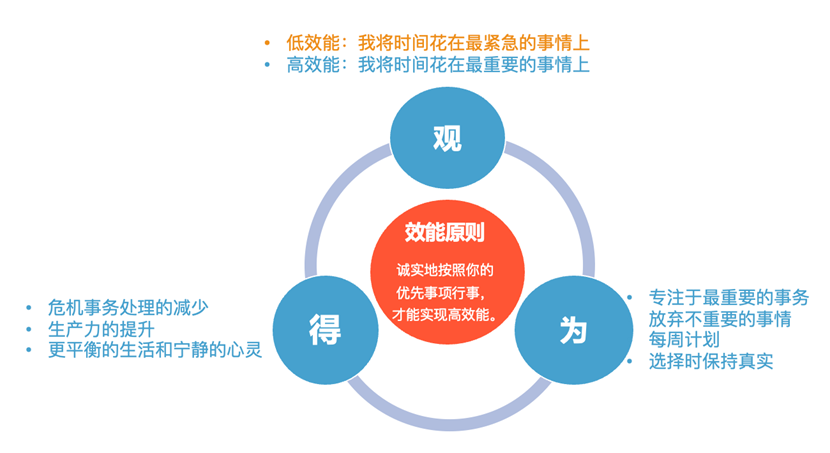
Image source: Speaker's presentation
Some of you may have seen the "big rocks" concept video. There's a glass container, plus some big rocks, small rocks, and a pile of sand. The teacher asks how to fit everything inside.
Someone tries putting small rocks in first, then big rocks, but can't squeeze everything in — many big rocks get left out. Later, they put the big rocks in first, then small rocks, then pour in the sand; after some shaking and tapping, nearly everything fits. It's fine if some small rocks and sand don't make it in.
Small rocks are like trivial tasks — it's okay if they don't all get done. The key is don't leave out the big rocks. What are your life's "big rocks"? Everyone has multiple roles, in work and life. Even as an entrepreneur, your "big rocks" aren't just one. What exactly they are — that's for each person to answer.
Analyzing Time Investment Through the "Time Management Matrix"
Once you recognize the importance of "choice" and "saying no," we can talk about effectiveness. Here's the "four quadrants" concept — Quadrant 1: important and urgent; Quadrant 2: important but not urgent; Quadrant 3: urgent but not important; Quadrant 4: neither important nor urgent.
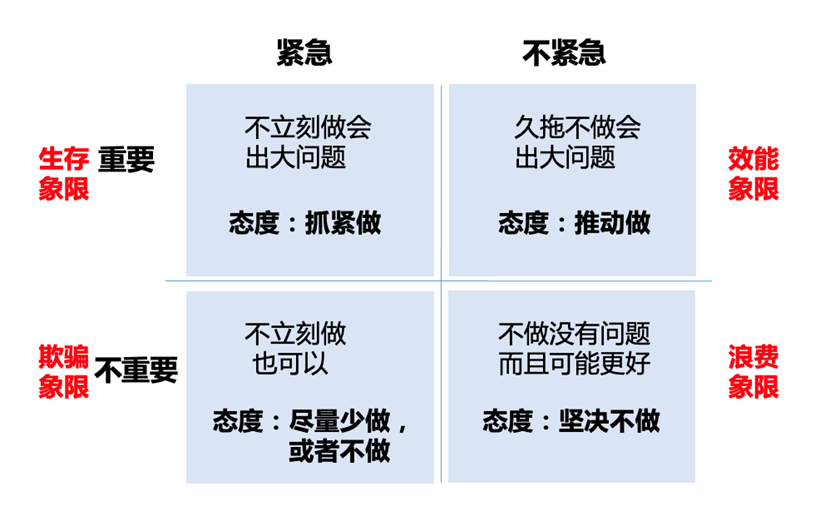
Image source: Speaker's presentation
Quadrant 1 represents things that are both urgent and important — handling an angry customer's complaint, fixing a critical bug, etc. This is the survival quadrant. Challenges here often arise from delays or insufficient prevention and preparation.
Quadrant 2 includes important but not urgent things. This is the effectiveness quadrant. Investing time here improves our capacity. Investment in this quadrant shrinks Quadrant 1.
Quadrant 3 includes many urgent but unimportant things. This is the deception quadrant — often an illusion of Quadrant 1. We spend lots of time here satisfying others' priorities and expectations, thinking we're doing Quadrant 1 work.
Quadrant 4 covers things neither urgent nor important — the waste quadrant. Because Quadrants 1 and 3 leave us battered, we often "escape" here to catch our breath.
Whenever we discuss the four quadrants, someone says: us workers don't have time for important but not urgent things — our bosses force us to do important and urgent stuff all day. True, this is survival. But if you spend 100% of your time on important and urgent things, you'll likely live in chaos your whole life without growing.
Only by allocating certain time to Quadrant 2 will you become increasingly composed. The ideal is beautiful, reality is harsh. Much of what bosses hand you becomes your Quadrant 1. But even so, you must find ways to carve out a small portion for Quadrant 2 — even starting from 5% — or you'll remain perpetually reactive.
Bosses think that by adding more assistants, they can accomplish infinite tasks. This violates the 80/20 principle. Often, business results have little direct correlation with headcount; more people actually complicate communication. The key is whether you achieve breakthroughs on your company's most important priorities.
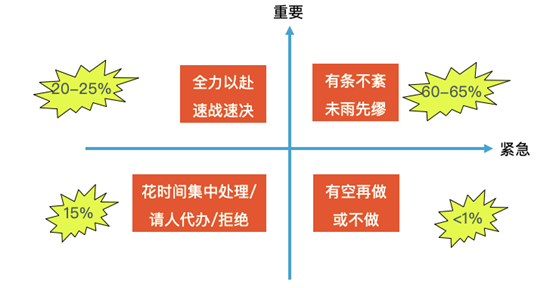
Image source: Speaker's presentation
To summarize: Quadrant 1 — go all out, resolve quickly; Quadrant 2 — methodically, prepare in advance; Quadrant 3 — batch process, delegate, or decline; Quadrant 4 — do when free, or simply don't do.
A Practical Tool for Time Management: "Weekly Planning"
I've presented time management to entrepreneurs and company managers on various occasions, usually just as a knowledge point, but it always generates tremendous interest and reflection. Clearly, time management is a widespread pain point.
Many entrepreneurs urgently want ready-to-use tools to manage their time. Beyond the principles and four-quadrant framework discussed above, there's a more grounded daily tool for practical implementation: "weekly planning." So how exactly does it work?
Step one: clarify your mission, roles, and goals, and the contributions and results you expect from each — this is the foundation of weekly planning, constantly linking back to your life mission and vision.
Step two: plan your "big rocks."
For example: you're a business unit head at a company, and also father to two children. Next week you have two major work meetings, plus a parent-teacher conference and an annual family dinner. These four things are your "big rocks" for the week. You need to block these into next week's schedule in advance.
Step three: then schedule everything else. Once you've secured your "big rocks," other things can be handled through "delegation" — they don't all require your personal involvement. This is especially important for entrepreneurs and CEOs. Some trivial things can be missed without consequence.
I generally recommend setting aside half an hour each Sunday, finding a quiet place, reviewing your mission, roles, and goals, and thinking about which things next week connect to these and need sufficient time reserved. Also remember to be honest in your choices.
Time management is a habit that requires long-term cultivation. Once you commit to change, persist. After some time, you'll see changes in efficiency and effectiveness. For entrepreneurs, good time management is a hidden advantage for strengthening personal leadership and managing your company well.


More Code Brain Content
Issue 17Your Startup's Core Team Needs a "Deep Dialogue" Issue 16Three Keywords in Corporate Crisis Management from 3·15 Issue 15The New Evolution of InsurTech
Issue 14 "Small" Trademark, "Big" Trouble — How Can Startups Effectively Avoid Pitfalls Issue 13 Financial Opportunities in Industrial Internet Issue 12 Strategic Thinking on Douyin Marketing for Consumer Brands Issue 11 Inclusive Finance Under the New Economic Landscape Issue 10Brand: Meaning, Symbol, Value Issue 9 Stoking the Fundraising Fire Issue 8Digging for Gold in India: Battle-Tested Insights