SaaS Business Fundamentals and Value-Add Criteria | Source Code Capital Internal Reference

Bonus Points Beyond the Three Core Business Metrics and Operating Data
Source Code Capital Insider
Issue 11
About the Author
YiWen Hao
Vice President, Investment

YiWen Hao joined Source Code Capital in 2014, focusing on investments in artificial intelligence, enterprise services, and education. His portfolio and managed projects include outstanding companies such as Hai Feng Education, Suishouji (Feidee), Abakus Technology, Huishoubao, WeDoctor, Chuxin Intelligence, and Minxing Shensai. Previously, he worked at Tencent, where he was responsible for the overall product planning of Enterprise QQ; at ASIMCO Group and Frost & Sullivan, where he led corporate strategy and market growth consulting projects; and with the support of HSG, founded Ingle Games, one of China's earliest game publishers targeting overseas markets. YiWen Hao holds a bachelor's degree in business administration from Tongji University.
Contact: yw@sourcecodecap.com
[ Editor's Note ]
Enterprise services entrepreneurship and investment is a hot topic in both China and the United States. Over the past few years, Source Code Capital has closely tracked the development of SaaS model startups in China, summarizing some of our insights and company evaluation frameworks in this space. This Issue 11 of Source Code Capital Insider is presented exclusively following our analysis and research.
Key Takeaways
How to Evaluate SaaS Model Companies and Value-Add Considerations
Research by/Source Code Capital
- China's SaaS companies are developing slowly but still hold market potential
- SaaS company business metrics have clear evaluation frameworks
- Value-add factors in market, sales, and internal management
We believe that China's enterprise services SaaS industry indeed lags behind the United States by roughly 3-5 years. The main manifestations are:
- Company Scale: Domestic companies with revenue exceeding 100 million RMB are few and far between. Compared to traditional software system integrators, SaaS remains a small industry, with few horizontal or vertical applications where the SaaS model has achieved full dominance.
- Ecosystem Environment: Abroad, there are foundational SMB application platforms like Google Apps, Office 365, and Salesforce, as well as unified access applications like Okta and OneLogin. China has no direct equivalents. This makes it extremely difficult for domestic startups to serve small businesses, making mid-to-large enterprise markets a necessity. DingTalk and WeCom may change this ecosystem in the future, but progress has been slow.
- Competitive Environment: U.S. SaaS companies typically compete in generational cycles of roughly ten years — FreshDesk vs. Zendesk, Stripe vs. PayPal. Entrepreneurs tend to find breakthrough points in different application scenarios, with extensive interoperability and partnership between products. In China, companies must survive brutal homogenized competition, leading some sectors to potentially end in multi-party losses with no one breaking through — WeChat official account site builders, QR-code ordering, for instance. Recently, there have also been cases where product supply has already exceeded demand before the market has even taken off, such as mini-program business card CRMs and mini-program site builders. Startups need to think more carefully about their entry points and product boundaries, because with few partnership options available, most must rapidly expand product lines to capture customer budgets.
- Exit Mechanisms: Overseas, large enterprise services companies frequently acquire startups, and listing standards are more accommodating, providing favorable exit environments for VCs and founders.
Currently, primary and secondary markets at home and abroad have broadly accepted valuation methods based on PS multiples for SaaS companies, with relatively clear expectations for revenue growth at different stages. This relatively mature pricing system leaves less room for imagination for startups, slowing valuation appreciation.
That said, while overall market growth has not been fast, China has still produced many outstanding SaaS entrepreneurs, and Source Code Capital is actively seeking partnership opportunities. We also have some experience to share regarding evaluation methods for individual SaaS projects.
1
Foundational Business Metrics
SaaS company business metrics have long had relatively clear evaluation frameworks. Among the most comprehensive summaries is David Skok's "SaaS Metrics 2.0," which has multiple Chinese translations available domestically. The explanations of foundational metrics are already very thorough and detailed, so we won't repeat them here.
For interested readers, scan the QR code below for details:

In practice, there are three metrics not covered in SaaS Metrics 2.0 that we believe are also critical for investors and CEOs in assessing business progress:
1. Lead Velocity Rate

This metric reflects month-over-month sales lead growth. First, it helps determine whether the market ceiling is sufficiently high. Second, it serves as a leading indicator for sales performance 3-6 months out. Finally, it can push sales teams to balance their efforts between lead generation and deal closing.
2. Quick Ratio

The Quick Ratio can be understood as the escape velocity for a SaaS company to break free from Earth's gravity. The SaaS business model is a process of acquiring new contracts on one hand, while creating value through service and preventing customer churn on the other. It is generally believed that the Quick Ratio must exceed 2 for revenue growth to avoid being dragged back down by churn from existing customers.
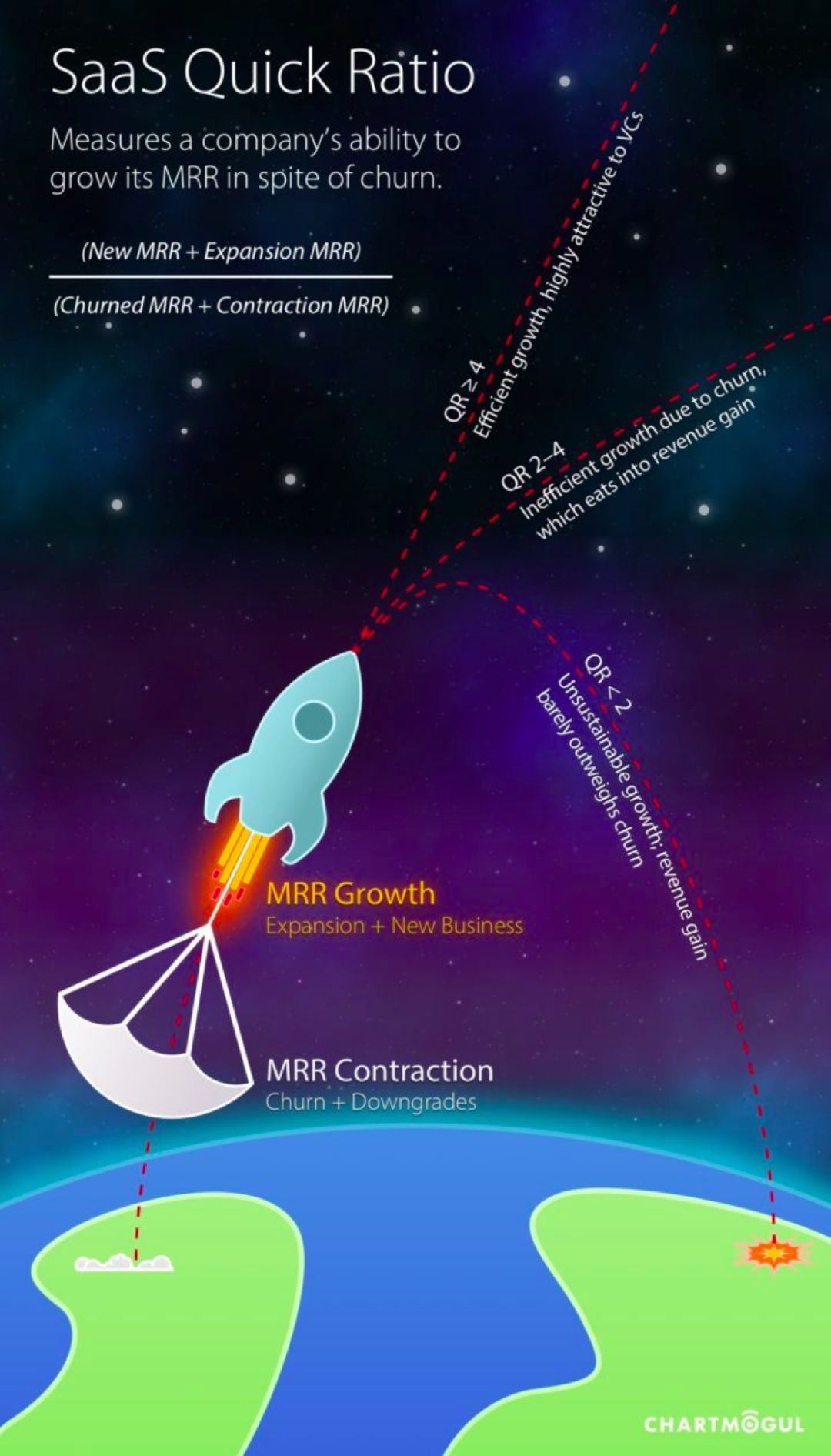
Image source: Chartmogul
3. North Star Metric
The North Star metric is unique to each company: every company must find an operational metric that measures the lasting, real value created by its product. This metric is generally not a financial metric like MRR, nor a surface-level operational metric like MAU or DAU, but rather a core metric that truly reflects product value. For an enterprise IM product, for example, one might define the ratio of users who send/receive more than 10 messages in a single day and log in for more than 6 hours to total registered users as the core metric. The image below shows North Star metrics defined by some SaaS companies in Social Capital's portfolio:
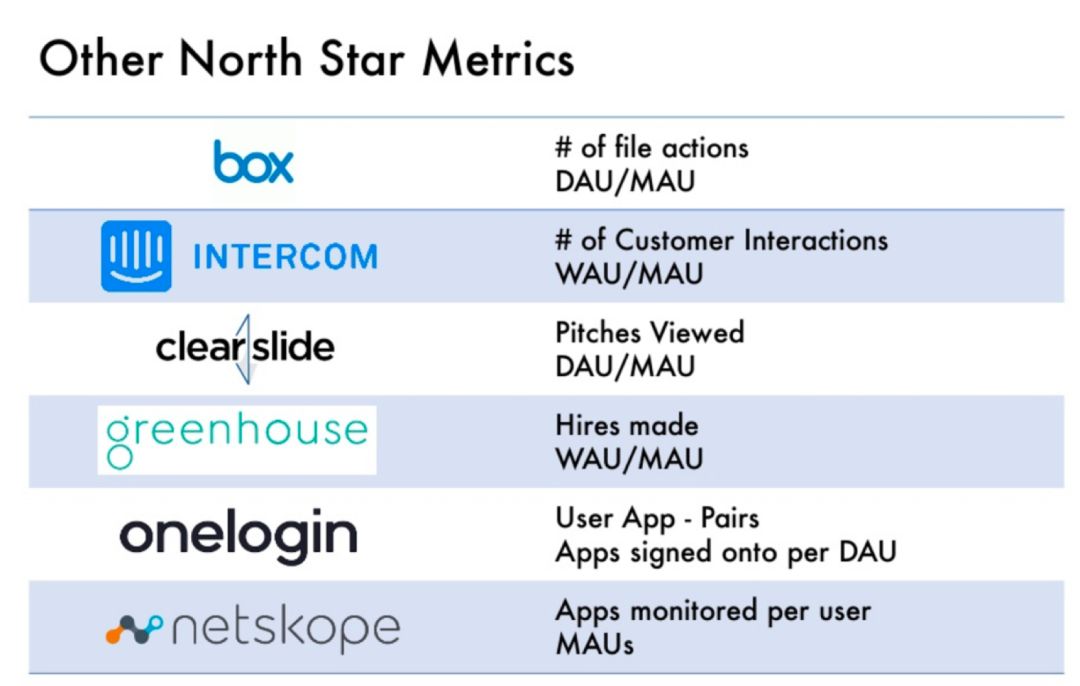
Image source: Social Capital
2
Value-Add Factors Beyond Operational Data
1. Market-Level Value-Adds
Market Leadership: Once a leadership position is established, a company gains substantial inbound sales leads and invitation-to-bid opportunities, significantly lowering CAC. In China's current competitive environment, endurance is the path to victory in many SaaS sectors.
Many entrepreneurs struggle to tolerate the slow development pace of SaaS and constantly pivot. Those who settle in to create value for customers often achieve market dominance after 5-8 years.
However, it's worth noting that some companies in the mid-to-late stage have outlasted competitors but also suffered damage to their own pricing power, losing revenue momentum. For these companies, the key judgment is their ability to upsell new products.
Mobile Scenarios: Supporting B-side mobile work scenarios with multi-terminal products. Compared to traditional B/S architecture products, the development barrier is much higher.
Of course, as WeCom and mini-programs become more integrated, the cost of developing enterprise mobile applications may decrease significantly in the future, making this value-add potentially less important.
Payment Integration: Capital flows through the company, creating future opportunities for data and financial services.
Trading Marketplace: Vertical industry players have relatively more opportunity to cut into supply chains and build industry S2B models.
Hardware-Software Integration: Combining with IoT devices for raw data collection, with software value partially embedded in hardware pricing, making data collection capability a moat.
AI: New methods for extracting value from data.
2. Sales-Level Value-Adds
The biggest challenge facing Chinese SaaS companies remains how to actually sell their products. The following factors can add value on the sales front:
Depth of Customer "Ore Veins" and Whether Mining Is Sustainable: Here, "ore veins" refers to the list of potential customers a company has access to at a given point in time. The market may be large, but a startup's lead volume and access to key decision-makers are always limited.
How to continuously acquire leads, how to distribute them fairly among sales teams, how to prevent salespeople from only mining rich veins, abandoning poor ones back to the "public ocean," or even sabotaging other teams to win performance competitions — these all require conscious management by sales leadership, timely monitoring of pipeline conversion, and reducing dependence on individual star salespeople.
Dependence on Friends-and-Family Sales: In the early stages, quickly cold-starting by selling to the founder's network or sibling companies under the same investment firm is understandable. But once a formal sales team is built and revenue begins to climb, there needs to be conscious control of friends-and-family deals, with cold outreach and friends-and-family deals tracked separately, to avoid overly optimistic perceptions of product-market fit and sales conversion rates.
Whether Incentive Mechanisms Are Rational and Sustainable: There needs to be conscious control of salespeople's actual compensation. Commission spend is the fuel that drives the sales engine; the company needs to actively monitor its fuel consumption metrics.
If a salesperson worth 15,000 RMB per month in the talent market is consistently earning 30,000-50,000 RMB monthly commissions with relatively low deal volume, the sales incentive policy is likely poorly designed. Expectation management for commissions is an art — "stay poor, stay hungry" is what keeps a sales team motivated for the long haul.
Whether Distributors Are Actively Hiring and Expanding Teams: Domestic enterprise services distributors are extremely pragmatic — they won't commit without seeing results — and often mix marketing/advertising products with enterprise services products.
CEOs need to pay special attention to the trend in full-time sales headcount for their own products. If the product sales team maintains net growth, and veteran salespeople from other product lines are willing to switch over, that proves the sales machine is successfully running. Of course, distributors may also be stockpiling inventory or fabricating orders to align with the company's fundraising timeline; this needs to be cross-checked against core usage data after enterprise users are onboarded.
3. Internal Management Value-Adds
Whether They Truly Believe in Their Own Product: For example, an SCRM company should at least use its own product to manage its own sales leads.
Degree of Internal System Informatization: Which vendors are used for R&D, sales, collaboration, and even teleconferencing systems, and how they were selected, also merit attention. If a SaaS company's internal management systematization is low and it doesn't understand best product practices across domains, its own product design risks being provincial.
Whether a Data-Driven Operations Mechanism Exists: Whether the CEO has sufficient data, from internal and external perspectives, to judge whether the company is on the right path. Abroad, there are even relatively mature professional BI products specifically for subscription software services to accomplish this — Gecko Board, Baremetrics, and others — which allow monitoring of company-wide data at very low cost, and can also guide early-stage companies in building their own operational systems.

More Source Code Capital Insider

Issue 10: In the OMO Era, Where Lies the Tech Dividend for New Retail Enterprises?
Issue 9: Four Dimensions for Positioning Innovation Opportunities in InsurTech
Issue 8: Viewing New Finance Opportunities Through an Asset Management Lens
Issue 7: The Trap of Technology Prophecy
Issue 6: Industrial Internet Investment Map
Issue 5: Convenience Stores: The Path for a Domestic 7-Eleven Under the New Retail Wind
Issue 4: Mobile Going Global: Entrepreneurs Should Keep Eyes on Content Product Opportunities
Issue 3: Targeting Unicorns in the Consumer Upgrade Wave
Issue 2: A Profile of "Reliable" AI Startup Characteristics
Issue 1: Under "New Retail," Where Do Offline Stores Go From Here?

Source Code Capital
Creating Lasting Real Value

WeChat ID:
sourcecodecapital
More professional content
Follow our official WeChat