Export E-commerce: How to Seize New Opportunities in the Trillion-Yuan Blue Ocean Market | Source Code Capital Insights

Cross-border e-commerce is the new blue ocean in a trillion-dollar market.
Source Code Capital Insider
Issue 12
About the Author
Yuan Di Vice President, Investment
Yuan Di is a Vice President in the investment team at Source Code Capital, where he joined in 2016. He focuses on digital entertainment and cross-border expansion investments, and previously worked at Fosun RZ Capital and Ping An Ventures. His investment and portfolio management experience includes Zenjoy, Mybo, RozBuzz, BluePay, and RiverPay. He holds a master's degree from Tsinghua University.
Contact: yd@sourcecodecap.com
[Editor's Note]
Cross-border e-commerce is a trillion-dollar track growing at high speed. Mature markets are advancing from a reseller model to brand-building, while emerging markets continue to surface new opportunities. In recent years, Source Code Capital has closely tracked the development, challenges, and opportunities of Chinese innovative companies expanding overseas, developing a distinctive perspective. After analysis and research, Source Code Capital presents Issue [12] of the Source Code Capital Insider.
Key Takeaways
- Cross-border e-commerce is a trillion-dollar track growing at high speed, with mature markets advancing from a reseller model to brand-building, while emerging markets continue to surface new opportunities.
- Semi-standardized and non-standardized goods where Chinese supply chain advantages are clear match well with strong demand for light industrial products in emerging markets. For non-Latin-script emerging markets, there is potential for new regional platforms to rise.
- As cross-border e-commerce evolves from self-operated B2C to platform B2C, companies must not only deepen their strength in core categories but also invest more in category expansion, local merchant services, and delivery experience — gradually building moats and forming competitive advantages over local e-commerce players.
- In regional markets with higher social media penetration, information flow and connectivity serve as core elements of online commerce. Combined with improvements in logistics and capital flow efficiency, this will provide more diversified vehicles for Chinese goods going global.
1. A New Blue Ocean in a Trillion-Dollar Market
Tracing its origins to eBay's acquisition of EachNet in 2003, China's cross-border e-commerce industry has undergone 15 years of development, reaching a transaction volume of 6.3 trillion yuan by 2017. Of this, the export B2C market totaled 1.2 trillion yuan, with a five-year CAGR of 43.1%. Its share of total cross-border e-commerce transaction volume rose from 12% in 2012 to 19.1% in 2017.
The rapid growth of export B2C e-commerce owes much to the efficiency gains of two-sided platforms: on the supply side, dramatically shortened distribution chains compared to traditional trade, lowering goods circulation costs; on the demand side, vastly expanded product variety and selection compared to traditional retail, with clear price-performance advantages.
Over the past five years, relatively complete industrial chain ecosystems and continuously optimized logistics costs have allowed advantage categories of "Made in China" — 3C electronics, footwear and apparel, luggage and bags — to flourish globally. Millions of Chinese sellers have reached overseas consumers through platforms like Amazon, eBay, AliExpress, and Wish, as well as through self-built platforms, with product quality and user experience steadily improving from the PC era.
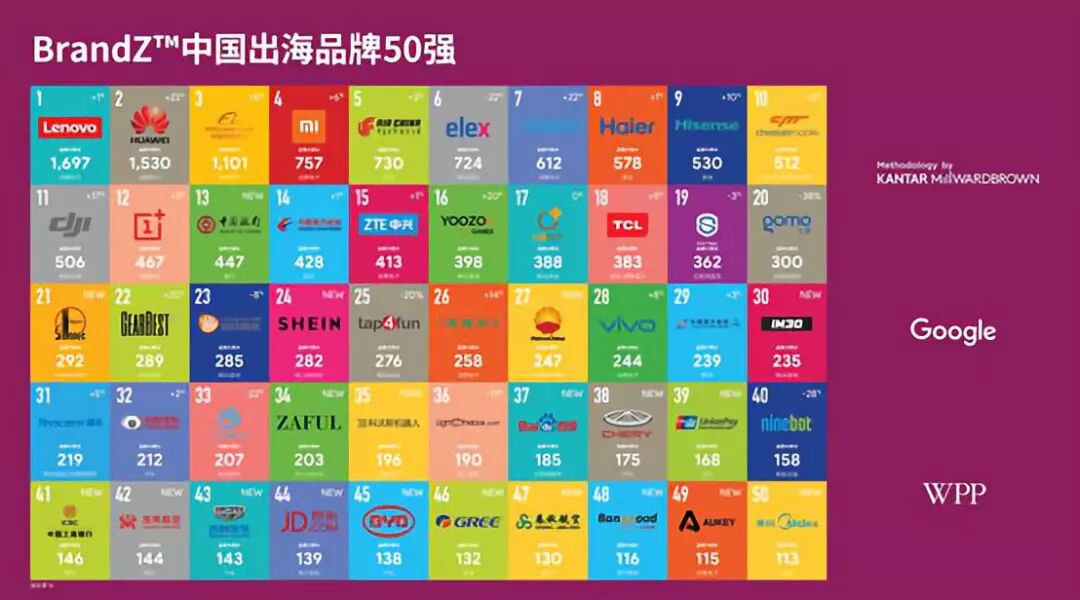
Image source: 2018 BrandZ China Top 50 Global Brand Builders report
In the 2018 China Top 50 Global Brand Builders rankings by Google and WPP, beyond repeat honorees Anker, GearBest, and LightInTheBox, newer cross-border e-commerce brands such as SheIn, Zaful, Banggood, and Aukey also made the list. Even so, overseas consumers, particularly in Europe and America, remain in the early stages of awareness for Chinese brands. The top company's sales share remains below 2%, indicating low industry concentration.
Due to shifts in global platform rules, category competitive dynamics, and traffic patterns in recent years, cross-border e-commerce targeting mature markets like Europe and America is undergoing an evolution from reseller models to brand-building. Meanwhile, emerging markets — with rising internet penetration and gradually improving e-commerce infrastructure — are surfacing new opportunities.
2. Framework for Evaluating Regional Markets
Evaluating opportunities across regional markets for cross-border e-commerce involves complex factors, from macroeconomic indicators to micro-level user needs. We organize these into four dimensions:
Market Size: Macroeconomic factors including GDP growth, demographic structure, per capita disposable income, and exchange rate fluctuations; e-commerce development factors including overall scale, retail penetration rate, and growth velocity.
Infrastructure: User-side factors including internet penetration, maturity of online payments, and e-commerce adoption; infrastructure-side factors including trunk and last-mile logistics efficiency, population density and concentration, and economic concentration.
Trade Conditions: Import policy orientation, customs clearance efficiency, and associated costs.
Competitive Landscape: Market concentration and competitive dynamics, international players' positioning and movements.
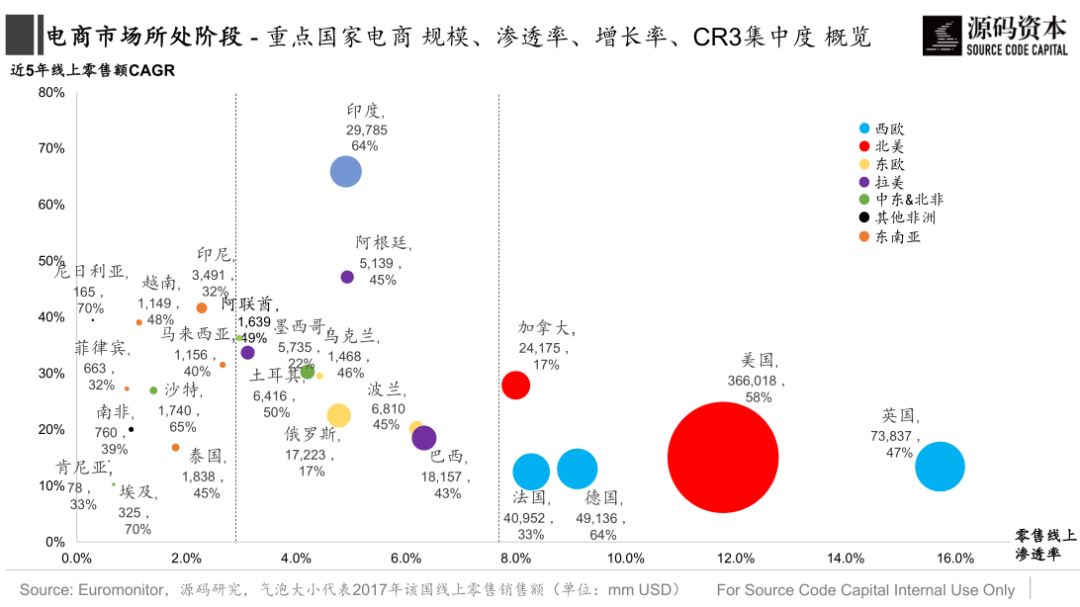
Image source: Source Code Capital
North American and Western European countries show e-commerce penetration above 8% with annual growth below 20%, but large existing market scale. Latin American and Eastern European countries have lower e-commerce penetration with annual growth above 20%. Middle Eastern, African, and Southeast Asian countries generally show e-commerce penetration below 3% with faster annual growth. South Asian countries led by India sit in the same penetration tier as Latin America and Eastern Europe but exceed 60% annual growth. In summary, emerging markets represented by Latin America, Eastern Europe, India, and parts of Southeast Asia present clear incremental e-commerce opportunities.
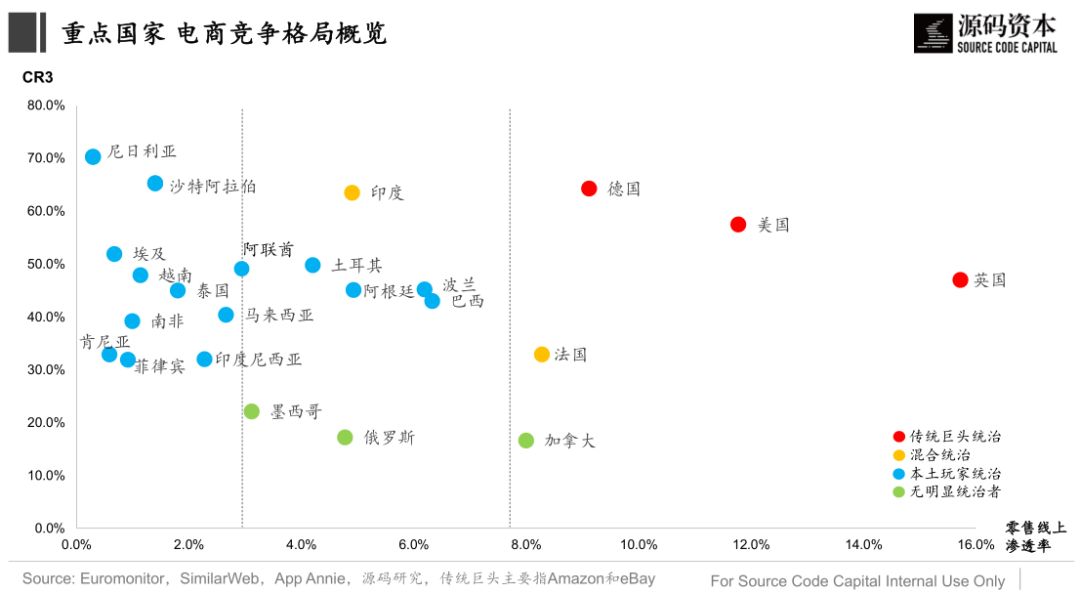
Image source: Source Code Capital
From a competitive landscape perspective, Amazon and eBay dominate North America and major Western European markets. India and France show coexistence between traditional giants and local players. Latin America, Eastern Europe, and Southeast Asia are primarily served by local e-commerce. Considering each country's light industrial development and product supply richness, semi-standardized and non-standardized categories where Chinese supply chains hold clear advantages — 3C electronics, apparel, footwear, home goods — can effectively fill light industrial product gaps in emerging markets. For non-Latin-script emerging markets where traditional giants have less presence, there is potential for new regional platforms to rise.
3. Model Evolution and Industry Chain Opportunities
Compared to the development paths of e-commerce giants like Amazon, eBay, and Taobao/Tmall, current Chinese cross-border e-commerce remains primarily in platform seller and self-operated B2C models. While these have leveraged Chinese supply chain and operational strengths to rapidly capture market share, overall development is still in early stages.
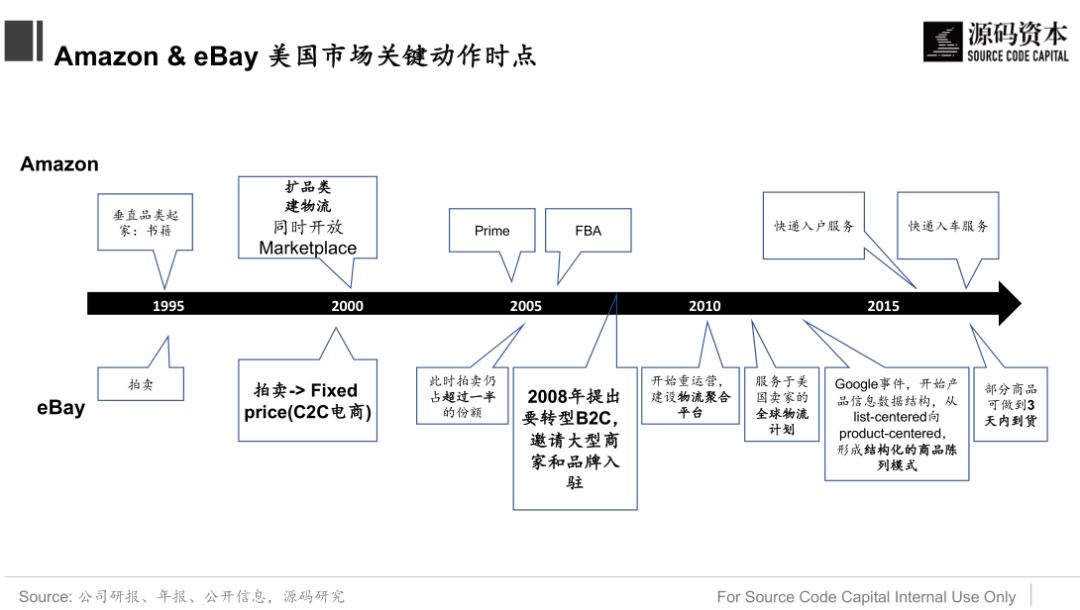
Image source: Source Code Capital
Benchmarking against Amazon and eBay's paths and key moves in the US market, we categorize platform evolution into two paths: "self-operated B2C → platform B2C" and "platform C2C → self-operated B2C / platform B2C." Reviewing global regional platform histories, most follow one of these two paths.
1. Self-operated B2C → Platform B2C
Representative companies include Lazada (Southeast Asia, founded 2012, expanded to platform B2C from 2013), FlipKart (India, founded 2007, expanded to platform B2C in 2013), and Jumia (Africa, founded 2012, expanded to platform B2C in 2014). Self-operated e-commerce mainly deals in standardized products with limited dependence on Chinese supply chains, building ecosystems primarily around local and international brand suppliers.
2. Platform C2C → Self-operated B2C / Platform B2C
Representative companies include Shopee (Southeast Asia, founded 2015, began B2C in 2016), Tokopedia (Southeast Asia, founded 2009, developed B2C in 2016), and Souq (Middle East, founded 2005, transformed to platform B2C in 2010). C2C platforms mainly deal in non-standardized products, often combined with auction and bidding models in early stages. The path from C2C to B2C requires transformation or launching new brands. Among the three, Shopee began B2C in its second year and launched Tmall-equivalent Shopee Mall in 2017. Souq shut down its auction and classifieds businesses as early as 2010 to transform into platform B2C.
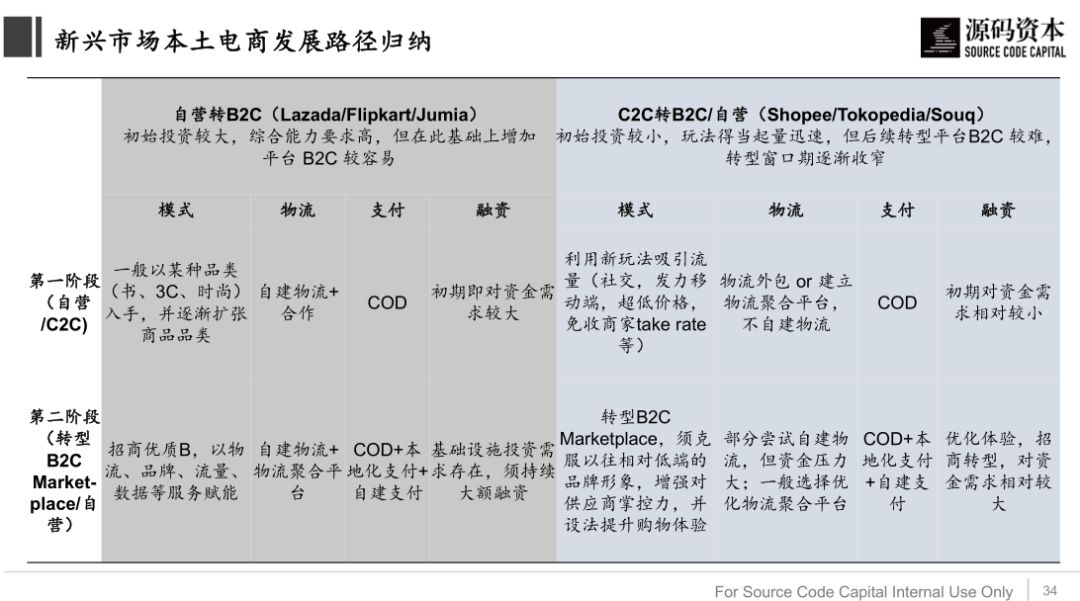
Image source: Source Code Capital
Current major Chinese cross-border e-commerce platform companies mostly sit in early stages of Phase 1 or Phase 2. Chinese supply chains have substantially met local user demand for non-standard and semi-standard goods, while warehousing, delivery, and payment infrastructure have matured, enabling these companies to rapidly scale GMV and establish market position. But in the long term, the evolution from self-operated B2C to platform B2C requires not only deepening core categories but also investing more in category expansion, local merchant services, and delivery experience — gradually building moats and forming competitive advantages over local e-commerce players.
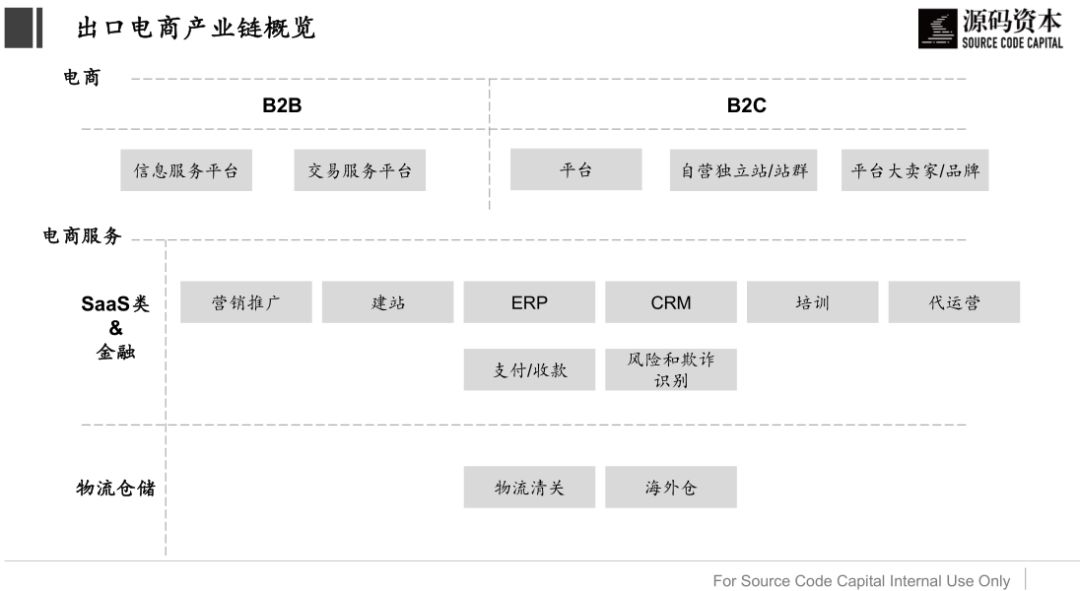
Image source: Source Code Capital
Although Amazon, Alibaba, and JD.com have invested massive resources in infrastructure for overseas expansion, compared to the service experience and finely segmented industrial chain division in the US and Chinese domestic markets, cross-border e-commerce still shows significant gaps in delivery experience, payments, and after-sales service. Whether切入 through SaaS, finance, logistics, or warehousing, there is room for optimization — and substantial startup opportunities within.
4. Social Commerce Overseas
The accelerated rise in global smartphone penetration in recent years has given most emerging markets an internet development trajectory distinct from both China and the US, particularly visible in the mismatch between communication tools/social media and e-commerce development stages.
Starting in 2015, social commerce built on the WeChat ecosystem injected new vitality into China's e-commerce industry. In most emerging markets, internet普及 first brought prosperity to communication and social products, forming the germination and development of a "we-commerce 1.0" model. Facebook's family of products claims over 300 million active users in India. As local supply chains and infrastructure improve, more than 3 million Indian e-commerce micro-sellers operate primarily through WhatsApp, providing fertile ground for startups like Meesho that empower merchants across supply chain and delivery to develop rapidly.
Meanwhile, social platforms commanding massive global traffic are actively exploring e-commerce. In October 2016, Facebook launched its C2C trading platform, now expanded to over 70 countries, with plans to introduce B2C e-commerce and online payments in India in 2018. The May 2018 full opening of Instant Game's in-app purchase interface also creates potential for future closed-loop e-commerce transactions within the platform. Additionally, Instagram tested "Tap to view" external-link e-commerce in 2017, and Snapchat launched Snap Store in February 2018... Social media's experimentation with and support for e-commerce in emerging markets will inevitably bring incremental social commerce possibilities alongside the vigorous development of centralized e-commerce platforms.
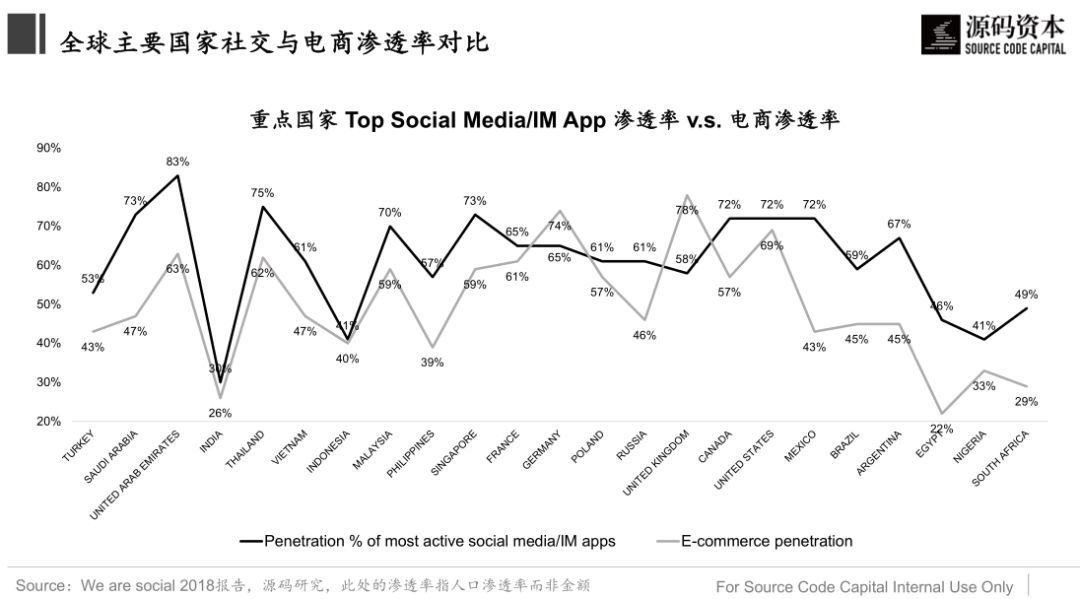
Image source: Source Code Capital
Comparing social media and e-commerce penetration across major countries, mature markets like Germany and France show higher e-commerce penetration than social/communication penetration, while Middle Eastern, Latin American, Eastern European, and Southeast Asian countries show more significant gaps between the two. As e-commerce infrastructure builds and user education progresses, social platform micro-sellers may reach and convert users before e-commerce platforms can. Over the past year-plus, cross-border e-commerce based on Facebook traffic导流 to H5 single-page product conversion with COD delivery has grown rapidly in Southeast Asian countries like Thailand. While facing considerable challenges in building brand recognition, centralized traffic aggregation, and repeat purchases, this also reflects user awareness and acceptance of social commerce.
To be sure, users in different regional markets vary in habits around culture, interaction, and sharing; China's WeChat ecosystem e-commerce model is difficult to copy and replicate at scale; and combining Chinese supply chains with local social media faces challenges across product selection, warehousing, delivery, and after-sales. Nevertheless, information flow and connectivity serve as core elements of online goods transactions, and combined with improvements in logistics and capital flow efficiency, will provide more diversified vehicles for Chinese goods going global.

More from Source Code Capital Insider

Issue 11 SaaS Business Fundamentals: Evaluation Criteria and Value Drivers
Issue 10: In the OMO Era, Where Lies the Tech Dividend for New Retail?
Issue 9: Four Dimensions to Pinpoint Innovation Opportunities in InsurTech
Issue 8: Viewing New Finance Opportunities Through an Asset Management Lens
Issue 7: The Pitfalls of Tech Prophecy
Issue 6: Industrial Internet Investment Landscape
Issue 5: Convenience Stores: Under the New Retail Wind, Where Is China's 7-Eleven?
Issue 4: Mobile Going Global: Entrepreneurs Eye Big Opportunities in Content Products
Issue 3: Targeting Unicorns in the Consumer Upgrade Wave
Issue 2: Profile of a "Reliable" AI Startup
Issue 1: Under "New Retail," Where Do Offline Stores Go?

Source Code Capital
Creating Lasting, Real Value

WeChat ID: sourcecodecapital
More professional content
Follow our official WeChat