Source Code Capital's Hongjiang Zhang Ranks No. 1 in China for Third Consecutive Year on Global Top Computer Scientists List
Guide2Research 2020 Global Top 1,000 Computer Scientists h-index Rankings
The 6th edition of the Guide2Research annual ranking of top computer scientists has just been released, tallying the world's top 1,000 computer scientists for 2020. More than 140 scholars of Chinese descent made the list, including 45 scientists from China. Hongjiang Zhang, Investment Partner at Source Code Capital, ranked first among mainland Chinese scientists, 5th among scholars of Chinese descent globally, and 36th worldwide.
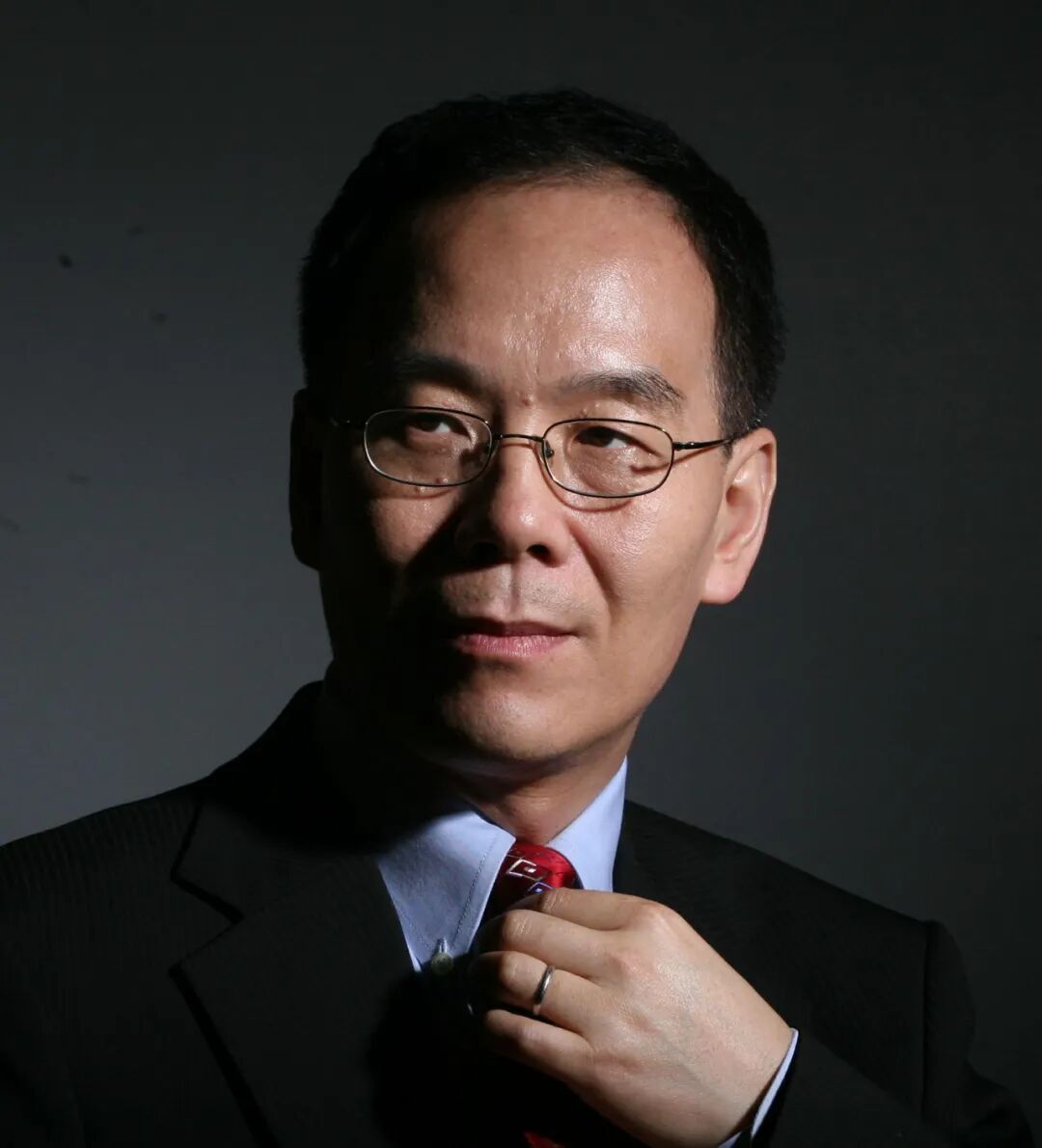
Hongjiang Zhang, Investment Partner at Source Code Capital
Dr. Zhang joined Kingsoft at the end of 2011 as Group Executive Director and CEO, while also serving as CEO of Kingsoft Cloud and as a board member of Cheetah Mobile, Xunlei, and VNET Group. He retired from Kingsoft in December 2016 and subsequently joined Source Code Capital as an Investment Partner. He previously served as CTO of Microsoft Asia-Pacific R&D Group and President of Microsoft Asia Engineering Institute, was one of Microsoft's first ten "Distinguished Scientists," and was a founding member and Associate Managing Director of Microsoft Research Asia.
Dr. Zhang is an internationally renowned pioneer and thought leader in multimedia, and a Fellow of both the Association for Computing Machinery (ACM) and the Institute of Electrical and Electronics Engineers (IEEE). For his groundbreaking contributions to multimedia research, he received the 2010 IEEE Technical Achievement Award and the 2012 ACM SIGMM Technical Achievement Award. In recognition of his outstanding contributions to R&D and technology transfer, he was awarded the "Distinguished Asian American Engineer of the Year" in 2008. With nearly 400 published academic papers and close to 200 international patents, he is among the most influential scientists in computer science globally.
The global Top 1000 Computer Scientists ranking by h-index reviewed the academic metrics of over 6,000 scientists worldwide, selecting the top 1,000. The ranking is based on Google Scholar H-index data collected before May 16, combined with DBLP and citation metrics. The H-index (the number of papers with citation counts higher than or equal to h, with h-index >= 40) measures both scientific productivity and research impact, quantifying not just citations but also publication volume.
By the numbers, the United States leads with 616 scientists, accounting for 61.6% of the total. Other top-ranking countries include the United Kingdom with 55, Germany with 38, Canada with 37, and Switzerland with 34. Asian scientists showed significant growth, with 55 making the list in 2020 compared to 37 in 2018.
More than 140 scholars of Chinese descent were selected, doubling the 2018 total, with Zhang ranking first among mainland Chinese scholars
For three consecutive years, Professor Jiawei Han has topped the list among scholars of Chinese descent, followed by Dr. Philip S. Yu in second place. Hongjiang Zhang, Investment Partner at Source Code Capital, ranks 5th among scholars of Chinese descent and has held the top spot among mainland Chinese scholars for three straight years.
According to incomplete statistics from the Guide2Research website, 144 scholars of Chinese descent were selected, with the top 10 as follows:
- The highest h-index among scholars of Chinese descent belongs to Professor Jiawei Han of the University of Illinois at Urbana-Champaign, with an h-index of 174 (164 in 2019, 158 in 2018). He is a professor in the Department of Computer Science at UIUC, a Fellow of both IEEE and ACM, and received the 2009 McDowell Award, IEEE's highest technical honor. In the field of data mining, Professor Han believes that to transform existing unstructured big data into useful knowledge, the first step is to structure the data. His outstanding contributions have earned him the title of "leader in data mining." His 2011 publication Data Mining: Concepts and Techniques has been cited 47,546 times.

- Ranking second among scholars of Chinese descent is Philip S. Yu, with an h-index of 161 (155 in 2019, 140 in 2018). A Fellow of both ACM and IEEE, he is currently a professor in the Department of Computer Science at the University of Illinois at Chicago. Professor Yu has conducted in-depth research on recommendation technologies, viewing recommendations as a form of classification and clustering technique that can also be approached through deep learning. In an interview, he noted that "achieving results in academia, like any other field, requires dedication, interest, and a bit of competitive spirit."

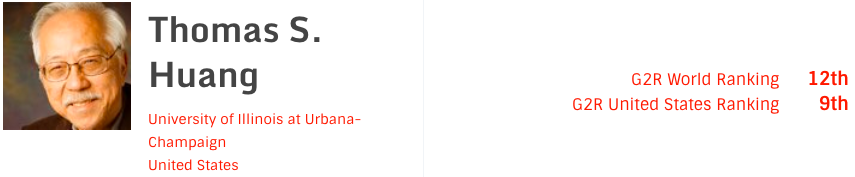
- Another Chinese-American, Thomas S. Huang, made outstanding contributions to computer vision, with an h-index of 155 (144 in 2019, 139 in 2018). This "father of computer vision" mentored numerous students who went on to achievements in academia and industry; nearly every accomplished scholar of Chinese descent in computer vision has some connection to Huang, making him a veritable beacon in the field.
- Guanrong Chen, Chair Professor at City University of Hong Kong and Chang Jiang Chair Professor at Peking University, has an h-index of 149. In 1996, he was elected IEEE Fellow for his foundational contributions to chaos control and bifurcation theory analysis and applications. He was elected to the European Academy of Sciences in 2014 and the Academy of Sciences for the Developing World in 2015.

- The highest-ranked mainland Chinese scholar by h-index is Hongjiang Zhang, Investment Partner at Source Code Capital, ranked 36th globally. Dr. Zhang is former CTO of Microsoft Asia-Pacific R&D Group, former President of Microsoft Asia Engineering Institute, and former CEO of Kingsoft. He is a world-class scientist in multimedia and artificial intelligence research, and the "founding father" of computer video retrieval research. He has received major awards from both IEEE and ACM, making him the first and, to date, only scientist of Chinese descent to receive both honors. His h-index is 130 (123 in 2019, 121 in 2018).

- Andrew Ng is an adjunct professor at Stanford University, named one of Time magazine's "100 Most Influential People" in 2012. He is also co-founder and former leader of Google Brain.

- Zidong Wang is currently Professor in the School of Information, Computing and Mathematics at Brunel University. He has received two Second Prizes and one Third Prize for the Ministry of Education's Science and Technology Progress Award. He received the Alexander von Humboldt Foundation Fellowship in 1996, the Japan Society for the Promotion of Science Fellowship in 1998, and the William Mong Fellowship from The University of Hong Kong in 2002.

- Professor Shih-Fu Chang is a Taiwanese computer scientist and electrical engineer known for his research in multimedia information retrieval, computer vision, machine learning, and signal processing. He is currently Senior Executive Vice Dean of Columbia University's School of Engineering and Applied Science. In 2016, he was named the most influential scholar in multimedia by AMiner, and was elected ACM Fellow in 2017.

- Xiaoou Tang is currently Professor in the Department of Information Engineering at The Chinese University of Hong Kong and a Distinguished Scholar of the Faculty of Engineering, also serving as Vice President of the Shenzhen Institute of Advanced Technology, Chinese Academy of Sciences, and the first Chinese editor-in-chief of IJCV (International Journal of Computer Vision). He is a "pioneer" and "pathfinder" in global face recognition technology, founder and chairman of SenseTime, and a board member of Khazanah Nasional, Malaysia's sovereign wealth fund.

- Professor Dacheng Tao is an internationally renowned scholar in artificial intelligence and information science, recipient of Australia's Eureka Prize, and Chief AI Scientist at UBTECH. He was elected ACM Fellow in 2019 for "contributions to representation learning and its applications."

22 from mainland China selected, double the 2018 figure:
- Hongjiang Zhang, Source Code Capital (130)
- Weiying Ma, Toutiao (111)
- Huijun Gao, Harbin Institute of Technology (107)
- Zhihua Zhou, Nanjing University (100)
- Xuelong Li, Northwestern Polytechnical University (99)
- Wen Gao, Peking University (92)
- Zhengyou Zhang, Tencent (87)
- Tieniu Tan, Institute of Automation, Chinese Academy of Sciences (87)
- Ying-Chang Liang, University of Science and Technology of China (81)
- Licheng Jiao, Xidian University (80)
- Yong Rui, Lenovo Capital and Incubator Group (76)
- Xiang-Yang Li, University of Science and Technology of China (76)
- Ya-Qin Zhang, Baidu (74)
- Fei-Yue Wang, Institute of Automation, Chinese Academy of Sciences (72)
- Feiping Nie, Northwestern Polytechnical University (72)
- Xiansheng Hua, Alibaba DAMO Academy (71)
- Hisao Ishibuchi, Southern University of Science and Technology (70)
- Kui Ren, Zhejiang University (69)
- Norman C. Beaulieu, Beijing University of Posts and Telecommunications (69)
- Ligang Wu, Harbin Institute of Technology (69)
- Xilin Chen, Institute of Computing Technology, Chinese Academy of Sciences (68)
- Shiguang Shan, Chinese Academy of Sciences (67)
Full 2020 global Top 1000 Computer Scientists H-index ranking:
http://www.guide2research.com/scientists/
More perspectives from Dr. Hongjiang Zhang:
- Hongjiang Zhang: AI's Long-Term Development Requires People Willing to Do the Unheralded Work
- Hongjiang Zhang in Conversation with Zexiang Li: How Tech Startups Can Break Through | Ma Hui 2018
- Dr. Hongjiang Zhang: The Global Shortage of AI Talent — Dialogue with Yang Rui
- Source Code Capital Investment Partner Dr. Hongjiang Zhang: AI Is the Next Big Opportunity for Chinese Startups
- Source Code Capital Investment Partner Dr. Hongjiang Zhang: The Nature and Opportunity of AI | Ma Hui 2017

More Awards and Honors for Source Code Capital
- Forbes Releases Major Ranking, Source Code Capital's Yi Cao and Yungang Huang Make the List
- Source Code Capital's Yi Cao Makes 2019 Forbes Midas List
- Source Code Capital Wins Five Awards Including Zero2IPO 2018 China Top 50 Venture Capital Firms
- Source Code Capital and Portfolio Companies Win Multiple Awards at 36Kr 2018 New Economy Kings
- 2018 Global Top 1000 Computer Scientists H-index Released, Dr. Hongjiang Zhang Tops Mainland China
- "Oscars of Global Investing" Announced: Source Code Capital's Yi Cao Makes Forbes 2018 Midas List
- Source Code Capital's Xingshi Wang Named to 36Kr "Top 10 Most Discovery-Focused Investors in China's Auto & Mobility Sector"
- Source Code Capital Named 36Kr "VC Firm of the Year Most Popular Among LPs"; Founding Partner Yi Cao Named "VC Investor of the Year Most Popular Among Entrepreneurs"
- Source Code Capital Wins Zero2IPO and PEDaily "2017 China Top 50 Venture Capital Firms" and "2017 China Top 10 Fintech Investors"
- Source Code Capital Named to China Top 50 VC Firms
- Source Code Capital's Yi Cao Named to 2017 China Top 50 VC Investors
- Source Code Capital Named to 2017 China Top 30 B2B Investors
- Source Code Capital Wins Top Investor and Investment Firm in China's New Finance Sector
- Source Code Capital Named "Top 10 AI Investment Firm in China"
- Source Code Capital's Yi Cao Named "Top 10 AI Investor in China"
- Source Code Capital Wins 2016 China Top 50 VC Firms, China Top 20 Foreign VC Firms, and China Top 10 Tech Finance Industry Investors
- Source Code Capital's Yi Cao Named iHeima "2016 Investor of the Year"
- Source Code Capital's Yi Cao Wins Cyzone "2016 China Angel Investor of the Year"
- Source Code Capital's Yi Cao Makes 2016 ChinaVenture-FT China Top 100 Leaders in Investment
- Source Code Capital's Yi Cao Makes Cyzone "40 Under 40" Investors
- Source Code Capital Makes 2015 China Top 50 Foreign VC Firms
- Source Code Capital Wins Three Annual Awards from Leading VC Industry Organizations in 2015