Yi Cao, Source Code Capital: "Four-Have Youth" — What Good Companies Look Like in the Second Half

A good company needs principles, systems, tactics, and tools.
On January 12, 2020, at the invitation of Tsinghua University's PBC School of Finance, Yi Cao, founding partner of Source Code Capital, returned to his alma mater for the "Tsinghua PBCSF EMBA & EE 2020 New Year's Ideas Forum." He delivered a speech titled "Four-Youth": Good Companies in the Second Half, sharing his perspective on what makes a quality company in the context of the internet's "second half."
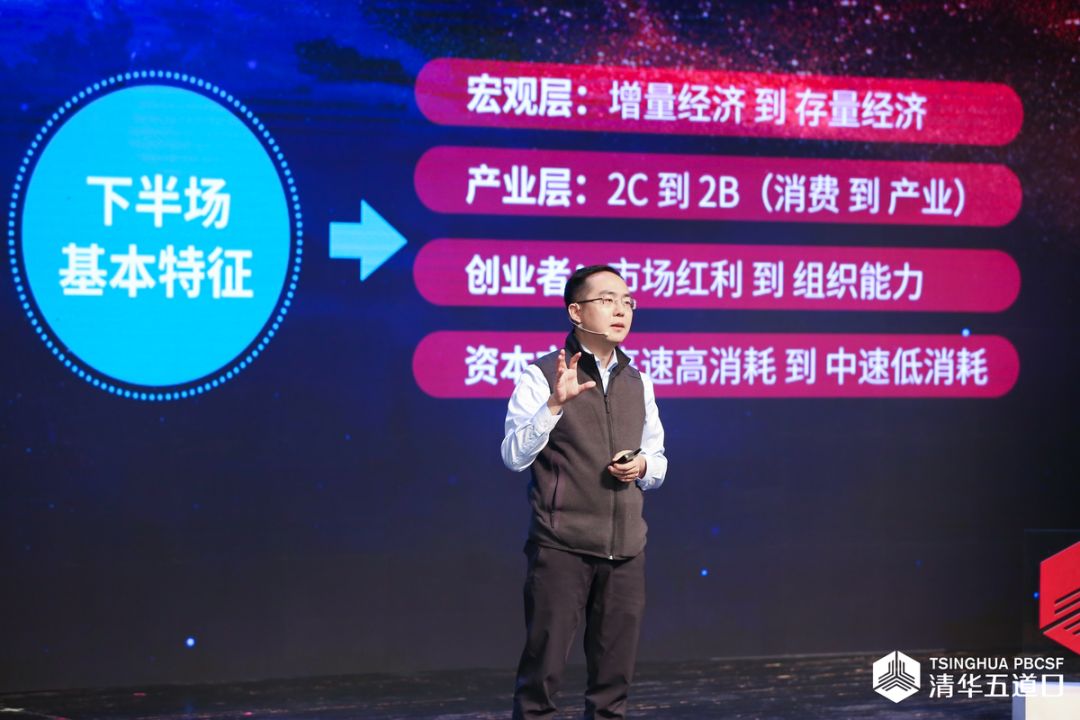
In the second half of the new economy, what kind of company qualifies as good? The "Four-Youth" framework: having the Way (Dao), the Method (Fa), the Technique (Shu), and the Tool (Qi). Through entrepreneurship and investing, one cultivates sincerity and self-improvement; through entrepreneurship and investing, one drives progress toward a better life and smarter business, creating lasting, real value.
— Yi Cao
Image source: Tsinghua PBCSF EMBA 2020 New Year's Ideas Forum
I'm glad to have this opportunity to return to Tsinghua today. Fifteen years ago, I was a junior here. Through a series of fortuitous events, I entered the internet venture capital industry. Fifteen years have passed—I've now reached my zodiac birth year, and the internet, as many have said, has entered its second half. Today I'd like to talk about what that second half actually means, and what it demands of good companies.
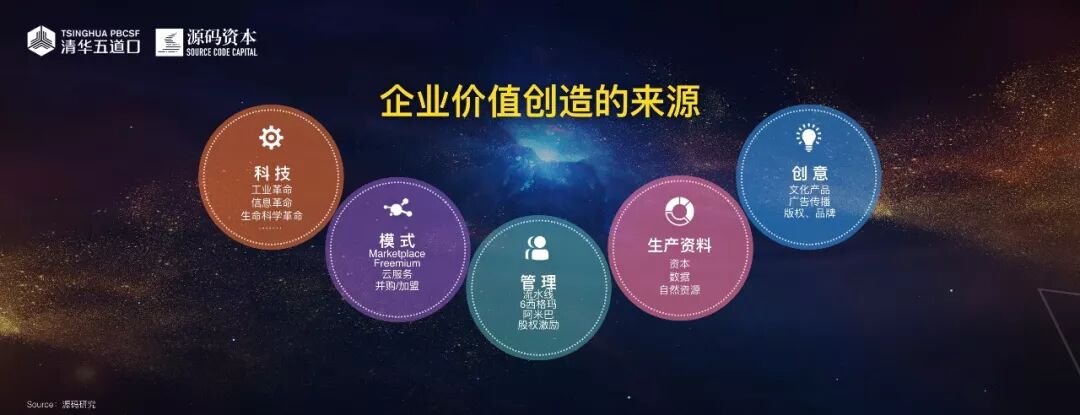
The Sources of Value Creation
First, I'd like to start from an abstract, macro-level perspective on the roots of enterprise value creation. We've identified several fundamental elements: technology, business models, management, and others. Looking back over the past several decades—or even centuries, to the Industrial Revolution and the Information Revolution—the core drivers have been technology, models, and management. These are likely the most important sources of value creation.
Technology is especially critical. It's the largest source of value creation for a company, and also the biggest variable. If a company can seize these major shifts effectively, it has the opportunity to ride the wave and create substantial value. For instance, in the Information Revolution era: the declining costs of computing, storage, and transmission; the evolution of computing platforms from PC internet to mobile internet, and potentially to connected vehicles, AR/VR, and other client-side platforms in the future; and cloud infrastructure moving from mainframes and minicomputers to traditional servers to today's cloud computing. These have been the most fundamental technological changes of the past decade, and it's these major shifts that are catalyzing massive value creation.
Technology, models, and management are relatively macro-level factors, but when we look at the enterprise level, the determinants of success become more micro-level. As a micro-level actor within a larger industry and amid larger changes, which companies perform well, and why?
Timing, Terrain, and Harmony — The Fundamentals of Enterprise Success
We've summarized three factors: timing, terrain, and harmony. It's classic Chinese wisdom, and I find it quite fitting.
Applied to enterprises, timing refers to the external environment—technology, demographics, culture, and so on. Terrain is the fundamental natural attributes of the chosen business model—whether it's an A-tier, A+ tier, A- tier, B-tier, or even C-tier business. To put it more vividly: is your chosen location at a strategic pass where one defender can hold off ten thousand attackers? Or is it in a canyon? The difficulty and magnitude of success vary dramatically depending on the business model. Third is harmony, which is likely the most important element I want to emphasize today. Given a certain timing (external environment) and terrain (business model), some companies still manage to outperform others significantly—and I believe the core reason is harmony (organizational capability). Some say enterprise success equals strategy multiplied by organizational capability; I would argue that strategy is itself an expression of organizational capability.

Attributes of Good Businesses
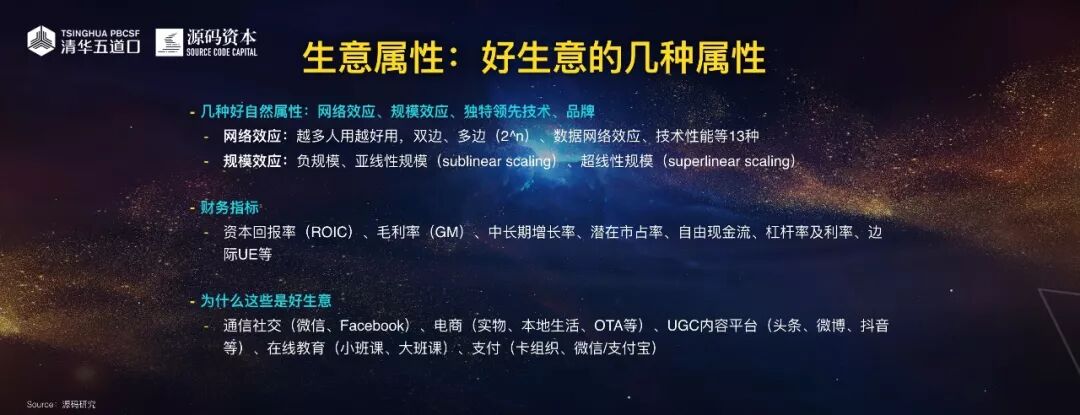
First, I'd like to briefly address the first two aspects—terrain and timing. Terrain, here, refers to business model or the natural attributes of a business. Having reviewed thousands, even tens of thousands of companies, we've found that the best businesses share several characteristics: network effects, preferably multi-sided network effects; failing that, scale effects—particularly superlinear scale effects—make for a solid business model as well. I won't elaborate further on proprietary technology or brand, but for a good business, these four are likely crucial attributes.
These favorable attributes ultimately show up in financial statements. What's the ROIC (return on invested capital)? On the income statement, what's the gross margin, the marginal unit economics? What's the medium-to-long-term growth rate, the potential market share? Regarding market share, we believe there are objective patterns—a first-place company holding 50% versus 70% follows certain natural laws. Even a dominant firm won't necessarily command 85% or 90% share; everything unfolds within the bounds of natural attributes. Facebook and WeChat in communications and social, Toutiao/Douyin and Weibo in UGC platforms, Alibaba and Meituan in e-commerce, TAL Education Group in education platforms—why are these good companies? They possess one or more excellent natural attributes, which compound into strong financial metrics: solid growth rates, high gross margins, and high returns on capital.
Characteristics of the "Second Half"
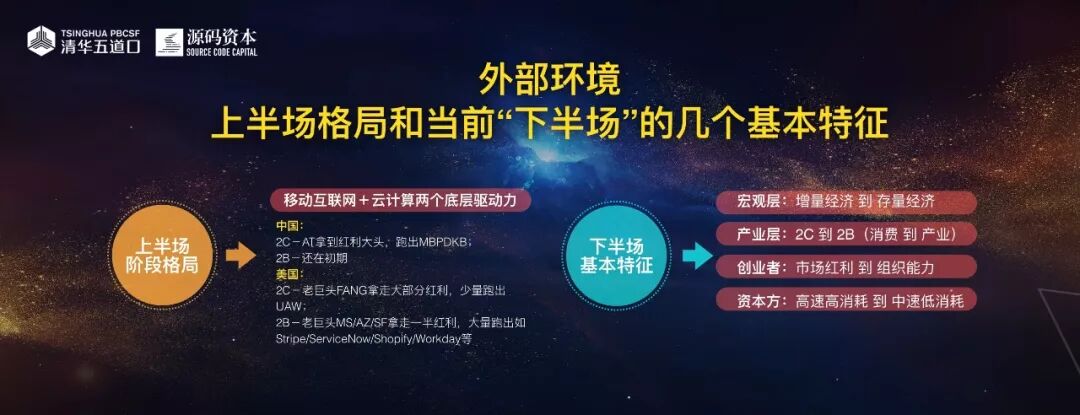
Timing, or the external environment, has now entered the second half. The past 10 to 15 years were a glorious first half, which I myself experienced in all its ups and downs and sweeping momentum. Standing at this point in time, we can simply say the first half has reached a certain stage of resolution, or report card. The first half was fundamentally driven by two underlying forces—mobile internet and cloud computing—which brought about the evolution from PC internet to mobile internet. Among the winners of the PC internet era, in the consumer space, Alibaba and Tencent still captured enormous second-half dividends, with their market caps growing from tens of billions to five or six hundred billion dollars. Mobile internet also produced new breakout companies—Meituan, ByteDance, Pinduoduo, DiDi, Xiaomi, and others emerged. In the enterprise space, China is still in early stages; the US lagged China in consumer internet but developed better on the enterprise side, producing new companies worth tens of billions or even over fifty billion dollars.
In the second half, what are the fundamental characteristics at the macro, industry, entrepreneur, and capital levels? At the macro level, we're moving from incremental to stock economies. At the industry level, the balance is shifting from consumer-focused to a more even mix of consumer and enterprise, with enterprise potentially overtaking consumer. For entrepreneurs, the emphasis is shifting from market opportunity insight and capture to organizational capability. At the capital level, the focus is moving from high-growth, high-burn models to moderate-growth, lower-burn models.
Organizational Capability: The Way, the Method, the Technique, and the Tool
One important reason good companies stand out in the second half is harmony—that is, organizational capability. We've summarized organizational capability into a framework of the "Four-Youth": having the Way (Dao), the Method (Fa), the Technique (Shu), and the Tool (Qi).

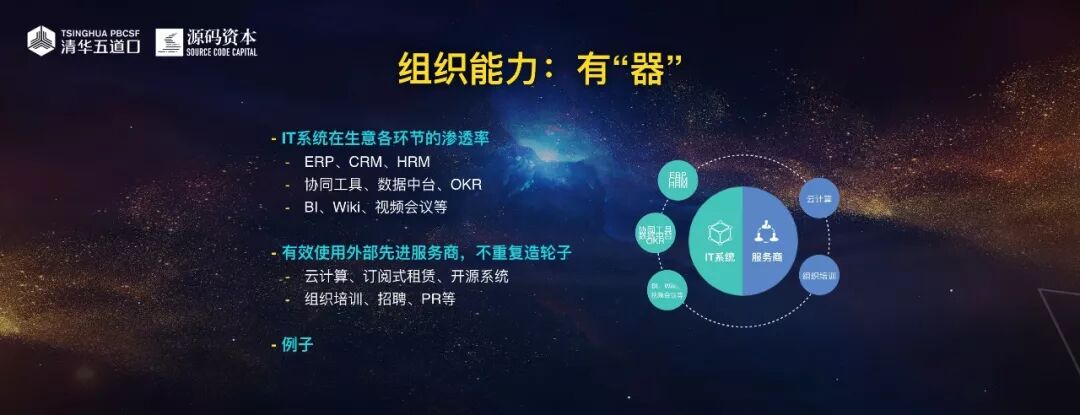
Having the "Tool" (Qi)
Having the "tool" means being adept at using tools. There are two broad categories here: core IT technology application capabilities, and effective use of external advanced service providers. IT application capability refers to how well a company uses IT systems to support operations across all functions—from ERP, CRM, and HRM to data middle platforms, BI, and various other tools. When we evaluate a company, we typically look at IT product penetration rates. Effectively leveraging external resources helps avoid reinventing the wheel.
Take Lianjia as an example. Ten years ago, it was still a relatively small company in terms of revenue and profit—perhaps with annual profits under 100 million RMB. But in subsequent years, it invested several hundred million in building out its IT systems. These systems ultimately supported its ACN (Agent Cooperation Network) well, with each agent's productivity two to three times higher than the industry average. This is a very typical case of IT tools supporting the business. ByteDance is another example—its IT products like Lark are now mature enough to be offered externally.
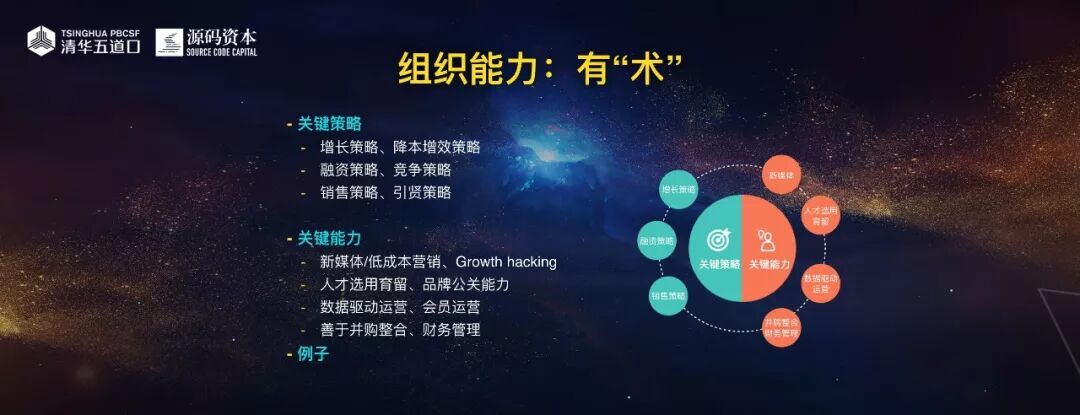
Having the "Technique" (Shu)
Having the "technique" means paying particular attention to building key strategies and critical capabilities. In the past, approaches were somewhat rough-and-tumble, guerrilla-style—not very focused on methodology or strategy. But now, every strategy, whether for growth, cost efficiency, financing, or competition, needs to be refined through iteration. How to better leverage existing infrastructure for customer acquisition, cost reduction, data-driven operations, and so on—these are fundamental capabilities that receive more emphasis in the second half than in the first. ByteDance, for instance, applies data-driven operations down to details like naming, logo design, and marketing material design.
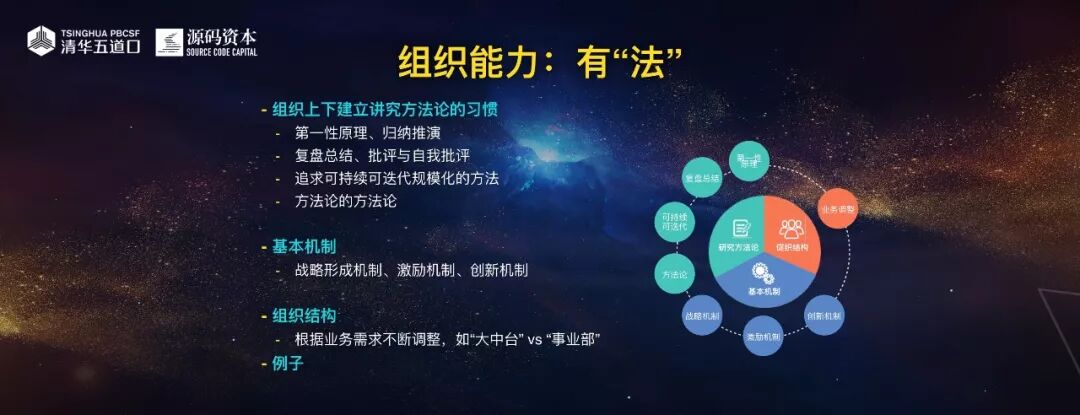
Having the "Method" (Fa)
Having the "method" means building a company with methodology—one that can continuously generate new methodologies based on existing ones. From the CEO through middle and senior management, there's an awareness of methodology. Every matter is approached with methodology-building in mind, not just short-term firefighting.
Huawei, for example, has its Basic Law, which articulates ten major contradictions the company faces. Each major contradiction can be addressed by referring to the principles and methods of the Basic Law. It uses systematic approaches to form methodologies that support "technique" and "tool." Meituan is also a company that highly values methodology, to the point of contemplating the methodology for systematically generating methodologies.
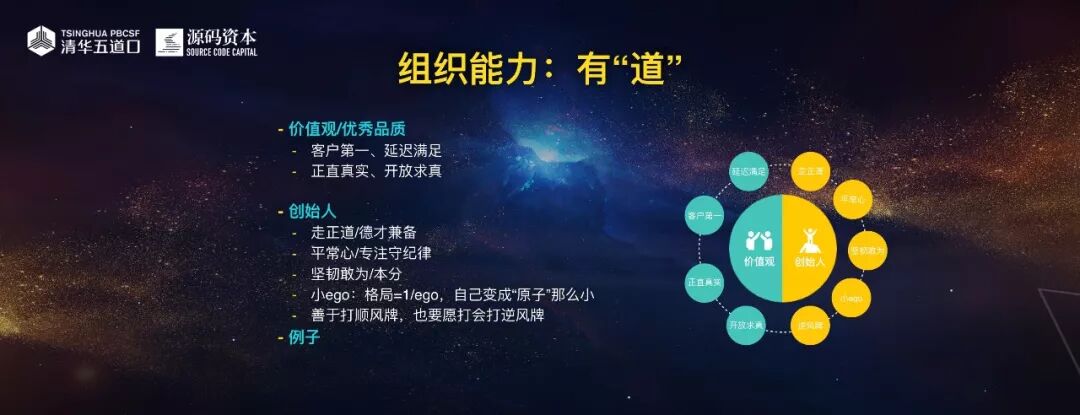
Having the "Way" (Dao)
Finally, the "Way" is especially important in the second half environment—a miss by a hair's breadth, and the error can be a thousand miles off. It's difficult to articulate; my own understanding is quite superficial. The moral dimension is the most intangible, yet I believe it's also the most fundamental and long-term. When a company reaches a certain stage—$1 billion, $10 billion in value—if problems emerge with the Way, it will eventually fall. This Way encompasses the core values of every employee from top to bottom: customer first, openness, truth-seeking. More importantly, can the CEO and founder cultivate themselves well? Especially in the second half, can they stay grounded and maintain equanimity, while remaining focused and disciplined? Shrink one's ego, and one's格局 (vision/scope) can expand. Be skilled at playing a winning hand, but also willing and able to play a losing one.
Conclusion
The Way gives birth to the Method, the Method gives birth to the Technique, the Technique gives birth to the Tool. In the process of investing and entrepreneurship, we often see problems at the level of "technique" or "tool"—these are relatively visible and easy to identify. Problems of "Way" and "Method" are hidden but more persistent and fundamental. "Diagnose by looking at the leaf; treat by seeking the root." When a leaf shows problems, one must trace back to the source. Seeing a problem with the leaf, one must examine whether the "root" has issues. If it is a root problem, it must be confronted squarely; if not, there's no need to overreact—it will be a localized, temporary issue. For example, many companies deliberately degrade their web experience to push app downloads, or the "big data price discrimination" we often see: these may be clever techniques, but problems may emerge at the level of the Way. Are they truly adhering to "customer first"?

Good companies should forever remain "youthful"—resilient and bold, pragmatic yet romantic, focused on the present, unburdened by the past, and charging forward with abandon.
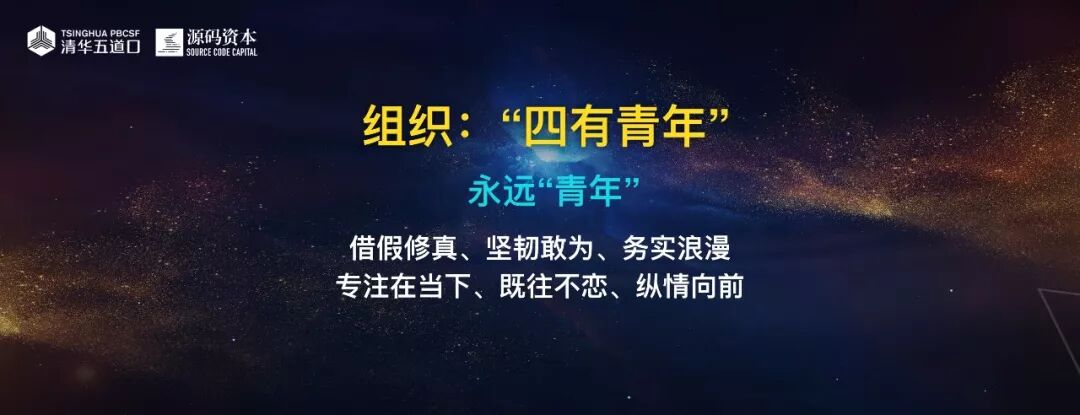
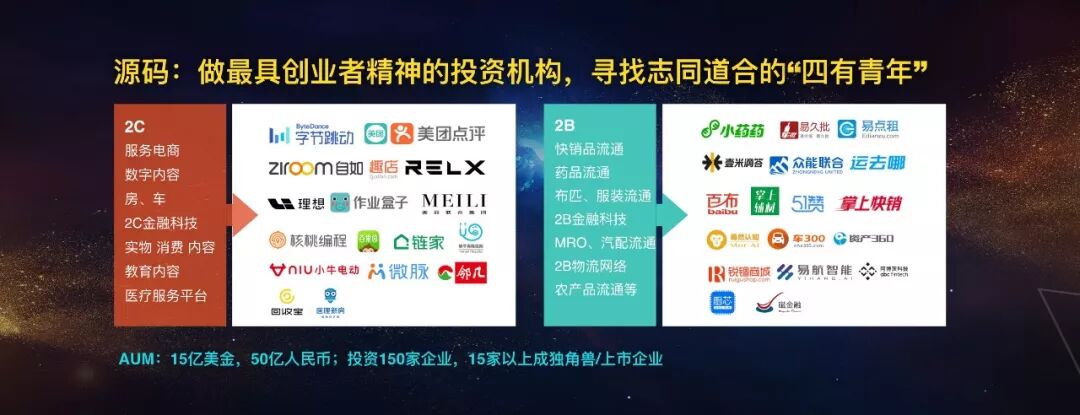
Finally, Source Code Capital is also young, and we hope to strive to become a "Four-Youth" ourselves—the most entrepreneur-like investment institution, seeking out more like-minded "Four-Youth" partners. In the second half, leveraging the power of technology and capital to drive business transformation and create lasting, real value! Thank you all!


More Partner Perspectives
- Yi Cao, Source Code Capital: Value Discovery and Creation in Industrial Internet
- Hongjiang Zhang: AI's Long-Term Development Requires People Willing to Do Unsung Work
- Dialogue with Future Entrepreneurs: You Can Practice Deliberately Like This
- Dr. Hongjiang Zhang: AI Talent Shortage Is a Global Problem — Dialogue with Yang Rui
- Alumni Interview: Yi Cao — Computer Science Inspires My Decision-Making
- Dr. Hongjiang Zhang, Investment Partner at Source Code Capital: AI Is the Next Big Opportunity for Chinese Startups
- Yi Cao, Source Code Capital: The Nine Faces of Technology Innovation
- Yi Cao: Inclusive Finance Enters an Era Where "Internet+" and "Intelligence+" Work in Tandem
- Yi Cao, Source Code Capital, Named Cyzone "2016 China Angel Investor of the Year"
- Yi Cao, Source Code Capital: VCs Must Keep Learning and Maintain a Far-Reaching Sense of Mission
- Yi Cao: Source Code Capital's "Three Horizontals, Nine Verticals" Investment Map
- Yi Cao, Source Code Capital: "Internet+" Has Concluded; the Next Waves Are "Intelligence+" and "Global+"
- Yi Cao, Source Code Capital: The More Cross-Disciplinary the Startup, the Higher Its Odds of Success