"Manufacturing-First Retail": The Opportunity and Its Rise | Source Code Capital Internal Briefing

Touch factories and customers with both hands.
Source Code Capital Internal Briefing
Issue 14
About the Author
Di Wu | Consumer Investment

Di Wu joined Source Code Capital in 2016, focusing on consumer sector investments. Prior to Source Code Capital, he worked at BDA, serving top-tier USD hedge funds and private equity firms, with extensive research experience in e-commerce, gaming, and internet advertising. Di Wu holds a bachelor's degree in management from the University of International Business and Economics.
Contact: wd@sourcecodecap.com
[Editor's Note]
"Manufacturing retail" refers to a 2.0 model where brands and channels integrate with each other, building upon the traditional 1.0 retail value chain where brands only handled production and channels only handled sales. This manufacturing retail model has been widely adopted across different industries and corporate strategies, giving rise to numerous global industry giants such as IKEA and Nitori, Zara and UNIQLO, among others. What lessons can new retail startups draw from the development experience of classical retail? Source Code Capital presents exclusive analysis in Issue 14 of the Source Code Capital Internal Briefing.
Key Insights
- Manufacturing retail enterprises typically need to integrate both "retail" and "manufacturing" functions. Based on advanced IT systems, they collect, organize, and analyze information from multiple stages including production, logistics, and sales — using retail-side data trends to influence production, or using production-side product development plans and capacity arrangements to formulate retail-side sales strategies.
- A new wave of new retail brand or channel startups will face a 3.0 model: "manufacturing-promotion retail."
1. Manufacturing Retail
In 2014, Makoto Usui, former chief information systems officer (CTO) at Japanese convenience store giant 7-ELEVEn and the architect behind one of Japan's most advanced retail information systems, published The Service Upgrade of Manufacturing Retailer 7-ELEVEn. The book described the business processes, management, and operations of retail giant 7-ELEVEn from an IT systems perspective.
Notably, the book classified "7-ELEVEn" as a manufacturing retailer — an unexpected connection between the convenience store industry and manufacturing.
The broad understanding of manufacturing retail across industries is this: building upon the traditional 1.0 retail value chain where brands only handled product production and channels only handled product sales, it represents a 2.0 model where brands and channels integrate with each other.
Manufacturing retail enterprises typically need to integrate both "retail" and "manufacturing" functions. Based on advanced IT systems, they collect, organize, and analyze information from multiple stages including production, logistics, and sales — using retail-side data trends to influence production, or using production-side product development plans and capacity arrangements to formulate retail-side sales strategies.
There is nothing new under the sun. Modern retail has spawned countless business models over the past several decades.
What's interesting is that leading companies across many industries have adopted some variation of the "manufacturing retail" model — IKEA and Nitori, Zara and UNIQLO, to name a few.
What lessons can new retail startups draw from the development experience of classical retail?
2. Reasons for Its Rise
Manufacturing retail has gained traction primarily because supply-demand dynamics and the external environment have shifted as economies have developed.
On the product side, as overall manufacturing capabilities and production processes have improved, homogenization of basic products has increased dramatically.
Whether it's silicone-free shampoo, desensitizing toothpaste, or basic apparel, the actual difference in consumer experience across brands is minimal. It's becoming increasingly difficult for brands to create strong brand memory and differentiation in consumers' minds, which in turn affects user stickiness and loyalty.
The problem with the product side in the 1.0 model is that product development cannot obtain timely market feedback — it exists in a state disconnected from the market.
Large brands can leverage certain external data (consumer surveys, third-party market data, etc.) to help improve R&D. However, due to the lag in such data and potential sampling biases, brands are increasingly unable to keep pace with rapidly evolving consumer demands.
We can see that some once-excellent brands have faced serious market share challenges in recent years.
On the channel side, as brand and distribution information has become more transparent, channel product mixes have also become highly homogenized.
Supermarket A and Supermarket B, Convenience Store A and Convenience Store B — they may all sell Coca-Cola, Head & Shoulders, and so on. Competition among channels has increasingly devolved into price competition, and proximity to consumers (which is, in some sense, a competition over rent).
Channels have also become locked in battles for exclusive brands, which is why we see e-commerce giants forcing merchants to choose sides during major promotional events. Another path, of course, is developing private label (PB) products — Costco's Kirkland, for example, contributes over 25% of Costco's sales revenue.
In Japan, Lawson and FamilyMart have long been outpaced by 7-ELEVEn in store count, so they've invested heavily in bento boxes, milk, cakes, and ice cream, creating strong differentiation in consumers' minds.
3. Applicable to Both Cost Leadership and Differentiation Strategies
Drawing from classical retail experience, the brands and channels that ultimately stick in consumers' memories either consistently deliver high cost-performance products — UNIQLO, IKEA, MUJI (in its Japanese positioning), and so on — or consistently deliver superior experiential products — Apple phones, Dyson hair dryers, and so on.
Yet whether the competitive strategy is cost leadership or differentiation, the manufacturing retail model proves highly applicable.
Take clothing, a major category in classical retail. The manufacturing retail model in apparel is the widely adopted SPA (Specialty retailer of Private label Apparel) model.
The prototype was first developed in the 1980s by The Limited (now L Brands, parent company of Victoria's Secret), and the model was formally defined in GAP's 1986 annual report.
Typical representatives are UNIQLO and Zara — completely different user positioning and corporate strategies, completely different development paths, yet both ultimately converged on the manufacturing retail model and achieved success.
In 1984, UNIQLO opened its first store in Hiroshima, Japan, pioneering a self-service apparel retail model inspired by bookstores and record shops. Customers could browse and select items freely, unburdened by pushy sales staff.
However, until 1990, UNIQLO's model remained a pure channel 1.0 model — sourcing finished goods directly from external garment factories for resale. The decade from 1990 to 2000 was critical for the company. During this period, four major initiatives laid the foundation for its current market position:
- Clear, precise positioning: Targeting all ages and genders (broad audience), focusing on low-priced casual wear at ¥1,000 and ¥1,900 price points (the mainstream market following Japan's economic bubble burst).
- Store standardization for rapid expansion: Developing standardized store operation manuals so that new employees could quickly get up to speed simply by following the manual.
- In 1998, launching the ABC (All Better Change) reform. The core proposal came from Takashi Sawada, a senior executive recruited that year from Itochu Corporation (7-ELEVEn). He proposed remodeling UNIQLO's operations based on 7-ELEVEn's model — the so-called "manufacturing retail" model. Interestingly, Sawada rose to become vice president of UNIQLO's parent company Fast Retailing, and after various turns, is currently president of FamilyMart Co., Ltd. in Japan — a testament to the commonalities between apparel and convenience store businesses in the manufacturing retail model.
- In 2000, fully committing to private label products. All UNIQLO merchandise was unified under the UNIQLO brand, with strict implementation of an integrated business model spanning product planning, production, and sales.
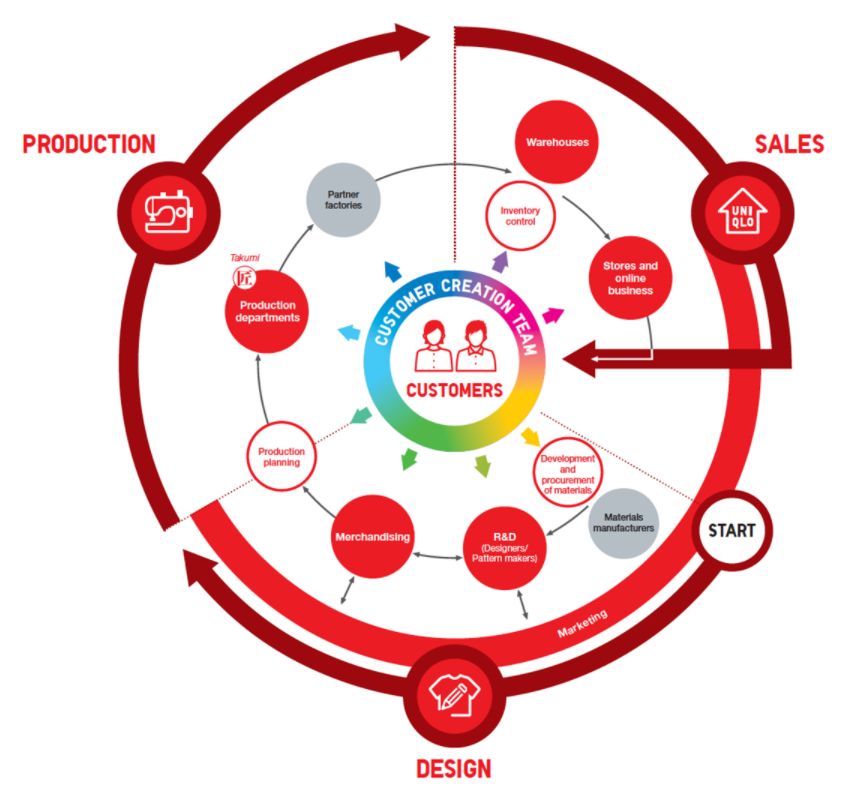
Image source: Internet
UNIQLO chose to offer low-priced clothing for mass consumers. Another apparel giant, Zara, targets fashion-conscious mid-tier consumers with the most trendy styles. And unlike UNIQLO's integration from channel to brand, Zara's development represented an extension from brand to channel.
In 1963, Amancio Ortega and his wife quit their jobs at a clothing store to found a garment manufacturing company called GOA, specializing in bathrobes and women's lingerie.
Over ten years, the team expanded to 500 people and developed a professional design team. GOA operated on a traditional 1.0 model, selling downstream through distributors. However, a sudden return of goods by a downstream distributor once plunged the company into a crisis of unsold inventory and near-bankruptcy.
Meanwhile, some distributors' buyers failed to appreciate GOA's product vision, leading Amancio Ortega to feel he was missing market opportunities.
In 1975, Zara's first store opened in A Coruña, Spain, primarily selling GOA's products. Gradually, Zara tasted the benefits of this model: on one hand, by integrating upstream and downstream operations, it captured more value across the entire chain; more importantly, through direct consumer contact and real-time feedback on bestsellers and slow-movers, it enhanced the brand's original design capabilities. The manufacturing retail strategy also influenced Zara's subsequent store expansion strategy.
Rather than following the principle of dense store concentration in already-entered markets, Zara initially scattered its stores to cover as many major developed countries globally as possible — in order to collect local customer feedback and fashion trends.
Amancio Ortega distilled his decades of experience into a corporate creed:
"Touch the factories and customers with two hands. Do everything possible to let one hand help the other."
4. The 3.0 Model: Manufacturing-Promotion Retail?
Beyond the external environment changes described above, new retail startups today face an additional layer of change: the promotion channel has shifted. Consumer attention has become fragmented, and communication methods have diversified.
The traditional model of simply pouring money into advertising is seeing diminishing ROI; the "good wine needs no bush" approach of focusing solely on product can easily get drowned out in today's information explosion.
Conversely, many so-called "internet-famous brands" have left deep impressions on consumers through creative, well-crafted promotional strategies, converting that awareness into sales and repeat purchases.
Promotion methods have become varied: some use social media for viral growth, some operate their own WeChat public accounts, Weibo, and Douyin accounts to create MCN-style content marketing, some leverage KOL live-streaming sales. In recent years, we've seen entrepreneurs deploy all manner of ingenuity — each finding their own path to success.
In the future, it won't just be production and sales data influencing each other — promotion-derived data (such as pre-sale warm-up feedback, public sentiment, post-purchase reviews, etc.) will also be incorporated into companies' core algorithms, jointly influencing corporate strategy and direction, helping contenders break through in this wave of retail.
We look forward to exchanging ideas with entrepreneurs who possess "manufacturing-promotion retail" thinking.
More Source Code Capital Internal Briefings

Issue 12: Export E-Commerce: How to Seize New Opportunities in a Trillion-Dollar Blue Ocean Market
Issue 11: Basic Evaluation and Value-Added Criteria for SaaS Model Enterprises
Issue 10: In the OMO Era, Where Lies the Technology Dividend for New Retail Enterprises?
Issue 9: Four Dimensions for Positioning Innovation Opportunities in InsurTech
Issue 8: Viewing New Finance Opportunities Through an Asset Management Lens
Issue 7: The Trap of Technology Prophecies
Issue 6: Industrial Internet Investment Landscape
Issue 4: Mobile Going Global: Entrepreneurs Should Keep Eyes on Content Product Opportunities
Issue 3: Targeting Unicorns in the Consumer Upgrade Wave
Issue 2: Profile of "Reliable" AI Startup Characteristics
Issue 1: Under "New Retail," Where Do Offline Stores Go From Here?

Source Code Capital
Creating Lasting, Genuine Value

WeChat ID:
sourcecodecapital
More professional content
Follow our official WeChat account