Commercial Rocket Launches: A Protracted Battle Balancing Technology, Market, and Conviction | Source Code Capital Internal Reference

The industry is still one to two years away from the formal test flights of each company's flagship models, which leaves a window for players with unique capabilities and fresh strategies to break through.
Source Code Capital Insider
Issue 16
About the Author
Liu Yang
Investing in Enabling Tech and Automotive Mobility

Mr. Liu Yang joined Source Code Capital in 2015, focusing on investments in Enabling Tech, automotive mobility, and related fields. He previously worked at Alibaba Mobile Business Group's Shenma Search and Baidu, where he worked on search and mobile community products, bringing extensive experience in software development and internet product management. Before that, he was a software engineer at ASM Pacific's Singapore R&D Center, a Hong Kong-listed company. Mr. Liu Yang graduated from Beihang University with a bachelor's degree in Computer Science and Technology.
Contact: ly@sourcecodecap.com
[Editor's Note]
In 2018, China's venture capital scene caught "space fever" — and this time, it wasn't about wind lifting pigs into the sky, but about building rockets that could actually get there. We set out to cut through the industry hype and map out how this business really works. After extensive analysis, Source Code Capital presents Issue 16 of the Source Code Capital Insider.
Key Takeaways
- Rockets are the only fundamental vehicle to space. They stand to benefit from the explosion in space applications, while technological advances will further expand their use cases and addressable markets.
- Different models and technical approaches suit different market segments. Startups should plan their product roadmaps based on current technical capabilities and target customer needs. Blindly piling onto a single route with campaign-style R&D undermines a company's ability to build differentiated competitive moats.
- Rocket launch is a long-distance race requiring endurance. The core founding team must be focused, stable, and capable — accurately grasping customer needs and delivering highly reliable, low-cost products.
- With a 1-2 year window before each company's main model makes its maiden flight, companies with unique capabilities and fresh approaches still have a shot at breaking out.
I. Market Observations
1. How Big Is the Market?
First, let's look at the rocket launch market in recent years. From 2012 to 2018, annual global orbital launches ranged from 70 to 114 missions. In 2018 alone, 476 satellites, spacecraft, and other payloads were launched, generating roughly $5-6 billion in annual revenue. During this period, China launched 15-22 rockets annually, with a sudden surge to about 40 launches in 2018.
Based on this historical data alone, the rocket market doesn't look particularly impressive. But as the only fundamental vehicle to space, rockets not only stand to benefit from the explosion in space applications — technological progress will further expand their use cases and addressable markets. With that in mind, let's explore the market's future potential:
1) Orbital launch services: According to incomplete statistics, approximately 20,000 satellites are planned for launch globally between 2018 and 2025. In China alone, the top 10 constellation plans total over 2,000 satellites. Existing rocket launch capacity falls far short of meeting this demand. This is currently the main battleground for domestic commercial rocket companies.
2) High-speed flight platforms: A relatively new application scenario, primarily serving domestic aerospace universities and research institutions. The United States conducted 199 flight tests using the X-15 aerial flight test platform from 1959 to 1968, focusing on hypersonic flight above Mach 5. In 2016, the HyRAX program was launched to develop reusable hypersonic test platforms.
Previously, similar tests in China could only obtain partial data through ground wind tunnels — expensive and limited to short-duration measurements. The estimated annual domestic market is at least RMB 500 million to 1 billion, but very few rocket companies can provide such services, which require near-space hypersonic flight and rocket recovery.
3) Space tourism: Short or long trips carrying passengers to suborbital space or around the moon. This market is difficult to predict, but we can extrapolate from Antarctic tourism — roughly 30,000-40,000 visitors annually, with average trip costs of RMB 50,000-100,000.
-
Virgin Galactic is attempting suborbital space travel. In late 2018, SpaceShipTwo flew to the edge of space twice and returned safely, with commercial service potentially starting as early as 2020. Tickets are priced at $250,000 each, with over 600 reportedly sold and strong demand.
-
Blue Origin's New Shepard spacecraft is also attempting suborbital travel.
-
SpaceX's Big Falcon Rocket will eventually offer circumlunar trips, with Japanese billionaire Yusaku Maezawa set to become the first private passenger to fly around the moon.
4) Point-to-point cargo/passenger transport: As rocket reusability technology matures, Musk has proposed using the newly developed BFR for non-orbital ballistic flights, traveling from offshore launch pads near major cities to any other launch pad on Earth within an hour. Musk estimates seat prices would be roughly comparable to economy-class airfare for the same distance.
5) Sounding rockets: Atmospheric detection and scientific experiments in near-space, measuring atmospheric structure, composition, and key parameters at various altitudes, and studying ionospheric, geomagnetic, cosmic ray, solar ultraviolet, and other solar-terrestrial physical phenomena. They fly higher than weather balloons and lower than low-Earth orbit satellites, making them effective tools for exploring the 30-200 km altitude range. The Aerospace Fourth Academy's Zhongtian Rocket generates roughly RMB 50-100 million in annual revenue from sounding rockets.
2. What Market Changes Are Creating Opportunities for New Companies?
1) Policy guidance: Under the national military-civilian integration strategy, China's commercial aerospace companies enjoy a more favorable policy environment, including significantly improved support for component supply chains, test facilities, launch sites, approval processes, and even orders from state-owned entities. This somewhat resembles the United States in the 1990s, which heavily funded private companies like Boeing and Lockheed Martin before introducing competition to support startup rocket companies like SpaceX, Blue Origin, Sierra Nevada, and Orbital Sciences.
2) Technical direction: Customer demand has shifted from multi-ton large satellites to small satellites weighing tens to hundreds of kilograms, creating a market for small rockets. Reusable technology has been validated, intensifying the importance and competition around cost reduction.
3) Talent mobility: Sixty years of China's aerospace development has accumulated substantial technical talent. Since 2015, the wild growth of commercial aerospace companies has attracted waves of bold, creative backbone personnel from state-owned entities — a trend that continues to accelerate. As aerospace industry compensation rises, more elite students will choose to join this sector.
4) International benchmarks: American star companies like SpaceX have validated how startup private commercial aerospace companies can grow through new technological innovation and government partnerships, achieving valuations exceeding $20 billion.
II. Industry Debates
China's commercial aerospace market is still nascent, and divergent viewpoints are inevitable — and in fact helpful — during this early stage. Here we summarize several core debates of particular interest.
1. Solid-fuel vs. Liquid-fuel Rockets
Liquid-fuel rockets dominate today's global space launch vehicles, but solid-fuel rockets have important characteristics that make them valuable. The former is well-understood and needs no further elaboration; we'll focus on solid-fuel rockets' advantages:
-
Short launch preparation cycles — the Long March 11 can launch within 24 hours. By contrast, liquid-fuel rockets typically require 7-20 days for transfer, multiple rounds of testing, final checks, propellant loading, and other procedures.
-
Storage life of several years with no volatilization or corrosion, suitable for quasi-routine launches. Liquid-fuel rockets require propellant loading at the launch site; room-temperature propellants (like nitrogen tetroxide and unsymmetrical dimethylhydrazine) can be stored for about 7 days after loading; cryogenic propellants (like liquid hydrogen/liquid oxygen) only about 1 day.
-
Solid motors actually offer very powerful thrust capabilities at relatively low cost, which is why solid motors are used as boosters on the Space Shuttle and several heavy-lift launch vehicles. The ESA's P120C produces maximum thrust of 460 tons; China's 200-ton-thrust solid motor has also successfully completed test firing, and future integration with the Long March 11 will increase SSO capacity to no less than 1.5 tons.
-
Solid motors are relatively less difficult to develop, making them suitable starting points for countries with weak aerospace industrial bases and for startup companies.
These characteristics show that solid-fuel rockets are well-suited for flexible, mobile, quasi-routine launches.
2. Large Rockets (Medium/Heavy) vs. Small Rockets
Large rockets have greater payload capacity, suitable for batch satellite deployment in single launches, as well as large satellites, crewed spacecraft, and other missions. Small rockets are well-suited for flexible, mobile deployment of initial network test satellites and later constellation replenishment launches.
On cost: large rockets deploying satellites in batch have lower per-satellite or per-kilogram costs. But you can't simply divide launch cost by total payload mass — you must also consider how many satellites the rocket can carry, which depends on rocket diameter, fairing volume, satellite spatial arrangement, and other factors.
In the small satellite constellation market, large rockets' real advantage is rapid network deployment through multiple-satellite single launches — getting more constellation satellites into orbit in a short time.
Constellation replenishment demand after initial deployment is also substantial. Consider: with thousands of small satellites having average design lives of 5-7 years, you'd expect hundreds of replenishment launches needed annually.
3. Vertical Recovery vs. Horizontal Recovery
Star companies SpaceX and Blue Origin have popularized the concept of reusable recovery, dramatically reducing launch costs by recovering and reusing first-stage rockets. There are two typical global approaches:
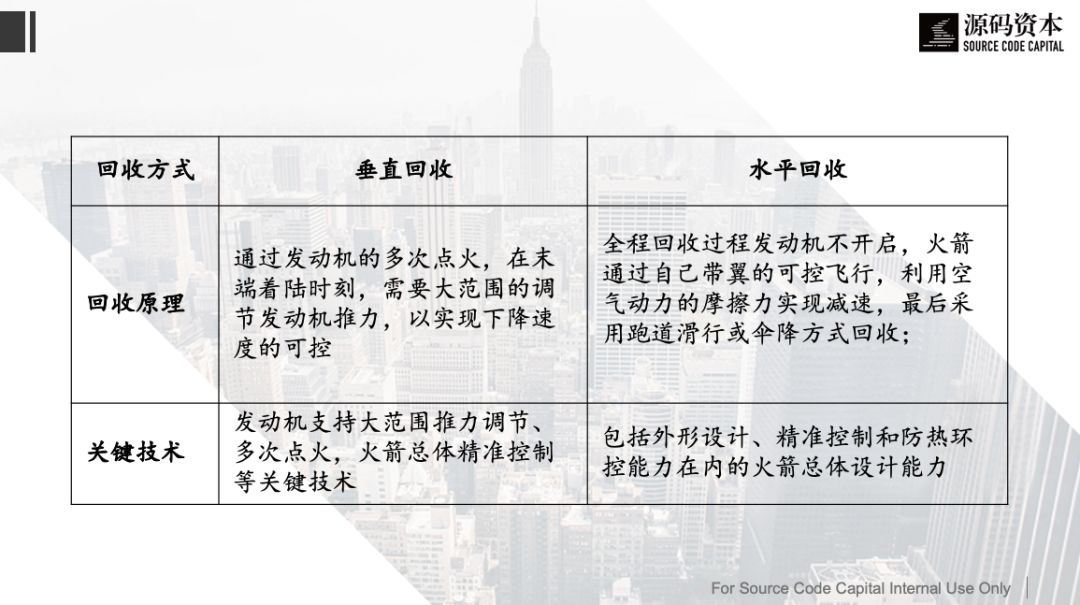
Image source: Source Code Capital
From a technical perspective, neither approach has significant inherent advantages or disadvantages — the core goal of both is recovery and reuse to reduce costs. But the technical capability requirements differ enormously. Currently, domestic companies are exploring both approaches:
-
In vertical recovery, engine technology is foundational, requiring coordination with good overall rocket design. For example, when the first stage descends, most fuel is already consumed, making it very light — requiring minimal thrust for a slow landing, which demands careful engine arrangement on the first stage. Relatively speaking, configurations with five, seven, or nine engines bundled together make this easier to achieve: during descent, only the center engine is ignited, reducing thrust modulation requirements.
-
Horizontal recovery's positioning difficulty is a genuine issue with pure parachute solutions, given the long distance from parachute deployment to ground and high uncontrollability. But if wings can glide to a relatively accurate area before parachute deployment, or if the rocket can glide to landing like an aircraft, then positioning and recovery become essentially non-issues.
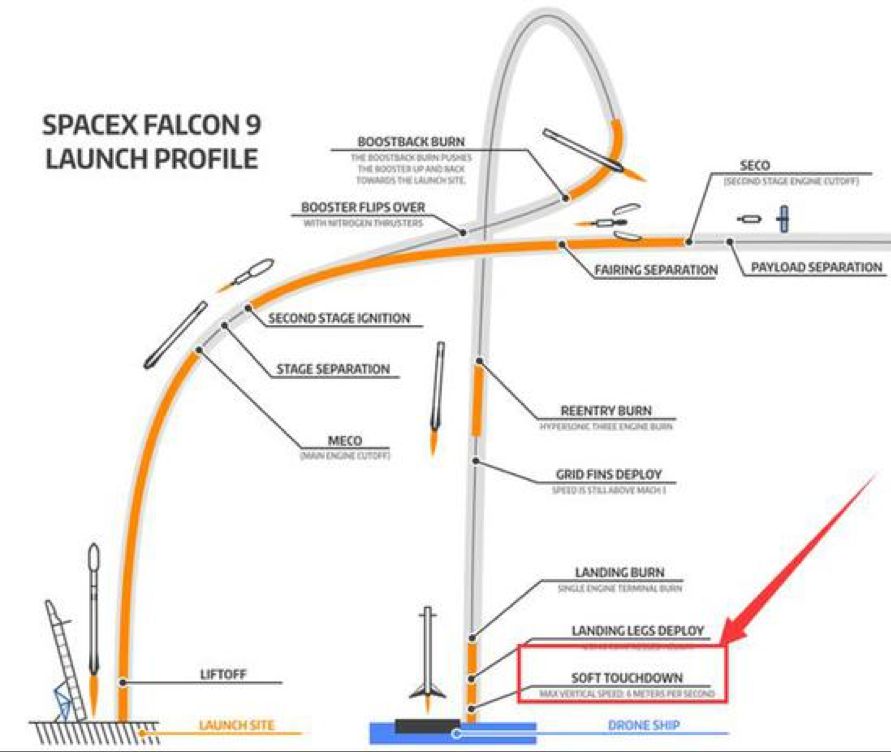
Figure 1: SpaceX Falcon 9 vertical recovery trajectory schematic
(Image source: Internet)
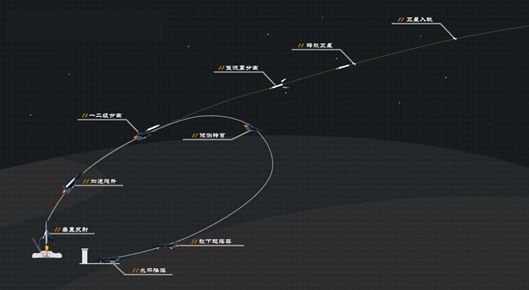
Figure 2: Horizontal recovery trajectory schematic (Image source: Internet)
4. Liquid Engine Propellant Choice: Liquid Oxygen/Methane vs. Liquid Oxygen/Kerosene
Liquid oxygen/kerosene and liquid oxygen/methane are collectively called liquid oxygen hydrocarbon propellants. Kerosene has been maturely used for years in mainstream launch vehicles in Russia, China, and elsewhere; methane has become a research hotspot in recent years. From an application perspective, neither can be simply judged as better — it depends on the rocket company's technical accumulation and application scenarios:
-
From physical characteristics, methane's vacuum specific impulse is slightly higher than kerosene by about ten-plus seconds. But methane's lower density means less mass for equivalent volume, resulting in lower density-specific impulse. Given a rocket's fixed fuel capacity, liquid oxygen/methane's combustion efficiency isn't actually better than liquid oxygen/kerosene.
-
Methane's real advantage is higher coking temperature and relatively less severe carbon deposit issues, making it more suitable for staged combustion cycle engines that can use fuel-rich rather than oxidizer-rich mixtures. This achieves higher specific impulse with relatively less design difficulty and longer engine life. However, current domestic commercial rocket companies all use gas generator cycles, with no near-term capability to develop staged combustion cycle engines.
-
For reusable technology, both propellants are viable. SpaceX's Falcon rocket Merlin engines have proven that liquid oxygen/kerosene can suppress coking issues in oxygen-rich environments for reusable rockets. Post-recovery refurbishment costs may be somewhat higher, but likely not by orders of magnitude.
-
Equivalent-class liquid oxygen/methane engines are relatively more difficult to develop. No liquid oxygen/methane engine has yet actually flown, inevitably requiring more time for various testing and validation phases.
5. Self-developed Engines vs. Purchased Engines
Engines are among a rocket's most critical components and represent key technology and moats that rocket companies need to master in the long term. But this doesn't mean rocket companies must dive into engine development from day one. In overall launch services, the most critical metrics remain rocket reliability, launch cost, and launch preparation cycle.
Globally in commercial aerospace, purchasing engines is quite common. For a startup rocket company, obtaining a mature engine that has been market-tested through multiple launches may be more suitable than building an entirely new engine from scratch.
China's domestic engine procurement environment is also gradually improving. Small solid motors have progressed from embargo to gradual liberalization, and liquid engines may not be impossible in the future. Meanwhile, numerous engine companies are developing products for sale, becoming future supply sources for the engine market.
A thought experiment: as rocket launches increase dramatically, will the rocket industry chain develop specialization similar to the stable relationship between aircraft manufacturers (Boeing/Airbus) and aero-engine companies (General Electric/Rolls-Royce/Pratt & Whitney)?
6. Funding Stage/Founding Date: First-Tier vs. Second-Tier Companies
Rocket launch is a long-distance race. Early technical accumulation and trial-and-error consume substantial time. While earlier-founded companies have clear leads in funding stage and company scale, it's premature to say the battle is decided. After all, there's still a 1-2 year window before each company's main model makes its maiden flight, and the various technical directions and strategic choices mentioned above will also affect R&D timelines to some degree. Thus, second-tier companies still have opportunities to overtake on the curves.
III. Profile of Potential Winners
What characteristics make a company more likely to emerge victorious in the rocket launch race?
1. Strong, Stable Core Team
As a long-distance race requiring extended periods for technical R&D, testing, and product validation, core team stability and sustained commitment are essential. This typically requires founding partners with sufficient strength and credentials to unite the team, alongside steady, continuous business progress.
Four core capabilities for rocket companies: overall design, control, propulsion, and launch. Overall design and control require sufficiently strong technical leaders to properly define a suitable, reliable rocket product from the R&D outset; propulsion and launch are also critical and must be covered in a timely manner according to the company's product roadmap in the medium to long term.
2. Ability to Deliver Highly Reliable, Low-Cost Rocket Products
High reliability is the most important metric for rocket launches (possibly without equal). It comes from continuous refinement of mature models and technologies, as well as long-term repeated launches to train technical and engineering teams. For emerging commercial rocket companies, various opportunities are needed to build a reliability brand and strong reputation for star models.
Low cost is the future direction for commercial rockets, with four main approaches:
A) Reducing supply chain costs: replacing state-owned/institutional supply chains with more private industrial systems;
B) Reducing production costs: industrial-scale batch manufacturing;
C) Increasing usage cycles and lifespan: reusable recovery technology;
D) Reducing launch costs: large liquid-engine multiple-satellite launches and small solid-engine routine launches.
Approaches A and B will be pursued by all private rocket companies; C and D are key competitive capabilities, and possessing either can potentially yield low-cost advantages.
In China's aerospace system, capability D for large liquid engines is relatively weak and may require extended R&D investment to master; for C, vertical recovery depends on liquid engines with later technical maturity timelines, while horizontal recovery currently appears to be among the fastest-to-implement technologies but demands extremely high team capabilities that only a few teams can master.
3. Precise Grasp of Market and Customer Needs
Taking small satellite constellation customers as an example:
-
2018-2020: Primarily first technical verification satellites, with needs for fast launch cycles and single or few satellites, mainly through small rocket dedicated launches or large rocket rideshare launches.
-
2020-2023: Rapid constellation deployment, with needs for speed and low cost, mainly through large rocket multiple-satellite launches, with supply including both domestic institutional providers and overseas companies like SpaceX.
-
Post-2023: Primarily replenishment launches for existing networks, with needs for fast launch cycles and precise orbital placement, with different application scenarios for both small rocket dedicated launches and large rocket multiple-satellite launches.
4. Long-Distance Endurance
A company's main model (especially large rockets) has a long development cycle. Before product maturity, stable and continuous self-sustaining capability is needed, such as offering suborbital rockets, small launch vehicles, and attitude/orbit control engines. These both help hone technical capabilities and provide crucial revenue when needed. Meanwhile, founders need strong fundraising and resource aggregation capabilities — great force accomplishes great things.
More Source Code Capital Insider

Issue 15: To Do Business with Gen Z Consumers, First Understand Li Dan
Issue 14: The Opportunity and Rise of "Manufacturing-Driven Retail"
Issue 12: Export E-commerce: How to Seize New Opportunities in the Trillion-Dollar Blue Ocean Market
Issue 11: Basic Evaluation and Value-Add Factors for SaaS Business Models
Issue 10: In the OMO Era, Where Are the Technology Dividends for New Retail Companies?
Issue 9: Four Dimensions to Position Innovation Opportunities in InsurTech
Issue 8: Viewing New Finance Opportunities Through an Asset Management Lens
Issue 7: The Trap of Technology Prophecies
Issue 6: Industrial Internet Investment Landscape
Issue 5: Convenience Stores: Under the New Retail Wind, Where Is China's 7-Eleven?
Issue 4: Mobile Going Global: Entrepreneurs Should Target Content Product Opportunities
Issue 3: Targeting Unicorns in the Consumer Upgrade Wave
Issue 2: Profile of "Reliable" AI Startup Characteristics
Issue 1: Under "New Retail," Where Are Offline Stores Headed?

Source Code Capital
Creating Lasting, Real Value

WeChat ID:
sourcecodecapital
More Professional Content
Follow our official WeChat