Opportunities in Industrial Internet from the Perspective of Apparel Supply Chain | Source Code Capital Insights

Efficiency gains will be at the heart of future competition.
Source Code Capital Insider
Issue 17

Editor's Note
China's apparel industry has cycled through rapid growth, inventory overhang, destocking, and renewed growth over the past three decades. Today, every link in the value chain faces fresh opportunities and challenges. Source Code Capital presents Issue 17 of our exclusive insider briefing, based on our own analysis and research.
Key Takeaways
Three core pain points plague the apparel industry:
The tension between consumers' desire for personalized clothing and the supply chain's reliance on mass production, slow response times, and high manufacturing costs
The tension between consumers' pursuit of high value-for-money apparel and brands' high markup rates
The tension between short product lifecycles and severe inventory problems
Source Code Capital sees two trends in apparel supply chains:
The shift from long-production-cycle trade-show models to fast-response models is inevitable
Domestic apparel brands currently carry excessive markups, leaving room for supply chain reform
China boasts the world's largest apparel production and consumption market. On the demand side, China's domestic apparel retail market is worth 1.5 trillion RMB. On the supply side, China produces nearly 80 billion meters of fabric and nearly 30 billion garments annually, exporting nearly $200 billion worth of apparel.
Over the past 30 years, China's apparel industry has cycled through rapid growth, inventory overhang, destocking, and renewed growth, while also alternating between export-driven and domestic-demand-driven phases, maturing along the way.
The evolution of China's apparel industry can be summarized in the chart below:
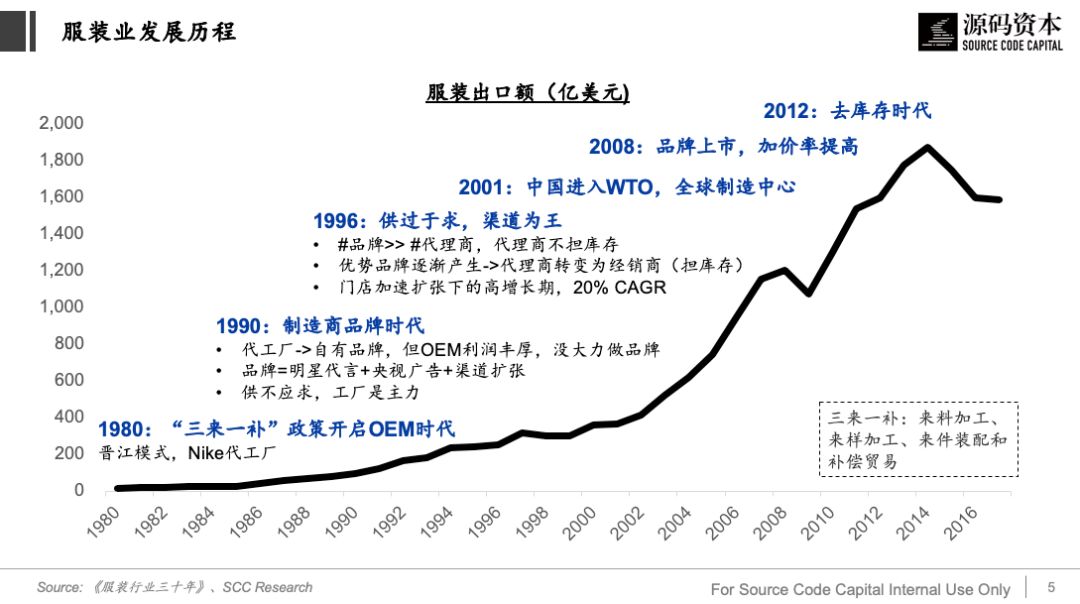
Image source: Source Code Capital
Yet China's apparel industry remains highly fragmented and short on giants. Aside from ANTA Group and Shenzhou International, no company has reached a $10 billion market cap, and few brands or products command international influence. Our research shows that the industry's overall supply chain informatization and data intelligence levels remain low — a challenge that also represents opportunity for entrepreneurs and investors.
First, we note the following characteristics when analyzing the apparel industry:

Image source: Source Code Capital
I. The Apparel Industry Chain and Process
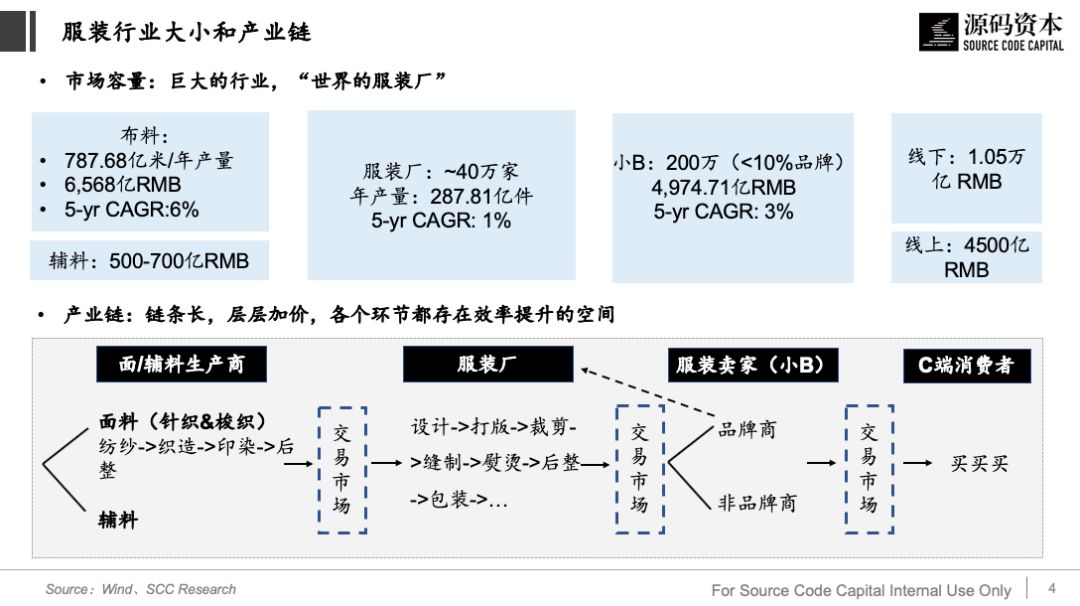
Image source: Source Code Capital
Apparel design, production, and distribution involve many fragmented steps, making it a labor-intensive industry. The value chain is relatively straightforward but long, with numerous participants. Players are highly dispersed, SKU/SPU counts are massive, and most companies are SMEs scattered across the country. These small and medium enterprises invest very little in R&D and IT informatization, resulting in low industry-wide informatization and digitization levels.
Production capacity has seen little growth over the past five years due to destocking pressures, rising labor costs, and trade war impacts. Therefore, efficiency improvement will be the core of future competition. On the distribution side, the industry's inherent offline nature and data sparsity keep it in a highly inefficient state.
II. Pain Points in the Apparel Industry
a. The tension between consumers' desire for personalized clothing and the supply chain's reliance on mass production, slow response times, and high manufacturing costs. The traditional push supply chain, driven top-down from brands, can no longer meet consumer demands and must shift to a consumer-driven pull supply chain.
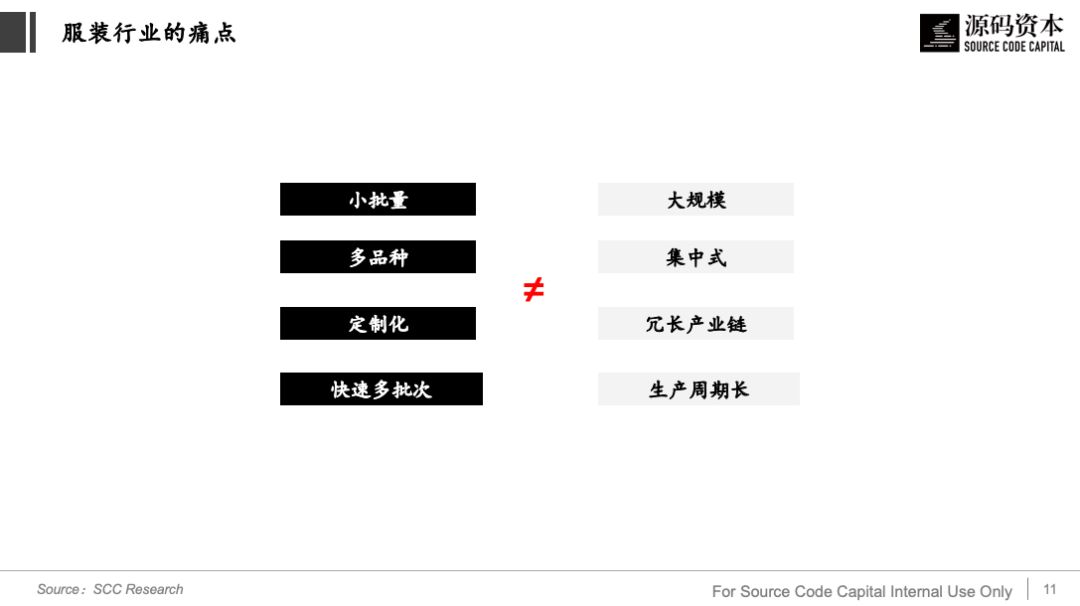
Image source: Source Code Capital
b. The tension between consumers' pursuit of high value-for-money apparel and brands' high markup rates
Markup rates vary by brand as shown below:
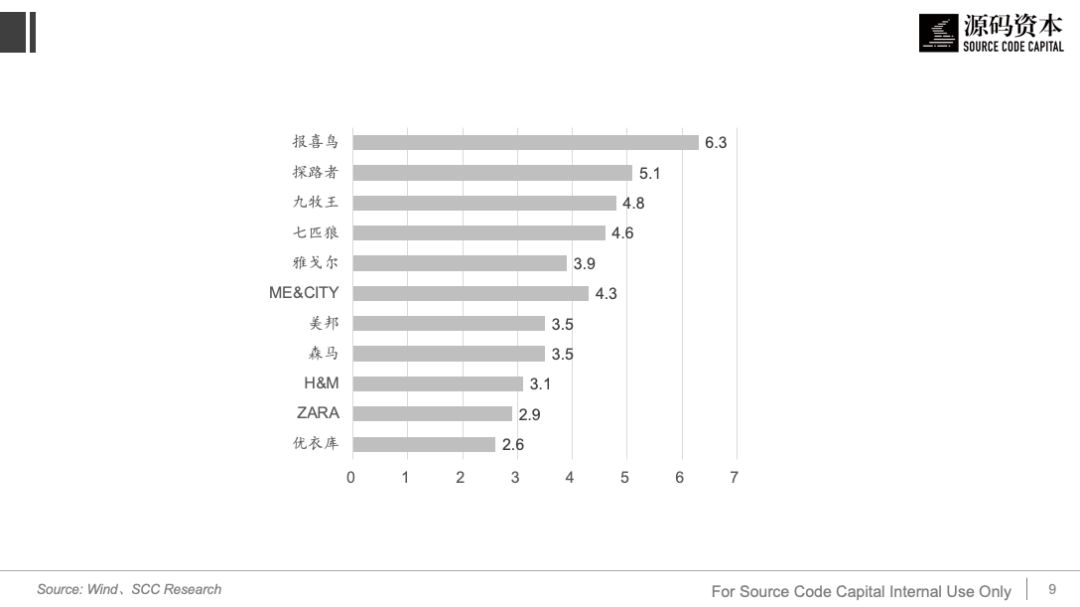
Image source: Source Code Capital
c. The tension between short product lifecycles and severe inventory problems
Inventory has long been apparel's achilles heel. Since 2012, brands have faced serious inventory overhangs, with inventory turnover ratios plummeting and inventory-to-total-revenue ratios persisting at elevated levels of 25%-30%.
III. Current State and Opportunities Across the Apparel Value Chain
a. Fabric and Accessories Market
As consumer demand for personalization grows more pronounced, it has spurred demand for fast-response apparel supply chains. Among the constraints on fast response, uncertainty in fabric and accessories sourcing stands out. Producers must source from multiple channels, driving fabric and accessories trading toward greater fragmentation. Information asymmetry in this market is severe, with markups at every layer. Production is dispersed and cycle times are long, making efficient coordination with garment factories difficult.
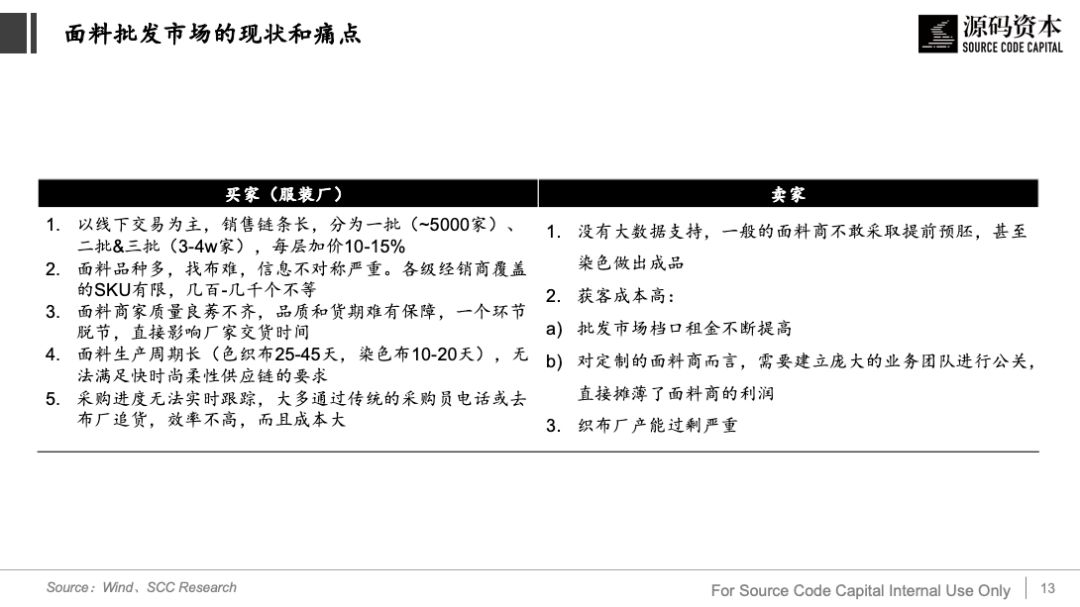
Image source: Source Code Capital
The current landscape reveals clear opportunities for B2B platforms in fabric and accessories, with potential to expand from distribution into production. Baibu has emerged as a leader in this space.
b. Apparel Wholesale Markets
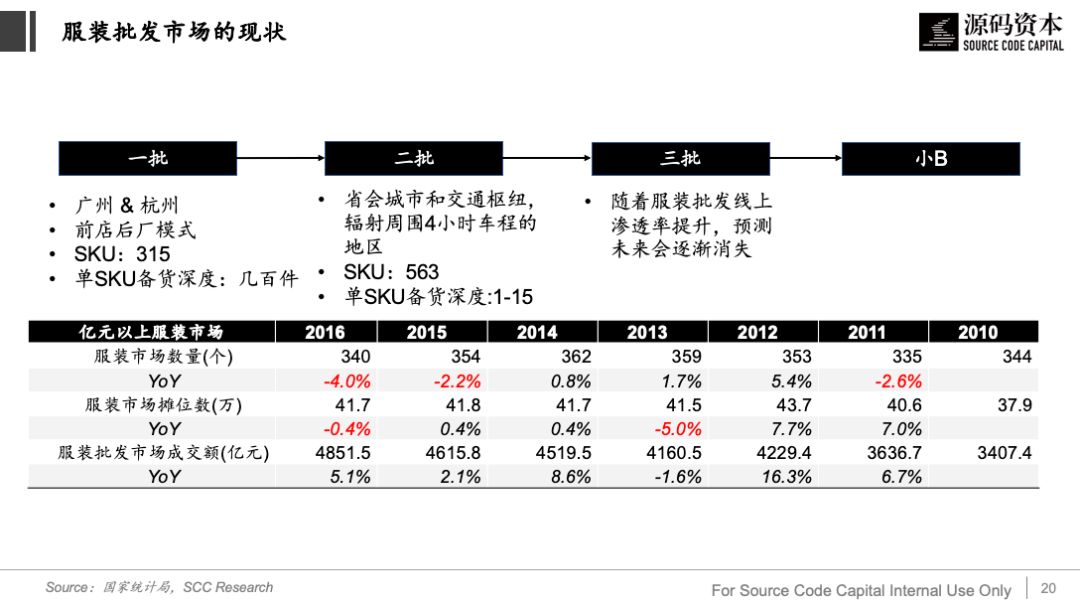
Image source: Source Code Capital
Apparel wholesale markets feature long transaction chains with markups at every step, yet the value provided by secondary wholesalers — primarily curation, spot availability, and credit terms — remains difficult to replace. Industry turnover is rapid: individual secondary wholesalers typically replace 100% of inventory every two weeks. In recent years, offline wholesale markets have been shrinking while online penetration has gradually increased.
Physical constraints limit small Bs' (offline stores and online shops) offline sourcing options. Most small Bs visit wholesale markets at least monthly, arriving when doors open at 4 a.m. and browsing until noon. The environment is chaotic, with insufficient time to cover the entire market. More recently, urban governance initiatives have pushed wholesale markets to suburban locations, while small Bs increasingly purchase via WeChat, leaving wholesalers facing insufficient foot traffic.
We believe that apparel B2B platforms, with controlled fulfillment and delivery, can create superior purchasing experiences for apparel retailers and will capture significant market share going forward.
c. Garment Factories
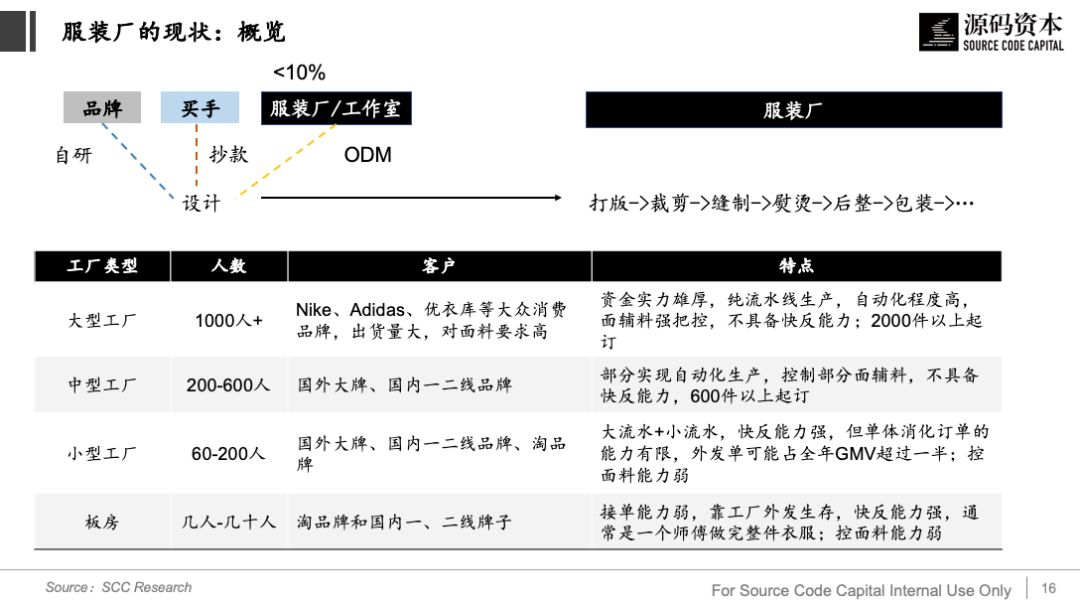
Image source: Source Code Capital
Garment factories currently operate with low informatization levels. Production quality depends mainly on managers' professional competence, with data scattered across various offline work orders. Workers generally have low education levels, and working conditions and staff quality are ill-suited to operating complex systems.
The rising demand for quick response capability represents garment factories' primary challenge. Addressing this requires, beyond fabric and accessories certainty (discussed above), greater system and data support, including:
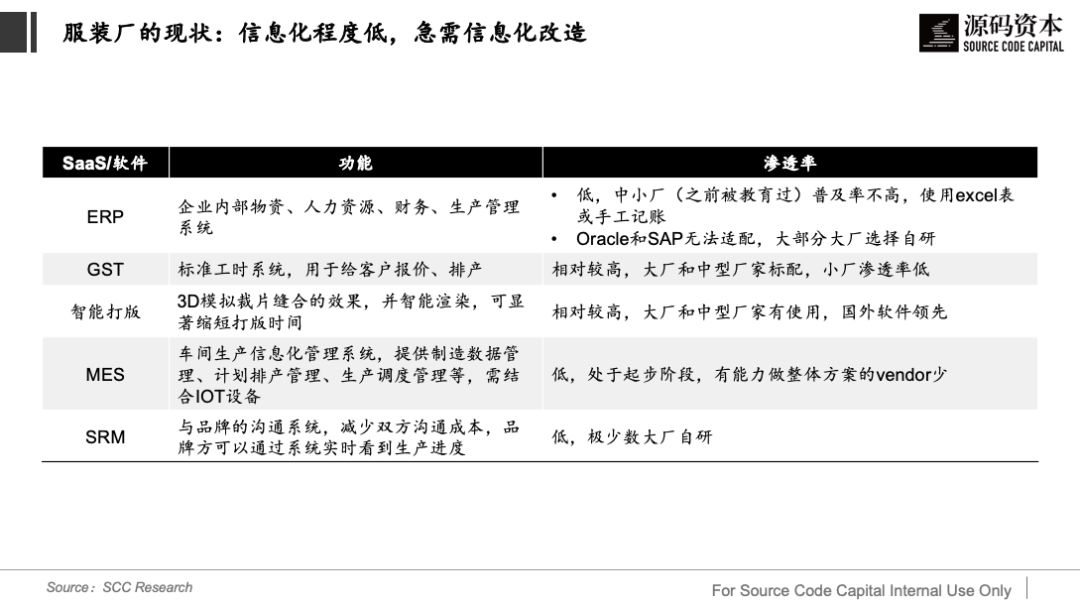
Image source: Source Code Capital
By improving fabric and accessories certainty and using software and hardware to achieve factory informatization and digitization, production efficiency can be improved from the capacity side, increasing supply chain flexibility. We see opportunity for a flexible apparel supply chain platform that connects and distributes orders across informatized factories, enabling efficient apparel production and delivery.
IV. Case Study: The Zara Secret
- ZARA created the "fast fashion" myth: 18,000 garments produced per minute, with "design — pattern-making — production — store placement" completed in 2-3 weeks. Its dedicated logistics center spans 90 soccer fields, enabling new products to ship from production sites to worldwide destinations within 24 to 72 hours.
- We believe ZARA's highly efficient supply chain enables an ultra-short lead time of 7-12 days, achieving "many SKUs, small batches, quick replenishment."
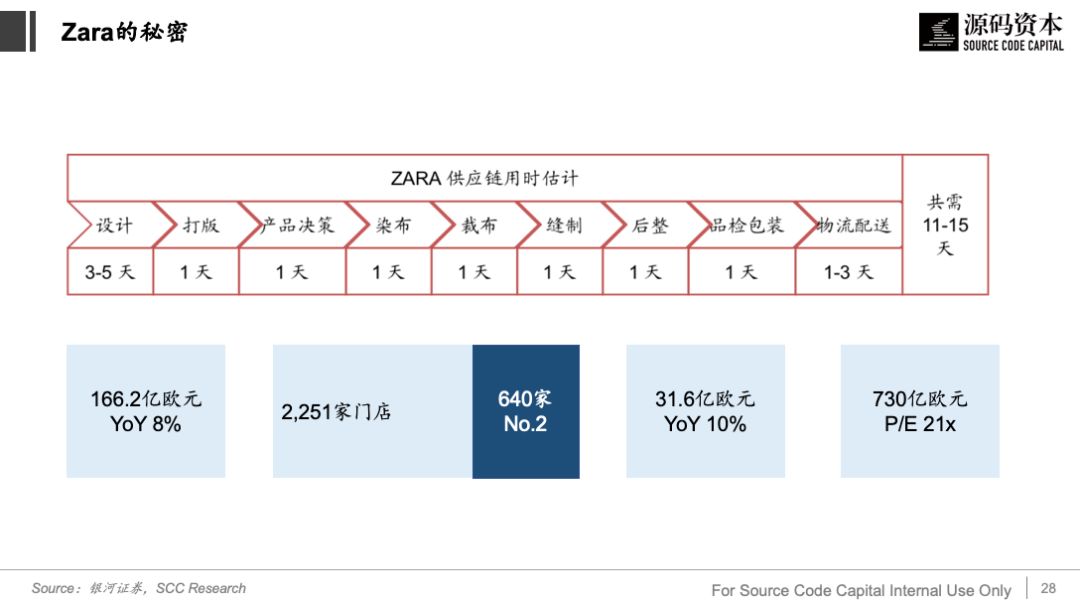
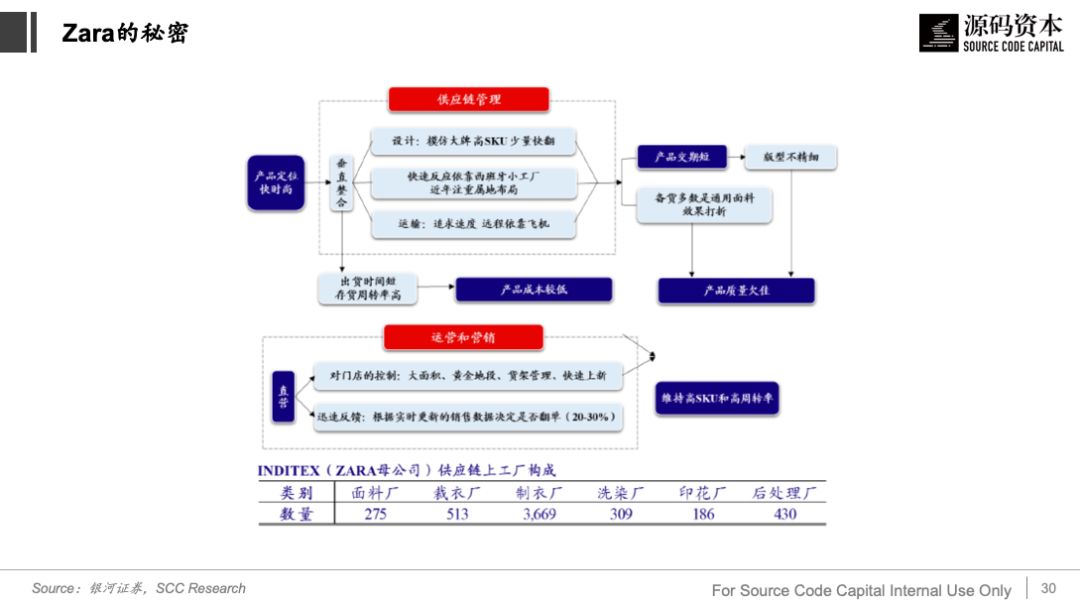
Image source: Source Code Capital
Zara's innovations across the following dimensions have given it enormous advantage:
- Organizational Design: A 400+ person design team comprising designers, marketers, and buyers completes pattern-making at headquarters, designing a garment in 3-5 days. New releases increased from 17 seasons annually to 52.
- Sourcing and Production: 50% of goods are self-produced, with raw materials coming from parent group INDITEX's own suppliers. After cutting materials in-house, low-skill sewing work goes to nearby contract factories. Meanwhile, Zara hollowed out the ground beneath a 200-kilometer radius around headquarters to build an underground conveyor network for vertically integrated production. The company sends brand trend manuals to traders monthly; traders develop sample garments based on these, Zara modifies them, and traders remake and resend samples.
- Logistics and Distribution: Products ship to European stores via transport trucks from the logistics center, supplemented by two air freight bases. European stores receive goods within 24 hours, U.S. stores within 48 hours, and Japan within 48-72 hours — global delivery within three days.
- Sales Feedback: Stores send sales data back to headquarters daily, while submitting replenishment orders twice weekly. Headquarters makes replenishment decisions based on sales, inventory, and other data. Zara produces only about 15% of next quarter's shipment volume before the current season. If a product sells well and headquarters has fabric in stock, it ramps up production for quick replenishment; if no fabric is available, production stops. Typical replenishment rates are 20-30%, with best-sellers restocked at most twice.
- Information Systems: IT systems integrate the four stages from design to sales, standardizing fashion information entry, managing product and inventory information, standardizing production processes, and tracking logistics throughout distribution.
From Zara's case, we learn how far a apparel company can push supply chain capability to create product competitiveness and advantage, and how connecting IT systems and data from storefronts all the way back to supply chain origins can dramatically enhance a brand's ability to serve consumers. This merits study by all Chinese apparel enterprises.
V. Where Lies the "Industrial Internet" Opportunity in Apparel?
Trends we can confirm:
a. The shift from long-production-cycle trade-show models to fast-response models in apparel supply chains is inevitable;
b. Domestic apparel brands currently carry excessive markups, leaving room for supply chain reform.
Methods to improve supply chain efficiency:
a. Increase materials certainty while reducing production and distribution costs: B2B trading platforms for main fabrics, accessories, and ready-to-wear apparel (such as Baibu), positioned close to transactions, create substantial value;
b. More efficient production models: Single-point efficiency gains on the production side, such as intelligent sewing machines and intelligent fabric inspection machines;
c. Improve information exchange efficiency and production efficiency between single points or across nodes in the value chain through software and hardware, with platform potential.
We believe apparel supply chain opportunities are just beginning. We observe that even as traditional apparel enterprises transform themselves, increasingly outstanding entrepreneurs are entering this赛道. We look forward to continuing exchanges with industry experts and entrepreneurs to jointly create lasting, genuine value!

More Source Code Capital Insider Issues

Issue 16: Commercial Rocket Launches, A Protracted War Balancing Technology, Market, and Passion
Issue 15: To Do Business with Post-95s Consumers, First Understand Li Dan
Issue 14: The Opportunities and Rise of "Manufacturing-Driven Retail"
Issue 12: Export E-commerce: How to Seize New Opportunities in the Trillion-Dollar Blue Ocean Market
Issue 11: Basic Evaluation and Value-Add Criteria for SaaS Business Models
Issue 10: In the OMO Era, Where Lies the Tech Dividend for New Retail Enterprises?
Issue 9: Four Dimensions for Positioning Insurtech Innovation Opportunities
Issue 8: Viewing New Finance Opportunities Through an Asset Management Lens
Issue 7: The Pitfalls of Tech Prophecy
Issue 6: Industrial Internet Investment Landscape
Issue 5: Convenience Stores: Under the New Retail Wind, Where Is China's 7-Eleven?
Issue 4: Mobile Going Global: Entrepreneurs Should Keep Eyes on Content Product Opportunities
Issue 3: Targeting Unicorns in the Consumer Upgrade Wave
Issue 2: Profile of a "Reliable" AI Startup
Issue 1: Under "New Retail," Where Are Offline Stores Headed?