Three Realms of Industrial Internet Entrepreneurship | Source Code Capital Insights

A new wave of deep business model innovation in industrial internet is underway.
Source Code Capital Insider
Issue 18
About the Author
Xingshi Wang
Investing in Automotive & Mobility, Real Estate, and E-commerce

Xingshi Wang joined Source Code Capital in 2014, focusing on investments in automotive and mobility, real estate, and e-commerce. Prior to Source Code Capital, he worked at Hanergy Investment Group and TusPark Ventures, providing financing, M&A, and investment services to numerous internet companies. He holds a master's degree from Tsinghua University.
Contact: xs@sourcecodecap.com
[ Editor's Note ]
Since its founding in 2014, Source Code Capital has been continuously investing in the industrial internet sector. Over the past five years, we have grown alongside outstanding entrepreneurs, harnessing the power of technology and capital to drive industrial upgrading and innovation. Through this process, our understanding of the industrial internet has continued to evolve. In 2018, as internet giants doubled down on industrial internet and positioned themselves for the second half of the mobile internet era, industrial internet once again became a focal point for entrepreneurship and investment. Here, we borrow Wang Guowei's "three realms of life" — "establishing, persevering, attaining" — to summarize the three cognitive stages of industrial internet entrepreneurship that we have observed, and to share them with entrepreneurs in this space. Source Code Capital presents this exclusive analysis in Issue 18 of the Source Code Capital Insider.
Key Insights
- "Establishing": Industrial internet — the unmissable opportunity in the second half of the internet era.
- "Persevering": Creating value — doing the right thing, not the easy thing.
- "Attaining": Industrial evolution — an irreversible historical force.
First Realm — "Establishing": Industrial Internet — The Unmissable Opportunity in the Second Half of the Internet Era
Consumer internet has grown explosively for 20 years, turning 3.6 billion people worldwide into internet users. The internet business model of "serving massive numbers of users in real time at low cost"[1] has helped internet giants rise to the top ranks of global corporations in remarkably short order. Traffic dividends and business model innovation formed the powerful growth engine of the internet's first half. When the music of traffic dividends stopped, the internet immediately plunged into a brutal battle for existing market share. Any business model innovation now faces fierce competition, with giants wielding traffic and capital advantages rarely sitting on the sidelines.
The crowded internet needs new space. In 2018, Alibaba's GMV reached 4.8 trillion RMB, equivalent to the GDP of a developed European nation. Alibaba's rise was inseparable from the fertile trillion-yuan soil of the apparel industry, and today Alibaba is extending from the downstream to the upstream of that industry. If we follow this logic and turn our gaze to the real economy, it is not difficult to see that as the world's second-largest economy, China possesses nearly every global industrial chain. Among these, trillion-yuan industries like clothing, food, housing, and transportation are too numerous to count, with subdivided industries in the hundreds of billions or tens of billions even more abundant. What would happen if we could inject internet DNA into tens of trillions of yuan of industrial economic activity? From the internet's perspective, industrial internet offers vast opportunities with enormous potential.
From the industry's perspective, many sectors have reached a critical point where "adversity demands change, and change brings success." Automobiles and smartphones are major industries where China holds advantages. These two industries are already ahead of most others in terms of informatization, cost control, and channel management. In 2018, China's auto sales declined for the first time; smartphone shipments had already fallen for two consecutive years. Industrial economies must similarly face the challenge of exhausted dividends and search for new growth space and engines.
The second half of the mobile internet era may be precisely the opportunity for industrial economies to overtake competitors on the curve in global competition. This is an opportunity for incumbent industrial enterprises and new entrants alike. Consumer internet has completed the construction of infrastructure such as cloud computing, payments, and logistics, accumulated reserves of high-caliber internet talent at all levels, and created online-offline integrated consumer experiences at the highest level. Industrial economies can fully leverage internet infrastructure and talent to build exceptional experiences unique to industrial economies.
The convergence of industry and internet is already happening. Mature internet infrastructure has begun to find applications within industries. WeChat and QQ have become IM solutions for many sectors, with buyers and sellers using them to inquire about prices, quote, exchange product information, and conduct sales services. Replicating proven consumer internet models into industrial internet is a direct and effective entrepreneurial approach, and a classic model for industrial internet startups. A number of vertical B2B e-commerce trading platforms and on-demand service matching platforms have already achieved GMV exceeding tens of billions.
A new wave of deep business model innovation in industrial internet is beginning. We have always believed that the foundation of business innovation is creating value for users. Industrial internet users are enterprises, and enterprises are typically more rational than individuals. Industrial internet business model innovation always returns to the enterprise value chain[2], optimizing customers' operating activities. The value created by industrial internet for users will ultimately be reflected in users' financial statements.
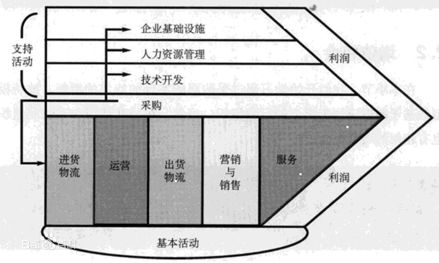
Image source: Baidu Baike
Value flows along the industrial chain. If efficiency improves for all enterprises in a chain due to innovation, the accumulated efficiency gains and value creation across the entire chain will produce a qualitative leap for the entire industry! Such a great undertaking is worth a lifetime of dedication from entrepreneurs.
Second Realm — "Persevering": Creating Value — Doing the Right Thing, Not the Easy Thing
Industrial internet entrepreneurship and innovation have never been easy. We observe that industrial enterprises grow significantly slower than internet companies, and many industries are highly fragmented, let alone achieving a "7-2-1" market structure. Many entrepreneurs are researching how to accelerate growth in industrial enterprises; we have tried a reverse-thinking approach to identify why industrial enterprises cannot grow quickly.
-
Incremental dividends versus stock replacement. Over the past decade, the smartphone赛道 represented incremental dividends, and the apps riding this wave were also incremental — food delivery platforms, for example. The instant delivery networks serving these platforms were incremental dividends. Looking at the entire mobile phone industry, smartphones represented stock replacement of feature phones. Looking at the broader food and beverage industry, food delivery represented stock replacement of home cooking and dining out. Industrial internet entrepreneurs must first clarify whether they are building an incremental or stock business. What is the underlying driver of incrementality? What we perceive as incremental may well be stock replacement of more fundamental needs. Rapid replacement of underlying stock requires revolutionary product upgrades. Strategies for incremental and stock businesses are often fundamentally different. Generally, incremental businesses must capture incremental market faster and more aggressively than competitors, building moats while enjoying first-mover advantages. Stock businesses must spend more time refining product service and operational systems, making products better than competitors', taking market share from rivals, and improving penetration rates.
-
Moving atoms takes more time than moving bits. Physical product design, raw material sourcing, assembly production, and delivery all have cycles. Recruiting, training, and bringing professionals to proficiency takes time. Production-oriented enterprises need time to ramp up capacity; sales and service personnel need time to improve per-capita efficiency. Building a nationwide sales and after-sales service network takes time. Internet product iteration can be rapid, with results visible quickly. But for industrial enterprises, product and business optimization may require a considerably long cycle to validate results. These objective factors determine that industrial enterprises cannot move fast and struggle to complete rapid iteration. Forcing acceleration can backfire, or require substantial time to make up for shortcomings. In the past, supply chain response speeds often lagged behind demand update speeds, creating inventory backlogs and declining profitability. If this problem is not solved, the larger the scale, the greater the inventory pressure, even exhibiting negative scale effects.
-
Offline data is offline by default; online data is online by default. Data is the new continent[3]. Most internet enterprise business occurs online, with user behavior and business activities recorded and directly analyzable, and optimization results immediately visible. Many industries have invested heavily in informatization, yet still fall short of internet-level standards. Take fast-moving consumer goods distribution: although most FMCG brands can be found in small shops beyond the Fifth Ring Road, the path these products take to reach such endpoints is often convoluted and opaque — a black box to brand owners. In some industries with opaque channel pricing and complex commercial relationships, manufacturers and distributors may not even have the willingness to make data transparent. Data being offline or missing creates enormous obstacles to efficiency optimization and severely impacts enterprises' ability to scale and replicate.
-
The human factor. Many industrial enterprises' fulfillment and sales cannot function without people. So the bigger the business, the more people are needed. Rising labor costs already create significant pressure. More management layers increase internal communication costs, and the pressure from team management and organizational development is even greater. Many industries exhibit typical diseconomies of scale: more people lead to worse management, greater variance in service quality, and poorer profitability. Although enterprise customers are more rational, as customers grow larger, more decision-making roles become involved, personalized demands increase, and the difficulty of business development for a large customer exceeds that for a small customer — often accompanied by demands for product customization. These internal and external human factors act like powerful friction, limiting industrial enterprises' growth rates while binding their ceilings to team management capabilities.
-
Barriers to entry and barriers to exit. Many long-fragmented, overly competitive industries can be explained by barriers to entry and exit. For example, the restaurant industry previously had low barriers to entry, but initial and accumulated investments quickly became sunk costs, raising barriers to exit. Even when operations falter, operators would rather tighten their belts and hope to persist a while longer for a potential turnaround. Small grocery stores and individual freight drivers face similar situations. This leads to continuous new entrants and reluctant exits, creating excessive competition. Generally, industrial enterprises should seek to raise barriers to entry quickly, allowing the industry to consolidate. Reasons for higher barriers to entry are varied: government-regulated pharmaceutical distribution, equipment leasing with high capital requirements, distribution industries requiring brand authorization. Achieving network effects similar to internet companies as a barrier to entry would be even better.
These industrial attributes differ fundamentally from the internet. Industrial internet entrepreneurs who lack full awareness of these objective laws will inevitably stumble. Because growth is insufficiently fast and markets insufficiently concentrated, the scale effects and network effects advantages that leading industrial enterprises might bring are difficult to realize in short timeframes — indeed, it may be impossible to validate whether certain models even possess scale or network effects. Either change the laws, or adapt to them and innovate. Industrial internet entrepreneurship and innovation must prepare for a protracted war.
Doing the right thing means creating genuine value. Common industrial internet entrepreneurship involves stock replacement businesses, yet many industrial chains, after decades of development and full competition, have entered a relatively stable state with high efficiency and reasonable profit margins for all parties. Many industries are not high-margin; some are typically low-margin. The third question industrial internet entrepreneurship must address: why can we do better than incumbents? What value do we create for customers? Is the investment to create this value economically viable?
-
Why can we do better than incumbents? Take typical distribution links: small and medium distributors have already pushed cost management to the extreme. The number of times goods are moved from A to B and the human input involved have already been minimized. What improvements have distribution-oriented B2B enterprises made? Higher delivery timeliness, improving from weekly to next-day or even same-day delivery. Offering more SKUs, one-stop e-commerce purchasing experiences, even automatic inventory replenishment. Increasing customer density, dynamically optimizing routes based on delivery demand. To achieve these optimizations, distribution B2B enterprises need stronger warehouse and delivery management capabilities, merchandise procurement and operations capabilities, and dynamic delivery optimization capabilities. Such business systems and capabilities are extremely difficult for traditional single-product distributors to build.
-
What value do we create for customers? Consumer internet often cites the requirement that a solution must be 10x better than existing solutions[4] as a prerequisite for customer switching. Does industrial internet have a similar switching prerequisite? Continuing the distribution B2B example: improving from weekly to daily delivery is 7x better; expanding from 100 to 1,000 active SKUs is 10x better — that's already 70x. This excludes manufacturer promotions, more convenient return and exchange services, and more favorable procurement prices. These benefits ultimately flow to customers' financial statements: improved procurement staff efficiency, even reduced procurement headcount; lower procurement costs bringing net profit improvement; one-stop purchasing enabling stores to increase available SKUs and revenue; high-efficiency delivery allowing customers to reduce warehouse space and increase display area, further boosting revenue. These real changes to revenue and profit are quite significant.
-
Is the investment to create this value economically viable? Today many entrepreneurs and investors repeatedly scrutinize and validate a business model's unit economics, hoping the business itself can be sustainably profitable. Internet's classic user monetization model has also deeply influenced industrial internet, with many entrepreneurs exploring innovative business models based on massive user bases with derivative monetization. Both monetization paths lead industrial internet enterprises toward business fundamentals: even the best bread won't work if flour costs more than bread. The former focuses on whether the industrial internet business itself is profitable. The latter focuses on whether the entire chain or ecosystem benefits, forming a benefit compensation mechanism in the process. Classic internet advertising monetization, for example, uses advertising revenue to offset the cost of serving users.
At this stage, entrepreneurs have fully integrated with industry, solidly creating genuine value, improving efficiency according to industry's own laws, and building excellent industrial internet companies.
Third Realm — "Attaining": Industrial Evolution — An Irreversible Historical Force
Evolution is the most powerful force in the universe; it is the only eternal thing, driving everything[5]. Industries are constantly evolving, absorbing external genes conducive to evolution. Every industrial revolution has been an opportunity for industries to accelerate evolution to the next stage. With each industrial revolution, production efficiency has improved qualitatively. If we visit the Toyota Museum, where Toyota's entire industrial evolution is condensed within a single building, this震撼 experience becomes even more intense. Distribution efficiency improvements are heavily influenced by logistics and commercial flows, with the information technology revolution having even greater impact. Today America's giant distribution enterprises are all built upon powerful information systems. Different industries are at different evolutionary stages, with varying commercial ecosystem structures, yet the direction of evolution is remarkably consistent: creating genuine value, continuously improving self-efficiency, improving transaction efficiency, improving the entire industry's efficiency.
Enterprises that cannot embrace innovation or actively evolve will eventually be eliminated. The transformation that new technology brings to industries is absolutely not as simple as addition or multiplication — new technology has already fundamentally changed the laws of some industries. Organizing and managing employees through mobile internet methods can break through traditional management bottlenecks in per-capita efficiency. The普及 of mobile internet and IoT enables previously offline data to be online in real time. We believe industrial internet will produce a batch of great enterprises. Looking back at the previous three industrial revolutions and复盘 the tremendous changes in industries, China's deep industrial foundation ensures that this batch of great enterprises will emerge in China!

Appendix and Recommended Reading:
[1] Business Intelligence
[2] Michael Porter, "Value Chain Analysis"
[3] Being Online
[4] Zero to One
[5] Principles
More Source Code Capital Insider

Issue 17: Opportunities in Industrial Internet from the Perspective of Apparel Supply Chain
Issue 16: Commercial Rocket Launches — A Protracted War Balancing Technology, Market, and Passion
Issue 15: To Understand Li Dan Is to Know How to Do Business with Post-95 Consumers
Issue 14: The Rise of Manufacturing-Driven Retail
Issue 12: Export E-commerce: How to Seize New Opportunities in the Trillion-Yuan Blue Ocean Market
Issue 11: Basic Evaluation and Value-Add Factors for SaaS Model Enterprises
Issue 10: OMO Era — Where Is the Technology Dividend for New Retail Enterprises?
Issue 9: Four Dimensions to Pinpoint Innovation Opportunities in InsurTech
Issue 8: Opportunities in New Finance from an Asset Management Perspective
Issue 7: The Pitfalls of Tech Prophecy
Issue 6: Industrial Internet Investment Landscape
Issue 5: Convenience Stores — Path Forward for Domestic 7-Eleven Under the New Retail Wave
Issue 4: Mobile Going Global — Entrepreneurs Eye Big Opportunities in Content Products
Issue 3: Targeting Unicorns in the Consumer Upgrade Wave
Issue 2: Reliable AI Startup Profiles
Issue 1: Under "New Retail," Where Do Offline Stores Go?