Unlocking Real Estate Aftermarket Potential Through Industrial Internet | Source Code Capital Insights

Three converging waves: post-property traffic shifting from B2C-led to B2B-led, "one-stop procurement" reducing decision points, and prefabrication comprehensively reshaping the industry chain.
Source Code Capital Insider
Issue 19
About the Author
Wanrong Zhao
Investor in B2B/S2B and Real Estate Aftermarket

Wanrong Zhao joined Source Code Capital in 2017, focusing on investments in B2B/S2B and real estate aftermarket sectors. He previously worked or interned at McKinsey & Company, DiDi Strategic Investment, and Kinzon Capital. Wanrong holds a bachelor's degree in Computer Science, a double degree in Economics, and a master's degree in Finance from Peking University. During his time at Peking University, he served as president of the Mountaineering Association and led teams to summit multiple peaks, including Mount Everest on May 15, 2018.
Contact: zwr@sourcecodecap.com
[Editor's Note]
From books and 3C electronics — lightweight services, highly standardized — to apparel and small commodities — lightweight services, non-standardized — then to home appliances and cosmetics — heavy services, highly standardized. Consumer internet conquered one industry after another. Yet when it reached home furnishings and building materials — heavy services, non-standardized — progress stalled. Apart from a small segment of mid-to-low-end panel furniture, this 4.5-trillion-yuan market still has e-commerce penetration in the single digits, with online traffic largely converting to offline store transactions. Transforming this traditional giant industry requires not only internet and information systems to connect industry information flows, but also leveraging traditional players across the value chain to improve operational efficiency. After analysis and research, Source Code Capital presents this exclusive Issue 19 of Source Code Capital Insider.
Key Insights
Three converging waves in real estate aftermarket (hereinafter "post-housing") industrial internet:
Post-housing traffic shifting from 2C-dominated to 2B-dominated
"One-stop procurement" reducing decision points
Prefabrication comprehensively reshaping the industry chain
I. What We Mean When We Talk About Post-Housing
For this massive market, traditional players mainly cluster in two areas: renovation and home furnishings/building materials.
- Home Furnishings & Building Materials
China's custom furniture production capacity already leads globally. In upholstered furniture, both production and consumption volumes rank as the world's largest market. Leading players Oppein Home and Man Wah Holdings both crossed the 10-billion-yuan revenue threshold in 2018. On the distribution side, dominant dealers like Huanai and Huiquan have established strong positions. And in retail, large marketplaces like Red Star Macalline and Easyhome dominate.
According to figures from Red Star Macalline's IPO prospectus, 65% of China's home furnishings and building materials sales in 2017 still flowed through direct-to-consumer retail channels. Considering the 2-3x markup typical of entering chain stores, and comparing to industry ecosystems like Japan's where 2B channels dominate, this multi-trillion-yuan market still has enormous room for optimization in its distribution links.
- Renovation
Compared to the mature division of labor across production, distribution, and fulfillment services in other consumer goods, the renovation segment in post-housing combines manufacturing attributes with significant distribution and fulfillment service functions. For a long time before interior industrialization matures in China, renovation will remain a crucial link in the entire post-housing market. Given China's currently low interior designer penetration rate, renovation — as the first step after buying a home — retains partial traffic gateway value for other home furnishings and building materials sales.
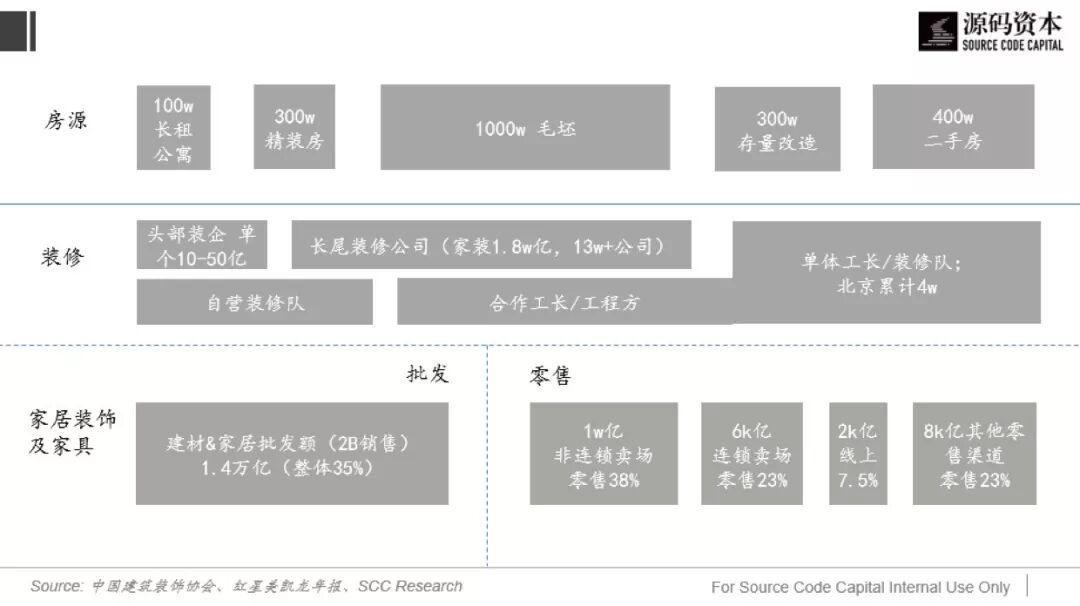
Image source: Source Code Capital
Beyond the development and interplay of renovation and home furnishings players themselves, property attributes on the supply side also significantly shape market dynamics. First-tier cities, dominated by second-hand and existing stock, differ greatly from third- and fourth-tier cities and below where new homes prevail. As policies mandating finished delivery of new homes continue rolling out, the market share of roughcast (unfinished) homes — previously mainstream — is being steadily eroded by other property types. Property developers, apartment operators, second-hand home agencies, and other players, after phases of野蛮 growth, are now leveraging informatization to extend their reach into renovation and home furnishings distribution, increasing per-customer ARPU.
Source Code Capital has invested in KE Holdings in second-hand home transactions, Juli Xinfang in new home transactions, and both Ziroom (self-operated long-term apartment operator) and Huizhaofang (online rental platform) in the rental space. We continue monitoring supply-side trends and their impact on the post-housing market.
II. The Renovation Industry's Dilemma, Viewed Through the Restaurant Industry
As a crucial link in the post-housing chain, the renovation industry is perhaps the most fragmented segment across the entire value chain. This "big industry, small companies" characteristic resembles the restaurant industry:
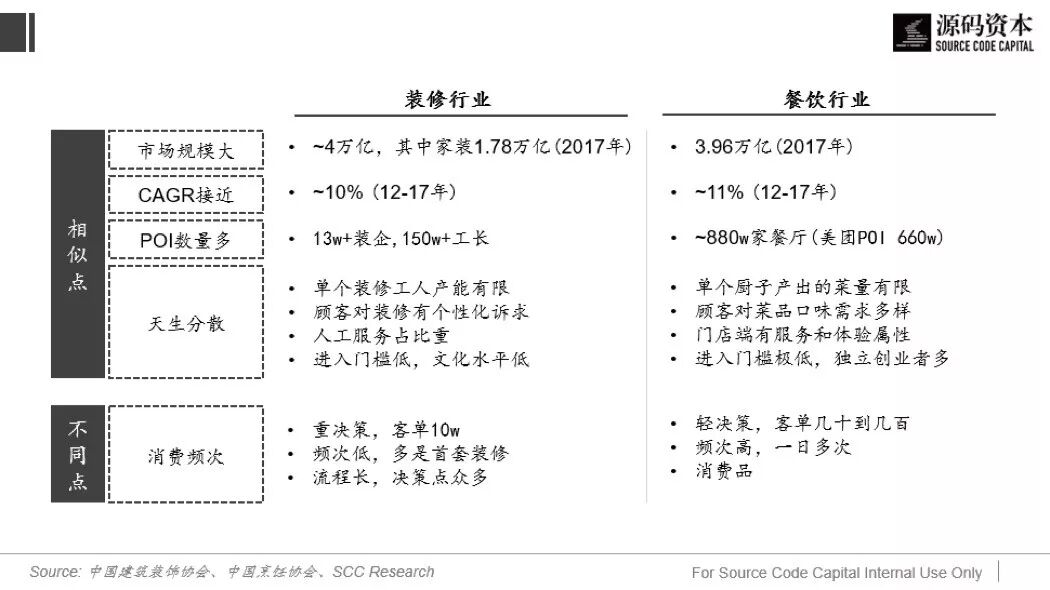
Image source: Source Code Capital
Breaking down current renovation industry players' responsibilities, there are mainly three functions: marketing/design, project management, and construction delivery. In today's renovation ecosystem, the foreman/crew leader wears multiple hats — project manager, customer service, engineering supervisor, even salesperson. Regardless of what title different renovation companies give them, the foreman role will remain indispensable in the industry chain for the foreseeable future. Quality foremen and small renovation companies that build loyal customer bases through high-quality delivery will long remain important market players.
On the other hand, as business scales, the countervailing force of scale against refined management of foremen and workers becomes a ceiling that all large renovation companies must break through. However, in standardized home renovation, bulk finished decoration, and commercial renovation, business characteristics inherently allow for larger management spans than traditional home renovation companies, with relatively weaker counter-scale gravitational pull on management issues and higher theoretical revenue ceilings. With the application of BIM and other informatization products, the management span in renovation is also expanding.
In the commercial renovation space, Source Code Capital has invested in inDeco, which focuses on fast office fit-outs.
III. Learning from Japan — What China's Post-Housing Ecosystem Can Learn
Compared to Europe and America where detached houses dominate, Japan's higher proportion of apartments in high-density environments offers more relevant lessons for China's market development:
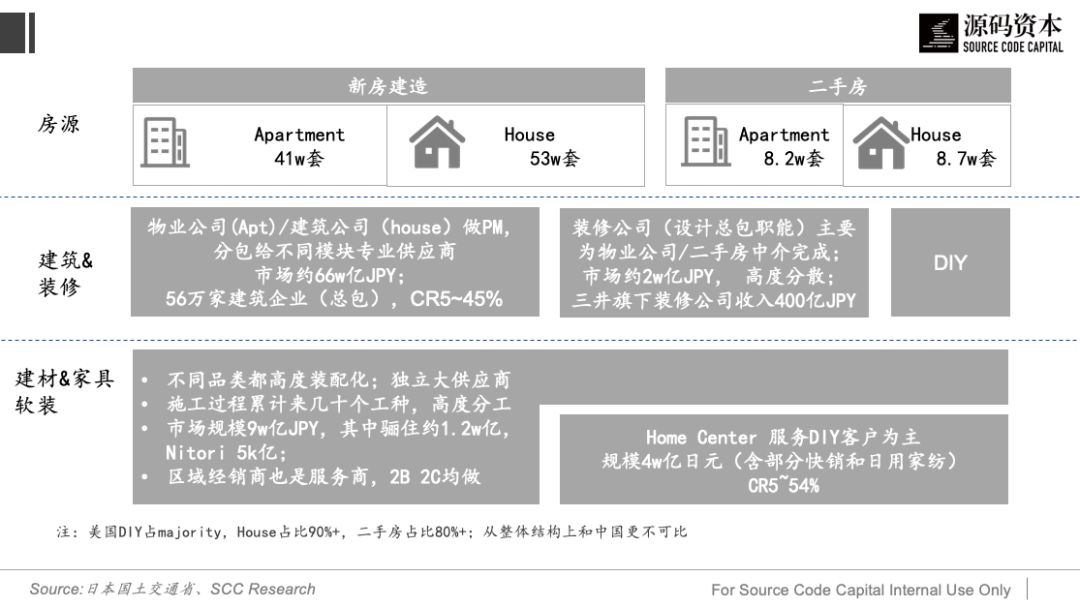
Image source: Source Code Capital
Compared to China, Japan's market overall has higher degrees of componentization and prefabrication. For different product categories, the industrialization level itself is higher, and distribution and on-site services are already highly efficient within the brand/channel-dominated system. The component supplier system handles the construction delivery function — the most management-heavy part of what Chinese renovation companies do.
On the property supply side, Japan's real estate developers and second-hand home agencies are mature after years of development. New homes are basically delivered finished; some existing home renovations are also handled by property management companies. Second-hand homes are typically renovated by agencies before being listed for sale. Apart from these properties without design/marketing needs, for owner-driven renovations, Japan has the world's highest interior design penetration rate, with specialized companies handling design and marketing functions.
As for the project management (PM) function that remains for Chinese renovation companies: due to higher component industrialization and minimal on-site construction, PM difficulty is greatly reduced, essentially handled "on the side" by marketing and design players. Compared to the Chinese phenomenon where owners taking on partial PM roles "basically become renovation experts," Japanese owners simply wait for the project to finish and receive a "what you see is what you get" result — a far better experience.
IV. Where Is Post-Housing Industrial Internet Headed?
Unlike the gradual, slow evolution of post-housing markets in developed countries over long cycles, China's post-housing market is seeing multiple forces and changes contesting simultaneously in a compressed timeframe:
- Post-housing traffic shifting from 2C-dominated to 2B-dominated
In recent years, dealers of various furniture and building materials — especially those with stores in marketplace channels — have lamented how difficult business has become. The real estate downturn is one factor, but property developers and renovation companies have also been building dam after dam upstream of home furnishings and building materials traffic.
As the penetration of finished homes, rentals, and other trends continues rising, various traffic-holding players are penetrating deeper into post-housing categories; renovation and other upstream links are extending their reach downstream. Traffic falling into the open 2C retail ocean is gradually diminishing.
- "One-stop procurement" reducing decision points
Simultaneous with supply-side traffic changes, demand-side owners are increasingly seeking one-stop purchasing. The industry mainstream has evolved from traditional labor-only (清包) models where owners only decided on main materials, to semi-package models. Since iSpace launched its full-package renovation套餐 in Beijing in 2014, full-package renovation套餐 penetration in Beijing's renovation market has reached 30% within five years.
Traditionally in post-housing, design, renovation construction, main materials, custom work, soft furnishings, and furniture were separate and relatively independent decision points. In this long decision process, different categories each had space for separate customer acquisition and sales. As consumer decision points decrease, cross-industry cooperation and full-package renovation套餐 shares will gradually rise. In recent years, listed companies across different categories have successively announced full-category "big home" strategies — a变相 form of "one-stop procurement" experience.
Under "one-stop procurement," marketing value in home furnishings and building materials weakens, but quality supply chain/production capacity integrators — especially channels that can complete terminal fulfillment and delivery — will retain long-term value.
Analogous to Meicai and other ingredient distributors in the restaurant sector, our investee Zhangshang Fucai is now Beijing's largest auxiliary materials distributor. After just over a year, Zhangshang Fucai's monthly procurement volume and number of served construction sites far exceed any single renovation company in Beijing. Efficient logistics and other infrastructure providers will also have their place in industry development.
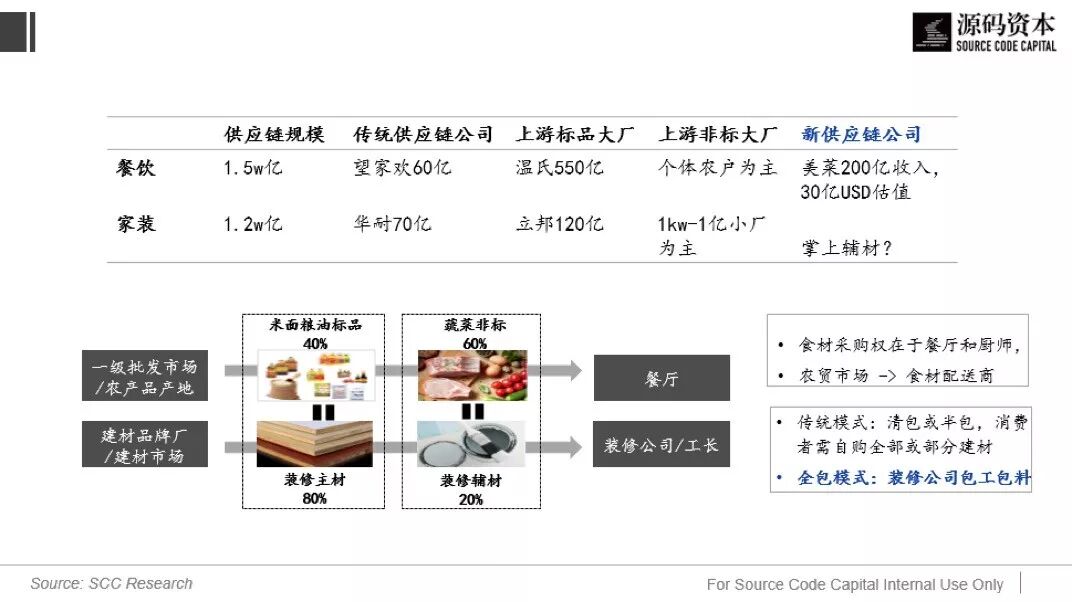
Image source: Source Code Capital
- Prefabrication comprehensively reshaping the industry
China's overall prefabrication ratio in post-housing renovation remains low, with on-site wet work still dominating. On one hand, companies offering comprehensive prefabricated interior solutions are developing rapidly. On the other hand, components like integrated ceilings and custom furniture — where prefabrication has advanced faster — are gradually脱离现场作业 for industrialized production, achieving component-level prefabrication ahead of whole-home prefabrication. As China's interior industrialization continues improving, industry division of labor will increasingly resemble Japan's current state.
Post-housing industrial internet remains in very early stages of development — still a blue ocean market full of opportunities. We welcome entrepreneurs interested in this massive赛道 to explore changes and opportunities in the post-housing space with us, and to mine the gold of post-housing industrial internet!

More Source Code Capital Insider Issues

Issue 18: Three Realms of Industrial Internet Entrepreneurship
Issue 17: Opportunities in Industrial Internet from the Perspective of Apparel Supply Chain
Issue 16: Commercial Rocket Launches, a Protracted War Balancing Technology, Market, and Passion
Issue 15: Understanding Li Dan to Do Business with Gen Z Consumers
Issue 14: The Opportunity and Rise of "Manufacturing-Driven Retail"
Issue 12: Export E-commerce: How to Seize New Opportunities in a Trillion-Yuan Blue Ocean Market
Issue 11: Basic Evaluation and Value-Add Criteria for SaaS Model Enterprises
Issue 10: OMO Era, Where Is the Technology Dividend for New Retail Enterprises?
Issue 9: Four Dimensions to Position Innovation Opportunities in Insurtech
Issue 8: Viewing New Finance Opportunities Through an Asset Management Lens
Issue 7: The Pitfalls of Tech Prophecy
Issue 6: Industrial Internet Investment Landscape
Issue 5: Convenience Stores: Paths for Domestic 7-Eleven Under the New Retail Wind
Issue 4: Mobile Going Global: Entrepreneurs Eyeing Big Opportunities in Content Products
Issue 3: Targeting Unicorns in the Consumer Upgrade Wave
Issue 2: Profile of "Reliable" AI Startup Characteristics
Issue 1: Under "New Retail," Where Do Offline Stores Go?