At the Doorstep of the Rental Economy | Source Code Capital Insights

Synchronous shifts on both the supply and demand sides are gradually pushing open the door to a rental economy.
Source Code Capital Insider
Issue 20
About the Author
Jihong Zhang
Investor in Consumer and Education Sectors

Jihong Zhang joined Source Code Capital in 2017, focusing on investments in consumer and education sectors. Prior to that, he worked at EMAlternatives, where he participated in direct investments across technology, media, and consumer industries, as well as fund investments in overseas markets. He graduated from Shanghai University of Finance and Economics with dual bachelor's degrees in Economics and Mathematics.
Contact: jh@sourcecodecap.com
[Editor's Note]
Driven by evolving demand from both enterprises and consumers, alongside maturing supply-side infrastructure and digitalization, we see the door to the rental economy gradually opening. How should we understand the essence, moats, and extensibility of rental businesses? What constitutes an ideal category? And how will the industry evolve? Source Code Capital presents its exclusive analysis in Issue 20 of Source Code Capital Insider.
Key Takeaways
- Synchronized shifts on both supply and demand sides are pushing open the door to the rental economy, with different category battlegrounds continuously emerging
- Circular economy, rental economy, and subscription economy — three sides of the same coin, developing in stages
- Long operational chains and wide moats are defining characteristics of rental businesses. We look forward to entrepreneurs continuously exploring, breaking through, and iterating — befriending scale and time to harvest the sweet fruits of head effects and compounding returns
I. The Four Quadrants of Rental
Looking back, rentable asset classes started with housing and vehicles, fundamentally transforming how production and consumption resources are used in accommodation, mobility, and logistics, before gradually penetrating other verticals.
Around existing assets, rental has transformed consumer behavior from traditional "own-and-use" to direct service purchasing: battery swap network operators have alleviated range anxiety for car owners, delivery riders, and everyday users; increasingly, enterprises are abandoning purchases in favor of Edianzu's computer leasing, gaining flexibility to handle business elasticity while enjoying superior IT services; in the IT domain, cloud services have reshaped the entire server and software ecosystem; meanwhile, we've seen B2B and B2C innovators begin exploring furniture, home appliances, and even tires, work uniforms, and linens.
In some emerging asset categories, rental has directly carved out and defined industry distribution and service systems, becoming a critical force in the value chain: in the rapidly growing aerial work equipment sector, ZNLH has already become a strategic channel partner for multiple manufacturers; in the emerging smart commercial dishwasher market, Chuxin Smart built its vertically integrated business model from day one.
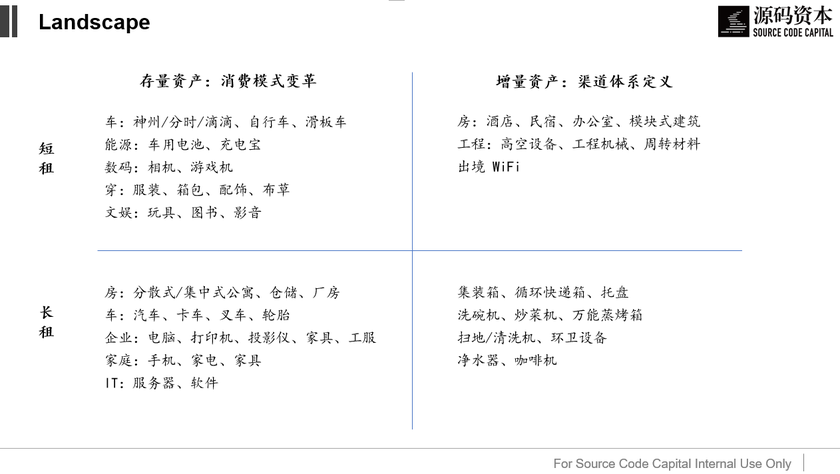
Image source: Source Code Capital
II. The Essence of Rental: Intertemporal Arbitrage Between Internal and External Depreciation Curves
In theory, customers always have two options:
-
Use a third-party rental service, paying rent over time;
-
Purchase goods in the open market, use them for a period, then resell in the secondary market — with the cost of use being the spread between purchase and sale prices.
Professional rental operators find their footing because, from an economic perspective, they essentially construct their own "internal depreciation curve" by leveraging competitive advantages across the operational chain: supply chain capabilities shift the external depreciation curve of the open market downward; recovery and disposal capabilities compress it further; refurbishment capabilities shift it rightward along the timeline — creating the design space for rental solutions (price vs. time).
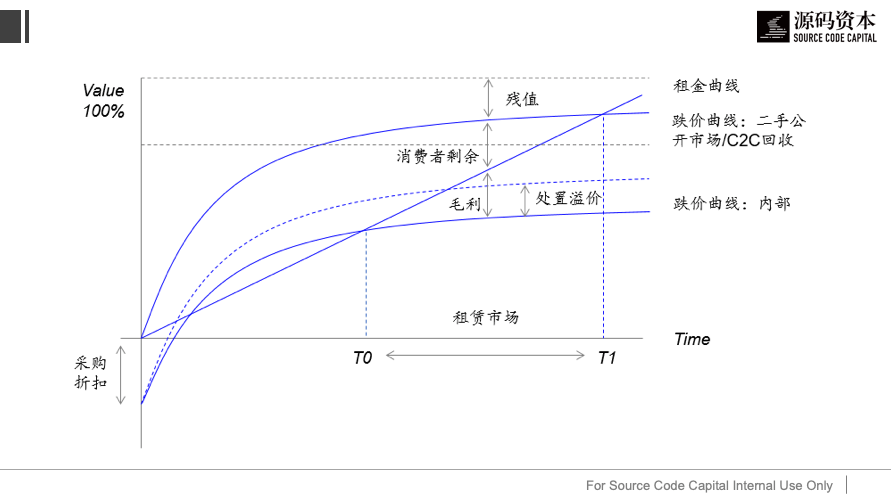
New Product Rental
Image source: Source Code Capital
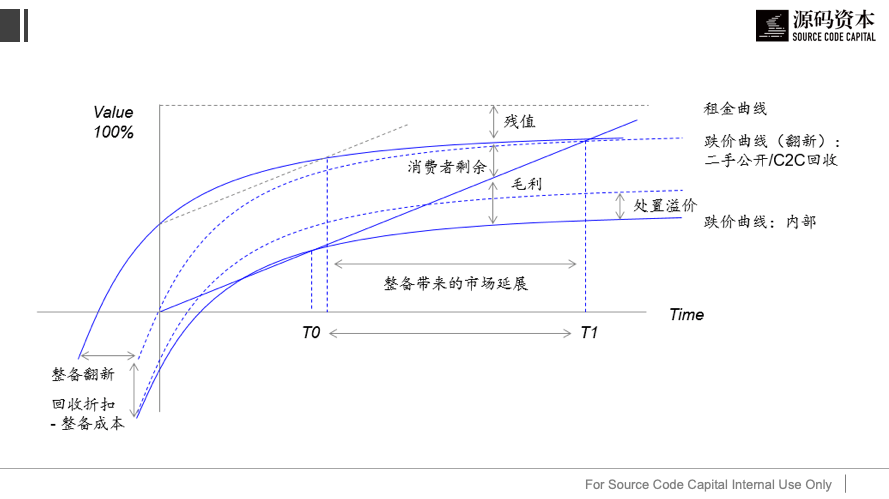
Used Product Rental
Image source: Source Code Capital
Thus, rental fundamentally earns efficiency returns — rent is intertemporal arbitrage between internal and external depreciation curves. On the supply side, rental development channels substantial capital seeking returns; more importantly, it dramatically improves the lifecycle utilization efficiency of social assets, maximizing their utility. On the demand side, it provides customers with one-stop, anxiety-free service, creating enormous value.
III. What Does an "Ideal Type" Look Like?
From the close relationship between rental and internal/external depreciation curves, we can sense that its development is intimately tied to the stage of the used goods/recycling market:
-
First, it cannot be too small or fragmented — it needs moderate development to support scaled disposal and circulation, building a foundation for managing residual value/price risk and inventory/turnover risk;
-
Ideally, it's also an opaque, somewhat inaccessible professional market, giving professional operators more room to optimize and extract greater efficiency value across operational segments. Edianzu and Xianghuanji exemplify this: the former leveraged its team's extensive early experience in the used computer industry to build a solid foundation for its rental business, while the latter drew on parent company AHS Recycle's phone recycling system built over six to seven years to rapidly gain a leading position upon entering the industry.
Based on this, we've attempted to sketch a possible "beauty contest" model, preliminarily comparing categories including automobiles, aerial equipment, computers, phones, home appliances, and furniture from this perspective. We welcome your discussion and feedback.
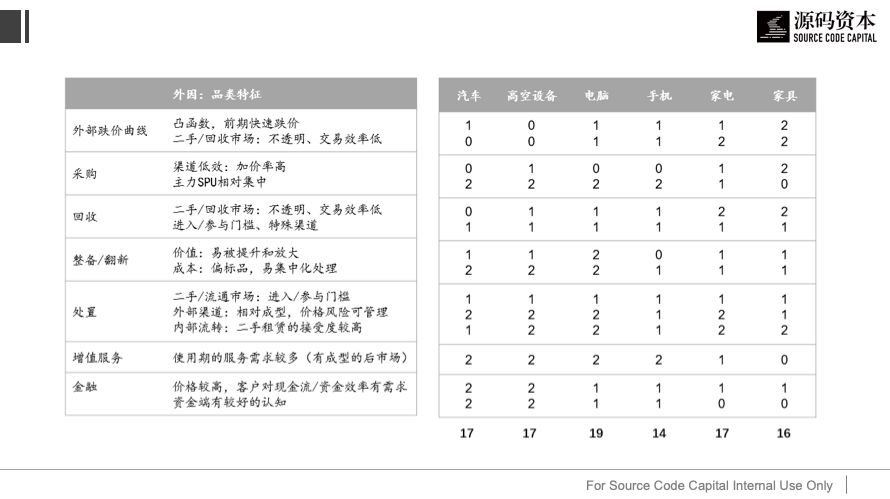
Image source: Source Code Capital
IV. Revisiting Rental Moats and Value Space
We believe that as a classic long-chain business, rental itself has high barriers to entry. Moreover, since everyone ultimately competes on efficiency, the competitive focus falls directly and clearly on price and service — and since efficiency gains across operational segments and core competency building are mostly tied to scale and time, most leading operational rental companies exhibit a pattern of sustained industry leadership with widening gaps: they are naturally positioned to befriend scale and time, possessing ever-broadening moats.
Beyond this, the beauty of rental also lies in its high ceiling: traditionally, retail, financial services, used goods trading/recovery, and aftermarket services during product use all revolve around individual consumers, with players acquiring customers discretely, operating independently, and competing against each other. As rental penetrates and expands, leading companies get to reshape the entire service value chain — they are naturally connected to customers' full lifecycle with frequent touchpoints. And as asset operators, they possess a natural integrative position to package previously fragmented service elements into bundled offerings, satisfying customers' one-stop needs.
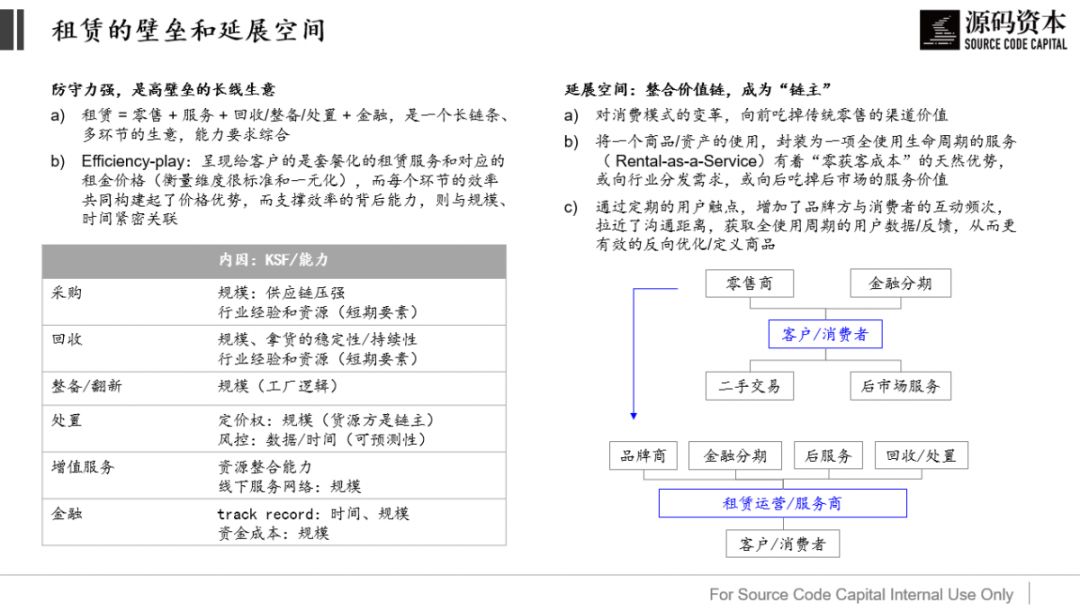
Image source: Source Code Capital
From used goods recovery and disposal, to rental operations, to service integration, we can clearly perceive a three-stage evolutionary curve linking the circular economy, rental economy, and subscription economy. Each leap forward is driven by synchronized changes on both supply and demand sides — related to both consumer attitudes and customer needs, and to the maturity of industry infrastructure.
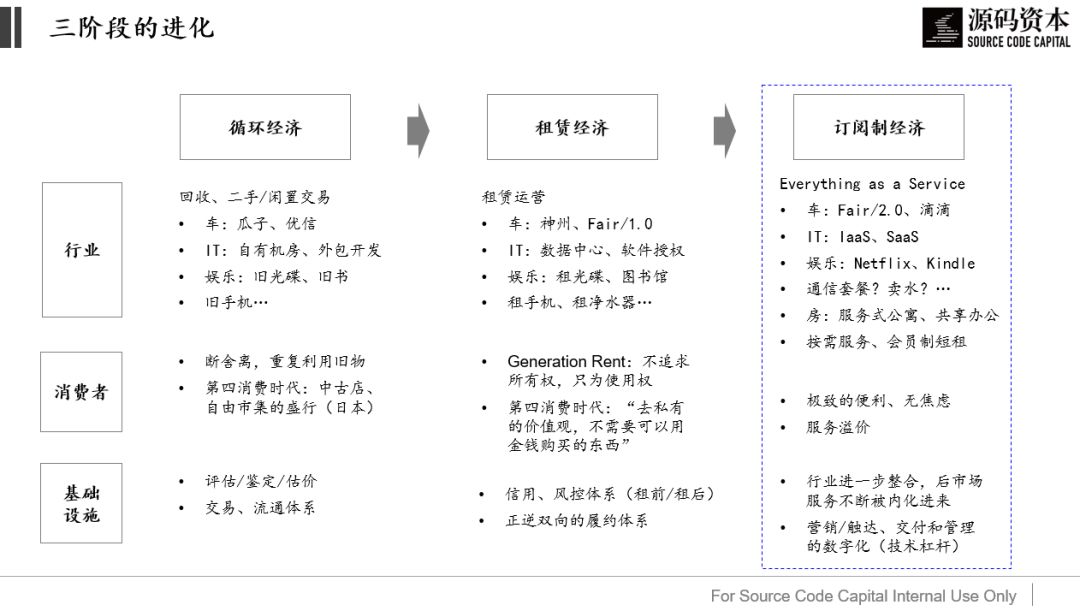
Image source: Source Code Capital
Fifty years ago, Cintas started as a small family laundry business, creatively combining laundry services with work uniform customization, serving various manufacturing and service enterprises through uniform rental. Around this seemingly unremarkable business, Cintas achieved 48 consecutive years of revenue and profit growth over the past half-century, growing into a $27 billion giant and delivering a 15-bagger over ten years in the capital markets.
A beautiful canvas awaits unfolding, with numerous B2B and B2C categories holding opportunities. Corresponding to their respective stages, we look forward to entrepreneurs continuously exploring breakthroughs, evolving and iterating, finding suitable entry points and paths, and courageously climbing the value chain peak.

More Source Code Capital Insider Issues

Issue 19: Mining Real Estate Aftermarket Industrial Internet
Issue 18: Three Realms of Industrial Internet Entrepreneurship
Issue 17: Opportunities in Industrial Internet from the Perspective of Apparel Supply Chain
Issue 16: Commercial Rocket Launches: A Protracted War Balancing Technology, Market, and Passion
Issue 15: To Understand Li Dan Is to Know How to Do Business with Post-95 Consumers
Issue 14: The Rise of Manufacturing-Driven Retail
Issue 13: The Mobility Track Under Multiple Waves, Nurturing Trillion-Dollar Great Enterprises
Issue 12: Export E-commerce: How to Seize New Opportunities in a Trillion-Dollar Blue Ocean Market
Issue 11: Basic Evaluation and Value-Add Factors for SaaS Model Enterprises
Issue 10: OMO Era: Where Is the Technology Dividend for New Retail Enterprises?
Issue 9: Four Dimensions to Position InsurTech Innovation Opportunities
Issue 8: New Finance Opportunities Through an Asset Management Lens
Issue 7: The Pitfalls of Tech Prophecy
Issue 6: Industrial Internet Investment Landscape
Issue 5: Convenience Stores: Domestic 7-Eleven's Path Under the New Retail Wind
Issue 4: Mobile Going Global: Entrepreneurs Eyeing Big Opportunities in Content Products
Issue 3: Targeting Unicorns in the Consumer Upgrade Wave
Issue 2: Profile of "Reliable" AI Startup Characteristics
Issue 1: Under "New Retail," Where Are Offline Stores Headed?