The Three Stages of Development for New Consumer Brands | Source Code Capital Insights

Hit product — Product matrix — Brand



Dandan Chen joined Source Code Capital in 2018, focusing on e-commerce investments. Before joining Source Code Capital, she was the founder and CEO of Taoshijie, a cross-border e-commerce platform for overseas shopping. She is well-versed in e-commerce operations, organizational structure, and organizational culture management, and is a DDI-certified leadership and corporate management trainer. Having studied in Germany for seven years, Chen holds a master's degree in Western Theater Studies from Ludwig Maximilian University of Munich and an Executive MBA from The Hong Kong University of Science and Technology.
Contact: cdd@sourcecodecap.com

As e-commerce channel penetration continues to rise and new media and marketing methods diversify, a new generation of consumer brands has the opportunity to complete the closed loop of reach-conversion-sales by going directly to consumers, no longer relying on agents and distributors to sell on their behalf. We call such brands D2C brands.
This article draws on an analysis of the different development stages of internet products to spark reflection on D2C brands in the new era, arriving at three developmental stages that new-era D2C brands must cross. It then attempts to elaborate on why new-era consumer brands need long-term strategy more than ever, from both micro-level organizational development and macro-level China's economic development perspectives.
Source Code Capital presents the 21st exclusive edition of Source Code Insights, following analysis and research.

-
The three development stages of new-era consumer brands: hero SKU — product portfolio — brand.
-
Simple stacking of price, form, and function does not constitute a brand. Only when they all serve the same strategic goal and are mutually coherent can they become a brand.
-
A company's mission should be the user value and social value it creates, not an expression of the company's own ego.
-
New-era consumer brands, serving consumers' higher material needs and more diverse spiritual needs, will require long-term strategic capabilities more than consumer companies of the previous era.
Starting with a Little Story
Let me tell you an interesting little story.
Three people are in an elevator. One is running in place, one is doing somersaults, one is doing push-ups. The elevator reaches the top of a skyscraper. Someone asks, how did you get up here?
One says I ran up, one says I somersaulted up, one says I did push-ups up.
The Three Development Stages of Internet Product Companies
Before I started investing, I founded a company — a cross-border e-commerce platform. It was the early days of mobile internet, and Taobao's product breadth had temporarily exceeded its operational refinement. New media like Weibo and WeChat offered fresh traffic dividends. Massive product overflow followed, and vertical e-commerce sites sprouted like bamboo after rain.
I remember my product mentor at the time once explained to me the stages of development for an internet product company. It benefited me greatly. Let me summarize — roughly three stages: feature — product — ecosystem.
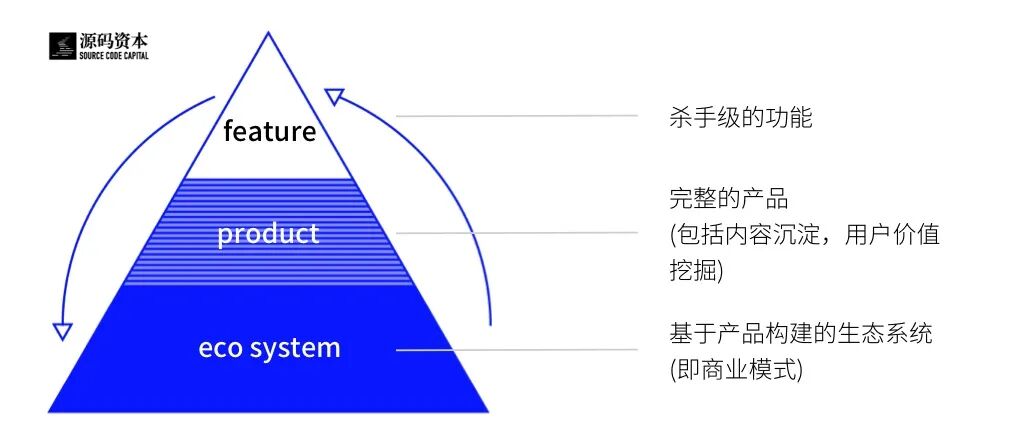
How to understand these three stages?
An internet product's early ability to acquire traffic and users usually comes from a killer feature — perhaps a product function, perhaps even just an operational mechanism. Once a company finds this trump card, it sees explosive growth. But some growth is just a flash in the pan, never forming stable user retention (like face-swapping apps). Some companies, however, can develop that feature into a complete product loop. The difference lies in whether there is content or relationship chain accumulation, whether continuous value is provided to users.
For example: early Xiaohongshu used shopping guide notes for overseas travel as its feature to complete cold start and initial accumulation. Later, through mining user needs, Xiaohongshu transformed long-form content into image-and-text PGC+UGC content, structured it for repeated reading, and completed the transformation from single feature to community product. This conversion supported its rapid development and accumulated millions of users.
In the third stage, Xiaohongshu completed the leap from product to ecosystem, gradually exploring business models, constructing an ecosystem, and forming its unique moat. On this point, Xiaohongshu went through a period of exploration: trying to find balance between e-commerce and community. As celebrity economy grew stronger and livestreaming sounded its horn, Xiaohongshu finally found a more suitable path.
An ecosystem requires multi-party participation. The more participants and beneficiaries, the higher its comprehensive barriers and the stronger its vitality. We see that Xiaohongshu evolved from initial PGC shopping notes to user-generated UGC content community, to today's ecosystem where users, KOLs, celebrities, brands, and sellers all profit together. This ecosystem in turn stimulates feature iteration and product improvement.
This is a continuously cycling process of mutual promotion and interdependence, giving the platform increasingly strong vitality.
The Three Development Stages of New-Era D2C Brands
In the past two years, the consumer goods track has suddenly bloomed as profusely as the mobile internet era once did. As online channel infrastructure becomes more complete, consumers' online shopping habits gradually form, and new media and marketing methods diversify, new consumer brands have the opportunity to complete the reach-conversion-sales loop by going directly to consumers, no longer needing to rely on agents and distributors. This places higher demands on new-era consumer companies. While early-stage launch may be relatively easier, compared to the previous generation of consumer companies, new-era D2C brands need more comprehensive capabilities and longer-term strategy.
Consumer brand development also follows certain objective laws. If summarized, it similarly requires three stages: hero SKU — product portfolio — brand.
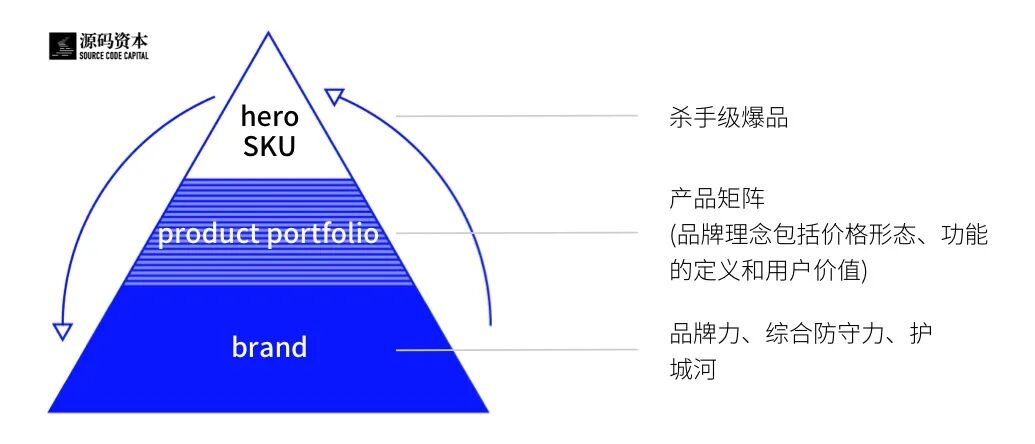
A consumer brand gains its first wave of users and traffic usually by "betting" on one or two hit products. The hero SKU logic is now standard practice for consumer companies — every killer hit product can bring direct revenue and user growth. But no single hit product can form long-term consumer loyalty. A brand company needs the ability to consistently and stably output new products — that is, a product portfolio. Randomly mining for "hit products" here and there remains at the product-selling stage and cannot form a brand.
So how to connect a single hero SKU into a product portfolio? This requires strategy behind it. A brand company, even with only a few SKUs, needs long-term strategic support to gain sustained vitality and form brand power with a moat. It needs to think about what user value its brand wants to provide consumers, and apply this user value to product definition — including price, form, and function definition — ultimately forming a brand concept that can be transmitted to consumers through a series of products, providing user value that consumers can deeply perceive. Simple stacking of price, form, and function does not constitute a brand. Only when they jointly serve the same strategic goal, are mutually coherent, and continuously and stably condense onto a series of products to form some consistent values that can be constantly transmitted to consumers through products and perceived by them, can there be a chance to become a brand.
In each process of reaching consumers from products, consumers develop cognition of the brand, and the brand is endowed with brand power.
Note: Brand power is not created by the company, but endowed by consumers. Brand power that consumers recognize is true brand power. And this brand power is by no means illusory — ultimately it can be summarized or presented through some data. From the enterprise's perspective, so-called brand power is the company's comprehensive defensive capability, its moat. Of course, different brands have very different moats. For example: UNIQLO's hero SKU is Heattech underwear. Its product portfolio is basic apparel with core fabrics at low prices. And the brand power and moat its brand conveys is its cultivation and innovation in fabric technology and cost structure so that consumers can continuously wear high cost-performance basic apparel. Imitators, even with identical styles and similar cuts, cannot achieve UNIQLO's fabric comfort and extreme cost performance.

UNIQLO "Heattech" | Image source: Internet
Another example: HEYTEA's hero SKU is a cup of Very Grape Cheezo. Its product portfolio is a series of delicious new-style Chinese teas. And all the company's daily work revolves around this strategic goal, including store ordering systems, new product development methods, and so on. To let consumers perceive "delicious" as user value, HEYTEA would rather sacrifice production efficiency, preserving the manual grape-peeling step in its standardization process. Behind this series of business decisions, there is consistent brand philosophy supporting it. Precisely because of this, HEYTEA can accurately convey what its brand represents to every consumer through cups of tea, making consumers remember it and willing to spread it. In this process, it also forms its unique moat — not just brand influence, but also product development methods, production processes, ordering systems, and so on that can produce a delicious cup of tea, gradually widening the gap with imitators.

HEYTEA "Very Grape Cheezo" | Image source: Internet
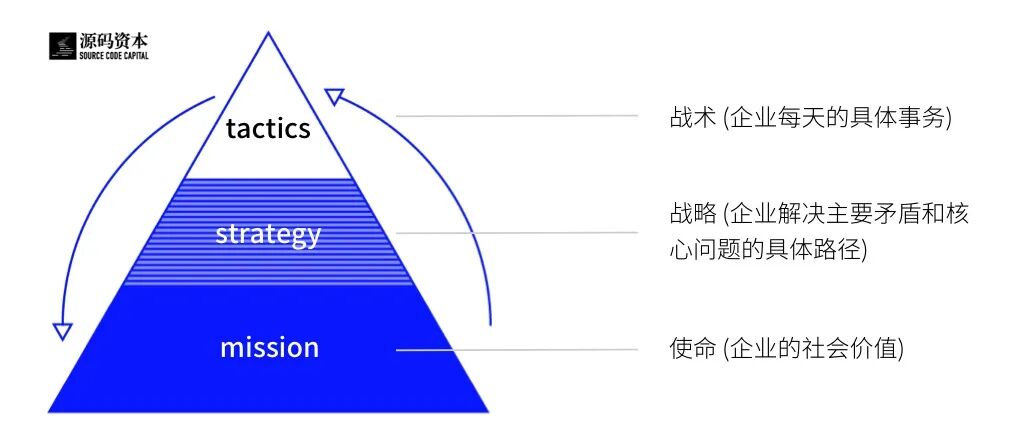
The hit product approach can be understood as company tactics, as feature. Early-stage startups may all gain initial growth through some very small entry point. Only when a company has clear strategy will its product portfolio show consistency and stability, able to carry and transmit brand philosophy. By continuously creating products with shared values, the brand gains vitality.
Consumers remember a brand not because it achieved industry "number one" or China's "biggest" — this is merely the company's own pursuit, a result. What brings consumers identification and belonging is the differentiated products, services, or experiences this brand provides consumers. A company's mission should be the user value and social value it creates, not an expression of the company's own ego.
Image source: Internet
So from the organizational perspective, there are also these three layers of relationship, and each layer is mutually interdependent, a continuously cycling process. For a consumer goods company, hit products are tactics, product portfolio is strategy, and the transmission of brand philosophy and values contained in the brand is mission.
Why Do New-Era Consumer Companies Need Long-Term Strategy More Than the Previous Generation?
Speaking of which, let's return to that little story at the beginning.
All three people thought they reached the top of the skyscraper by their own methods. But actually, the primary reason they reached the top was because they boarded the elevator.
Boarding the elevator is certainly very important. But if during this process, they didn't seize the opportunity well, precipitate core corporate assets, build high moats, and mistook the dividend for their own strength, then after the dividend fades, the company without strong defensive capability will ultimately be eliminated.
Facts have proven that of the countless apps that exploded during the mobile internet era a few years ago, those that ultimately survived were all companies that developed their own ecosystems. Large numbers of products that used short-term dividends to reach certain scale ultimately exited the historical stage because they couldn't continuously provide user value. Returning to today, we see the full bloom of consumer brands, see Alibaba launch the "Spring Thunder Plan": planning to incubate 1,000 new store brands with annual sales exceeding 10 million yuan. This to some extent conforms to the era's development, and gives entrepreneurs and investors a shot of confidence.
As if this feast will never stop.
But history always repeats itself. Today's D2C brands also seem to have boarded a rapidly rising elevator. Wanting some sales volume is very easy — after all, infrastructure is already very complete, and China's supply chain capabilities are extremely developed. However, if they just continuously create hit products without clear strategic layout, timely precipitation of core capabilities, and construction of their own moats and brand power, this brand will also struggle to stand out.
Having sales volume doesn't mean being able to establish a brand. Brand is ultimately a slow business.
Some might ask: why have many consumer brands of the past decades also reached certain scale without necessarily having very consistent product portfolios or brand power, with company missions and strategies not necessarily very clear?
I think this is an era question.
In the past decades of China's rapid development, the main contradiction in China's economy was that ordinary people's basic material needs could not be met. That was an era of野蛮生长 [wild growth]. As long as enterprises could produce goods, they could make sales. Under such macro waves, a batch of consumer companies was created. They solved production problems, controlled main sales channels and media传播 channels, and could rapidly develop.
But today, Chinese people's demand for consumer goods is gradually transitioning from having to having better. The 19th National Congress proposed that the main contradiction in the new era is "between unbalanced and inadequate development and the people's ever-growing needs for a better life." People's needs always develop from lower to higher levels. As society develops, people's needs become higher and more diverse. And the so-called "supply-side structural reform" is a process of "starting from improving supply quality, using reform methods to advance structural adjustment, correcting factor allocation distortion, and expanding effective supply."
From this perspective, past consumer brands mainly solved the contradiction of people's needs from nothing to something, more the basic, common needs of consumers, such as safety, quality consistency and stability. And today's consumer brands, if they cannot improve "supply quality" and provide "effective supply," will be eliminated. Under such era background, brand companies need both more acute market demand capture capability and more long-term strategic thinking ability — from single hero SKU to product portfolio carrying brand philosophy, innovatively changing relationships between various production factors, changing production structure and meeting flexible production needs, improving production efficiency, using new channels and new media transmission methods, and thereby transmitting brand power that conforms to modern people's higher material needs and more diverse spiritual needs.
Fully understanding and comprehending new-generation consumers' needs for a better life, responding to national call by improving supply quality and providing effective supply, and promoting supply-side structural reform — this is the opportunity for every new consumer brand. At the same time, Source Code Capital will also commit to continuously finding and long-term accompanying new consumer brands with long-term strategic capabilities, helping them realize their dreams and complete their missions from multiple dimensions.


Issue 20: Standing at the Door of the Rental Economy
Issue 19: Mining Opportunities in Real Estate Aftermarket Industrial Internet
Issue 18: Three Realms of Industrial Internet Entrepreneurship
Issue 17: Opportunities in Industrial Internet from the Clothing Supply Chain Perspective
Issue 16: Commercial Rocket Launch, a Protracted War Balancing Technology, Market, and Passion
Issue 15: Understanding Li Dan to Do Business with Post-95 Consumers
Issue 14: Opportunities and Rise of "Manufacturing-Driven Retail"
Issue 12: Export E-commerce: How to Seize New Opportunities in the Trillion-Dollar Blue Ocean Market
Issue 11: Basic Evaluation and Bonus Items for SaaS Model Enterprises
Issue 10: OMO Era, Where Is the Technology Dividend for New Retail Enterprises?
Issue 9: Four Dimensions to Position Innovation Opportunities in Insurtech
Issue 8: Viewing New Finance Opportunities from an Asset Management Perspective
Issue 7: The Trap of Technology Prophecy
Issue 6: Industrial Internet Investment Landscape
Issue 5: Convenience Stores: Under the New Retail Wind, Where Is the Domestic 7-Eleven's Path?
Issue 4: Mobile Going Global: Entrepreneurs Keep Eyes on Big Opportunities in Content Products
Issue 3: Targeting Unicorns Under the Consumer Upgrade Tide
Issue 2: Characterizing "Reliable" AI Startups
Issue 1: Under "New Retail," Where Are Offline Stores Headed?